1969 FORD MUSTANG gas
[x] Cancel search: gasPage 137 of 413
03-06-03
Manual Steering
03-06-03
MAJOR REPAIR OPERATIONS
STEERING GEAR
DISASSEMBLY
1. Rotate the steering shaft 3 turns
from either stop.
2.
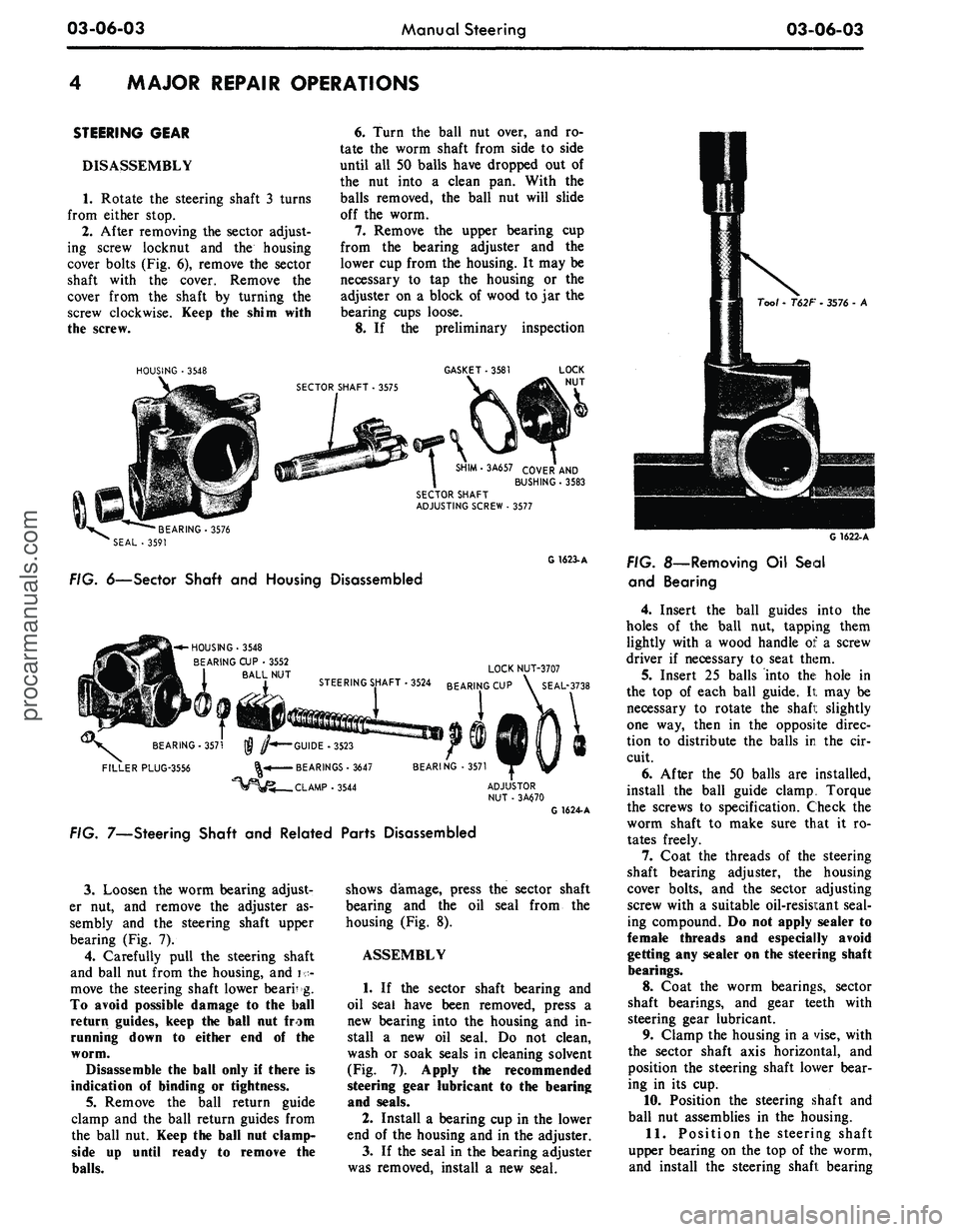
After removing the sector adjust-
ing screw locknut and the housing
cover bolts (Fig. 6), remove the sector
shaft with the cover. Remove the
cover from the shaft by turning the
screw clockwise. Keep the shim with
the screw.
HOUSING
•
3548
6. Turn the ball nut over, and ro-
tate the worm shaft from side to side
until all 50 balls have dropped out of
the nut into a clean pan. With the
balls removed, the ball nut will slide
off the worm.
7. Remove the upper bearing cup
from the bearing adjuster and the
lower cup from the housing. It may be
necessary to tap the housing or the
adjuster on a block of wood to jar the
bearing cups loose.
8. If the preliminary inspection
GASKET
• 3581
SHIM-3A657 COVER
AND
BUSHING
•
3583
SECTOR SHAFT
ADJUSTING SCREW
.
3577
•BEARING-3576
SEAL
- 3591
G 1623-A
FIG. 6—Sector Shaft
and
Housing Disassembled
-^-HOUSING-3548
BEARING
CUP •
3552
BALL
NUT
BEARING-3571
FILLER PLUG-3556
LOCK NUT-3707
3524 BEARING
CUP \
SEAL-3738
•GUIDE -3523
• BEARINGS
•
3647
.CLAMP-3544
BEARING
• 3571
G 1624-A
FIG. 7—Steering Shaft
and
Related Parts Disassembled
3.
Loosen the worm bearing adjust-
er nut, and remove the adjuster as-
sembly and the steering shaft upper
bearing (Fig. 7).
4.
Carefully pull the steering shaft
and ball nut from the housing, and i •-
move the steering shaft lower bearr g.
To avoid possible damage to the ball
return guides, keep
the
ball
nut
from
running down
to
either
end of the
worm.
Disassemble
the
ball only
if
there
is
indication
of
binding
or
tightness.
5.
Remove the ball return guide
clamp and the ball return guides from
the ball
nut.
Keep
the
ball
nut
clamp-
side up until ready to remove the
balls.
shows damage, press the sector shaft
bearing and the oil seal from the
housing (Fig. 8).
ASSEMBLY
1. If the sector shaft bearing and
oil seal have been removed, press a
new bearing into the housing and in-
stall a new oil seal. Do not clean,
wash or soak seals in cleaning solvent
(Fig.
7).
Apply
the
recommended
steering gear lubricant
to the
bearing
and seals.
2.
Install a bearing cup in the lower
end of the housing and in the adjuster.
3.
If the seal in the bearing adjuster
was removed, install a new seal.
Tool
-
T62F
•
3576
- A
G 1622-A
FIG.
8—Removing
Oil
Seal
and Bearing
4.
Insert the ball guides into the
holes of the ball nut, tapping them
lightly with a wood handle of a screw
driver if necessary to seat them.
5.
Insert 25 balls into the hole in
the top of each ball guide. It may be
necessary to rotate the shafi: slightly
one way, then in the opposite direc-
tion to distribute the balls in the cir-
cuit.
6. After the 50 balls are installed,
install the ball guide clamp. Torque
the screws to specification. Check the
worm shaft to make sure that it ro-
tates freely.
7. Coat the threads of the steering
shaft bearing adjuster, the housing
cover bolts, and the sector adjusting
screw with a suitable oil-resisi:ant seal-
ing compound. Do not apply sealer to
female threads and especially avoid
getting any sealer on the steering shaft
bearings.
8.
Coat the worm bearings, sector
shaft bearings, and gear teeth with
steering gear lubricant.
9. Clamp the housing in a vise, with
the sector shaft axis horizontal, and
position the steering shaft lower bear-
ing in its cup.
10.
Position the steering shaft and
ball nut assemblies in the housing.
11.
Position the steering shaft
upper bearing on the top of the worm,
and install the steering shaft bearingprocarmanuals.com
Page 138 of 413

03-06-04
Manual Steering
03-06-04
adjuster and the adjuster nut and
bearing cup. Leave the nut loose.
12.
Adjust the worm bearing pre-
load, using an in-lb torque wrench
(Fig. 9). See Part 3-13 for the speci-
fied preload.
13.
Position the sector adjusting
screw and adjuster shim, and check
the end clearance which should not
exceed 0.002 inch between the screw
head and the end of the sector shaft.
If clearance is greater than 0.002 inch,
add enough shims to reduce the end
play to within the 0.002 inch toler-
ance.
14.
Start the sector shaft adjusting
screw into the housing cover.
15.
Install a new gasket on the
housing cover.
16.
Rotate the steering shaft until
the ball nut teeth are in position to
mesh with the sector gear, tilting the
In - /b Torque Wrench
ADJUSTER NUT
21-A
FIG. 9—Checking Steering Shaft
Bearing Preload
housing so that the ball will tip
toward the housing cover opening.
17.
Lubricate the sector shaft jour-
nal and install the sector shaft and
cover.
18.
With the housing cover turned
out of the way fill the gear with 0.97
lbs of gear lubricant. Push the
housing cover and sector shaft assem-
blies into place, and install the two
top housing cover bolts. Do not tight-
en the cover bolts until it is certain
that there is some lash between ball
nut and sector gear teeth. Hold or
push the cover away from the ball nut,
then torque the bolts to specification.
19.
After loosely installing the sec-
tor shaft adjusting screw lock nut, ad-
just the sector shaft mesh load. See
Part 3-13 for the specified mesh load;
then, tighten the adjusting screw lock
nut.procarmanuals.com
Page 163 of 413

03-10-02
Ford-Thompson Power Steering Pump
03-10-02
LOWER PRESSURE
PLATE 3D590
SPRING-3D601
UPPER PRESSURE
PLATE -3A645
RETAINER END
PLATE-3D589
CAM AND ROTOR
ASSEMBLY-
-3D607
SCREW AND WASHER
ASSEMBLY-379376-S
PULLEY-3D673
PUMP SHAFT
SEAL 3B592
PLATE AND BUSHING
ASSEMBLY-3D643
0-RING
382744-S
HOUSING GASKET
3A760
G1343-B
FIG. 2—Power Steering Pump Disassembled
To adjust the belt on 8 cyl. engines
loosen the mounting bolt in the ad-
justing slot and the nut directly above
the adjusting slot. Place a suitable pry
bar between the cast boss on the
pump mounting bracket and the cast
boss on the pump cover plate and pry
upward to correct tension.
Do not pry against the reservoir to
obtain proper belt load as it can be
deformed and cause a leak.
3.
Recheck the belt tension. When
the tension has been correctly adjusted,
tighten the bolts and the fiut to speci-
fication (Part 3-13).
POWER STEERING
PUMP DRIVE BELT
REPLACEMENT
1.
Loosen the idler pulley attaching
bolts and remove the compressor drive
belt if equipped with an air condition-
er.
2.
Loosen 3 bolts and one nut at-
taching the power steering pump to
the pump bracket, and remove the
pump drive belt.
3.
Position the power steering
pump drive belt on the pulleys.
4.
Adjust the drive belt tension as
outlined in Section 2 to specification
(Part 3-13) and tighten the pump at-
taching bolts and one nut to specifica-
tion.
5.
Install the compressor drive belt
if equipped with an air conditioner
and adjust to specification (Part 16).
REMOVAL AND INSTALLATION
POWER STEERING
PUMP REPLACEMENT
EIGHT CYLINDER
WITHOUT AIR
CONDITIONER AND
ALL SIX CYLINDER
1.
Remove the power steering fluid
from the pump reservoir by discon-
necting the fluid return hose at the
reservoir, and allow the fluid to drain
into a suitable container.
2.
Disconnect the pressure hose
from the pump.
3.
Remove 3 bolts from the front of
the pump and the one nut at the rear
(rear nut on 8 cyl. engines only) that
attach the pump to the mounting
bracket; disconnect the belt from the
pulley and remove the pump from the
vehicle.
4.
Position the pump to the mount-
ing bracket and install the 3 bolts at
the front of pump and (rear nut on 8
cyl.
engines only) the 1 nut at the
rear. Torque to specification.
5.
Place the belt on the pulley and
adjust the belt tension (Section 2) with
Tool T63L-8620-A and tighten the
bolts and nut to specifications.
6. Torque the pressure hose fitting
hex nut to specification. Then, connect
the pressure hose to the fitting and
torque the hose nut to specification.
7.
Connect the hose to the pump.
Then, tighten the clamp.
8. Fill the power steering pump res-
ervoir with transmission fluid C1AZ-
19582-A and cycle the system to re-
move air from the steering gear sys-
tem.
9. Check for leaks and again check
the fluid level. Add fluid as necessary.procarmanuals.com
Page 164 of 413
03-10-03
Ford-Thompson Power Steering Pump
03-10-03
EIGHT CYLINDER WITH
AIR CONDITIONER
1.
Remove the power steering fluid
from the pump reservoir by discon-
necting the fluid return hose from the
reservoir and allow the fluid to drain
in a suitable container.
2.
Disconnect the pressure hose
from the pump.
3.
Remove 3 bolts from the front of
the pump and the one nut at the rear
that attach the pump to the mounting
bracket and remove the drive belt
from the pump pulley.
4.
Loosen the upper pump bracket-
to-engine attaching bolt and remove
the bolt in the belt adjusting slot. Re-
move the pump.
5.
Position the pump to the bracket
and install the bracket-to-pump at-
taching bolts and nuts. Tighten to spe-
cifications.
6. Place the belt on the pump pul-
ley. Adjust the belt tension as outlined
in Section 2 and tighten the bolts and
nut to specification.
7.
Torque the pressure hose fitting
hex nut to specification. Then, connect
the pressure hose to the fitting and
torque the hose nut to specification.
8. Connect the return hose to the
power steering pump and tighten the
clamp.
9. Fill the pump with automatic
transmission fluid C1AZ-19582-A.
Bleed the air from the system (Part
3-1) and check for leaks and again
check the fluid level. Add fluid as re-
quired.
POWER STEERING PUMP
PULLEY REPLACEMENT
REMOVAL
1.
Drain as much of the fluid as
possible from the pump through filler
pipe.
2.
Install a 3/8-16 inch capscrew in
the end of the pump shaft to prevent
damage to the shaft end by the tool
screw.
3.
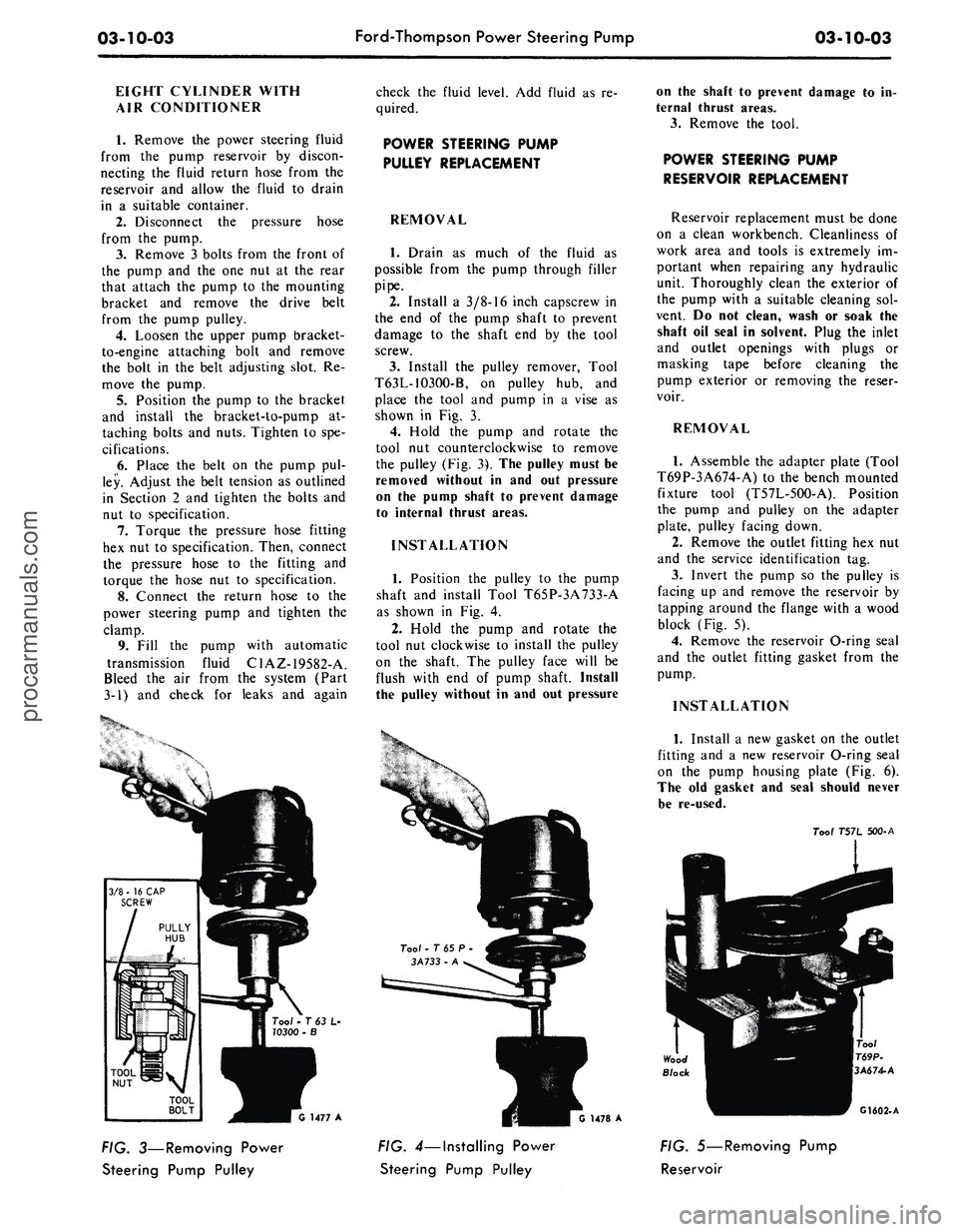
Install the pulley remover, Tool
T63L-1O3OO-B, on pulley hub, and
place the tool and pump in a vise as
shown in Fig. 3.
4.
Hold the pump and rotate the
tool nut counterclockwise to remove
the pulley (Fig. 3). The pulley must be
removed without in and out pressure
on the pump shaft to prevent damage
to internal thrust areas.
INSTALLATION
1.
Position the pulley to the pump
shaft and install Tool T65P-3A733-A
as shown in Fig. 4.
2.
Hold the pump and rotate the
tool nut clockwise to install the pulley
on the shaft. The pulley face will be
flush with end of pump shaft. Install
the pulley without in and out pressure
on the shaft to prevent damage to in-
ternal thrust areas.
3.
Remove the tool.
POWER STEERING PUMP
RESERVOIR REPLACEMENT
Reservoir replacement must be done
on a clean workbench. Cleanliness of
work area and tools is extremely im-
portant when repairing any hydraulic
unit. Thoroughly clean the exterior of
the pump with a suitable cleaning sol-
vent. Do not clean, wash or soak the
shaft oil seal in solvent. Plug the inlet
and outlet openings with plugs or
masking tape before cleaning the
pump exterior or removing the reser-
voir.
REMOVAL
1.
Assemble the adapter plate (Tool
T69P-3A674-A) to the bench mounted
fixture tool (T57L-5OO-A). Position
the pump and pulley on the adapter
plate, pulley facing down.
2.
Remove the outlet fitting hex nut
and the service identification tag.
3.
Invert the pump so the pulley is
facing up and remove the reservoir by
tapping around the flange with a wood
block (Fig. 5).
4.
Remove the reservoir O-ring seal
and the outlet fitting gasket from the
pump.
INSTALLATION
Tool • T 63 L-
10300 -
G 1477 A
FIG. 3—Removing Power
Steering Pump Pulley
1478 A
FIG. 4—Installing Power
Steering Pump Pulley
1.
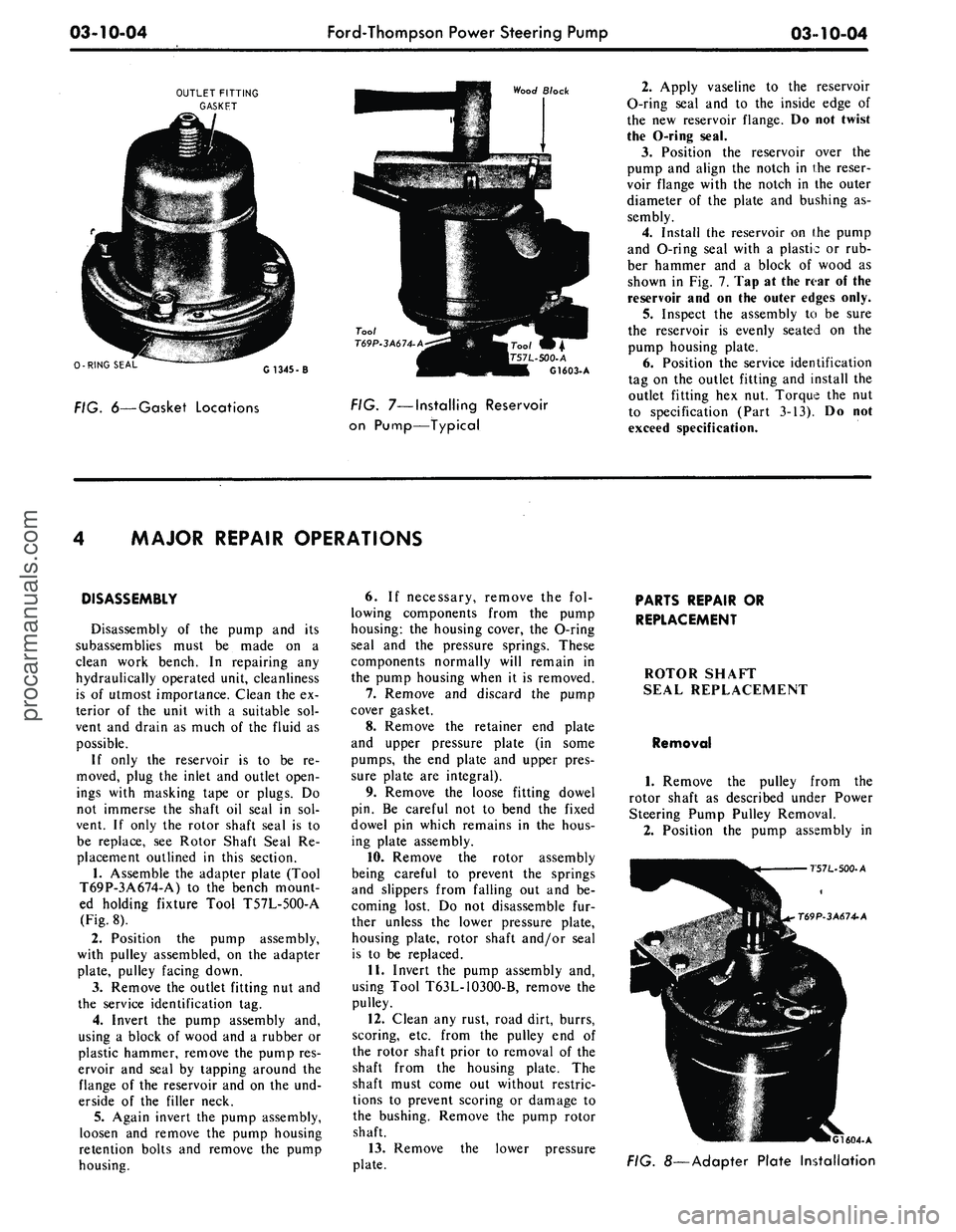
Install a new gasket on the outlet
fitting and a new reservoir O-ring seal
on the pump housing plate (Fig. 6).
The old gasket and seal should never
be re-used.
Too/
T57L 500-A
G1602-A
FIG. 5—Removing Pump
Reservoirprocarmanuals.com
Page 165 of 413
03-10-04
Ford-Thompson Power Steering Pump
03-10-04
OUTLET FITTING
GASKET
Wood Block
0-RING SEAL
G1345-
-500-
A
G1603- A
FIG. 6—Gasket Locations
FIG.
7—Installing
Reservoir
on Pump—Typical
2.
Apply vaseline to the reservoir
O-ring seal and to the inside edge of
the new reservoir flange. Do not twist
the O-ring seal.
3.
Position the reservoir over the
pump and align the notch in the reser-
voir flange with the notch in the outer
diameter of the plate and bushing as-
sembly.
4.
Install the reservoir on the pump
and O-ring seal with a plastic or rub-
ber hammer and a block of wood as
shown in Fig. 7. Tap at the rear of the
reservoir and on the outer edges only.
5.
Inspect the assembly to be sure
the reservoir is evenly seated on the
pump housing plate.
6. Position the service identification
tag on the outlet fitting and install the
outlet fitting hex nut. Torque the nut
to specification (Part 3-13). Do not
exceed specification.
MAJOR REPAIR OPERATIONS
DISASSEMBLY
Disassembly of the pump and its
subassemblies must be made on a
clean work bench. In repairing any
hydraulically operated unit, cleanliness
is of utmost importance. Clean the ex-
terior of the unit with a suitable sol-
vent and drain as much of the fluid as
possible.
If only the reservoir is to be re-
moved, plug the inlet and outlet open-
ings with masking tape or plugs. Do
not immerse the shaft oil seal in sol-
vent. If only the rotor shaft seal is to
be replace, see Rotor Shaft Seal Re-
placement outlined in this section.
1.
Assemble the adapter plate (Tool
T69P-3A674-A) to the bench mount-
ed holding fixture Tool T57L-5OO-A
(Fig. 8).
2.
Position the pump assembly,
with pulley assembled, on the adapter
plate, pulley facing down.
3.
Remove the outlet fitting nut and
the service identification tag.
4.
Invert the pump assembly and,
using a block of wood and a rubber or
plastic hammer, remove the pump res-
ervoir and seal by tapping around the
flange of the reservoir and on the und-
erside of the filler neck.
5.
Again invert the pump assembly,
loosen and remove the pump housing
retention bolts and remove the pump
housing.
6. If necessary, remove the fol-
lowing components from the pump
housing: the housing cover, the O-ring
seal and the pressure springs. These
components normally will remain in
the pump housing when it is removed.
7.
Remove and discard the pump
cover gasket.
8. Remove the retainer end plate
and upper pressure plate (in some
pumps, the end plate and upper pres-
sure plate are integral).
9. Remove the loose fitting dowel
pin. Be careful not to bend the fixed
dowel pin which remains in the hous-
ing plate assembly.
10.
Remove the rotor assembly
being careful to prevent the springs
and slippers from falling out and be-
coming lost. Do not disassemble fur-
ther unless the lower pressure plate,
housing plate, rotor shaft and/or seal
is to be replaced.
11.
Invert the pump assembly and,
using Tool T63L-1O3OO-B, remove the
pulley.
12.
Clean any rust, road dirt, burrs,
scoring, etc. from the pulley end of
the rotor shaft prior to removal of the
shaft from the housing plate. The
shaft must come out without restric-
tions to prevent scoring or damage to
the bushing. Remove the pump rotor
shaft.
13.
Remove the lower pressure
plate.
PARTS REPAIR OR
REPLACEMENT
ROTOR SHAFT
SEAL REPLACEMENT
Removal
1.
Remove the pulley from the
rotor shaft as described under Power
Steering Pump Pulley Removal.
2.
Position the pump assembly in
T57L-500-A
T69P-3A674-A
•
G1604-A
FIG. 8—Adapter Plate Installationprocarmanuals.com
Page 168 of 413
03-10-07
Ford-Thompson Power Steering Pump
03-10-07
15.
Place small amounts of vaseline
on the pump housing plate to hold the
cover gasket in place. Install the gas-
ket on the pump housing plate.
16.
Insert the pressure plate springs
into the pockets in the pump valve as-
sembly. Vaseline may be placed in the
spring pockets to hold the springs in
position (Fig. 17).
17.
Using Tool T69P-3B586-A,
plug the intake hole in the housing
(Fig. 17).
18.
Lubricate the inside of the
housing and the housing cover seal
with C1AZ-19582-A lubricant. Fabri-
cate two studs (3/8-16x1.55 ) to be
used as positioning guides. Install one
in the housing plate bolt hole closest
to the drain hole and one in the bolt
hole diametrically opposite.
19.
Align the small diameter lube
hole in the housing rim with the lube
hole in the housing plate.
20.
Install the housing, applying an
even, downward pressure. The pres-
sure plate springs must not be jarred
and moved out of position. Remove
the guide studs.
21.
Install the housing retaining
bolts finger tight.
22.
Remove Tool T69P-3B586-A.
23.
Torque the retaining bolts even-
ly to 28-32 ft-lbs until the housing
flange contacts the gasket.
24.
Install a 3/8x16 hex head
screw, finger tight, into the end of the
rotor shaft. Using a torque wrench,
check the input torque of the shaft
(Fig. 18). The torque should not ex-
ceed 15 in-lbs. If it does, loosen the
retaining bolts slightly, rotate the
rotor shaft, retorque the bolts evenly
and again check the shaft torque. The
pump must not be used if the shaft
torque exceeds 15 in-lbs.
25.
Release the pin in the bench
holding fixture and agitate the pump
assembly back and forth. If there is a
rattle, the pressure plate springs have
fallen out of their seats and must be
reinstalled.
26.
Install the reservoir O-ring on
the housing plate being careful not to
twist the O-ring. Apply vaseline to the
seal and to the ID of the reservoir
flange.
27.
Install the reservoir, aligning
the notch in the reservoir flange with
the notch in the OD of the pump
housing plate and bushing assembly.
Using only a plastic or rubber ham-
mer, tap at the rear on the outer cor-
ners of the reservoir to avoid damage.
28.
Inspect the assembly to deter-
mine if the reservoir is seated on the
housing plate.
29.
Install the service identification
tag on the outlet valve fitting.
30.
Install the outlet valve fitting
nut and torque to 43-47 ft-lbs.
31.
Invert the pump assembly.
32.
If the pulley was removed, in-
stall the correct pulley using Tool
T65P-3A733-A.procarmanuals.com
Page 170 of 413

03-11-02
Eaton Power Steering Pump
03-11-02
gasket. Withdraw the fluid with a suc-
tion gun.
2.
Remove the reservoir bracket-
to-cylinder block upper cap screw and
the lower cap screw and spacer.
3.
Disconnect the reservoir infet line
and the outlet line at the reservoir,
and remove the reservoir.
Installation
1.
Connect the reservoir-to-pump
line (outlet line) at the reservoir, but
do not tighten the clamp.
2.
Attach the reservoir and bracket
to the cylinder block with the upper
cap screw and the lower cap screw
and spacer. Tighten the cap screws.
3.
Tighten the outlet line clamp at
the reservoir. Connect the reservoir
inlet line to the reservoir.
4.
Fill the reservoir with the speci-
fied automatic transmission fluid. Run
the engine, and bleed the system by
cycling the steering gear with the
windshield wipers turned on. Check
for leaks, and recheck the fluid level.
WITH AIR CONDITIONING
Removal
1. Raise the front of the vehicle.
Remove the reservoir-to-pump line
(outlet line) clamp at the reservoir,
but do not disconnect the line at this
time.
2.
Disconnect the reservoir inlet line
at the reservoir.
3.
Remove the reservoir bracket to
the cylinder block upper cap screw.
Support the reservoir and remove the
lower cap screw and spacer.
4.
With a drain pan under the res-
ervoir, disconnect the outlet line hose
from the reservoir tube and allow the
fluid to drain.
5.
Remove the reservoir cover re-
taining nut and the cover. Position the
cover and the reservoir out of the way
and allow them to rest in the engine
compartment.
6. Lower the front of the vehicle.
Remove the fan shroud.
7.
Remove the reservoir and the
cover by manipulating them through
the opening between the radiator and
the compressor drive belt.
Installation
1.
Position the reservoir in the en-
gine compartment. Loosely attach the
reservoir and bracket to the cylinder
block with the upper cap screw.
2.
Install the fan shroud, then raise
the front of the vehicle.
3.
Connect the reservoir-to-pump
line (outlet line) at the reservoir.
4.
Install the reservoir bracket-
to-cylinder block lower cap screw and
spacer. Tighten both the upper and
the lower cap screws.
5.
Connect the reservoir inlet line at
the reservoir. Install the clamps on
both lines. Lower the car, and install
the reservoir cover and attaching nut.
6. Fill the reservoir with the speci-
fied automatic transmission fluid. Run
the engine, and bleed the system by
cycling the steering gear with the
windshield wipers turned on. Check
for leaks, and recheck the fluid level.
3 MAJOR REPAIR OPERATIONS
INSULATOR (2)
WASHER (2)
MOUNTING BOLT (2)
COVER
BOLT (7)
DOWEL
PIN (2)
ROTOR
ROTOR
SHAFT
COVER
SEAL
PLUG
O RING
VALVE
ASSEMBLY
VALVE
SPRING
INSULATOR
HOUSING
CAM RING
PRESSURE
PLATE
,
PUMP
i
HOUSING
SEAL
ROLL
PIN
INSULATOR
RETAINER
RING
TUBE SEAT
O RING
SCREW
(2)
G12O8-B
FIG.
1
— Power Steering Pumpprocarmanuals.com
Page 205 of 413
04-02-08
Rear Axle — Removable Carrier Type
04-02-08
REMOVAL AND INSTALLATION
CARRIER ASSEMBLY
REMOVAL
1.
Raise the vehicle on a hoist and
remove the two rear wheels and tires.
2.
Remove the two brake drums (3
Tinnerman nuts at each drum) from
the axle shaft flange studs. If diffi-
culty is experienced in removing the
drums, remove the brake adjuster
knockout slug or rubber plug (if so
equipped) and back off the brake
shoes.
3.
Working through the hole pro-
vided in each axle shaft flange, re-
move the nuts that secure the rear
wheel bearing retainer plate. Pull each
axle shaft assembly out of the axle
housing using axle shaft remover,
Tool 4235-C. (Fig. 4). Care must be
exercised to prevent damage to the
production-type synthetic oil seal, if so
equipped. Any roughing or cutting of
the seal element during removal or in-
stallation can result in early seal fail-
ure.
Install a nut on one of the brake
backing plate attaching bolts to hold
the plate to the axle housing after the
shaft has been removed. Whenever a
rear axle shaft is replaced, the wheel
bearing oil seals must be replaced.
Remove the seals with tool 1175AB.
4.
Make scribe marks on the drive
shaft end yoke and the axle U-joint
flange to insure proper position at as-
sembly. Disconnect the drive shaft at
the rear axle U-joint. Hold the cups
on the spider with tape. Mark the
cups so that they will be in their orig-
inal position relative to the flange
when they are assembled. Remove the
drive shaft from the transmission ex-
tension housing. Install an oil seal re-
placer tool in the housing to prevent
transmission leakage. Refer to the
transmission group for the appropriate
tool.
5.
Clean area around carrier to
housing surfaced with a wire brush and
wipe clean, to prevent dirt entry into
the housing. Place a drain pan under
the carrier and housing, remove the
carrier attaching nuts, and drain the
axle.
Remove the carrier assembly
from the axle housing.
INSTALLATION
Synthetic production-type wheel
bearing seals must not be cleaned,
soaked or washed in cleaning solvent.
1.
Clean the axle housing and
shafts using kerosene and swabs. To
avoid contamination of the grease in
the sealed ball bearings, do not allow
any quantity of solvent directly on the
wheel bearings. Clean the mating sur-
faces of the axle housing and carrier.
2.
Position the differential carrier
on the studs in the axle housing using
a new gasket between carrier and
housing. Install the carrier-to-housing
attaching nuts, and torque them to
specifications.
3.
Remove the oil seal replacer tool
from the transmission extension hous-
ing. Position the drive shaft so that
the front U-joint slip yoke splines to
the transmission output shaft.
4.
Connect the drive shaft to the
axle U-joint flange, aligning the scribe
marks made on the drive shaft end
yoke and the axle U-joint flange dur-
ing the removal procedure. Install the
U-bolts and nuts and torque to speci-
fications.
5.
If the synthetic, production-type
wheel bearing seals were replaced with
service-type leather seals, soak the
new rear wheel bearing oil seals in
SAE 10 oil for 1/2 hour before instal-
lation. Wipe a small amount of an oil
resistant sealer on the outer edge of
each seal before it is installed. Do not
put any of the sealer on the sealing
lip.
Install the oil seals in the ends of
the rear axle housing with one of the
tools shown in Figs. 10 and 12.
Tool
T65F-1177.A
E 1571-A
FIG. 12—Rear Axle Shaft Bearing
Seal Installation
6. Install the two axle shaft assem-
blies in the axle housing. Care must
be exercised to prevent damage to the
oil seals. The shorter shaft goes into
the left side of the housing.
Carefully slide the axle shaft into
the housing so that the rough forging
of the shaft will not damage the oil
seal. Start the axle splines into the
differential side gear, and push the
shaft in until the bearing bottoms in
the housing.
7.
Install the bearing retainers on
the attaching bolts on the axle housing
flanges. Install the nuts on the bolts
and torque to specifications.
8. If the rear brake shoes were
backed off, adjust the brakes as out-
lined in Part 2-1 and install rubber
plugs in the adjuster slots.
9. Install the two rear brake drums
and the drum Tinnerman nuts.
10.
Install the rear wheels and tires.
11.
Fill the rear axle with specified
lubricant.
AXLE HOUSING (COIL
SPRING SUSPENSION)
REMOVAL
1.
Remove the carrier assembly
from the axle housing as outlined in
Differential Carrier Removal and In-
stallation.
2.
Position safety stands under the
frame rear members, and support the
axle housing with either a floor jack
or hoist.
3.
Disengage the brake line from
the clips that retain the line to the
axle housing.
4.
Disconnect the vent tube from
the rear axle housing.
5.
Remove the brake backing plate
assemblies from the axle housing, and
support them with wire. Do not dis-
connect the brake line.
6. Disconnect the lower studs of the
two rear shock absorbers from the
mounting brackets on the axle housing
(Fig. 13 and 14).
7.
Remove the attaching nut and
washer, and disconnect the track bar
from the mounting stud on the axle
housing bracket.
8. Lower the axle housing until the
coil springs are released. Lift out the
coil springs and insulators.
9. Remove the nuts, washers and
pivot bolts that connect the suspension
lower arms to the axle housing. Dis-
connect both arms from the axle
housing.
10.
Disconnect the upper suspen-
sion arm from the axle housing by re-
moving the pivot bolt, nut, lock wash-
er and the two eccentric washers (Fig.
13 and 14).
11.
Lower the axle housing and re-
move it from under the vehicle.
INSTALLATION
1.
Transfer the track bar mounting
stud from the old to the new housing.procarmanuals.com