1969 FORD MUSTANG axle
[x] Cancel search: axlePage 33 of 413

TUBE ASSEMBLY-2B255
VIEW IN CIRCLES V
FUEL LINE
CLIP (4 REQUfRED)
PART OF AXLE ASSEMBLY
HOSE ASSEMBLY-2A448
FRAME
TUBE ASSEMBLY-2267
CHECK BRAKE HOSE
CLEARANCE TO ALL
COMPONENTS IN
METAL/METAL JOUNCE
AND METAL/METAL
REBOUND.
CLIP (3 REQUIRED)
TUBE ASSEMBLY-2267
BRAKE BOOSTER-2B195
HOSE-2A047
TUBE ASSEMBLY-2B255
TUBE ASSEM3LY-2420
[
TUBE-2263-C *
TUBE ASSEMBLY BRAKE TUBE
2268 ASSEMBLY
2267 R.R. BRAKE TUBE
ASSEMBLY
TUBE ASSEMBLY
2263
VIEW IN CIRCLES X
COVER-2A487
PEDAL PAD-2457
BRAKE PEDAL-2455
USE EXISTING NUTS
TUBE ASSEMBLY
2325r
TUBE ASSEMBLY
2264 L.H. 2263 R.H.
TUBE ASSEMBLY
2B171-C R.H.
23218-C L.H.
BOLT-381877-S2
(3REQUIRED)
CLIP-382088-S2
(3 REQUIRED)
ALL CONNECTIONS, TUBES, MASTER
CYLINDER AND FITTINGS MUST BE
FREE OF FLUID LEAKAGE WHEN
CHECKED AFTER ROAD TEST.
TUBE ASSY.-2A040
TUBE ASSY.-2B253
PRESSURE IMPULSE
VALVE
ALL BRAKE LINES, FITTINGS AND
FLEXIBLE HOSES MUST BE KEPT FREE
OF FOREIGN MATERIAL BEFORE
AND DURING ASSEMBLY OPERATIONS.
TUBE ASSEMBLY
2B255
PROPORTIONING
VALVE-2B328
GASKET-2149
(4 REQUIRED)
#LUBRICATE PIVOTS
CLIP-381799-S2
2REQUIRED
180°APART
BE LEAKPROOF
TUBE ASSEMBLY-2B255
6
w
Q
7T
3
CHECK BRAKE HOSE
CLEARANCE TO ALL COMPONENTS
IN METAL/METAL JOUNCE
METAL/METAL REBOUND AND FULL
INSIDE AND OUTSIDE TURNS.
BOLT
2 REQUIRED
TUBE ASSY. -2264
BRACKET ASSY.-2B328
O
6
H 1540-C
FIG. 20—Service Brake System—Thunderbird, Continental Markprocarmanuals.com
Page 35 of 413
02-02-16
Brake System
02-02-16
fitting that connects the tube to the
cylinder. Do not pull the metal tube
away from the cylinder. Pulling the
tube out of the cylinder connection
will bend the metal tube and make in-
stallation difficult. The tube will sepa-
rate from the cylinder when the cylin-
der is removed from the backing
plate.
4.
On all except the front wheels on
Ford, Mercury, and Meteor models,
remove the wheel cylinder attaching
bolts and lock washers and remove the
cylinder. On the front wheel of Ford,
Mercury and Meteor models, remove
the nut and washer that attaches the
cylinder to the anchor pin. Remove
the cylinder from the anchor pin.
INSTALLATION
Wipe the end(s) of the hydraulic
line to remove any foreign matter be-
fore making connections.
1.
On all models except Ford, Mer-
cury and Meteor, to install a front
wheel cylinder, position the cylinder to
the backing plate. Install the two lock
washers and attaching bolts. Torque
them to specifications.
On Ford, Mercury and Meteor
models, to install a front wheel cylin-
der, position the cylinder on the an-
chor pin against the backing plate. In-
stall the washer and cylinder attaching
nut on the anchor pin, and torque it
to specification. Lock the washer re-
tainer securely.
2.
Install a new copper gasket over
the hose fitting. Thread the hose into
the cylinder and tighten it to specified
torque.
3.
Engage the opposite end of the
hose to the bracket on the frame. In-
stall the horseshoe-type retaining clip,
and connect the brake tube to the
hose with the tube fitting nut. Tighten
the nut to specification with tool
1112-144.
4.
To install a rear wheel cylinder,
place the rear wheel cylinder into po-
sition. Enter the tubing into the cylin-
der, and start the tube fitting nut into
the threads of the cylinder.
5.
Secure the cylinder to the back-
ing plate by installing the attaching
bolts and lock washers.
6. Tighten the tube fitting nut to
specification with tool 1112-144.
7.
Install the links in the ends of
the wheel cylinder, install the shoes
and adjuster assemblies, and adjust
the shoes as outlined in this section.
8. Adjust the brakes (Part 2-2, Sec-
tion 2). Install the brake drum and
wheel. Bleed the brakes and centralize
the differential valve as outlined in
Part 2-1, Section 2.
BRAKE BACKING PLATE
DRUM BRAKE
REMOVAL
1.
Remove the wheel and brake
drum. Disconnect the brake line from
the brake cylinder.
2.
Remove the brake shoe and ad-
juster assemblies and the wheel cylin-
der as outlined in this section. On the
rear wheels, disconnect the parking
brake lever from the cable.
3.
If the rear backing plate is being
replaced, remove the axle shaft from
the applicable rear axle as outlined in
Group 4, Part 4-2— Rear Axle, Sec-
tion 2, disengage parking brake cable
retainer from backing plate. Remove
the backing plate and gasket.
If the front backing plate is being
replaced, remove the bolts and nuts
that secure the backing plate to the
front wheel spindle and remove the
plate and gasket.
INSTALLATION
If a rear backing plate is to be re-
placed, position a new rear backing
plate and gasket on the attaching
bolts in the axle housing flange. Insert
parking brake cable into backing plate
and secure retaining fingers. Install
the rear axle shaft for applicable rear
axle.
Refer to Group 4, Part 4-2 —
Rear Axle, Section 2 for the proper
installation procedure.
1.
If the front brake backing plate
is to be replaced, position a new front
backing plate and gasket to the wheel
spindle and install the attaching bolts
and nuts.
2.
Install the wheel cylinder and
connect the brake line as outlined in
this section.
3.
Install the brake shoe and ad-
juster assemblies as outlined in this
section. On a rear brake, connect the
parking brake cable to the lever.
4.
Adjust the brake shoes (Section
2),
and install the brake drums and
wheels. Bleed the brake system and
centralize the differential valve as out-
lined in Part 2-1, Section 2.
DISC BRAKE CALIPER
ASSEMBLY
ALL MODELS EXCEPT
LINCOLN CONTINENTAL
Removal
Refer to Figs. 22 and 23.
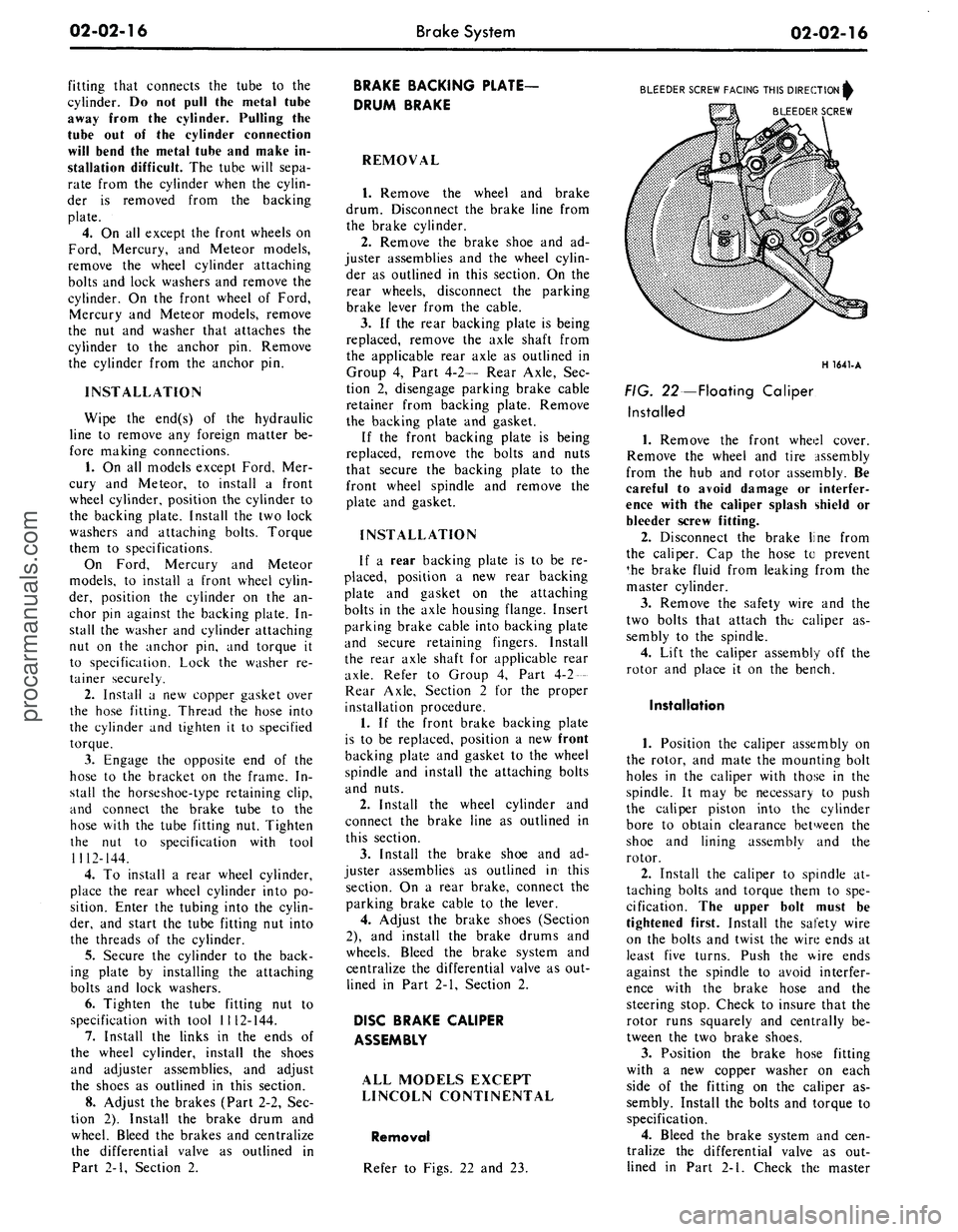
BLEEDER SCREW FACING THIS DIRECTION^
BLEEDER SCREW
H 1641-A
FIG. 22—Floating Caliper
Installed
1.
Remove the front wheel cover.
Remove the wheel and tire assembly
from the hub and rotor assembly. Be
careful to avoid damage or interfer-
ence with the caliper splash shield or
bleeder screw fitting.
2.
Disconnect the brake line from
the caliper. Cap the hose to prevent
*he brake fluid from leaking from the
master cylinder.
3.
Remove the safety wire and the
two bolts that attach the caliper as-
sembly to the spindle.
4.
Lift the caliper assembly off the
rotor and place it on the bench.
Installation
1.
Position the caliper assembly on
the rotor, and mate the mounting bolt
holes in the caliper with those in the
spindle. It may be necessary to push
the caliper piston into the cylinder
bore to obtain clearance between the
shoe and lining assembly and the
rotor.
2.
Install the caliper to spindle at-
taching bolts and torque them to spe-
cification. The upper bolt must be
tightened first. Install the safety wire
on the bolts and twist the wire ends at
least five turns. Push the wire ends
against the spindle to avoid interfer-
ence with the brake hose and the
steering stop. Check to insure that the
rotor runs squarely and centrally be-
tween the two brake shoes.
3.
Position the brake hose fitting
with a new copper washer on each
side of the fitting on the caliper as-
sembly. Install the bolts and torque to
specification.
4.
Bleed the brake system and cen-
tralize the differential valve as out-
lined in Part 2-1. Check the masterprocarmanuals.com
Page 57 of 413
02-02-38
Brake System
02-02-38
2.
Disconnect the actuator solenoid
and warning switch harness connectors
from the control module.
3.
Remove the two wiring harness
grommets from the dash panel and
push the wiring harness and connec-
tors through the openings in the dash
panel.
4.
Working in the engine compart-
ment loosen the hose clamp and re-
move the air hose from the air filter.
5.
Remove the engine air cleaner-
Loosen the hose clamp and remove
the vacuum hose from the vacuum
manifold fitting.
6. Raise the vehicle on a hoist.
7.
Disconnect the exhaust pipes
from the exhaust manifold and sup-
port with wire to provide access to the
actuator assembly.
8. Remove the bolt retaining the
actuator ground wire to the rear outer
corner of the engine right bank.
9. Loosen the tube nuts and discon-
nect the brake system hydraulic tubes
from the hydraulic valve housing.
10.
Remove the three nuts retaining
the actuator assembly to the actuator
support bracket.
11.
Remove the three bolts that re-
tain the actuator mounting bracket to
the side rail and remove the mounting
bracket.
12.
Remove the actuator assembly
from the vehicle and place it on a
bench.
13.
Remove the air and vacuum
hoses from the actuator.
INSTALLATION
1.
Install the air and vacuum hoses
on the new actuator.
2.
Place the actuator assembly into
position under the vehicle, routing the
air and vacuum hoses up between the
engine and fender apron and inserting
the solenoid leads through the holes in
the firewall.
3.
Position the ground wire to the
rear of the engine block and install re-
taining bolt.
4.
Position the actuator mounting
bracket to the frame side rail and in-
stall the three retaining bolts.
5.
Position the actuator assembly
to the mounting bracket and install
the three retaining nuts.
6. Connect the hydraulic tubes to
the hydraulic valve assembly and
tighten the tube nuts to specifications.
7.
Connect the exhaust pipes to the
exhaust manifolds.
8. Lower the vehicle.
9. Pull the actuator solenoid and
brake warning switch wiring harness
through the two holes in the dash
panel from inside the car. Seat the
wiring harness grommets in the dash
panel.
10.
Connect the actuator solenoid
and brake warning switch wiring har-
ness connectors to the control mo-
dules.
'
11.
Position the control module in
the bracket under the glove box and
install the retaining screw.
12.
In the engine compartment con-
nect the air hose to the air filter and
position the hose clamp.
13.
Connect the vacuum hose to the
engine vacuum manifold fitting. In-
stall the engine air cleaner.
14.
Bleed the rear brake system and
centralize the pressure differential
valve.
15.
Raise the rear wheels. Apply
the brakes with the rear wheels turn-
ing to verify proper operation of the
anti-skid control system.
ANTI-SKID CONTROL MODULE
REMOVAL
Refer to Fig. 39.
1.
Remove the retaining strap hold-
ing the harnesses.
2.
Remove the screw that attaches
the forward end of the control module
retainer to the support assembly.
3.
Lower the forward end of the
control module and retainer from the
support assembly; move the module
and retainer forward slightly until the
flange clears the slot in the support
assembly.
4.
Disconnect the five wiring har-
ness plugs from the control module.
5.
Remove the control module from
the vehicle.
INSTALLATION
1.
Connect the five wiring harness
plugs to the control module. Only one
arrangement is possible.
2.
Position the control module in
the retainer, orienting the module per
the markings on it, and insert the re-
tainer flange into the slot at the rear
of the support assembly.
3.
Pivot the retainer and control
module upward and align the screw
hole in the forward end of the retainer
with the hole in the support bracket
assembly. Install the retaining screw.
4.
Test the vehicle on the hoist to
verify correct operation of the skid
control system.
5.-
Secure the wiring to the module
support extension with the retaining
strap.
ANTI-SKID CONTROL SENSOR
REMOVAL
Refer to Fig. 39.
1.
Raise the vehicle on a hoist.
2.
Remove the rear wheel and tire
assembly.
3.
Remove the three Tinnerman
nuts (3) and remove the brake drum.
4.
Disconnect the sensor lead from
the rear wiring harness.
5.
Unseat the sensor lead grommet
pushing it to the inside of the brake
assembly.
6. Remove the four nuts that retain
the sensor to the backing plate and
pull the axle shaft, sensor assembly
and wheel bearing assembly from the
axle housing.
7.
Press the wheel bearing retainer
and wheel bearing off the axle shaft
(Refer to Part 4-2).
8. Remove the sensor assembly and
press the rotor off the shaft with tool
T69P-2B384-A Detail 2 and TOOL
1225-DA.
INSTALLATION
1.
Press a new rotor onto the axle
shaft. Install a new sensor assembly
on the shaft with tool T69P-
2B384-ADetail 1 and TOOL 1225-
DA, and press the bearing and bear-
ing retainer onto the shaft (Refer to
Part 4-2).
2.
Insert the axle shaft assembly in
the rear axle housing onto the four
backing plate retaining bolts, feeding
the sensor lead through the hole in the
backing plate.
3.
Seat the sensor lead grommet in
the backing plate.
4.
Install the four nuts on the re-
taining bolts and tighten to specifica-
tions.
5.
Connect the sensor lead to the
rear wiring harness and install two re-
taining straps.
6. Install the rear brake drum and
retain with the Tinnerrhan drum re-
taining nuts.
7.
Install the rear wheel and tire as-
sembly and tighten the wheel nuts to
specifications.
8. Test the vehicle on the hoist to
verify proper operation of the skid
control system.procarmanuals.com
Page 58 of 413
02-02-39
Brake System
02-02-39
MAJOR REPAIR OPERATIONS
BRAKE DRUM REFINISHING
Minor scores on a brake drum can
be removed with sandpaper. A drum
that is excessively scored or shows a
total indicator runout of over 0.007
inch should be turned down. Remove
only enough stock to eliminate the
scores and true up the drum. The refi-
nished diameter must not exceed 0.060
inch oversize.
Check the inside diameter of the
brake drum with a brake drum mi-
crometer (Tool FRE-14^1).
If the drum diameter is less than
0.030 inch oversize after refinishing^
standard lining may be installed. If
the drum diameter is 0.030—0.060
inch oversize after refinishing, oversize
lining must be installed.
After a drum is turned down, wipe
the refinished surface with a cloth
soaked in clean denatured alcohol. If
one drum is turned down, the opposite
drum on the same axle should also be
cut down to the same size.
ROTOR REFINISHING
Rotunda Disc Brake Attachment,
FRE-2249-2, is the only recommended
tool to refinish the disc brake rotors.
The step-by-step resurfacing procedure
provided with the tool must be ad-
hered to.
The finished braking surfaces of the
rotor must be flat and parallel within
0.0007 inch; lateral runout must not
exceed 0.003 inch total indicator read-
ing, and the surface finish of the brak-
ing surfaces are to be 80/15 micro
inches. The minimum limiting dimen-
sions (Figs. 11 and 12, Part 2-1) from
the inboard bearing cup to the out-
board rotor face and from the inboard
bearing cup to the inboard rotor face
must be observed when removing ma-
terial from the rotor braking surfaces.
On all models except Lincoln Con-
tinental, the limiting dimensions are to
be measured with a ball and gage bar
(Rotunda Kit FRE-70160).
BRAKE SHOE RELINING
Brake linings that are worn to with-
in 1/32 inch of the rivet head or are
less than 0.030 inch thick (bonded lin-
ing) or have been contaminated with
brake fluid, grease or oil must be re-
placed. Failure to replace worn linings
will result in a scored drum. When it
is necessary to replace linings, they
must also be replaced on the wheel on
the opposite side of the vehicle.
Inspect brake shoes for distortion,
cracks, or looseness. If this condition
exists,
the shoe must be discarded. Do
not attempt to repair a defective brake
shoe.
1.
Wash the brake shoes thoroughly
in a clean solvent. Remove all burrs
or rough spots from the shoes.
2.
Check the inside diameter of the
brake drum with a brake drum mi-
crometer (tool FRE-1431). If the di-
ameter is less than 0.030 inches over-
size,
standard lining may be installed.
If the diameter is 0.030—0.060 inches
oversize, oversize lining should be in-
stalled.
3.
Position the new lining on the
shoe.
Starting in the center, insert and
secure the rivets, working alternately
towards each end. Replacement lin-
ings are ground and no further grind-
ing is required.
4.
Check the clearance between the
shoe and lining. The lining must seat
tightly against the shoe with not more
than 0.008 inch clearance between any
two rivets.
RETAINER - 2B245
DUAL MASTER CYLINDER
DISASSEMBLY
1.
Clean the outside of the master
cylinder and remove the filler cover
and diaphragm. Pour out any brake
fluid that remains in the cylinder. Dis-
card the old brake fluid.
2.*
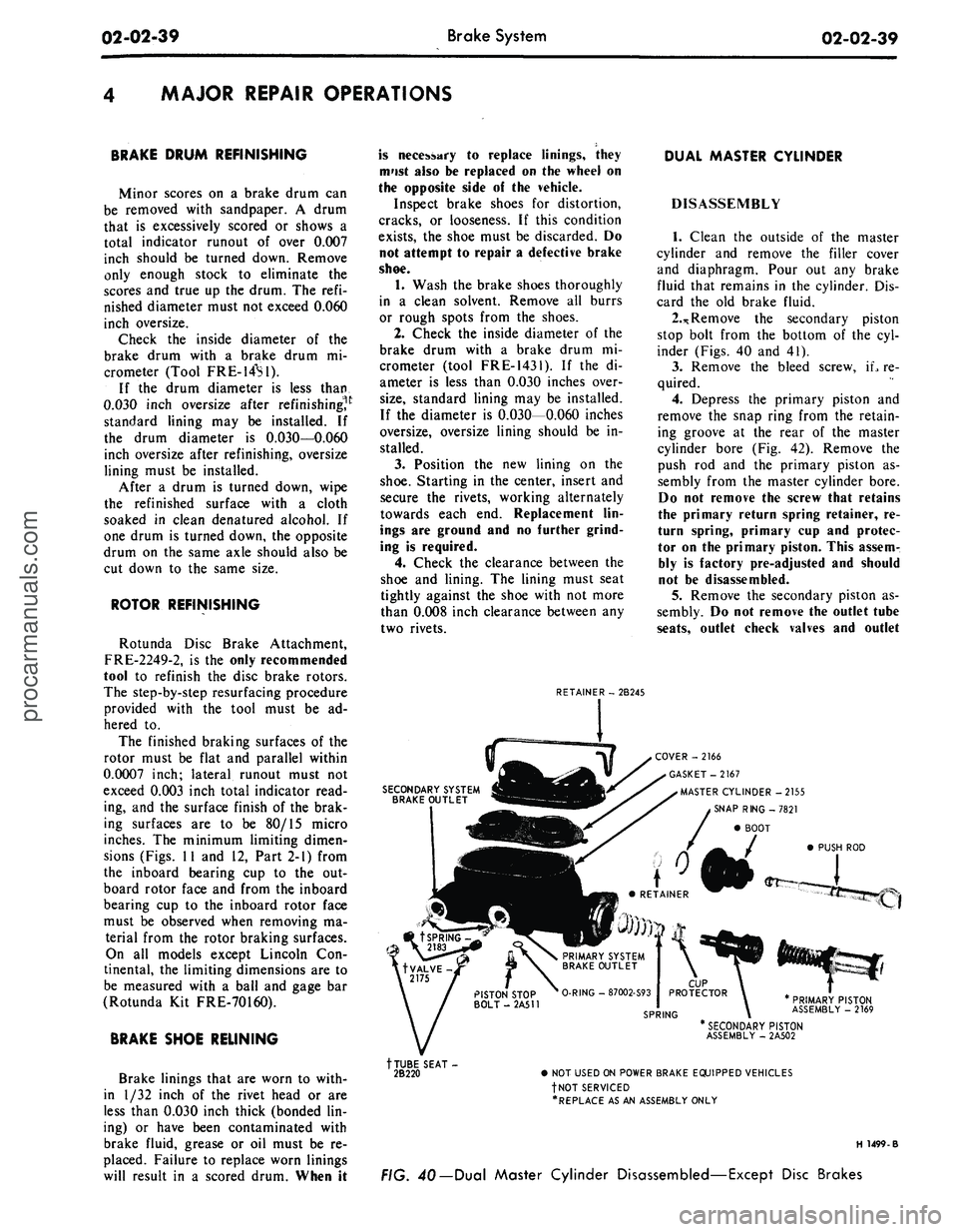
Remove the secondary piston
stop bolt from the bottom of the cyl-
inder (Figs. 40 and 41).
3.
Remove the bleed screw, iL re-
quired.
4.
Depress the primary piston and
remove the snap ring from the retain-
ing groove at the rear of the master
cylinder bore (Fig. 42). Remove the
push rod and the primary piston as-
sembly from the master cylinder bore.
Do not remove the screw that retains
the primary return spring retainer, re-
turn spring, primary cup and protec-
tor on the primary piston. This assem-
bly is factory pre-adjusted and should
not be disassembled.
5.
Remove the secondary piston as-
sembly. Do not remove the outlet tube
seats,
outlet check valves and outlet
SECONDARY SYSTEM
BRAKE OUTLET
COVER -2166
GASKET-2167
MASTER CYLINDER -2155
SNAP RING -7821
BOOT
PUSH ROD
PRIMARY PISTON
ASSEMBLY - 2169
tTUBE SEAT-
2B220
* SECONDARY PISTON
ASSEMBLY - 2A502
• NOT USED ON POWER BRAKE EQUIPPED VEHICLES
fNOT SERVICED
•REPLACE AS AN ASSEMBLY ONLY
H 1499-B
FIG. 40— Dual Master Cylinder Disassembled—Except Disc Brakesprocarmanuals.com
Page 64 of 413

02-03-03
Specifications
02-03-03
ROTOR REFINISH
The following requirements must be met when resurfacing disc
brake rotors:
Rotunda Disc Brake Attachment FRE-2249-2 is the only approv-
ed tool to be used to ref inish the disc brake rotors. The step-by-
step resurfacing procedure provided with the tool must be adhered
t0" The finished braking surfaces of the rotor must be flat and
parallel within 0.0007
inch;
lateral runout must not exceed 0.003
inch total indicator reading, and the surface finish of the braking
surfaces are to be 15-80 micro inches.
On all models except Lincoln Continental the limiting dimen-
sion from the inner bearing cup to the inner rotor face must be
measured with a ball and gage bar (Rotunda FRE-70160).
On Lincoln Continental models the limiting dimension from the
inboard bearing cup to the inboard rotor face of 0.755 inch
mini-
mum and from the inboard bearing cup to the outboard rotor face
of 0.395 inch minimum must be observed.
TORQUE LIMITS -GENERAL -FT-LBS.
Parking Brake Control Assembly
Mounting Nuts and Bolts
Master Cylinder to Dash Panel Screw
Master Cylinder to Booster
Booster to Dash Panel
Disc Brake Caliper to Spindle Bolts
Disc Brake Rotor Splash Shield
to Spindle
Brake Hose to Caliper Connection Bolt
Caliper Locating Pins
Caliper Stabilizer to Anchor Plate
Bolt
Caliper Brake Shoe Clips
Caliper Bleeder Screws
Wheel Cylinder to Backing Plate Screws
Wheel Cylinder & Backing Plate
Anchor Pin Nut
Rear Brake Backing Plate to Axle
Housing:
Removable Carrier
Integral Type
Front Brake Backing Plate to Spindle
Wheel Cylinder Bleeder Screw
Brake Hose Connection to Front
Wheel Cylinder
Brake Line Connection to Rear Axle
Housing:
Removable Carrier
Integral Type
Hydraulic Tube Connections ®
3/8 x 24
7/16 x 24
1/2 x 20
9/16 x 18
Wheel to Hub and Drum or Hub and
Rotor Nuts
Ford-Mercury
Meteor
Cap Screw
12-19
Nuts 7-11
13-20
13-?0
13-20
Upper ©
110-140
Lower
90-120
9-14
17-25
25-35
8-11
6-10
6-15
10-20
20-30
50-70
IPo
25-40
6-15
12-20
30-40
25-35
10-15
10-15
10-17
10-17
70-115
Fair
lane-
Montego
Falcon
12-25
13-20
13-20
13-20
Upper CD
100-140
Lower
55-75
9-14
17-25
25-35
8-11
6-10
6-15
10 in. Brake
10-20
9 in. Brake
5-7
50-70
20-40
28-35
32-65 ®
Inch-lb.
12-20
12-19
12-19
10-15
10-15
10-17
10-17
4 lug
55-85
5 lug
70-115
Mustang-
Cougar
12-25
13-20
13-20
13-20
Upper ©
100-140
Lower
55-75
9-14
17-25
25-35
8-11
6-10
6-15
10 in. Brake
10-20
9 in. Brake
5-7
50-70
20-40
28-35
32-65 ®
Inch-lb.
12-20
12-19
12-19
10-15
10-15
10-17
10-17
4 lug
55-85
5 lug
70-115
Thunderbird
Continental
Mark III
1218
13-20
13-20
Upper ©
110-140
Lower
90-120
9-14
17-25
25-35
8-11
6-10
6-15
10-20
50-70
6-15
30-40
10-15
10-15
10-17
10-17
70-115
Lincoln
Continental
Dash Panel
10-20
Inst. Panel
712
13-20
13-20
100-140
9-14
7-9
6-15
10-20
30-35
6-15
10-15
10-15
10-17
10-17
70-115
® The upper bolt must be tightened first.
® On front disc brake calipers 6-15 ft-lbs.
® All hydraulic lines must be tightened to the specified torque value and be free of fluid leakage.procarmanuals.com
Page 65 of 413

02-03-04
Specifications
02-03-04
SERVICE TOOLS
Ford Tool
No.
Rotunda
HRE
8650
Tool
7000-00
Rotunda
70160
Tool 33621
Tool 4235-C
Rotunda
FRE 1431
Rotunda
FRE
22492
Former
No.
LM 119
2018-A
2162
2035N
33621
Milbar
1112-144
4235-C
J
22742 (Kent Moore)
Description
Brake
Adjusting
Gage
Brake
Cylinder
Retaining
Clamp
Brake
Adjusting
Tool
Adapter
Cap
Brake Shoe
R
&
R
Spring
Rubber
Tipped
Air
Nozzle
Ball
and
Gage
Bar
Internal
Snap Ring PMers
Inch Pound Torque
Wrench
Axle Shaft
Remover
Brake Drum
Micrometer
Bleeder
Valve Clip Spring
Disc Brake Rotor
Attachmentprocarmanuals.com
Page 69 of 413
03-01-04
Suspension — Steering, Wheels And Tires — General Service
03-01-04
Tool
- T 65 P -
3000
B or C
1266-B
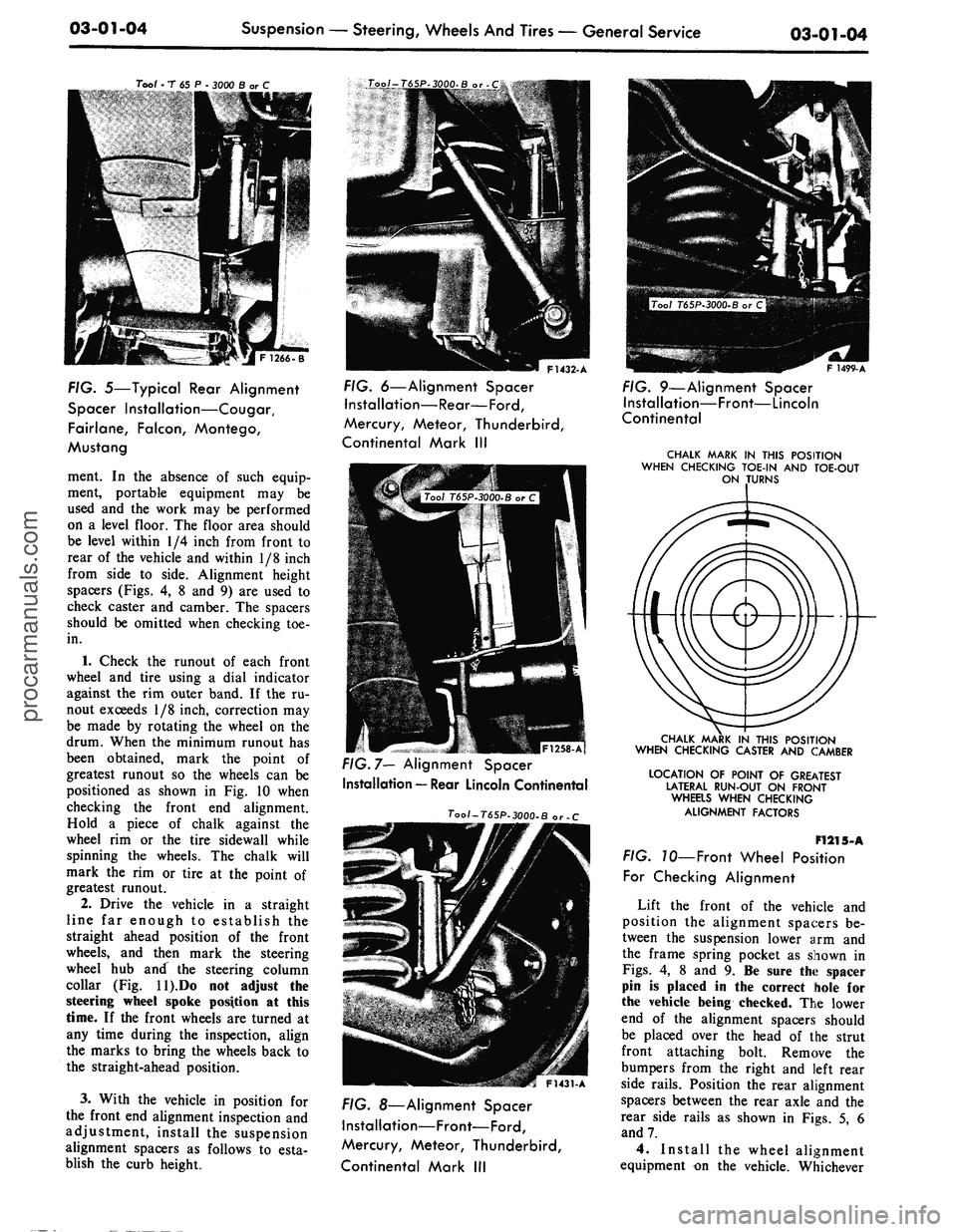
FIG. 5—Typical Rear Alignment
Spacer Installation—Cougar,
Fairlane, Falcon, Montego,
Mustang
ment. In the absence of such equip-
ment, portable equipment may be
used and the work may be performed
on a level floor. The floor area should
be level within 1/4 inch from front to
rear of the vehicle and within 1/8 inch
from side to side. Alignment height
spacers (Figs. 4, 8 and 9) are used to
check caster and camber. The spacers
should be omitted when checking toe-
in.
1.
Check the runout of each front
wheel and tire using a dial indicator
against the rim outer band. If the ru-
nout exceeds 1/8 inch, correction may
be made by rotating the wheel on the
drum. When the minimum runout has
been obtained, mark the point of
greatest runout so the wheels can be
positioned as shown in Fig. 10 when
checking the front end alignment.
Hold a piece of chalk against the
wheel rim or the tire sidewall while
spinning the wheels. The chalk will
mark the rim or tire at the point of
greatest runout.
2.
Drive the vehicle in a straight
line far enough to establish the
straight ahead position of the front
wheels, and then mark the steering
wheel hub and the steering column
collar (Fig. ll).Do not adjust the
steering wheel spoke position at this
time. If the front wheels are turned at
any time during the inspection, align
the marks to bring the wheels back to
the straight-ahead position.
3.
With the vehicle in position for
the front end alignment inspection and
adjustment, install the suspension
alignment spacers as follows to esta-
blish the curb height.
F1432-A
FIG. 6—Alignment Spacer
Installation—Rear—Ford,
Mercury, Meteor, Thunderbird,
Continental Mark III
|F1258-Af
FIG. 7— Alignment Spacer
Installation — Rear Lincoln Continental
Tool-T65P-3000-B or -C
F1431-A
FIG. 8—Alignment Spacer
Installation—Front—Ford,
Mercury, Meteor, Thunderbird,
Continental Mark III
F 1499-A
FIG. 9—Alignment Spacer
Installation—Front—Lincoln
Continental
CHALK MARK IN THIS POSITION
WHEN CHECKING TOE-IN AND TOE-OUT
ON TURNS
CHALK MARK IN THIS POSITION
WHEN CHECKING CASTER AND CAMBER
LOCATION OF POINT OF GREATEST
LATERAL RUN-OUT ON FRONT
WHEaS WHEN CHECKING
ALIGNMENT FACTORS
F1215-A
FIG. 70—Front Wheel Position
For Checking Alignment
Lift the front of the vehicle and
position the alignment spacers be-
tween the suspension lower arm and
the frame spring pocket as shown in
Figs.
4, 8 and 9. Be sure the spacer
pin is placed in the correct hole for
the vehicle being checked. The lower
end of the alignment spacers should
be placed over the head of the strut
front attaching bolt. Remove the
bumpers from the right and left rear
side rails. Position the rear alignment
spacers between the rear axle and the
rear side rails as shown in Figs. 5, 6
and 7.
4.
Install the wheel alignment
equipment on the vehicle. Whicheverprocarmanuals.com
Page 78 of 413

03-02-02
Suspension
03-02-02
COMPONENT INDEX
REAR SPRING
Disassembly
and
Overhaul
Removal
and
Installation
REAR SUSPENSION
Description
REAR SUSPENSION LOWER
ARM
Removal
and
Installation
REAR SUSPENSION UPPER
ARM
Removal
and
Installation
SPRING LEAVES
AND
TIE-BOLT
Removal
and
Installation
STABILIZER
Removal
and
Installation
TRACK
BAR
Removal
and
Installation
UPPER
ARM
-
REMOVED
Removal
and
Installation
UPPER
ARM
SHAFT AND/OR BUSHING
Removal
and
Installation
UPPER BALL JOINT
Removal
and
Installation
MODEL APPLICATION
All
Models
Ford
N/A
02-23
02-02
02-24
02-25
N/A
02-11
02-25
N/A
N/A
02-08
Mercury
N/A
02-23
02-02
02-24
02-25
N/A
02-11
02-25
N/A
N/A
02-08
Meteor
N/A
02-23
02-02
02-24
02-25
N/A
02-11
02-25
N/A
N/A
02-08
Cougar
N/A
02-25
02-04
N/A
N/A
N/A
02-11
N/A
N/A
02-09
02-08
Fairlane
N/A
02-25
02-04
N/A
N/A
N/A
02-11
N/A
N/A
02-09
02-08
Falcon
N/A
02-25
02-04
N/A
N/A
N/A
02-11
N/A
N/A
02-09
02-08
Montego
N/A
02-25
02-04
N/A
N/A
N/A
02-11
N/A
N/A
02-09
02-08
Mustang
N/A
02-25
02-04
N/A
N/A
N/A
02-11
N/A
N/A
02-09
02-08
Lincoln-
Continental
02-28
02-26
02-04
N/A
N/A
02-29
N/A
N/A
02-27
N/A
02-10
Thunderbird
N/A
02-23
02-02
02-24
02-25
N/A
02-11
02-25
N/A
N/A
02-08
Continental-
Mark III
N/A
02-23
02-02
02-24
02-25
N/A
02-11
02-25
N/A
N/A
02-08
A page number indicates that
the
item
is
for the
vehicle listed
at
the
head
of
the
column.
N/A indicates that
the
item
is
not
applicable
to
the
vehicle listed.
DESCRIPTION
FRONT SUSPENSION
Each front wheel rotates
on a
spindle.
The
upper
and
lower ends
of
the spindle
are
attached
to
upper
and
lower ball joints which
are
mounted
to
an upper
and
lower
arm
respectively.
The upper
arm
pivots
on a
bushing
and shaft assembly which
is
bolted
to
the frame.
The
lower
arm
pivots
on a
bolt
in the
front crossmember (Figs.
1,
2
and 3). A
coil spring seats between
the lower (upper
on
Cougar, Fairlane,
Falcon, Montego
and
Mustang)
arm
and
the top of the
spring housing.
A
double action shock absorber
is
bolted
to
the arm and the top of the
spring
housing.
REAR SUSPENSION
FORD, MERCURY,
METEOR, THUNDERBIRD
AND
CONTINENTAL MARK
III
Each rear wheel,
hub, and
brake
drum assembly
is
bolted
to the
rear
axle shaft flange.
The
axle shaft
as-
sembly rotates
in the
rear axle hous-
ing.
The rear axle housing
is
suspended
from
the
frame
by a
coil spring
and
shock absorber
at
each side
of the ve-
hicle
and by
three arms
(one
upper
and
two
lower) which pivot
in the
frame members
(Fig.
4).
Each coil spring
is
mounted
be-
tween
a
lower seat, which
is
welded
to
the axle housing,
and an
upper seat
which
is
integral with
the
frame.
The upper
end
of
the
rear shock
ab-
sorber
is
attached
to the
spring upper
seat;
the
lower
end is
bolted
to a
bracket
on the
axle housing.
The upper suspension
arm
attaches
to
the
right side
of the
axle housing
through
an
eccentric pivot bolt
and a
bracket which
is
welded
to the top of
the housing.
The
forward
end of the
arm
is
connected
by a
pivot bolt
to
the frame crossmember.
Each lower suspension
arm
attaches
to
one end of the
axle housing
through
a
pivot bolt
and a
bracket
which
is
welded
to the
underside
of
the housing.
The
forward
end of the
arm
is
connected
by a
pivot bolt
to
the frame side member.
A track
bar is
connected between
the upper
arm
bracket
on the
axle
housing
and a
mounting bracket
on
the left frame side rail.
procarmanuals.com