1969 FORD MUSTANG air condition
[x] Cancel search: air conditionPage 75 of 413
03-01-10
Suspension — Steering, Wheels And Tires — General Service
03-01-10
The following procedure should be
followed when cleaning the relief valve
which is a part of the pump valve as-
sembly.
1.
Using a punch or rod of suitable
diameter, apply an even pressure in a
straight line to the tip of the relief
valve pin (Fig. 20). Depress the valve
two or three times to exhaust the oil
which is trapped in the assembly. Do
not hammer on the valve pin or hous-
ing.
2.
Submerge the assembly in a con-
tainer of clean solvent. Again applying
an even pressure to the tip of the relief
valve pin, (a sudden strong force could
push the pin through the relief valve
spool) move the valve in and out sev-
eral times, thereby thoroughly flushing
the assembly. Pressure created within
the valve bore when the valve is moved
inward should force the cleaning fluid
out through the sensing orifice. If this
does not occur, the sensing orifice
should be cleaned with a piece of wire.
The valve must move freely and even-
ly. If the pin is bent or damaged, or if
the valve binds, the pump valve must
be replaced.
INSPECTION
The following describes the compo-
nents of the power steering pump
which must be replaced regardless of
condition and how to determine when
other components should be replaced.
The outlet fitting hex nut may be
reused if the corners of the hex are
not rounded. The housing bolts may
be reused if the threads are not dam-
aged.
All gaskets and seals must be re-
placed with new components except
the rotor shaft seal which should be
reused unless it was leaking.
The reservoir assembly may be
reused if the reservoir seal and gasket
areas are not damaged (dents, scratch-
es,
etc.). The soldered joints of the re-
turn and fill tubes must not be loose
or bent. Be sure to check for a broken
baffle.
The housing or housing assembly
may be reused if there is no damage
(scratches, etc.) at reservoir gasket,
outlet fitting or cover seal areas.
If the outlet fitting is damaged, the
pump housing must be replaced. The
pressure plate springs may be reused
providing they are not bent, broken or
have not taken a set.
Do not reuse the retainer end plate
if it is burred or damaged. The upper
pressure plate may be reused if there
is no scoring on the wear surface. It is
acceptable to polish the phosphate
coating.
The rotor and cam assembly can be
reused if there is no wear other than
the removal of the phosphate coating
on the cam contour. Do not disas-
semble the rotor and cam assembly.
Push the rotor part way out the cam
insert taking care not to let the slip-
pers and springs fall out. Check the
cam ID for scoring and burning.
Check the rotor faces and OD for
scoring and chipping. Do not attempt
to repair or refinish the lower and
upper pressure plates, cam or rotor
assembly. When wear or burning is
encountered, replace, them with new
components.
Install a new rotor and cam assem-
bly if the slippers are worn. Replace
the springs if they are bent or broken.
Polishing the phosphate coating of the
slipper sealing surface is permissable.
The rotor shaft can be reused if the
front and rear thrust faces, the bush-
ing diameter and the shaft seal diame-
ter are not excessively worn or scored.
The housing plate and bushing as-
sembly may be reused if all of the
threaded holes are not damaged
beyond repair and the bushing diame-
ter is not scored or worn .0005 inch
over the maximum dimension of .6897
inch. Threaded holes can be repaired
by drilling out the damaged threads
and installing a helicoil insert. If the
bushing is scored or excessively worn,
a new plate and bushing assembly
must be installed.
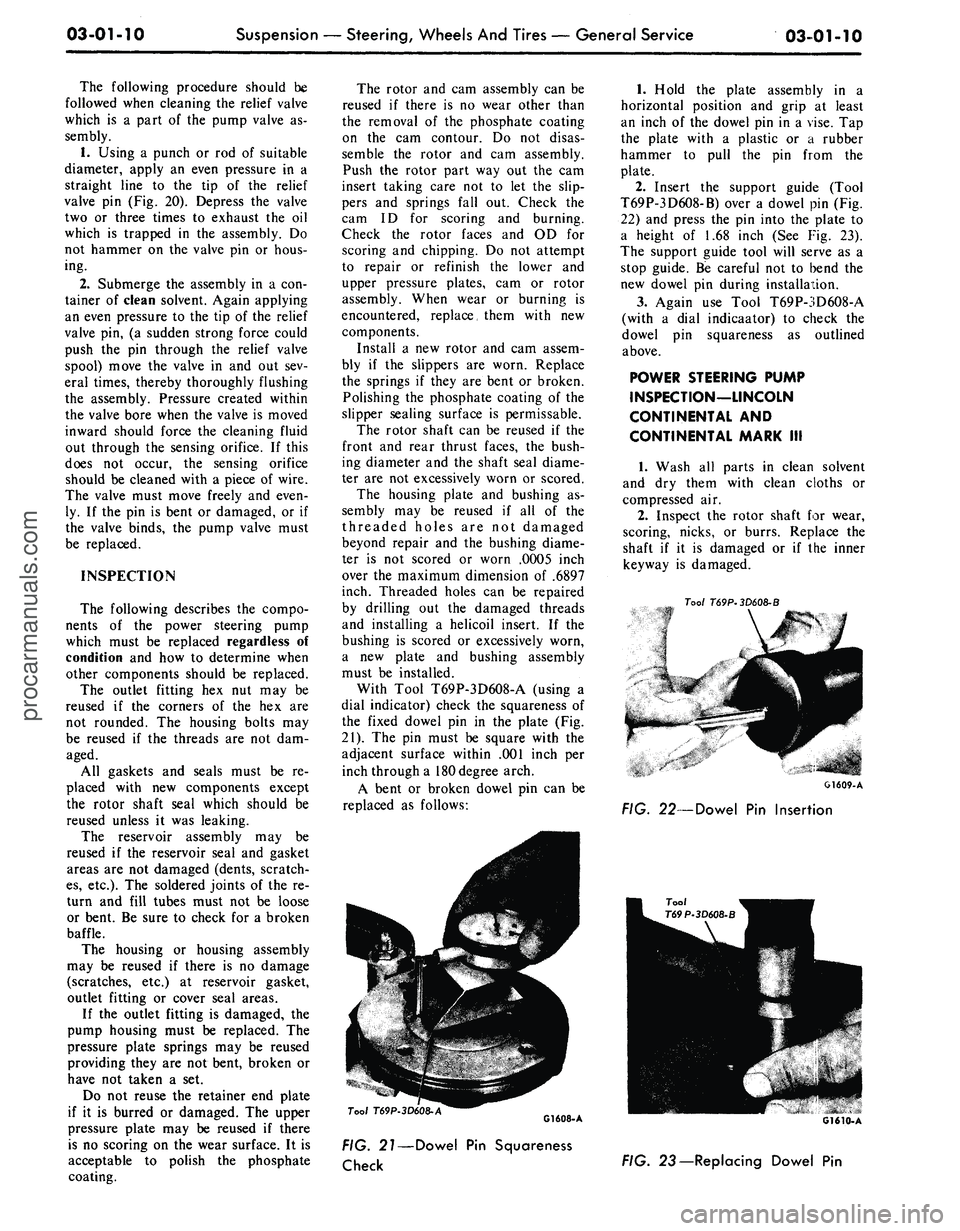
With Tool T69P-3D608-A (using a
dial indicator) check the squareness of
the fixed dowel pin in the plate (Fig.
21).
The pin must be square with the
adjacent surface within .001 inch per
inch through a 180 degree arch.
A bent or broken dowel pin can be
replaced as follows:
1.
Hold the plate assembly in a
horizontal position and grip at least
an inch of the dowel pin in a vise. Tap
the plate with a plastic or a rubber
hammer to pull the pin from the
plate.
2.
Insert the support guide (Tool
T69P-3D608-B) over a dowel pin (Fig.
22) and press the pin into the plate to
a height of 1.68 inch (See Fig. 23).
The support guide tool will serve as a
stop guide. Be careful not to bend the
new dowel pin during installation.
3.
Again use Tool T69P-3D608-A
(with a dial indicaator) to check the
dowel pin squareness as outlined
above.
POWER STEERING PUMP
INSPECTION—LINCOLN
CONTINENTAL AND
CONTINENTAL MARK III
1.
Wash all parts in clean solvent
and dry them with clean cloths or
compressed air.
2.
Inspect the rotor shaft for wear,
scoring, nicks, or burrs. Replace the
shaft if it is damaged or if the inner
keyway is damaged.
Tool
T69P-3D608-B
G1609-A
FIG. 22—Dowel Pin Insertion
Tool
T69P-3D608-A
G1608-A
FIG. 21—Dowel Pin Squareness
Check
FIG. 23 — Replacing Dowel Pinprocarmanuals.com
Page 76 of 413

03-01-11
Suspension — Steering, Wheels And Tires — General Service
03-01-11
3.
Inspect the rotor, rollers, cam
ring, pressure plate, cover, and bush-
ing in the pressure plate for wear or
scoring. If damaged, replacement of
the pump (less housing) is required.
4.
Make sure the inner faces of the
cover and the housing are free of
paint, nicks, or burrs. Check all fluid
passages for restrictions.
5.
Inspect the valving surfaces
(areas where the rotor and rollers con-
tact) for wear or scoring. Replace the
pressure plate or the cover if worn or
scored. Inspect the bushing in the
pressure plate for wear or scoring, and
replace the plate if necessary.
6. Inspect the control valve for
scores, nicks, or burred edges. Re-
place the valve if damaged. Do not dis-
assemble the valve. Check the valve
for free movement in the housing
bore.
7.
Inspect the tube seat in the hous-
ing. If damaged, remove it with an
E-Z-Out and install a new seat.
SHOCK ABSORBER CHECKS
All vehicles are equipped with hy-
draulic shock absorbers of the direct-
acting type and are nonadjustable and
nonrefillable. They cannot be repaired.
Before replacing a shock absorber,
check the action of the shock absor-
bers as follows:
ON VEHICLE TESTS
1.
Check the shock absorber to be
sure it is securely and properly in-
stalled. Check the shock absorber in-
sulators for damage and wear.
Replace any defective insulators and
tighten attachments to the specified
torque (on a shock absorber which in-
corporates integral insulators, replace
the shock absorbers).
2.
Inspect the shock absorber for
evidence of fluid leakage. A light film
of fluid is permissible. Be sure any
fluid observed is not from sources
other than the shock absorber.
Replace the shock absorber if leak-
age is severe.
3.
Disconnect the lower end of the
shock absorber. Extend and compress
the shock absorber as fast as possible,
using as much travel as possible.
Action should become smooth and
uniform throughout each stroke.
Higher resistance on extension than
on compression is a normal condition.
Faint swish noises are also normal.
Remove the shock absorber for a
bench test if action is erratic. If the
action is smooth, but the shock absor-
bers are suspected of being weak fol-
low step 4:
4.
Repeat step 3 on the mating
shock absorber installed on the oppo-
site side of the vehicle, and compare
results of both tests. If the action is
similar, it is unlikely that either shock
absorber is defective. Reconnect both
shock absorbers.
Replace the shock absorber having
the lower resistance. Ensure that the
part number of the replacement is the
same as that of the original shock ab-
sorber. The replacement shock absor-
ber resistance will appear to be higher
than either original due to initial fric-
tion of the rod seal.
BENCH TEST
With the shock absorber right side
up (as installed in vehicle), extend it
fully. Then turn the shock absorber
upside down and fully compress it.
Repeat this procedure at least three
times to ensure that any entrapped air
has been expelled. Now place the
shock absorber right side up in a vise,
and hand stroke the shock absorber as
described in On Vehicle Tests, step 3.
If action is not now smooth and uni-
form, install a new shock absorber.procarmanuals.com
Page 106 of 413

03-03-01
Automatic
Air
Leveling System
03-03-01
PART
3-3
Automatic
Air
Leveling System
COMPONENT INDEX
AIR COMPRESSOR
Disassembly
and
Overhaul
Removal
and
Installation
AIR CYLINDER
Removal
and
Installation
DESCRIPTION
HEIGHT CONTROL VALVE
Disassembly
and
Overhaul
Removal
and
Installation
MODEL APPLICATION
All
Models
Ford
03-03
03-02
03-02
03-01
03-03
03-02
Mercury
03-03
03-02
03-02
03-01
03-03
03-02
Meteor
03-03
03-02
03-02
03-01
03-03
03-02
Cougar
N/A
N/A
N/A
N/A
N/A
N/A
Fairlane
N/A
N/A
N/A
N/A
N/A
N/A
A page number indicates that the item
is for the
vehicle listed
at
the head
of
the column.
N/A indicates that
the
item
is not
applicable
to the
vehicle listed.
Falcon
N/A
N/A
N/A
N/A
N/A
N/A
Montego
N/A
N/A
N/A
N/A
N/A
N/A
Mustang
N/A
N/A
N/A
N/A
N/A
N/A
Lincoln-
Continental
N/A
N/A
N/A
N/A
N/A
N/A
Thunderbird
N/A
N/A
N/A
N/A
N/A
N/A
Continental-
Mark III
N/A
N/A
N/A
N/A
N/A
N/A
DESCRIPTION
The automatic level control
is an
accessory item
on the
Ford, Mercury
and Meteor vehicles
(Fig. 1).
This
de-
vice
is a
supplement
to the
rear coil
spring suspension,
and
will automati-
cally maintain
the
rear standing height
of
the
vehicle
at an
approximate
con-
stant position compensating
for
vary-
ing loaded conditions.
The
system
consists
of a
vacuum operated
com-
pressor, control valve,
air
cylinders
and
the
connecting lines
and
fittings.
In
the
event
of
accidental
air
loss,
the
conventional coil springs will support
the vehicle.
RUBBER
AIR
CYLINDER
WITHIN COIL SPRING
HEIGHT CONTROL
VALVE
RUBBER
AIR
CYLINDER
WITHIN COIL SPRING
RUBBER VACUUM LINE
TO
VACUUM
DISTRIBUTION CONNECTOR
RED CLAMP STATION WAGON ONLY
COMPRESSOR
NYLON
AND
STEEL LINES
FROM VALVE
TO
CYLINDERS
FIG.
1
—
Air Leveling System
FT475-A
procarmanuals.com
Page 139 of 413

03-07-01
Ford Design Non-Integral Power Steering System
03-07-01
PART
3-7
Ford Design Non-Integral Power
Steering System
COMPONENT INDEX
CONTROL VALVE
Disassembly
and
Overhaul
Removal
and
Installation
CONTROL VALVE CENTERING SPRING
Adjustment
CONTROL VALVE
TO
POWER STEERING
CYLINDER HOSE
Removal
and
Installation
HOISTING INSTRUCTIONS
POWER CYLINDER
Removal
and
Installation
POWER CYLINDER SEAL
Removal
and
Installation
POWER STEERING PUMP CLEANING
AND INSPECTION
(See
Part 03-01)
Removal
and
Installation
POWER STEERING PUMP
TO
CONTROL
VALVE HOSE
Removal
and
Installation
STEERING GEAR
Cleaning
and
Inspection
(See Part 03-01)
MODEL APPLICATION
All
Models
Ford
N/A
N/A
N/A
N/A
N/A
N/A
N/A
N/A
N/A
Mercury
N/A
N/A
N/A
N/A
N/A
N/A
N/A
N/A
N/A
Meteor
N/A
N/A
N/A
N/A
N/A
N/A
N/A
N/A
N/A
Cougar
N/A
N/A
N/A
N/A
N/A
N/A
N/A
N/A
N/A
Fairlane
07-04
07-03
07-02
07-02
07-02
07-04
07-06
07-03
07-02
Falcon
07-04
07-03
07-02
07-02
07-02
07-04
07-06
07-03
07-02
Montego
07-04
07-03
07-02
07-02
07-02
07-04
07-06
07-03
07-02
Mustang
07-04
07-03
07-02
07-02
07-02
07-04
07-06
07-03
07-02
Lincoln-
Continental
07-04
07-03
07-02
07-02
07-02
07-04
07-06
07-03
07-02
Thunderbird
N/A
N/A
N/A
N/A
N/A
N/A
N/A
N/A
N/A
Continental-
Mark
III
N/A
N/A
N/A
N/A
N/A
N/A
N/A
N/A
N/A
A page number indicates that
the
item
is for the
vehicle listed
at the
head
of the
column.
N/A indicates that
the
item
is not
applicable
to the
vehicle listed.
DESCRIPTION
The Ford Non-Integral Power
Steering System
(Fig. 1) is a
hydrauli-
cally controlled linkage-type steering
system which includes
an
integral
pump
and
fluid reservoir,
a
control
valve,
a
power cylinder,
the
connecting
fluid lines,
and the
steering linkage.
The hydraulic pump
and
belt, driven
from
the
engine crankshaft, draws
fluid from
the
reservoir
and
provides
fluid pressure
for the
system. Within
the pump itself
is a
pressure-relief
valve which governs
the
pressures
within
the
steering system according
to
the
varying conditions
of
operation.
After fluid
has
passed from
the
pump
to
the
control valve
and the
power
cyl-
inder,
it
returns
to the
reservoir.
procarmanuals.com
Page 163 of 413

03-10-02
Ford-Thompson Power Steering Pump
03-10-02
LOWER PRESSURE
PLATE 3D590
SPRING-3D601
UPPER PRESSURE
PLATE -3A645
RETAINER END
PLATE-3D589
CAM AND ROTOR
ASSEMBLY-
-3D607
SCREW AND WASHER
ASSEMBLY-379376-S
PULLEY-3D673
PUMP SHAFT
SEAL 3B592
PLATE AND BUSHING
ASSEMBLY-3D643
0-RING
382744-S
HOUSING GASKET
3A760
G1343-B
FIG. 2—Power Steering Pump Disassembled
To adjust the belt on 8 cyl. engines
loosen the mounting bolt in the ad-
justing slot and the nut directly above
the adjusting slot. Place a suitable pry
bar between the cast boss on the
pump mounting bracket and the cast
boss on the pump cover plate and pry
upward to correct tension.
Do not pry against the reservoir to
obtain proper belt load as it can be
deformed and cause a leak.
3.
Recheck the belt tension. When
the tension has been correctly adjusted,
tighten the bolts and the fiut to speci-
fication (Part 3-13).
POWER STEERING
PUMP DRIVE BELT
REPLACEMENT
1.
Loosen the idler pulley attaching
bolts and remove the compressor drive
belt if equipped with an air condition-
er.
2.
Loosen 3 bolts and one nut at-
taching the power steering pump to
the pump bracket, and remove the
pump drive belt.
3.
Position the power steering
pump drive belt on the pulleys.
4.
Adjust the drive belt tension as
outlined in Section 2 to specification
(Part 3-13) and tighten the pump at-
taching bolts and one nut to specifica-
tion.
5.
Install the compressor drive belt
if equipped with an air conditioner
and adjust to specification (Part 16).
REMOVAL AND INSTALLATION
POWER STEERING
PUMP REPLACEMENT
EIGHT CYLINDER
WITHOUT AIR
CONDITIONER AND
ALL SIX CYLINDER
1.
Remove the power steering fluid
from the pump reservoir by discon-
necting the fluid return hose at the
reservoir, and allow the fluid to drain
into a suitable container.
2.
Disconnect the pressure hose
from the pump.
3.
Remove 3 bolts from the front of
the pump and the one nut at the rear
(rear nut on 8 cyl. engines only) that
attach the pump to the mounting
bracket; disconnect the belt from the
pulley and remove the pump from the
vehicle.
4.
Position the pump to the mount-
ing bracket and install the 3 bolts at
the front of pump and (rear nut on 8
cyl.
engines only) the 1 nut at the
rear. Torque to specification.
5.
Place the belt on the pulley and
adjust the belt tension (Section 2) with
Tool T63L-8620-A and tighten the
bolts and nut to specifications.
6. Torque the pressure hose fitting
hex nut to specification. Then, connect
the pressure hose to the fitting and
torque the hose nut to specification.
7.
Connect the hose to the pump.
Then, tighten the clamp.
8. Fill the power steering pump res-
ervoir with transmission fluid C1AZ-
19582-A and cycle the system to re-
move air from the steering gear sys-
tem.
9. Check for leaks and again check
the fluid level. Add fluid as necessary.procarmanuals.com
Page 164 of 413
03-10-03
Ford-Thompson Power Steering Pump
03-10-03
EIGHT CYLINDER WITH
AIR CONDITIONER
1.
Remove the power steering fluid
from the pump reservoir by discon-
necting the fluid return hose from the
reservoir and allow the fluid to drain
in a suitable container.
2.
Disconnect the pressure hose
from the pump.
3.
Remove 3 bolts from the front of
the pump and the one nut at the rear
that attach the pump to the mounting
bracket and remove the drive belt
from the pump pulley.
4.
Loosen the upper pump bracket-
to-engine attaching bolt and remove
the bolt in the belt adjusting slot. Re-
move the pump.
5.
Position the pump to the bracket
and install the bracket-to-pump at-
taching bolts and nuts. Tighten to spe-
cifications.
6. Place the belt on the pump pul-
ley. Adjust the belt tension as outlined
in Section 2 and tighten the bolts and
nut to specification.
7.
Torque the pressure hose fitting
hex nut to specification. Then, connect
the pressure hose to the fitting and
torque the hose nut to specification.
8. Connect the return hose to the
power steering pump and tighten the
clamp.
9. Fill the pump with automatic
transmission fluid C1AZ-19582-A.
Bleed the air from the system (Part
3-1) and check for leaks and again
check the fluid level. Add fluid as re-
quired.
POWER STEERING PUMP
PULLEY REPLACEMENT
REMOVAL
1.
Drain as much of the fluid as
possible from the pump through filler
pipe.
2.
Install a 3/8-16 inch capscrew in
the end of the pump shaft to prevent
damage to the shaft end by the tool
screw.
3.
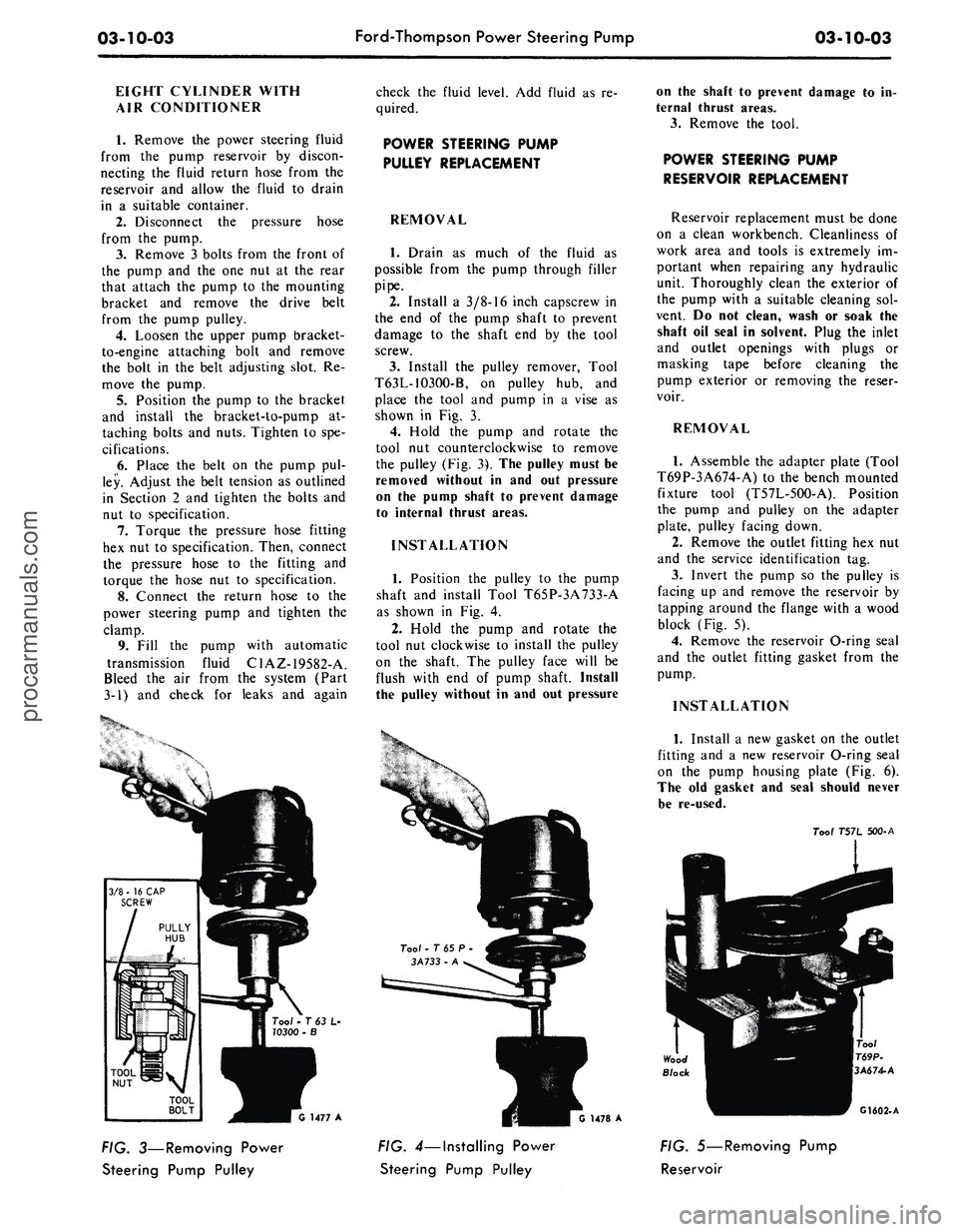
Install the pulley remover, Tool
T63L-1O3OO-B, on pulley hub, and
place the tool and pump in a vise as
shown in Fig. 3.
4.
Hold the pump and rotate the
tool nut counterclockwise to remove
the pulley (Fig. 3). The pulley must be
removed without in and out pressure
on the pump shaft to prevent damage
to internal thrust areas.
INSTALLATION
1.
Position the pulley to the pump
shaft and install Tool T65P-3A733-A
as shown in Fig. 4.
2.
Hold the pump and rotate the
tool nut clockwise to install the pulley
on the shaft. The pulley face will be
flush with end of pump shaft. Install
the pulley without in and out pressure
on the shaft to prevent damage to in-
ternal thrust areas.
3.
Remove the tool.
POWER STEERING PUMP
RESERVOIR REPLACEMENT
Reservoir replacement must be done
on a clean workbench. Cleanliness of
work area and tools is extremely im-
portant when repairing any hydraulic
unit. Thoroughly clean the exterior of
the pump with a suitable cleaning sol-
vent. Do not clean, wash or soak the
shaft oil seal in solvent. Plug the inlet
and outlet openings with plugs or
masking tape before cleaning the
pump exterior or removing the reser-
voir.
REMOVAL
1.
Assemble the adapter plate (Tool
T69P-3A674-A) to the bench mounted
fixture tool (T57L-5OO-A). Position
the pump and pulley on the adapter
plate, pulley facing down.
2.
Remove the outlet fitting hex nut
and the service identification tag.
3.
Invert the pump so the pulley is
facing up and remove the reservoir by
tapping around the flange with a wood
block (Fig. 5).
4.
Remove the reservoir O-ring seal
and the outlet fitting gasket from the
pump.
INSTALLATION
Tool • T 63 L-
10300 -
G 1477 A
FIG. 3—Removing Power
Steering Pump Pulley
1478 A
FIG. 4—Installing Power
Steering Pump Pulley
1.
Install a new gasket on the outlet
fitting and a new reservoir O-ring seal
on the pump housing plate (Fig. 6).
The old gasket and seal should never
be re-used.
Too/
T57L 500-A
G1602-A
FIG. 5—Removing Pump
Reservoirprocarmanuals.com
Page 169 of 413
03-11-01
Eaton Power Steering Pump
03-11-01
PART 3-11 Eaton Power Steering Pump
COMPONENT INDEX
MODEL APPLICATION
3
§>
"o
4
POWER STEERING PUMP
Cleaning and Inspection (See Part 03-01)
Description
N/A
N/A
N/A
N/A
N/A
N/A
N/A
N/A
11-01
N/A
11-01
Disassembly and Overhaul
N/A
N/A
N/A
N/A
N/A
N/A
N/A
N/A
11-03
N/A
11-03
Removal and Installation
N/A
N/A
N/A
N/A
N/A
N/A
N/A
N/A
11-01
N/A
11-01
POWER STEERING PUMP RESERVOIR
Removal and Installation
N/A
N/A
N/A
N/A
N/A
N/A
N/A
N/A
11-01
N/A
11-01
A page number indicates that the item is for the vehicle listed at the head of the column.
N/A indicates that the item is not applicable to the vehicle listed.
l
DESCRIPTION
The roller-type hydraulic pump,
driven by the crankshaft, draws auto-
matic transmission fluid down the res-
ervoir and provides fluid pressure for
the system. Steering gear lubrication
is also provided by the same fluid
from the reservoir. Within the pump
itself is a flow-control and pressure-
relief valve which governs the pres-
sures within the steering system ac-
cording to the varying conditions of
operation. After fluid has passed from
the gear, it returns to the reservoir.
REMOVAL AND INSTALLATION
POWER STEERING PUMP
REMOVAL
1.
Open the hood, and install fend-
er covers.
2.
If the vehicle is equipped with air
conditioning, loosen the compressor
adjusting and support bracket bolts
and remove the drive belt.
3.
Loosen the generator adjusting
and support bracket bolts, and remove
the drive belts.
4.
Remove the fan, pulley, and spa-
cer.
5.
Raise the vehicle.
6. Remove the crankshaft damper
bolt and washer. Remove the damper
with Tool 6306-AG. Remove the drive
key.
7.
Disconnect the pump inlet line at
the pump, and plug the end of the line
to prevent the loss of fluid. Disconnect
the pump pressure line at the pump.
8. Remove the pump-to-engine
front cover cap screws, and remove
the pump. Remove the seal from the
front cover.
INSTALLATION
1.
Install a new seal on the engine
front cover.
2.
Align the slot in the pump rotor
shaft with the drive key in the crank-
shaft, and slide the pump onto the
shaft. Install the pump-to-engine front
cover cap screws. Torque the cap
screws to specification.
3.
Connect the pump inlet line and
the pressure line.
4.
Install the damper drive key,
damper, washer and bolt. Torque the
bolt to specification.
5.
Install the fan, pulley, and spa-
cer. Install the generator drive belts.
Adjust the belt tension, and tighten
the adjusting and support bracket
bolts.
6. If the vehicle is equipped with air
conditioning, install the compressor
drive belt. Adjust the belt tension, and
tighten the adjusting and support
bracket bolts.
7.
Run the engine at idle speed,
and check the fluid level in the reser-
voir. If required, add the specified au-
tomatic transmission fluid. Turn on
the windshield wipers. Rotate the
steering wheel from stop to stop sever-
al times to bleed the air from the sys-
tem. Recheck the fluid level.
POWER STEERING PUMP
RESERVOIR
WITHOUT AIR
CONDITIONING
Removal
1.
Remove the reservoir cover andprocarmanuals.com
Page 170 of 413

03-11-02
Eaton Power Steering Pump
03-11-02
gasket. Withdraw the fluid with a suc-
tion gun.
2.
Remove the reservoir bracket-
to-cylinder block upper cap screw and
the lower cap screw and spacer.
3.
Disconnect the reservoir infet line
and the outlet line at the reservoir,
and remove the reservoir.
Installation
1.
Connect the reservoir-to-pump
line (outlet line) at the reservoir, but
do not tighten the clamp.
2.
Attach the reservoir and bracket
to the cylinder block with the upper
cap screw and the lower cap screw
and spacer. Tighten the cap screws.
3.
Tighten the outlet line clamp at
the reservoir. Connect the reservoir
inlet line to the reservoir.
4.
Fill the reservoir with the speci-
fied automatic transmission fluid. Run
the engine, and bleed the system by
cycling the steering gear with the
windshield wipers turned on. Check
for leaks, and recheck the fluid level.
WITH AIR CONDITIONING
Removal
1. Raise the front of the vehicle.
Remove the reservoir-to-pump line
(outlet line) clamp at the reservoir,
but do not disconnect the line at this
time.
2.
Disconnect the reservoir inlet line
at the reservoir.
3.
Remove the reservoir bracket to
the cylinder block upper cap screw.
Support the reservoir and remove the
lower cap screw and spacer.
4.
With a drain pan under the res-
ervoir, disconnect the outlet line hose
from the reservoir tube and allow the
fluid to drain.
5.
Remove the reservoir cover re-
taining nut and the cover. Position the
cover and the reservoir out of the way
and allow them to rest in the engine
compartment.
6. Lower the front of the vehicle.
Remove the fan shroud.
7.
Remove the reservoir and the
cover by manipulating them through
the opening between the radiator and
the compressor drive belt.
Installation
1.
Position the reservoir in the en-
gine compartment. Loosely attach the
reservoir and bracket to the cylinder
block with the upper cap screw.
2.
Install the fan shroud, then raise
the front of the vehicle.
3.
Connect the reservoir-to-pump
line (outlet line) at the reservoir.
4.
Install the reservoir bracket-
to-cylinder block lower cap screw and
spacer. Tighten both the upper and
the lower cap screws.
5.
Connect the reservoir inlet line at
the reservoir. Install the clamps on
both lines. Lower the car, and install
the reservoir cover and attaching nut.
6. Fill the reservoir with the speci-
fied automatic transmission fluid. Run
the engine, and bleed the system by
cycling the steering gear with the
windshield wipers turned on. Check
for leaks, and recheck the fluid level.
3 MAJOR REPAIR OPERATIONS
INSULATOR (2)
WASHER (2)
MOUNTING BOLT (2)
COVER
BOLT (7)
DOWEL
PIN (2)
ROTOR
ROTOR
SHAFT
COVER
SEAL
PLUG
O RING
VALVE
ASSEMBLY
VALVE
SPRING
INSULATOR
HOUSING
CAM RING
PRESSURE
PLATE
,
PUMP
i
HOUSING
SEAL
ROLL
PIN
INSULATOR
RETAINER
RING
TUBE SEAT
O RING
SCREW
(2)
G12O8-B
FIG.
1
— Power Steering Pumpprocarmanuals.com