1969 FORD MUSTANG air condition
[x] Cancel search: air conditionPage 174 of 413

03-12-03
Wheels And Tires
03-12-03
DISC BRAKES
1.
Raise the vehicle until the wheel
and tire clear the floor.
2.
Pry off the wheel cover and re-
move the grease cap (Fig. 2) from the
hub.
3.
Wipe the excess grease from the
end of the spindle, and remove the ad-
justing nut cotter pin and nut lock.
4.
Loosen the bearing adjusting nut
three turns. Then, rock the wheel,
hub,
and rotor assembly in and out
several times to push the shoe and lin-
ings away from the rotor.
5.
While rotating the wheel, hub,
and rotor assembly, torque the adjust-
ing nut to 17-25 ft-lbs to seat the
bearings (Fig. 4).
6. Back the adjusting nut off one
half turn. Then, retighten the adjust-
ing nut to 10-15 in-lbs with a torque
wrench or finger tight.
7.
Locate the nut lock on the ad-
justing nut so that the castellations on
the lock are aligned with the cotter
pin hole in the spindle.
8. Install a new cotter pin, and
bend the ends of the cotter pin around
the castellated flange of the nut lock.
9. Check the front wheel rotation.
If the wheel rotates properly, install
the grease cap and the hub cap or
wheel cover. If the wheel still rotates
roughly or noisily, clean or replace the
bearings and cups as required.
10.
Before driving the vehicle,
pump the brake pedal several times to
obtain normal brake lining to rotor
clearance and restore normal brake
pedal travel.
BALANCING LIFE
GUARD TIRE
Tires fitted with the Life Guard
Safety Spare are balanced in the same
manner as conventional tires. If an ex-
cessive out of balance condition exists
the following procedure can be used to
correct the condition:
1.
Remove the core housing and de-
flate both air chambers.
2.
Install the core housing.
3.
Unseat the beads of tire with the
bead breakers away from the valve
stem as shown in Fig. 5.
F 1383
FIG. 5—Breaking Top Bead of
Tire From Wheel Rim
4.
Rotate tire casing 90 degrees on
the wheel rim.
5.
Rotate the tire casing back and
forth on the rim to center the valve.
6. Inflate both chambers of the tire
following steps 13 through 15 of the
Tire Installation procedure.
7.
Balance the tire in the normal
manner.
CORRECTING VIBRATION
AND SHAKE-
LIFE GUARD TIRE
The condition of excessive vibration
and shake is generally the result of an
incorrect pressure relationship between
the inner and outer air chambers that
may cause the life guard to shift posi-
tion within the tire. The following
procedure should be used to correct
vibration and shake conditions:
1.
Check pressure of the inner and
outer air chambers on all four tires.
2.
If the inner chamber has at least
five psi more pressure than the outer
chamber the pressures should be ad-
justed and the tires rebalanced if nec-
essary.
3.
If the pressures of the inner and
outer air chambers are equal the Air
Container is leaking. To repair the
leaking air container the recommend-
ed procedures for the removal, repair
of air container, mounting, and bal-
ancing should be followed.
REMOVAL AND INSTALLATION
HOISTING INSTRUCTIONS
Damage to steering linkage compo-
nents and front suspension struts may
occur if care is not exercised when po-
sitioning the hoist adapters of 2 post
hoists prior to lifting the vehicle.
If a 2 post hoist is used to lift the
vehicle, place the adapters under the
lower arms or the No. 1 crossmember.
Do not allow the adapters to contact
the steering linkage. If the adapters
are placed under the crossmember, a
piece of wood (2x4x16 inches) should
be placed on the hoist channel be-
tween the adapters. This will prevent
the adapters from damaging the front
suspension struts.
WHEELS AND TIRES
WHEEL AND TIRE
REMOVAL
1.
Pry off the wheel hub cap or
wheel cover. Loosen but do not re-
move the wheel hub nuts.
2.
Raise the vehicle until the
wheel and tire clear the floor.
3.
Remove the wheel hub nuts
from the bolts, and pull the wheel
and tire from hub and drum.
F1424-
A
FIG.
6—Bead
Loosening Tool
REMOVING CONVENTIONAL
TIRE FROM WHEEL
The tire can be demounted on a
mounting machine. Be sure that the
outer side of the wheel is positioned
downward. If tire irons are used, fol-
low the procedure given here.
1.
Remove the valve cap and core,
and deflate the tire completely.
2.
With a bead loosening tool,
break loose the tire side walls from
the wheel (Fig. 6).
3.
Position the outer side of the
wheel downward, and insert two tire
irons about eight inches apart between
the tire inner bead and the back side
of the wheel rim. Use only tire irons
with rounded edges or irons designed
for removing tubeless tires.
4.
Leave one tire iron in position,
and pry the rest of the bead over the
rim with the other iron. Take small
bites with the iron around the tire inprocarmanuals.com
Page 239 of 413

04-04-08
Rear Axle — Ford Light-Duty (WER)
04-04-08
E 1577-A
75—Pinion Bearing
Cup
Installation—Typical
2.
Remove
the
bolts that attach
the
ring gear
to the
differential case. Press
the ring gear from
the
case
or tap it
off with
a
soft-faced hammer.
PARTS REPAIR
OR
REPLACEMENT
Clean
and
inspect
all the
parts
as
outlined
in
Cleaning
and
Inspection,
Part 4-1, Section
3 of
this Shop
Man-
ual.
Before assembling
the
carrier,
re-
pair
or
replace
all
parts
as
indicated
by
the
inspection.
The
principle
re-
placement operations
are
covered
in
the following procedures.
All
other
re-
pair
or
replacement operations
are
performed during
the
Cleaning
and
Inspection, Part 4-1, Section
3
opera-
tions noted above,
or
during
the as-
sembly
in
this section.
PINION BEARING CUPS
Do
not
remove
the
pinion bearing
cups from
the
carrier casting unless
the cups
are
worn
or
damaged.
If
the
pinion bearing cups
are to be
replaced, drive them
out of the
carrier
casting with
a
drift.
Tap on the
side
opposite
the cup. Use
care
to
prevent
the cups from cocking
in the
carrier.
Install
the new
cups with
the
tool
shown
in Fig. 15.
Make sure
the
cups
are properly seated
in
their bores.
If a
0.0015-inch feeler gauge
can be
insert-
ed between
a cup and the
bottom
of
its bore
at any
point around
the cup,
the
cup is not
properly seated.
Whenever
the
cups
are
replaced,
the
cone
and
roller assemblies should also
be replaced.
DRIVE PINION
AND
GEAR
SET
Individual differences
in
machining
the carrier casting
and the
gear
set re-
quire
a
shim between
the
pinion rear
bearing cone
and the
pinion gear
to
locate
the
pinion
for
correct tooth
contact with
the
ring gear.
When replacing
a
ring gear
and pin-
ion
it
should
be
noted that
the
original
factory installed shim
is of the
correct
thickness
to
adjust
for
individual vari-
ations
in
both
the
carrier casting
di-
mension
and in the
original gear
set
dimension; therefore,
to
select
the cor-
rect shim thickness
for the new
gear
set
to be
installed, follow these steps:
1.
Use a
micrometer
to
measure
the thickness
of the
original shim
re-
moved from
the
axle
and use the
same
thickness upon installation
of the re-
placement carrier assembly
or
drive
pinion.
If
further shim change
is nec-
essary,
it
will
be
indicated
in the
tooth
pattern check.
2.
If the
original shim
is
lost,
sub-
stitute
a
nominal shim
for the
original
and
use the
tooth pattern check
to de-
termine
if
further shim changes
are re-
quired. Nominal shim thicknesses
is
indicated
in
Part
4-3,
Specifications.
A
new
ring gear
and
pinion should
always
be
installed
in an
axle
as a
matched
set
(never separately).
Be
sure
the
same identifying (matching)
number, painted, appears
on the
bolt
hole face
of the
ring gear
and on the
head
of the
drive pinion
(Fig. 16).
3.
After determining
the
correct
shim thickness
as
explained
in the
foregoing steps, install
the new
pinion
and ring gear
as
outlined under
As-
sembly which follows
in
this section.
MATCHED
GEAR
SET
IDENTIFICATION
E 1628-A
. ?6—Pinion
and
Ring Gear
Markings
3ress
Ro-
Tool
T57L-4221-A-1
DIFFERENTIAL
BEARING CONE
ANC ROLLER
|E 1579-A
PIG. 77—Differential Bearing
Installation
DIFFERENTIAL CASE,
BEARINGS,
AND
DRIVEN
GEAR
If
the
ring gear runout check
(be-
fore disassembly) exceeded specifica-
tions,
the
condition
may be
caused
by
a warped gear,
a
defective case,
or ex-
cessively worn differential bearings.
To determine
the
cause
of
excessive
runout, proceed
as
follows:
1.
Press
the
original bearings
on
the one-piece differential case hubs
without
the
ring gear installed.
2.
Place
the
differential bearing
cups
on the
bearing cone
and
roller
and
set the
differential case
in the car-
rier.
3.
Install
the
matched (marked)
bearing caps
and
adjusting nuts
as
outlined
in
steps
11
thru
14
under
In-
stallation
of
Drive Pinion
and
Differ-
ential Case which follows
in
this
sec-
tion.
4.
Tighten
the
left adjuster
nut
until
it just touches
the
bearing
cup
then
tighten
the nut two
notches beyond
the point where
it
first contacts
the
bearing
cup.
Rotate
the
differentialprocarmanuals.com
Page 268 of 413

06-01-02
General Transmission Service
06-01-02
REAR SEAL REPLACEMENT
1.
Remove the drive shaft.
2.
Remove the seal from the exten-
sion housing with the tool shown in
Fig. 2.
3.
Install the new seal in the exten-
sion housing with the tool shown in
Fig. 3.
4.
Install the drive shaft.
.REAR OIL SEAL
Tool-T61L-7657-A
EXTENSION HOUSING
C 1830.A
FIG. 3—Installing Extension
Housing Seal
Too/-7J75-AB
Tool-TSOT-lOO-A
FIG. 2—Removing Extension Housing Seal
EXTENSION HOUSING
Tool-T52L-7000-GAE
or 7000-G
C1O28-D
FIG. 4—Removing Extension
Housing Bushing and Seal
EXTENSION HOUSING
D
1927. A
Tool—T57P-7697-B
57-G
BUSHING
C 1832.A
FIG. 5—Installing Extension
Housing Bushing
REAR BUSHING AND SEAL
REMOVAL AND INSTALLATION
1.
Remove the drive shaft from the
vehicle.
2.
Insert the tool shown in Fig. 4
into the extension housing until it
grips on ihe front side of the bushing.
3.
Turn the screw clockwise until
the seal and the bushing are free of
the housing.
4.
Drive a new bushing into the ex-
tension housing with the tool shown in
Fig. 5.
5.
Install a new seal in the housing
as shown in Fig. 3.
6. Install the drive shaft.
LUBRICATION
Lubricant level should be even with
the bottom of the filler hole at the
right side of the transmission case.
CLEANING AND INSPECTION
CLEANING
1.
Wash all parts, except the ball
bearings and seals in a suitable clean-
ing solvent. Brush or scrape all foreign
matter from the parts. Be careful not
to damage any parts with the scraper.
Do not clean, wash or soak transmis-
sion seals in cleaning solvents. Dry all
parts with compressed air.
2.
Rotate the ball bearings in a
cleaning solvent until all lubricant is
removed. Hold the bearing assembly
to prevent it from rotating and dry it
with compressed air.
3.
Lubricate the bearings with ap-
proved transmission lubricant and
wrap them in a clean, lint-free cloth
or paper until ready for use.
4.
Clean the magnet welded to the
bottom of the case with kerosene or
mineral spirits.
INSPECTION
1.
Inspect the transmission case for
cracks, worn or damaged bearings
bores,
damaged threads or any other
damage that could affect the opera-
tion of the transmission.
2.
Inspect the front face of the case
for small nicks or burrs that could
cause misalignment of the transmis-
sion with the flywheel housing. Re-
move all small nicks or burrs with a
fine stone.
3.
Replace a cover that is bent or
distorted. Make sure that the vent
hole in the cover is open.
4.
Check the condition of the shift
levers, forks, shift rails and the lever
and shafts.
5.
Examine the ball bearing races
for cracks, wear or roughness. Inspect
the balls for looseness, wear, end play
or other damage. Check the bearings
for looseness in the bores. If any of
these conditions exist, replace the
bearings.
6. Replace roller bearings that are
broken, worn or rough.
7.
Replace the countershaft (clust-
er) gear if the teeth are chipped, brok-
en or worn. Replace the countershaft
if it is bent, scored or worn.
8. Replace the reverse idler gear or
sliding gear if the teeth are chipped,
worn or broken. Replace the idler
gear shaft if bent, worn or scored.
9. Replace the input shaft and gear
if the splines are damaged or if the
teeth are chipped, worn or broken. If
the roller bearing surface in the bore
of the gear is worn or rough, or if the
cone surface is damaged, replace the
gear and the gear rollers.
10.
Replace all other gears that areprocarmanuals.com
Page 297 of 413

07-01-06
General Transmission Service
07-01-06
MAKE MARK HERE
BELLOWS INTACT
BELLOWS FAILED
FIG. 9—Checking Vacuum Unit Bellows
tester equipped with a vacuum pump
(Fig. 8). Set the regulator knob so
that the vacuum gauge reads 18 inches
with the end of the vacuum hose
blocked off.
Then connect the vacuum hose to
the transmission vacuum unit. If the
gauge still reads 18 inches, the vacuT
urn unit diaphragm is not leaking. As
the hose is removed from the trans-
mission vacuum unit, hold a finger
over the end of the control rod. When
the hose is removed, the internal
spring of the vacuum unit should push
the control rod outward.
ALTITUDE
COMPENSATING-TYPE
The vacuum diaphragm should be
checked for ruptured or damaged bel-
lows.
Check the diaphragm assembly
as follows:
1.
Remove the diaphragm and
throttle valve rod from the transmis-
sion.
2.
Insert a rod into the diaphragm,
making sure that the rod is buttonec
in the hole. Make a reference mark on
the rod where it enters the diaphragm
hole.
3.
Hold the assembly in such a way
that the end of the rod is resting on
the weighing surface of a scale (Fig.
9).
4.
Gradually press down on the dia-
phragm assembly until the rod is
pressed into the diaphragm body. If
the reference mark on the rod is still
visible with 12 pounds of force regis-
tered on the scale, the bellows are in-
tact. If the mark disappears before 4
pounds of force is exerted, the bellows
have failed and the diaphragm must
be replaced. If the bellows are intact,
then perform various pressure checks.
SHIFT POINT CHECKS
Check the minimum throttle up-
shifts in D. The transmission should
start in first gear, shift to second, and
then shift to third, within the shift
points specified in the specification
section.
While the transmission is in third
gear, depress the accelerator pedal
through the detent (to the floor). The
transmission should shift from third to
second or third to first, depending on
the vehicle speed.
Check the closed throttle downshift
from third to first by coasting down
from about 30 mph in third gear. The
shift should occur within the limits
specified in the specification section.
When the selector lever is at 2, the
transmission can operate only in sec-
ond gear.
With the transmission in third gear
and road speed over 30 mph, the
transmission should shift to second
gear when the selector lever is moved
from D to 2 to 1. The transmission
will downshift from second or third to
first gear when this same manual shift
is made below approximately 25 mph
with a C4 transmission, 30 mph with
D 1791.A
a C6 transmission or 35 mph with an
FMX transmission. This check will
determine if the governor pressure and
shift control valves are functioning
properly.
During the shift point check opera-
tion, if the transmission does not shift
within specifications or certain gear
ratios cannot be obtained, refer to the
Ford Car and Truck Diagnosis Manu-
al to resolve the problem.
AIR PRESSURE CHECKS
A NO DRIVE condition can exist,
even with correct transmission fluid
pressure, because of inoperative
clutches or bands. Erratic shifts could
be caused by a stuck governor valve.
The inoperative units can be located
through a series of checks by subst-
ituting air pressure for the fluid pres-
sure to determine the location of the
malfunction.
To make the air pressure checks,
drain the transmission fluid and re-
move the oil pan and the control valve
body assembly. The inoperative units
can be located by introducing air pres-
sure into the transmission case passa-
ges leading to the clutches, servos, and
governor (Figs. 10, 11 or 12).
HYDRAULIC SYSTEM BENCH
TESTS (FMX TRANSMISSION)
After the transmission has been as-
sembled and is ready for installationprocarmanuals.com
Page 299 of 413

07-01-08
General Transmission Service
07-01-08
3.
Install the bench testing tool on
the transmission.
4.
Remove the
1/8-inch
pipe plug
at the transmission case. Turn the
front pump in a clockwise direction at
75-100 rpm until a regular flow of
transmission fluid leaves the hole in
the transmission case. This operation
bleeds the air from the pump.
5.
Install the pressure gauge (77820
or T57L-77820-A) as shown in Fig.
13.
PRESSURE TESTS
Turn the front pump at 75-100 rpm
and note the gauge readings. The
pressure readings on the bench test
must be within the limits as outlined
in Figure 13, for the engine idle check.
If pressure gauge readings are with-
in limits in all selector lever positions,
install the vacuum diaphragm control
rod unit.
COMMON ADJUSTMENTS AND REPAIRS
TRANSMISSION FLUID DRAIN
AND REFILL
Normal maintenance and lubrica-
tion requirements do not necessitate
periodic automatic transmission fluid
changes.
If a major repair, such as a clutch
band, bearing, etc., is required in the
transmission, it will have to be re-
moved for service. At this time the
converter, transmission cooler and
cooler lines must be thoroughly
flushed to remove any dirt.
When filling a dry transmission and
converter, install five quarts of fluid.
Start the engine, shift the selector
lever as outlined below, and check and
add fluid as necessary.
Following are the procedures for
partial drain and refill due to in-
vehicle repair operation.
C4 TRANSMISSION
1.
On PEA models, disconnect the
fluid filler tube from the transmission
oil pan to drain the fluid.
On PEB and PEE models, loosen
the pan attaching bolts to drain the
fluid from the transmission.
2.
When the fluid has stopped
draining from the transmission, re-
move and thoroughly clean the pan
and the screen. Discard the pan gas-
ket.
3.
Place a new gasket on the pan,
and install the pan on the transmis-
sion.
4.
On PEA models, connect the
filler tube to the pan and tighten the
fitting securely.
5.
Add three quarts of fluid to the
transmission through the filler tube.
6. Run the engine at idle speed for
about two minutes, and then run it at
fast idle speed (about 1200 rpm) until
it reaches it's normal operating temp-
erature. Do not race the engine.
7.
Shift the selector lever through
all the positions, place it at P, and
check the fluid level. The fluid level
should be above the ADD mark. If
necessary, add enough fluid io the
transmission to bring the level be-
tween the ADD and FULL marks on
che dipstick. Do not overfill the trans-
mission.
FMX OK C6
TRANSMISSION
1.
Raise the vehicle on a hoist or
jack stands.
2.
Place a drain pan under the
transmission.
3.
Loosen the pan attaching bolts
to drain the fluid from the transmis-
sion.
4.
After the fluid has drained to the
level of the pan flange, remove the
rest of the pan bolts working from the
rear and both sides of the pan to
allow it to drop and drain slowly.
5.
When the fluid has stopped
draining from the transmission, re-
move and thoroughly clean the pan
and the screen. Discard the pan gas-
ket.
6. Place a new gasket on the pan,
and install the pan on the transmis-
sion.
7.
Add three quarts of fluid to the
transmission through the filler tube.
8. Run the engine at idle speed for
about two minutes, and then run it at
fast idle speed (about 1200 rpm) until
it reaches normal operating tempera-
ture.
Do not race the engine.
9. Shift the selector lever through
all the positions, place it at P, and
check the fluid level. The fluid level
should be above the ADD mark. If
necessary, add enough fluid to the
transmission to bring the level be-
tween the ADD and FULL marks on
the dipstick. Do not overfill the trans-
mission.
OIL COOLER TUBE
REMOVAL AND INSTALLATION
When fluid leakage is found at the
oil cooler, the cooler must be re-
placed. Cooler replacement is de-
scribed in the Cooling System Section
of Group 11.
When one or more of the fluid
cooler steel tubes must be replaced,
each replacement tube must be fabri-
cated from the same size steel tubing
as the original line.
Using the old tube as a guide, bend
the new tube as required. Add the
necessary fittings, and install the tube.
After the fittings have been tight-
ened, add fluid as needed, and check
for fluid leaks.
VACUUM DIAPHRAGM
ADJUSTMENT NON-ALTITUDE
COMPENSATING TYPE
The C4 and C6 transmissions are
equipped with an adjustable vacuum
diaphragm assembly. A similar ad-
justable diaphragm has been released
for service with the FMX transmis-
sion. However, the FMX service dia-
phragm is not interchangeable with
that used on C4 and C6 models.
The vacuum diaphragm assembly
has an adjusting screw in the vacuum
hose connecting tube (Fig. 14).
SPRING
SEAT
THIS CLEARANCE CHANGED
BY ADJUSTING SCREW
D1830-A
FIG. 14—Adjustable Vacuum Unit
The inner end of the screw bears
against a plate which in turn bears
against the vacuum diaphragm spring.
All readings slightly high or all
readings slightly low may indicate the
vacuum unit needs adjustment to cor-
rect a particular shift condition.procarmanuals.com
Page 317 of 413

07-02-09
C4 Automatic Transmission
07-02-09
11.
Remove the handle from the se-
lector lever.
12.
Install the selector housing and
lever assembly as shown in Figure 8.
Torque the attaching bolts 4-6 ft-lbs.
13.
Connect the dial indicator light.
14.
Install the pointer back-up
shield on the housing and lever assem-
bly.
15.
Install the dial housing and
tighten the attaching screws.
16.
Install the selector lever handle
and tighten the attaching screw.
17.
Position the selector lever in the
D position.
18.
Raise the vehicle. Install the
transmission manual lever rod to the
selector lever. Adjust the manual link-
age.
19.
Lower the vehicle and check the
transmission operation in each selo:c-
tor lever detent position.
BAND ADJUSTMENT
INTERMEDIATE BAND
1.
Clean all the dirt from the band
adjusting screw area. Remove and dis-
card the locknut.
2.
Install a new locknut on the ad-
justing screw. With the tool shown in
Fig. 13, tighten the adjusting screw
until the tool handle clicks. The tool is
a pre-set torque wrench which clicks
and overruns when the torque on the
adjusting screw reaches 10 ft-lbs.
I D1854-A
FIG. 13—Adjusting Intermediate
Band
Tool-T59P-77370-B
D1855-A
FIG. 14—Adjusting Low-Reverse
Band
3.
Back off the adjusting screw ex-
actly 1 3/4 turns.
4.
Hold the adjusting screw from
turning and torque the lock nut to
specification.
LOW-REVERSE BAND
1.
Clean all the dirt from the band
adjusting screw area. Remove and dis-
card the locknut.
2.
Install a new locknut on the ad-
justing screw with the tools shown in
Fig. 14, tighten the adjusting screw
until the tool handle clicks. The tool is
a pre-set torque wrench which clicks
and overruns when the torque on the
adjusting screw reaches 10 ft-lbs.
3.
Back off the adjusting screw ex-
actly 3 full turns.
4.
Hold the adjusting screw from
turning and torque the lock nut to
specification.
OIL PAN AND CONTROL
VALVE BODY REPLACEMENT
1.
Raise the vehicle so the trans-
mission oil pan is accessible.
2.
Drain the transmission fluid.
If the same fluid is to be used
again, filter the fluid through a 100
mesh screen. Re-use the fluid only if it
is in good condition.
3.
Remove the transmission fluid
pan attaching bolts, pan and gasket.
4.
Remove the valve body-to-case
attaching bolts (Fig. 25). Remove the
valve body from the case and the
transmission inner control levers.
5.
Refer to the Major Repair Oper-
ation for control valve body repair op-
eration.
6. Thoroughly clean and remove all
the gasket material from the pan and
the pan mounting face of the case. In-
stall the valve body to the case, engag-
ing the transmission inner control le-
vers with the valve body manual and
downshift valves.
7.
Install the eight valve body to
case attaching bolts. Torque the bolts
to specification. Operate the external
manual and downshift levers to check
for proper travel of the valve body
manual and downshift valves.
8. Place a new gasket on the pan.
Install the pan and attaching bolts.
Torque the bolts to specification. In-
stall the fluid filler tube if it was re-
moved. Torque the attaching nut to
specifications.
9. Lower the vehicle and fill the
transmission with fluid. Check the
transmission pan area for fluid leak-
age.
INTERMEDIATE SERVO
REPLACEMENT
1.
Raise the vehicle and remove the
four servo cover-to-case attaching
bolts.
2.
Remove the servo cover, gasket,
piston, and piston return spring. Re-
move the piston from the cover (Fig.
45).
3.
Remove the piston seals and
cover gasket.
4.
Install new piston seals on the
piston. Lubricate the piston seals with
clean transmission fluid. Install the
servo piston in the cover.
5.
Install the piston retvrn spring in
the case. Place a new gasicet on the
cover. Install the piston and cover into
the transmissic se. Use two 5/16
18 x 1 1/4 bolts, 180 degrees apart to
position the cover against the case.
6. Install the two servo cover at-
taching bolts. Remove the two 1 1/4
inch bolts and install two attaching
bolts.
Torque the bolts to specifica-
tion.
7.
Adjust the intermediate band.
Lower the vehicle and check the trans-
mission fluid level.
8. If the band can not be adjusted
properly, the struts are not in posi-
tion. Remove the pan and valve body.
Install the struts, valve body, pan, and
adjust the band. Refill the transmis-
sion with fluid.
LOW-REVERSE SERVO
PISTON REPLACEMENT
1.
Raise the vehicle on a hoist.
2.
Loosen the reverse band adjust-
ing screw lock nut. Tighten the reverse
band adjusting screw to 10 ft-lbs tor-
que.
(Tightening the screw will insure
that the band strut will be held against
the case by the band, preventing it
from falling down when the reverse
servo piston assembly is removed).
3.
Remove the four servo cover to
case attaching bolts. Remove the iden-
tification tag and vent tube retaining
clip.
Remove the servo cover and s»»^
from the case.
4.
Remove the servo piston from
the case. The piston seal cannot be re-
placed, without replacing the piston.
The seal is bonded to the piston.
5. To remove the piston from the
stem, insert a small screw driver in the
hole of the piston (Fig. 44). Remove
the piston attaching nut.
6. Position the accumulator spring
and spacer (Fig. 43) on the piston
stem. Make sure the crowned side of
the spring is facing toward the rod.
Install.a new piston on the piston re-
taining shaft. Install the attaching nut.
Torque the nut to specification.procarmanuals.com
Page 350 of 413
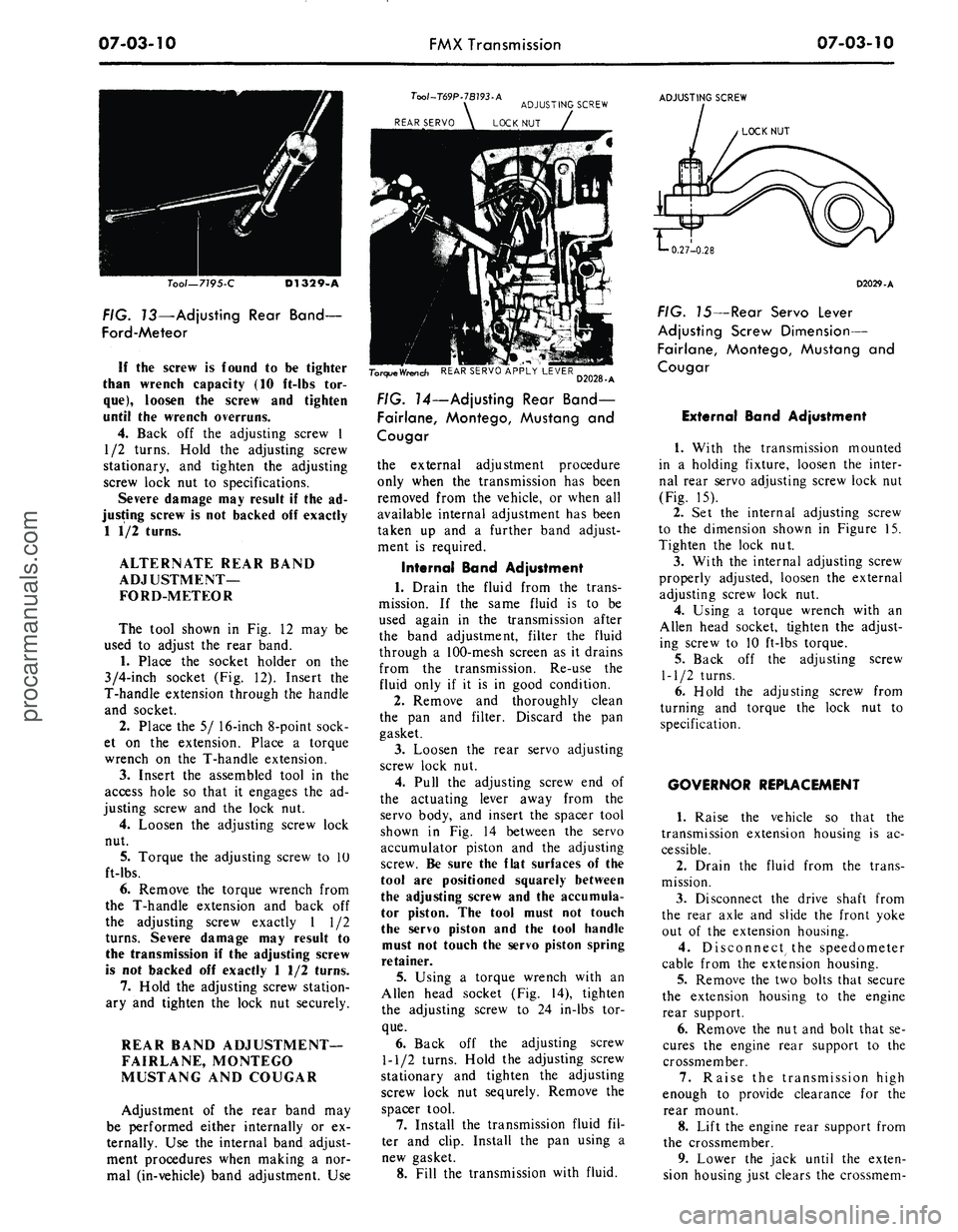
07-03-10
FMX Transmission
07-03-10
Too/-T69P-7B793-A
ADJUSTING SCREW
REAR SERVO \ LOCK NUT
Tool—7795-C
D1329-A
FIG. 13—Adjusting Rear Band—
Ford-Meteor
If
the
screw
is
found
to be
tighter
than
wrench
capacity
(10
ft-lbs
tor-
que),
loosen
the
screw
and
tighten
until
the
wrench
overruns.
4.
Back off the adjusting screw 1
1/2 turns. Hold the adjusting screw
stationary, and tighten the adjusting
screw lock nut to specifications.
Severe damage may result if the ad-
justing screw is not backed off exactly
1 1/2 turns.
ALTERNATE REAR BAND
ADJUSTMENT—
FORD-METEOR
The tool shown in Fig. 12 may be
used to adjust the rear band.
1.
Place the socket holder on the
3/4-inch socket (Fig. 12). Insert the
T-handle extension through the handle
and socket.
2.
Place the 5/ 16-inch 8-point sock-
et on the extension. Place a torque
wrench on the T-handle extension.
3.
Insert the assembled tool in the
access hole so that it engages the ad-
justing screw and the lock nut.
4.
Loosen the adjusting screw lock
nut.
5.
Torque the adjusting screw to 10
ft-lbs.
6. Remove the torque wrench from
the T-handle extension and back off
the adjusting screw exactly 1 1/2
turns.
Severe
damage
may
result
to
the
transmission
if the
adjusting
screw
is
not
backed
off
exactly
11/2
turns.
7.
Hold the adjusting screw station-
ary and tighten the lock nut securely.
REAR BAND ADJUSTMENT—
FAIRLANE, MONTEGO
MUSTANG AND COUGAR
Adjustment of the rear band may
be performed either internally or ex-
ternally. Use the internal band adjust-
ment procedures when making a nor-
mal (in-vehicle) band adjustment. Use
ADJUSTING SCREW
LOCK NUT
I
IN
TorqueWrench REAR SERVO APPLY LEVER
D2028-A
FIG. 14—Adjusting Rear Band—
Fairlane, Montego, Mustang and
Cougar
the external adjustment procedure
only when the transmission has been
removed from the vehicle, or when all
available internal adjustment has been
taken up and a further band adjust-
ment is required.
Internal Band Adjustment
1.
Drain the fluid from the trans-
mission. If the same fluid is to be
used again in the transmission after
the band adjustment, filter the fluid
through a 100-mesh screen as it drains
from the transmission. Re-use the
fluid only if it is in good condition.
2.
Remove and thoroughly clean
the pan and filter. Discard the pan
gasket.
3.
Loosen the rear servo adjusting
screw lock nut.
4.
Pull the adjusting screw end of
the actuating lever away from the
servo body, and insert the spacer tool
shown in Fig. 14 between the servo
accumulator piston and the adjusting
screw.
Be
sure
the
flat
surfaces
of the
tool
are
positioned
squarely
between
the
adjusting
screw
and the
accumula-
tor
piston.
The
tool must
not
touch
the servo
piston
and the
tool
handle
must
not
touch
the
servo
piston
spring
retainer.
5.
Using a torque wrench with an
Allen head socket (Fig. 14), tighten
the adjusting screw to 24 in-lbs tor-
que.
6. Back off the adjusting screw
1-1/2 turns. Hold the adjusting screw
stationary and tighten the adjusting
screw lock nut sequrely. Remove the
spacer tool.
7.
Install the transmission fluid fil-
ter and clip. Install the pan using a
new gasket.
8. Fill the transmission with fluid.
D2029-A
FIG. 15—Rear Servo Lever
Adjusting Screw Dimension—
Fairlane, Montego, Mustang and
Cougar
External Band Adjustment
1.
With the transmission mounted
in a holding fixture, loosen the inter-
nal rear servo adjusting screw lock nut
(Fig. 15).
2.
Set the internal adjusting screw
to the dimension shown in Figure 15.
Tighten the lock nut.
3.
With the internal adjusting screw
properly adjusted, loosen the external
adjusting screw lock nut.
4.
Using a torque wrench with an
Allen head socket, tighten the adjust-
ing screw to 10 ft-lbs torque.
5.
Back off the adjusting screw
1-1/2 turns.
6. Hold the adjusting screw from
turning and torque the lock nut to
specification.
GOVERNOR REPLACEMENT
1.
Raise the vehicle so that the
transmission extension housing is ac-
cessible.
2.
Drain the fluid from the trans-
mission.
3.
Disconnect the drive shaft from
the rear axle and slide the front yoke
out of the extension housing.
4.
Disconnect the speedometer
cable from the extension housing.
5.
Remove the two bolts that secure
the extension housing to the engine
rear support.
6. Remove the nut and bolt that se-
cures the engine rear support to the
crossmember.
7.
Raise the transmission high
enough to provide clearance for the
rear mount.
8. Lift the engine rear support from
the crossmember.
9. Lower the jack until the exten-
sion housing just clears the crossmem-procarmanuals.com