1967 CHEVROLET CAMARO ABS
[x] Cancel search: ABSPage 552 of 659

ELECTRICAL-BODY AND CHASSIS 12-40
Fig.
54 - Seat Separator Instrument Console
consists of a single red light which will indicate an over-
heated engine condition.
Engine Sender Unit Replacement
1.
Drain engine cooling system to a level below unit.
2.
Remove sender unit (located in cylinder head near
an exhaust port on L-6 engines and in the inlet mani-
fold near water pump housing on V-8 engines).
3.
Replace unit, refill cooling system and check opera-
tion of unit.
DIRECTIONAL SIGNAL
Directional signal assemblies provide as standard pro-
duction equipment a lane changing feature and hazard
warning system on all model applications. Two different
design switches are used as shown in Figure 55. Major
difference between the two units is that one type has can-
celling and detent springs which are serviceable, other-
wise both units are not repairable and must be replaced
as an assembly in service.
Due to the integral design relationship of the signal
switch and the energy absorbing steering column, refer-
ence should be made to Steering, Section 9 of this manual
whenever any service operations are performed on the
steering column. The directional signal switch replace-
ment procedures covered in this section are intended to
supplement the detail service operations outlined in Sec-
tion 9.
Special note should be taken of the fact that different
signal flasher units are used in Chevrolet models depend-
ent on the number of lamps to be operated. The hazard
warning unit, even though an integral component of the
directional switch assembly, requires the installation of
an additional flasher unit in the fuse panel capable of op-
CHEVROtET CHASSIS SERVICE MANUAL
Page 562 of 659

ELECTRICAL-BODY AND CHASSIS 12-50
SERVICE OPERATIONS
MOTOR SECTION
DISASSEMBLY
NOTE:
Motor section
may be
disassembled
independently
of
the gear box.
Brush Plate and Circuit Breaker Removal
1.
Scribe
a
reference line along the side of the casting
and end cap to insure proper re-assembly.
2.
Remove the two motor thru bolts.
3.
Feed exposed excess length
of
motor leads thru the
casting grommet
and
carefully back
the
case
and
field assembly plus
the
armature away from
the
casting (fig. 76).
NOTE:
It may be
necessary
to
remove
the
armature end play adjusting screw and insert
a
rod thru
the
opening
in
order to apply pressure
against the end of the armature.
4.
Unsolder
the
black lead from circuit breaker
(fig.
77).
5.
Straighten
out the 4
tabs that secure the brush plate
to the field coil retainers (fig. 77).
CAUTION:
Be
careful
not to
break
any of
the
retainer tabs.
6. Install
"U"
shaped brush retainer clip over brush
holder that has brush lead attached to circuit breaker
(fig. 78).
7.
Holding
the
opposite brush from that retained in Step
6, carefully lift
the
brush holder
off the
mounting
tabs
far
enough
to
clear
the
armature commutator
(fig. 78).
8. Allow
the
brush, held
in
Step
7, to
move out
of its
holder. Remove
the
brush spring
and
lift the brush
holder
off
the armature shaft.
Armature Removal
1.
Follow Steps
1
thru
8
under brush plate removal.
2.
Lift armature out
of
case and field assembly.
3.
Remove thrust ball from
end of
armature shaft
as
PUMP
ASSEMBLY
CAM SLOT
DRIVE PLATE
AND
ASSEMBLY
RELAY SWITCH
ASSEMBLY
WASHER PUMP
DRIVE
PIN
Fig.
75
-
Wiper and Washer
Pump
Mechanism
required and save
for
reassembly.
NOTE: Thrust ball
may be
easily removed
with
a
magnet.
MOUNTING
GROMMET
WASHER PUMP COVER
RETAINING RING
STAKE MARKS -
CASE
TO
FIELD
LAMINA
(4
PLACES)
Fig. 74 - Depressed Park 2-Speed Wiper
Fig. 76 - Wiper Motor Separation
CHEVROLET CHASSIS SERVICE MANUAL
Page 564 of 659

ELECTRICAL-BODY AND CHASSIS 12-52
GEAR MECHANISM
NOT IN PARK
RELAY SWITCH ATTACHING SCREW
Fig.
81 -
Drive Gear not
in
Park Position
TERMINAL BOARD
1 2 3
RELAY LEADS (RED)
SOLDER TO NO. 1 TERMINAL
RELAY
COIL-RED
TAN-SOLDER TO
SAME RELAY SWITCH TERMINAL WITH RED COIL LEAD
BLACK WITH PINK STRIPE
ASSEMBLY
1.
If new field and case assembly is being installed,
splice the black and black with pink stripe leads of
the new field with the corresponding leads of the
wiper.
2.
Install the rubber thrust disc, steel thrust disc and
felt lubricating washer in the case assembly bearing
in the order indicated.
3.
Lubricate end of armature shaft that fits in case
bearing. Next, install thrust ball in end of shaft.
4.
Assemble armature in the case and field assembly.
5.
Position the partially assembled brush plate over the
armature shaft far enough to allow re-assembly of
the remaining brush in its brush holder;- then position
the brush plate assembly on the mounting tabs in the
position shown in Figure 78.
NOTE: Circuit breaker ground lead will not
reach circuit breaker terminal if brush plate is
positioned wrong.
6. Center the brush plate mounting holes over the
mounting tabs and bend the tabs toward the brush
holders as required to secure the brush plate in
position.
CAUTION: Be sure tabs are centered in brush
plate mounting holes.
7.
Remove brush retainer clips and resolder circuit
breaker ground lead to circuit breaker. Refer to
Figure
8. If new case and field assembly'is used, scribe a line
on it in the same location as the one scribed on the
old case. This will insure proper alignment of the
new case with the scribed line made on the housing
(Step
1
under Brush Plate Removal).
9. Position armature worm shaft inside the housing and,
using the scribed reference marks, line up as near
Fig.
82 - Relay Assembly Wiring
Fig.
83 -
Terminal Board Resistor
CHEVROLET CHASSIS SERVICE MANUAL
Page 603 of 659

BUMPERS 14-2
placed in the tab of each bumper bracket. Dial the
adjustment washers in the tabs as required to posi-
tion the bumper at the correct mounted height
3.
Tighten all bolts securely, connect parking lamp wir-
ing, and lower vehicle.
REAR BUMPER ASSEMBLY (Fig. 2)
Removal
1.
Raise and support rear end of vehicle.
2.
Disconnect rear license plate lamp wiring.
3.
On Caprice models, disconnect back-up lamp wiring.
4.
Remove center face bar to frame attaching bolts lo-
cated behind license plate door.
5. Remove bolts from each side "attaching bumper
brackets and braces to frame.
6. Remove bumper from vehicle.
Fig.
1 -
Front Bumper Assembly
-
Chevrolet
FILLER
STAPLE
VIEW
B \ ^7 ^^ B
ALL EXCEPT STATION WAGON
Fig. 2 - Rear Bumper Assembly - Chevrolet
Disassembly
1.
Remove license plate lamp.
2.
On Caprice models, remove
assemblies.
Remove bolts
3.
back-up lamp
each bumper brace to
retaining
bumper.
4.
Remove bolts retaining each bumper bracket to
bumper and separate sections of face bar at joints.
5.
The license plate door (sedan models) and bumper
pads (station wagon models) may be removed by re-
moving the attaching parts shown in Figure 2.
Assembly
On Caprice models, attach both back-up lamps to cen-
ter face bar and tighten bolts firmly. Assemble the rear
bumper following the disassembly procedure in reverse
order. Except for back-up lamp attachments on Caprice
models, install all bolts loosely; do not tighten any bolts
until all bolts are installed.
Installation
1.
Position bumper assembly on vehicle aligning holes
in braces and mounting brackets with those in frame,
2.
Loosely install bolts, lock washers, and nuts includ-
ing center face bar to frame bolts behind license
plate door. Note that eight sided adjustment washers
(fig. 2) are placed in the tab of each bumper mounting
bracket. Dial the adjustment washers in the tabs as
CHEVROLET CHASSIS SERVICE MANUAL
Page 604 of 659

BUMPERS 14-3
required to position the bumper at the correct
mounted height. ,
3.
Tighten all mounting bolts securely and connect li-
cense plate lamp wiring. On Caprice models, con-
nect back-up lamp wiring. Lower vehicle.
GENERAL DESCRIPTION-CHEVELLE
The new front bumper is of a one piece design with the
parking and turn signal lamp assemblies attached to each
outboard end of the bumper.
The rear bumper is also of a one piece design with
provisions for rear gas fill. The back-up lamp assem-
blies are attached near the center of the bumper.
SERVICE OPERATIONS
FRONT BUMPER ASSEMBLY
Removal
1.
Raise and support front of vehicle.
2.
Disconnect parking lamp wiring. -
Fig.
3 - Front Bumper Assembly - Chevelle
Disassembly
1.
Remove bolts attaching braces and brackets to
bumper.
2.
Remove bolts from each parking lamp assembly and
remove parking lamps from bumper.
Assembly
Attach both parking brake lamp assemblies to front
bumper and tighten bolts firmly. Assemble the front
bumper parts by following the disassembly procedure in
reverse order. Except for the parking lamp attachments,
install all bolts loosely; do not tighten any bolts until all
bolts are installed.
Installation
1.
Position the front bumper on the frame horns align-
ing holes in brackets and braces with those in the
frame.
2.
Loosely install bolts, lock washers, and nuts. Note
that eight sided adjustment washer (fig. 3) is placed
in the tab of each mounting bracket. Dial tjie adjust- .
ment washers in the tabs as required to position the
bumper at the correct mounted height.
3.
Tighten all mounting bolts securely, connect the
parking lamp wiring, and lower front of vehicle.
3.
Remove bolts retaining the bumper brackets and
braces to the frame.
4.
Remove bumper assembly from vehicle.
ADJUSTMENT
WASHER
Fig.
4-Rear Bumper Assembly - Chevelle
REAR BUMPER ASSEMBLY (Fig. 4)
Removal
1.
Raise rear end of vehicle.
2.
Disconnect rear license plate lamp and back-up lamp
wiring.
3.
Remove bolts, located behind license plate door, at-
taching face bar reinforcement to frame.
4.
Remove four bolts retaining bumper brackets and
braces to frame.
5. Remove bumper from vehicle.
Disassembly
1.
Remove license plate lamp and back-up lamps from
bumper.
2.
Remove brackets and braces at each end of bumper.
3.
Remove license plate door.
4.
Remove rivets attaching bracket at center of bumper.
Assembly
Attach license plate lamp and back-up lamp assemblies
to bumper; tighten bolts firmly. Assemble the bumper
parts by following the disassembly procedure in the re-
verse order. Except for the license plate lamp and back-
up lamp attachments, install all bolts loosely; do riot
CHEVROLET CHASSIS SERVICE MANUAL
Page 608 of 659

BUMPERS 14-7
only and the distance between inner upper brace and
frame filled in with shims. Bolts may then be installed
to secure brace to frame.
REAR LICENSE PLATE HOUSING
The rear license plate housing may be removed from
the vehicle by removing the license plate and removing
the retaining screws as shown in Figure 9.
Fig.
9- Rear License Plate Housing
GENERAL DESCRIPTION-CAMARO
The Camaro front and rear bumpers are of a single
piece wrap around design. The front license plate bracket
functions as a bumper support between the valance panel
and bumper. Holes in the underside of bumpers, slightly
inboard of lower bumper bracket bolt, provide for new
jack load rest stud for jacking purposes.
SERVICE OPERATIONS
FRONT BUMPER ASSEMBLY (Fig. 10)
Removal
1.
Raise and support front end of vehicle.
2.
Remove bolts securing bumper support brackets to
frame.
3.
Remove bolts, one on each side at fender extension
panels, securing bumper to outer bumper bracket.
4.
Remove screws and nuts securing license plate
bracket to valance panel and remove bumper from
vehicle.
Disassembly
1.
Remove bolts attaching two support brackets to
bumper.
2.
Remove screw and nut securing license plate bracket
to bumper.
Assembly
Assemble the front bumper following the disassembly
procedure in reverse order. Install all bolts loosely; do
not tighten any bolts until all bolts are installed.
Installation
1.
Position assembled bumper on frame horns aligning
holes in bumper brackets with those in frame.
2.
Loosely install bolts, lock washers, and nuts. .Note
3.
the eight sided adjustment washers (fig. 10) are
placed in the tab of each bumper bracket. Dial the
adjustment washers in the tabs as required to posi-
tion the bumper at the correct mounted height.
Tighten all bolts securely and lower vehicle.
REAR BUMPER ASSEMBLY (Fig. 11)
Removal
1.
Raise and support rear end of vehicle.
2.
Remove bolts securing bumper brackets to frame
and rear fenders.
3.
Remove screws securing license plate bracket to
body and remove bumper from vehicle.
Disassembly
1.
Remove bolts securing four support brackets to
bumper.
2.
Remove rivets securing license plate bracket to
bumper.
Assembly
Assemble the rear bumper following the disassembly
procedure in reverse order. Install all bolts loosely; do
not tighten any bolts until all bolts are installed.
CHEVROLET CHASSIS SERVICE MANUAL
Page 620 of 659
ACCESSORIES 15-11
12 VOLTS D.C.
ELECTRIC BRAKE
RELEASE
IGNITION
SWITCH
ENGINE
VACUUM
TRANSDUCER
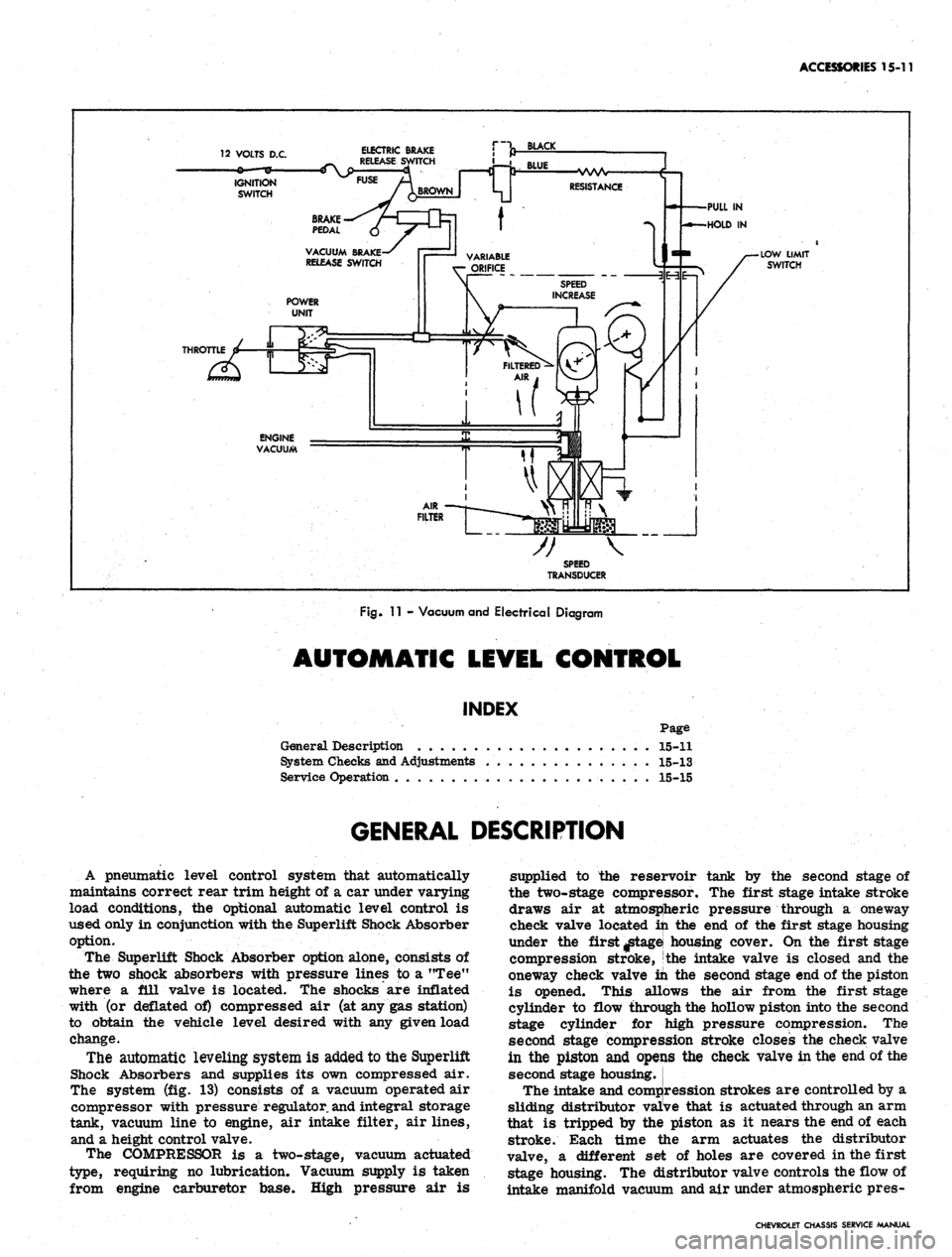
Fig.
11 - Vacuum and Electrical Diagram
AUTOMATIC LEVEL CONTROL
INDEX
Page
General Description . . 15-11
System Checks and Adjustments 15-13
Service Operation . 15-15
GENERAL DESCRIPTION
A pneumatic level control system that automatically
maintains correct rear trim height of a car under varying
load conditions, the optional automatic level control is
used only in conjunction with the Superlift Shock Absorber
option.
The Superlift Shock Absorber option alone, consists of
the two shock absorbers with pressure lines to a "Tee"
where a ill valve is located, the shocks are inflated
with (or deflated of) compressed air (at any gas station)
to obtain the vehicle level desired with any given load
change.
The automatic leveling system is added to the Superlift
Shock Absorbers and supplies its own compressed air.
The system (fig. 13) consists of a vacuum operated air
compressor with pressure regulator,
and
integral storage
tank, vacuum line to engine, air intake filter, air lines,
and a height control valve.
The COMPRESSOR is a two-stage, vacuum actuated
type, requiring no lubrication. Vacuum supply is taken
from engine carburetor base. High pressure air is
supplied to the reservoir tank by the second stage of
the two-stage compressor. The first stage intake stroke
draws air at atmospheric pressure through a oneway
check valve located in the end of the first stage housing
under the first ^tagei housing cover. On the first stage
compression stroke, the intake valve is closed and the
oneway check valve in the second stage end of the piston
is opened. This allows the air from the first stage
cylinder to flow through the hollow piston into the second
stage cylinder for jhigh pressure compression. The
second stage compression stroke closes the check valve
in the piston and opeijis the check valve in the end of the
second stage housing.
The intake and compression strokes are controlled by a
sliding distributor valive that is actuated through an arm
that is tripped by the piston as it nears the end of each
stroke. Each time the arm actuates the distributor
valve, a different set of holes are covered in the first
stage housing. The distributor valve controls the flow of
intake manifold vacuum and air under atmospheric pres-
CHEVROLET CHASSIS SERVICE MANUAL
Page 621 of 659
ACCESSORIES 15-12
VACUUM
(WIT
P
VACUUM Llh
, AIR SUPPt
LINES
t
SUPERLIFT F
SHOCK ABSO
OPERATED AIR COMPRESSOR
H STORAGE TANK AND
RESSURE REGULATORJV
\A
4E FROM ENG«NE^"^
/ \-HEIGHT CONTROL
•^-Z n VALVE (WITH TIME
^*
EAR II
RBERS
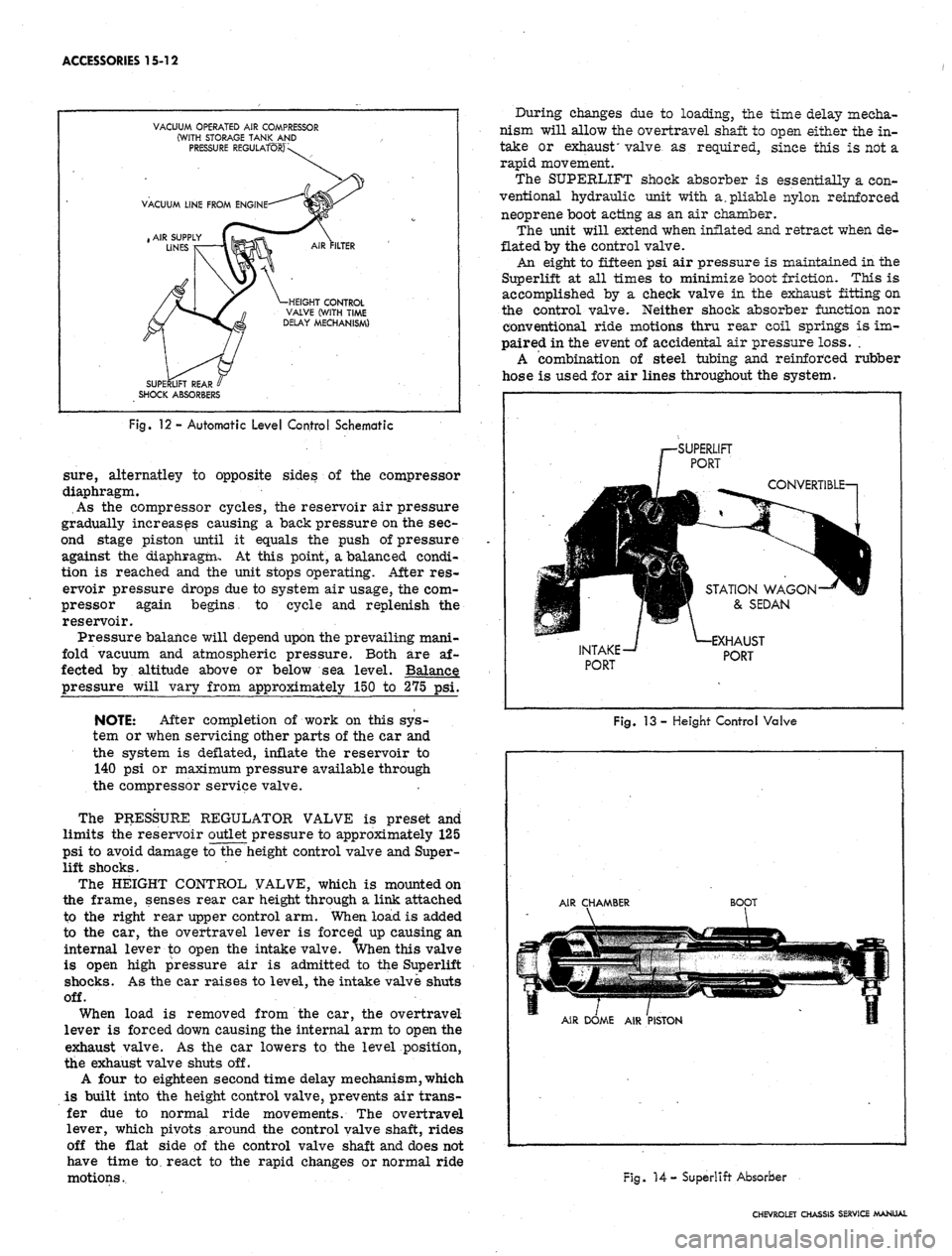
Fig.
12 - Automatic Level Control Schematic
sure,
alternatley to opposite sides of the compressor
diaphragm.
As the compressor cycles, the reservoir air pressure
gradually increases causing a back pressure on the sec-
ond stage piston until it equals the push of pressure
against the diaphragm- At this point, a balanced condi-
tion is reached and the unit stops operating. After res-
ervoir pressure drops due to system air usage, the com-
pressor again begins to cycle and replenish the
reservoir.
Pressure balance will depend upon the prevailing mani-
fold vacuum and atmospheric pressure. Both are af-
fected by altitude above or below sea level. Balance
pressure will vary from approximately 150 to 275 psi.
NOTE: After completion of work on this sys-
tem or when servicing other parts of the car and
the system is deflated, inflate the reservoir to
140 psi or maximum pressure available through
the compressor service valve.
The PRESSURE REGULATOR VALVE is preset and
limits the reservoir outlet pressure to approximately 125
psi to avoid damage to the height control valve and Super-
lift shocks.
The HEIGHT CONTROL VALVE, which is mounted on
the frame, senses rear car height through a link attached
to the right rear upper control arm. When load is added
to the car, the overtravel lever is forced up causing an
internal lever to open the intake valve, when this valve
is open high pressure air is admitted to the Superlift
shocks. As the car raises to level, the intake valve shuts
off.
When load is removed from the car, the overtravel
lever is forced down causing the internal arm to open the
exhaust valve. As the car lowers to the level position,
the exhaust valve shuts off.
A four to eighteen second time delay mechanism, which
is built into the height control valve, prevents air trans-
fer due to normal ride movements. The overtravel
lever, which pivots around the control valve shaft, rides
off the flat side of the control valve shaft and does not
have time to. react to the rapid changes or normal ride
motions.
During changes due to loading, the time delay mecha-
nism will allow the overtravel shaft to open either the in-
take or exhaust' valve as required, since this is not a
rapid movement.
The SUPERLIFT shock absorber is essentially a con-
ventional hydraulic unit with a. pliable nylon reinforced
neoprene boot acting as an air chamber.
The unit will extend when inflated and retract when de-
flated by the control valve.
An eight to fifteen psi air pressure is maintained in the
Superlift at all times to minimize boot friction- This is
accomplished by a check valve in the exhaust fitting on
the control valve. Neither shock absorber function nor
conventional ride motions thru rear coil springs is im-
paired in the event of accidental air pressure loss. .
A combination of steel tubing and reinforced rubber
hose is used for air lines throughout the system.
-SUPERLIFT
PORT
STATION WAGON
& SEDAN
INTAKE
PORT
HAUST
PORT
Fig. 13 - Height Control Valve
AIR CHAMBER
BOOT
AIR DOME AIR PISTON
Fig. 14- Superlift Absorber
CHEVROLET CHASSIS SERVICE MANUAL