1967 CHEVROLET CAMARO radiator cap
[x] Cancel search: radiator capPage 500 of 659

CHASSIS SHEET METAL 11-13
HOOD ADJUSTMENT
The alignment of the hood in relation
to*
other sheet
metal parts is controlled by the position of the hood
hinges and the height of the two bumpers, located one at
each end of the radiator support. The adjustments at
the hood latch must be made after the hinges and bumpers
are positioned to yield the dimensions shown in Figure
17.
Latch adjustments are made so that effort required
to open and close the hood is reasonable, and hood align-
ment obtained by hinge and bumper adjustment is main-
tained when the hood is closed. Note that the hood latch
is not designed or intended to correct basic hood align-
ment faults.
To align the hood and lock, proceed as follows:
HOOD HINGE (Fig. 18)
1.
Note that the mounting holes in the body-mounted
end of the hinge are slotted to provide up and down
movement of the hood assembly while the hood
mounted end is slotted to provide fore and aft move-
ment.
2.
Scribe a mark around the entire hinge plate which
will be involved in the adjustment.
3.
Loosen the appropriate screws and shift the position
of the hood on the hinge plate the approximate amount
to correct misalignment, using the scribed marks to
check amount of movement. Check condition of ad-
justment by tightening cap screws and closing hood.
Fig.
18 - Hood Hinge - Chevy II
Fig.
19 - Hood Lock, Catch and Support - Chevy II
HOOD BUMPERS
Hood bumpers must be adjusted until hood and fender
line up as shown in Figure 17.
HOOD CATCH AND LOCK (Fig. 19)
Hood lock plate mounting holes are slotted to provide
fore and aft adjustment of the hood lock bolt. The hood
lock bolt itself is adjustable for up and down positioning
of the lock bolt head so that its proper engagement in the
latch assembly may be provided for. The distance that
the lock bolt protrudes out of the lock plate should be
adjusted so that the hood bumpers are slightly com-
pressed by the fully latched hood and so that the effort
required to release the hood catch is reasonable.
FENDER ADJUSTMENT (Figs. 17 and 20)
DO NOT CHANGE SKIRT ASSEMBLY-TO-DASH SHIM-
MING IN AN EFFORT TO ADJUST THE DOOR-TO-
FENDER GAP OR ANY OTHER SHEET METAL AP-
PEARANCE ITEM.
The front fenders are shimmed independently of the
skirt assemblies, unlike conventional- vehicles on which
almost the entire front end sheet metal assembly is
shimmed and adjusted as a unit.
Figure 20 shows the locations of front fender shims.
1.
The rocker panel extension location allows adjust-
ment to make fender outer surface flush with door
outer surface.
2.
The upper or plenum chamber location provides a
means of adjusting fender upper surface so that it
is flush with the upper surface of the cowl.
3.
The locations atop the skirt assembly are shimmed
to close the gap created between the fender mounting
flange and skirt assembly when the plenum chamber
CHEVROLET CHASSIS SWVICE MANUAL
Page 501 of 659
CHASSIS SHEET METAL 11-14
location is shimmed; thus keeping the fender mount-
ing bolts from crushing in the fender mounting
flange.
If shimming is done without the fenders being disas-
asembled, it is suggested that fender mounting bolts
rearward of radiator support be loosened while shims
are inserted and sheet metal fit is checked. Tighten
shimmed mounting bolts first, then all others.
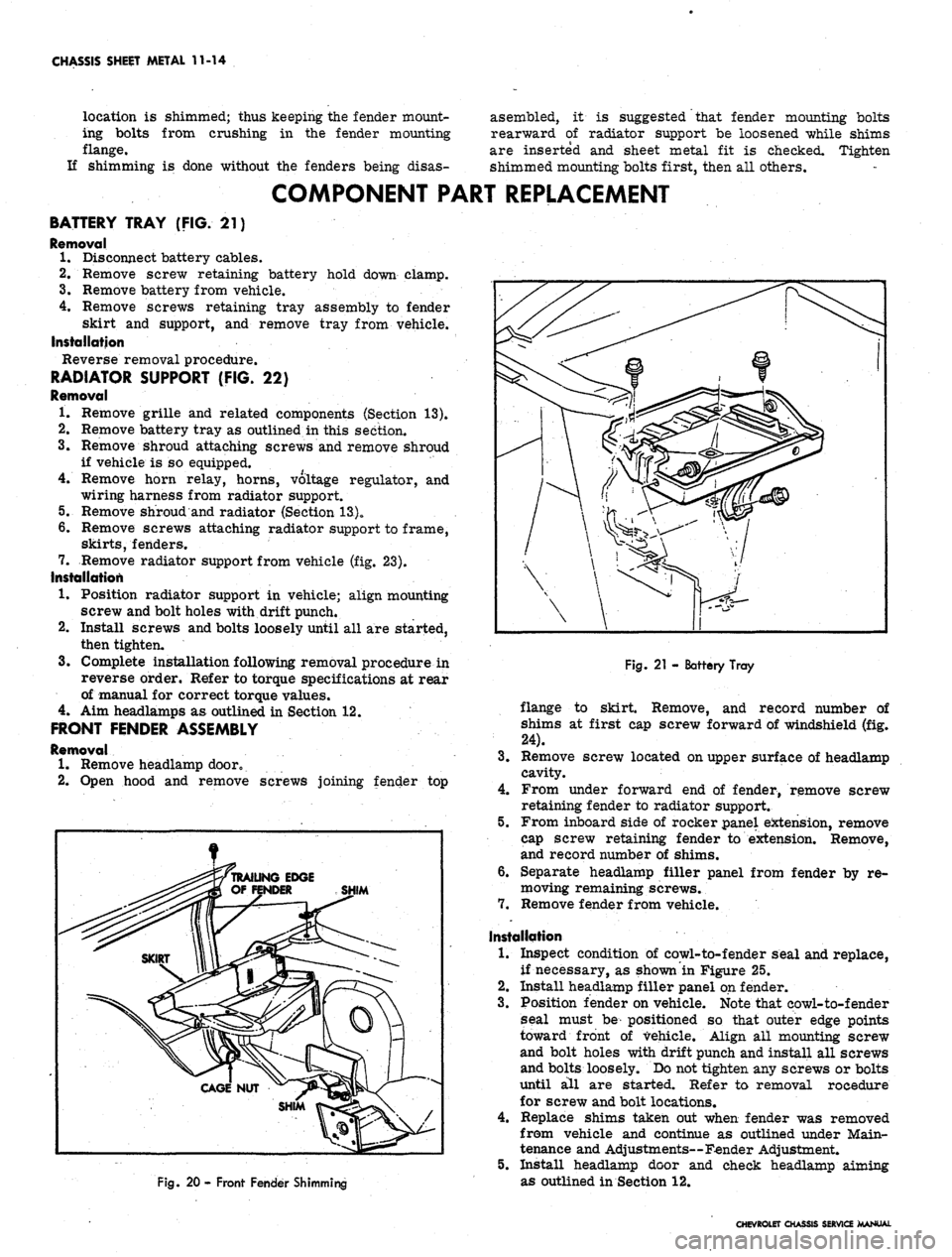
COMPONENT PART REPLACEMENT
BATTERY TRAY (FIG. 21)
Removal
1.
Disconnect battery cables.
2.
Remove screw retaining battery hold down clamp.
3.
Remove battery from vehicle.
4.
Remove screws retaining tray assembly to fender
skirt and support, and remove tray from vehicle.
Installation
Reverse removal procedure.
RADIATOR SUPPORT (FIG. 22)
Removal
1.
Remove grille and related components (Section 13).
Remove battery tray as outlined in this section.
Remove shroud attaching screws and remove shroud
if vehicle is so equipped.
Remove horn relay, horns, voltage regulator, and
wiring harness from radiator support.
Remove shroud and radiator (Section 13)o
Remove screws attaching radiator support to frame,
skirts,
fenders.
Remove radiator support from vehicle (fig. 23).
Installation
1.
Position radiator support in vehicle; align mounting
screw and bolt holes with drift punch.
Install screws and bolts loosely until all are started,
then tighten.
3.
Complete installation following removal procedure in
reverse order. Refer to torque specifications at rear
of manual for correct torque values.
4.
Aim headlamps as outlined in Section 12.
FRONT FENDER ASSEMBLY
Removal
1*
Remove headlamp dooro
2.
Open hood and remove screws joining fender top
2.
Fig. 20 - Front Fender Shimming
Fig.
21 - Battery Tray
flange to skirt. Remove, and record number of
shims at first cap screw forward of windshield (fig.
24).
3.
Remove screw located on upper surface of headlamp
cavity.
4.
From under forward end of fender, remove screw
retaining fender to radiator support.
5.
From inboard side of rocker panel extension, remove
cap screw retaining fender to extension. Remove,
and record number of shims.
6. Separate headlamp filler panel from fender by re-
moving remaining screws.
7.
Remove fender from vehicle.
Installation
1.
Inspect condition of cowl-to-fender seal and replace,
if necessary, as shown in Figure 25.
2.
Install headlamp filler panel on fender.
3.
Position fender on vehicle. Note that eowl-to-fender
seal must be positioned so that outer edge points
toward front of vehicle. Align all mounting screw
and bolt holes with drift punch and install all screws
and bolts loosely. Do not tighten any screws or bolts
until all are started. Refer to removal rocedure
for screw and bolt locations.
4.
Replace shims taken out when fender was removed
from vehicle and continue as outlined under Main-
tenance and Adjustments—Fender Adjustment.
5.
Install headlamp door and cheek headlamp aiming
as outlined in Section 12.
CHEVROLET CHASSIS SERVICE MANUAL
Page 506 of 659

5.
6.
7.
8.
2.
Install all fender mounting screws, replacing original
shimming. Refer to removal procedure for screw
location.
3.
Install hydraulic lines at main cylinder and right
hand skirt. Install fuel line at right hand skirt.
4.
Install steering gear as outlined in Section 9. Do
not fail to perform adjustment procedure listed under
Mast Jacket - Installation.
CAMARO
INDEX
Page
General Description 20
Maintenance and Adjustments 20
Hood / . 20
Hinge 20
Bumpers ' . . . 20
Catch Assembly 21
Lock . 21
Fenders 21
Sheet Metal 22
CHASSIS SHEET METAL 11-19
Install pitman arm as outlined in Section 9 under
Maintenance and Adjustments - Steering Gear Ad-
justments.
Remove jack stands and jack.
Bleed brakes as outlined in Section 5.
Perform body alignment as outlined in Fisher Body
Service Manual.
Page
Component Part Replacement . 22
Battery Tray 22
Radiator Support 22
Fender and Skirt Assembly 22
Hood Assembly . 22
Lock and Catch Assembly 22
Trim and Insulation . . . 24
Cowl Vent Grille . . 24
Fig.
32 - Front End Sheet Metal - Camaro
1.
Fender
2.
Hood Hinge
3. Hood
4.
Cowl Vent Grille
5. Trim
6. Molding
7. Fender Extension
8. Bumper Bracket
9. Valance Pane!
10.
Header Panel
11.
Radiator Support
12.
Radiator
13.
14.
15.
Shroud
Hood Lock
Radiator Cap
16.
17.
18.
Bracket (V-8
Hood Catch
Brace
Engine
Only)
19.
20.
21.
Skirt
Seal
Battery
Tray
CHEVROLET CHASSIS SERVICE MANUAL
Page 513 of 659

SECTION 12
ELECTRICAL-BODY AND CHASSIS
CONTENTS
OF
THIS
SECTION
Page
Page
System 12-1
Instruments and Gauges 12-21
Directional Signal 12r40
Windshield Wipers and Washers 12-44
Wiring Diagrams 12-56
Special Tools 12-60
LIGHTING SYSTEM
INDEX
Page
General Description
!2-i
Maintenance and Adjustments
•.................. 12-2
Headlamp Adjustment......................
12-3
Headlamp Panel Travel Adjustment.
12-5
Service Operations.
. . .. 12-5
Front Lighting
12-5
Headlamp
. 12_5
Parking Lamp
12-5
Fender Lamp
. 12_^
Headlamp Panel
12-8
Headlamp Panel Motor
^2-9
Rear Lighting
l2-10
Tail, Stop and Directional Lamps
12-10
Page
Backing Lamps
12-14
License Plate Lamp
12-14
Automatic Transmission Quadrant Lamp
12-14
Seat Separator Console Lamps
. 12-15
Lighting Switch
. . 12-15
Wiper Switch.
12-15
Stoplight Switch
12-15
Dimmer Switch
12-15
Backing Lamp Switches
12-15
Neutral Safety Switches
12-17
Parking Brake Alarm Switch
................. 12-19
Instrument Panel Compartment Lamp/Switch
12-19
Cirgarette Lighter
12-19
GENERAL DESCRIPTION
.
The lighting system includes: the main lighting switch,
stop light, dimmer, and backing lamp switches, head-
lamps, parking lamps, stop, tail and directional lamps,
instrument illumination and indicator lamps, and the
necessary wiring to complete the various circuits. A
fuse panel provides convenient power take offs and fuse
clips for the appropriate circuits (fig. 1).
Chevrolet and Chevelle headlamp installation is all
new in that the headlamps are located in the radiator
support with adjusting screws and springs. Eliminating
the need for having separate headlamp housings. Chev-
rolet and Chevelle headlamp retainers and springs are
interchangeable.
Chevy n headlamp housings are new because of revised
front end styling and Corvette front end lighting is basi-
cally carryover.
Front fender lamps have been added as an option for
Chevrolet models and as standard equipment on Caprice
series.
Camaro models use single headlamps and the Rally
Sport model headlamps are covered by a retractable
section of the grille when lamps are not used. The sec-
tion of the grille covering the headlamps folds back when
lights are required; the headlamps are stationary. The
covering is retracted by a small electric motor mounted
to the headlamp housing. The headlamps are automat-
ically uncovered when the headlight switch is pulled "ON"
for illumination. If at any time the electrical circuit
becomes inoperative, the lamps can be uncovered manu-
ally. The ignition switch must be
"ON"
in order to close
the headlamp doors.
Parking lamp for Chevelle and Chevrolet models are
new due to revised front end sheet metal and bumper
styling. Parking lamps are located in the bumper on
Chevrolet, Chevelle and Chevy n models
Camaro parking lamps are located in the radiator
grille except for the Rally Sport models on which the
parking lamps are in the valance panel. For styling
reasons, the lens is white and an amber glass bulb is
used. All Camaro parking lamps require a separate
ground wire to assure a good ground contact because of
the plastic grille and painted contact surfaces.
The Chevrolet tail, stop, and directional lamps are in
one housing with a three section lens design on Impala
and Caprice sedans. The center lens for Impala series
is the back-up lamp. The center lens on the Caprice is
a tail lamp with the back-up lamps being located in the
rear bumper. Chevrolet station wagons have three indi-
vidual housings with three lenses, the center lamp being
the back-up. Biscayne and Bel-Air sedans have a single
housing and lens for tail, stop, and directional lamp with
a similarly constructed back-up lamp inboard and adja-
cent to it.
Chevelle tail, stop, and directional lamps are a single
lens design that follows through with the rear fender
styling. The back-up lamp is located in r.ear bumper.
Camaro models except Rally Sport have tail lamps
with integral back-up lamps mounted inboard of the rear
fenders between the trunk opening and bumper. The
Rally Sport model has dual tail lamps in the rear housing
and valance mounted back-up lamps.
Corvette, Chevy n, and Corvair tail and directional
signal lights are carryover. The Corvette has new back-
up lamps center mounted above the license plate opening.
CHEVROLET CHASSIS SERVICE
Page 594 of 659

SECTION 13
RADIATOR AND GRILLE
INDEX
Page Page
General Description 13-1 Repairs 13-4
Radiator and Shroud-All Vehicles (Except Corvette) . . . . 13-1 Installation 13-4
Removal 13-1 Grille Assembly - Chevy II 13-4
Installation 13-1 Removal . 13-4
Radiator and Fan Shroud - Corvette . . . . 13-1 Repairs 13-5
Fan Shroud Replacement 13-1 Installation . 13-5
Aluminum Radiator 13-1 Grille Assembly - Corvette 13-5
Copper Radiator . 13-1 Removal . . . . 13-5
Grille Assembly - Chevrolet 13-2 Installation ....*... 13-5
Removal 13-2 Grille Assembly - Caxnaro 13-5
Repairs 13-3 Removal 13-5
Installation 13-3 Repairs . 13-6
Grille Assembly - Chevelle 13-3 Installation . . 13-6
Removal 13-.Q
GENERAL DESCRIPTION
Radiator assemblies are attached by cap screws either the radiator and shroud are basically the same for each
to the radiator support or radiator shroud, depending on vehicle,
the engine installation of each vehicle. The Camaro fan
Shroud is mounted in two bottom slots and secured by one NOTE: Refer to the Fisher Body Service Man-
bolt at the top. Removal and installation procedures for ual for Body, Section IX for Sheet Metal, Section
14 for Bumpers, and Section 1A for Air Condi-
tioning information when required.
SERVICE OPERATIONS
RADIATOR
AND
SHROUD—ALL VEHICLES
NOTE: Reach upper two shroud bolts from top,
(EXCEPT CORVETTE)
between hood and radiator support. Reach lower
4 by reaching around front edge of open hood.
Removal
1.
Drain radiator. 4.- Remove shroud carefully (tilt rearward, then lift up
2.
Disconnect inlet and outlet radiator hoses, and Pow- to clear fan blades).
erglide cooler lines if vehicle is so equipped. 5. Reverse procedure to install, fill cooling system and
3.
Remove radiator and shroud attaching screws and lift check for leaks.
radiator and shroud out of vehicle.
Aluminum Radiator
Installation
NOTE:
Refer to Figures 1 through 5 for radi- Removal and Installation
ator fan and shroud assembled positions for each 1. Remove shroud as previously outlined.
vehicle. Reverse removal procedures, fill cool- 2. Disconnect lower raciiator hose at either end.
ing system and check for leaks. 3. Remove radiator upper mount bracket bolts and
bracket, then lift radiator from vehicle.
RADIATOR AND FAN SHROUD-CORVETTE 4. Reverse procedure to install.
Fan Shroud Replacement (Fig. 4) Copper Radiator
1.
Drain radiator and open hood. (Install a bolt in hole
of hood support bracket for safety purposes.) Removal and Installation
2.
Disconnect upper radiator hose and supply tank hose 1. Remove hood panel assembly after scribing bracket
at radiator connection. location.
3.
Remove shroud bolts. 2. Drain radiator and disconnect radiator hoses.
CHEVROLET CHASSIS SERVICE MANUAL