1967 CHEVROLET CAMARO Wiring
[x] Cancel search: WiringPage 87 of 659

HEATER AND AIR CONDITIONING 1A-64
Fig.
90—Evaporator Wiring (Corvette)
AIR INLET VALVE
Four-Season System
Chevrolet
Figure 88 illustrates the vacuum valve which controls
the air inlet operation of the Four-Season System.
A vacuum tank and check valve is used to assure that
the air door will not change its position due to variations
in engine vacuum.
Camqro
Figure 89 illustrates the outside air inlet door assem-
bly, and the door in the kick pad which admits reeir-
culated air to the system.
BLOWER AND EVAPORATOR ASSEMBLY
(Corvette)
Replacement
1.
Remove the evaporator core as outlined under
"Evaporator Core Replacement".
2.
Remove the blower motor as outlined under "Blower
Motor Replacement".
3.
Remove the heater and air conditioning distributor
as outlined under "Air Distributor Duct Removal".
4.
Remove the remaining nuts attaching the blower
and evaporator assembly and the cover assembly
to the studs on the -firewall.
5. Replace the components removed by reversing the
removal, procedure.
AIR DISTRIBUTOR ASSEMBLY
AND OUTLET DUCTS
Four Season System
Chevrolet and Chevelle
Figures 92 through .95 illustrate the air distributor and
outlet ducts as used in the Chevrolet, Chevelle, Camaro,
and Corvette.
Corvette
Right Outlet Duct
Removal
1.
Remove the clamp screw at the inner end of the
outlet duct and loosen the clamp.
2.
Remove the screw and lock washer attaching the
duct outer mounting tab to the body hinge pillar
brace.
3.
Pull the duct and clamp down and away from the
distributor assembly. Disconnect the courtesy light.
4.
The duct extension assembly may now be removed
if desired as well as the deflector assembly. See
Figure 95.
AIR COND.
PULL
AIR PULL- DEFROSTER
FAN PULL HOT PULL
Fig.
91—Corvette Four-Season Controls
CHEVROLET CHASSIS SERVICE MANUAL
Page 89 of 659

HEATER AND AIR CONDITIONING 1A-66
Fig.
93—Chevelle Four-Season Ducts
8. Remove the radio speaker and grille.
9. Remove the right outlet duct.
10.
Disconnect the bowden cables from their brackets
and operating levers on the distributor assembly.
11.
Disconnect the flexible tubing from the center and
left side outlet ducts at the air distributor assembly.
12.
Remove the heated air distributor ducts from the
air-distributor assembly.
13.
Remove the single remaining distributor to dash
panel attaching nut (the others were removed from
beneath the hood when the core cover was removed
in Step 2) located at the right end of the air dis-
tributor assembly.
14.
Carefully pull the assembly out from under the
dash, disconnecting the compressor switch wiring
connector and the water valve control switch vacuum
lines.
Installation
Reverse the removal procedure to reinstall the air
distributor assembly.
COMFORTRON AUTOMATIC
CONTROL COMPONENTS
The Comfortron system is the same as the Chevrolet
Four Season system insofar as the basic system compo-
nents are concerned. , Most removal and installation
procedures wUl remain as stated for the Four Season
system except where the automatic control components
are encountered. Each such component will be covered
in the pages which follow.
CHEVROLET CHASSIS SERVICE MANUAL
Page 90 of 659

HEATER AND AIR CONDITIONING 1A-67
Fig.
94—Camaro Four-Season Ducts
Heater and Air Distributor Assembly
Removal
rfooo
1.
Disconnect battery ground cable.
2.
Drain radiator (do not purge refrigerant system).
3.
Disconnect all connectors attached to the Comfortron
wiring harness which are on the engine side of the
firewall. Push the wiring harness grommet through
the firewall to the rear.
4.
Disconnect the four vacuum hoses coming from the
underdash through the large firewall grommet. Push
the hose grommet through the firewall to the rear.
5.
Remove the nuts from the heater and air distributor
case studs which project through the firewall from
the dash side.
6. Disconnect the heater hoses from the core tubes.
Under Dash
1.
Remove glove box assembly.
2.
Remove the dash center face plate, ash tray assem-
bly, and any radio and/or tape equipment.
3.
Remove the Comfortron control assembly mounting
screws and lower the control unit.
4.
Remove the vacuum line from the kick pad valve
diaphragm.
5.
Disconnect all harness connectors between the Com-
fortron harness and the rest of the dash wiring.
6. Remove the air distributor duct which supplies the
dash outlets.
7.
Remove the screws attaching the heater and air
distributor to the firewall.
8. Pull the assembly rearward then down to remove
from the dash. Pull the Comfortron wiring harness
and vacuum hose assembly through the firewall.
Installation
1.
Place the entire case assembly with wiring, vacuum
hoses,
and control assembly into the car on the floor.
2.
Pass the underhood wiring harness and vacuum hose
harness as far as possible through the appropriate
firewall holes.
3.
Lift the assembly up into position and pass the case
studs through the firewall mounting holes. Attach
the case to the firewall with the mounting screws.
4.
Mount the dash outlet air distributor duct to the face
of the case.
CHEVROLET CHASSIS SERVICE MANUAL
Page 91 of 659

HEATER AND AIR CONDITIONING 1A-68
Fig.
95—Corvette Four-Season Ducts
5. Connect the various Comfortron harness connectors
to the dash wiring and connect the vacuum hose to
the kick pad valve diaphragm. Push the vacuum hose
harness and wiring harness through the firewall to
the proper location and install their respective
grommets.
6. Raise the control unit into place and install the
mounting screws. Check that all connections are
complete.
7. Replace any radio and/or tape equipment, the ash
tray assembly, and face plate.
8. Replace the glove box assembly.
9. Connect the heater hoses to the core tubes, and
attach the nuts to the case studs through the firewall.
10.
Reconnect the four vacuum hoses as follows: Purple
to the cylinder on the thermo-vacuum valve, yellow
tracer to the body of the thermo-vacuum valve, red
tracer to the vacuum source "Tee" connection, and
white tracer to the vacuum tank inlet.
11.
Connect the wiring harness to the underhood air
conditioning components.
12.
Refill cooling system, connect battery ground cable
and check system performance.
Vacuum Tank
The vacuum tank is mounted on the firewall as shown
in Figure 97. Notice that the two vacuum lines are
clamped to the vacuum tank ports. *
Thermal Vacuum Valve
This heat operated vacuum valve is located in the
heater core input line. Figure 98 illustrates valve instal-
lation with clamps attaching the water hoses as well as
the vacuum hoses in place.
Resistor Assembly
Figure 99 illustrates the location and installation of
the blower speed resistor assembly.
Relays
Two relays are used in the system, both mounted on the
evaporator case as shown in Figure 100. The mounting
bracket forms a common ground for the relays and as a
plug for the hole in the evaporator housing used in the
Four Season system for resistor installation.
Sensors (Thermistors)
Ambient Switch and Sensor
This combination unit, which engages the compressor
clutch at about 40°F and also senses outside air tem-
perature and sun load, is mounted to the firewall within
the engine compartment with its long neck extending
deep into the cowl vent plenum chamber. Figure 98 il-
lustrates this installation,
In-Car Sensor
This sensor is located beneath the lip of the instru-
ment panel overhand just to the right of the driver as
shown in Figure 101.
Removal
1.
Remove glove box assembly.
2.
Disconnect sensor wires connector at harness.
3.
Remove sensor mounting screws, remove sensor
and pull wires and connector through hole in dash.
Installation
1.
Insert connector and
through the dash hole.
wires of replacement sensor
CHEVROLET CHASSIS SERVICE MANUAL
Page 94 of 659

HEATER AND AIR CONDITIONING 1A-71
SUN-AMBIENT
SENSOR AND COMPRESSOR
CLUTCH SWITCH
HIGH BLOWER
DELAY RELAY
THERMAL
VACUUM
VALVE
Fig.
102-Comfortron Underhood Wiring
use when inspecting a damaged vehicle equipped with air
conditioning.
1.
Remove the drive belt. Cut belt off if necessary.
2.
Visually inspect the condenser, receiver-dehydrator,
compressor, mounting brackets, conditioning unit, all
connecting lines, and all controls to determine the
extent and nature of the damage.
a. No repairs, such as soldering, welding or braz-
ing, should be attempted on the condenser be-
cause of its construction. If the vapor passages
in the horizontal tubes or return bends or mani-
folds have been damaged in any way, the con-
denser should be replaced with a new one.
b.
The receiver-dehydrator should be replaced if
there is any evidence of its having sustained
either internal damage or a fracture at any of
the lines or welded joints or if the system has
been exposed to the atmosphere for an undeter-
mined period of time.
c. Examine the compressor for any visible external
damage.
d. The evaporator should be examined for damage
and, if necessary, removed or replaced or the
entire unit processed where damaged or exposed
to the atmosphere.
e. All connecting lines and flexible hoses should be
examined throughout their entire length for dam-
age.
If damaged in any manner, replace with new
lines.
f. Check all controls and connecting wires for
damage and replace with new parts where needed.
g. Check the clutch pulley for proper operation and
freedom from damage.
3.
Install gauge set.
4.
Purge the system. Pressure should not exceed 3 to
5 pounds.
5. Remove the compressor from mounting and remove
the oil test fitting.
6. Pour out the oil into a clean glass container and ex-
amine it for any foreign substance such as dirt,
water, metal particles, etc. If any of these are
present, the compressor and receiver-dehydrator
should be replaced and the other system components
should be flushed with liquid refrigerant.
7. If the oil is clean and free of any harmful substance,
replace oil with Frigidaire Oil available through
Parts Stock.
NOTE:
If the system components have been
replaced or flushed, replace the full charge of
oil. If not, add no more fresh oil than was
drained in Step 6.
8. Charge up the compressor to drum or can pressure
and leak test the compressor seals prior to in-
stallation of compressor.
9. Reinstall the compressor and evacuate the system
by following the Evacuating Procedure.
CHEVROLET CHASSIS SERVICE MANUAL
Page 96 of 659

HEATER AND AIR CONDITIONING 1A-73
Fig.
105—Comfortron Control Head
10.
Introduce R-12 vapor at cylinder (room) temperature
and pressure.
11.
Leak test all fittings and connections and give partic-
ular attention to a leak test at the compressor shaft
seal if compressor has not been leak tested on the
bench.
12.
Complete system processing and charge system.
FUSES
A fuse, located in the junction block protects the entire
air conditioning system except for the blower when op-
erating at high speed.
A second fuse, to protect the high speed blower circuit,
is located in the electrical wiring between the horn relay
and the Air Conditioner relay (except Universal). The
Universal unit has a fuse in the line between the ignition
switch and the Air Conditioner blower switch. See the
specification page for the proper replacement fuse.
FOUR SEASON HEATER COMPONENTS
Corvette
The heater components of the system are, in general,
much the same as those of the standard Corvette heater.
Heater hoses carry the engine coolant to the heater core,
located in the air distributor duct beneath the instrument
panel.
A significant difference is that in the Corvette Air
Conditioning System there is no flow through the heater
core until the COOL IN-HOT PULL knob is pulled out.
This movement opens the vacuum switch on the air
distributor assembly and allows vacuum to be applied
to the water valve mounted in the engine compartment,
opening the valve. Thus the heater core is unheated
until needed, at which time it receives full flow of the
engine coolant. Air passing through the core receives
maximum heat which is tempered by mixing with un-
heated air before entering the passenger compartment.
Heater Core
Replacement
The heater core in the Corvette Air Conditioning
System is removed in the same manner as the core in
the Corvette heater. The distributor assembly must first
be removed from under the dash as covered previously
in this section before the core can be removed and
replaced.
Water Valve
Installation of the water valve is illustrated in Figure
113.
An inoperative valve must be replaced.
Chevrolet
Heater Core
Removal
1.
Disconnect battery ground cable.
2.
Drain radiator
3.
Remove right front fender and skirt assembly.
Fig.
106—Comfortron Temperature Dial Adjustment
Fig.
107—Amplifier Removal
CHEVROLET CHASSIS SERVICE MANUAL
Page 101 of 659

^\
16B
—>
-COMPRESSOR
Clutch Coil
•To battery pos")
HEATER AND AIR CONDITIONING 1A-78
WIRING DIAGRAMS
Blower
Motor
Resistor
•
Asm
EVAPORATOR—v
ASM.
\
-Diode
(Arc I
suppressor)
^\
16B
—>
-COMPRESSOR
Clutch Coil
•To battery positive
(+) terminal
No vacuum
in hose
#3
Blower
intake
air
Outside
air entry
Valve
by vacuum
in
hose
#3
Valve
normally
closed (spring
held)
Inside
car
air
(Recirc.)
AIR INLET
VALVE
POSITION:
Outside
air
intake
Recirc. air'intake
CONTROL ASM
TEMP CONTROL LEVER
(Operates temp valve
cable
&
equipment
in
chart shown below)
Compressor
Sw.
(Normally closed
Temp valve
begins
to
open
valveV
cable
arm
•Fan Speed Selector Switch
Switch
lever
position
Off
Low
Med
High
Contacts
made
B
to
None
BtoL
B to L
&
M
B to
L
& H
Fan
speed
Low
Low
Med
High
Resistance
in series with
Bio Motor
Hi
Rl
(RiR2)/(Rl+R2)
None
•Blower switch contacts must
be
dosed
before
fan
switch will
be
operable.
COLD
(O.
A.)
COLD a.A.)
Blower
H
y—low
switch
M/
-med
(Norm,
closed
contacts)
Fan speed switch
(See chart
at
left)
To vacuum,
tank
EXTENSION—vy
Horn relay "Bat" WIRE
ASM
X
harness
terminal
V
.**-__.. ;_
1 I panel
Legend:
___. —
Production wiring
Wire
is
part
of
equip.
•—————* Air
conditioning
wrg.
| i
T Agn. sw.
accsy
I term.
I
Temp
Control
Lever
Position
OFF
VENT.
COLD(I.A.)
COLEKO.AJ
HOT
Blower
(Master)
switch
contacts
Open
Closed
Closed
Closed
Closed
Vac switch
connects
vac source
to hose
#
#2
#2
&
#3
None
#3
#2
&
#3
Compressor
switch
contacts:
Open
Open
Closed
Closed
Open
Blower
intake
air
Outside
car air
intake used
Inside
car air
recirculated
Outside
car air
intake used
.Outside
car air
intake used
Fig. 114—Chevrolet—Four-Season Wiring Diagram
CHEVROLET CHASSIS SERVICE MANUAL
Page 102 of 659
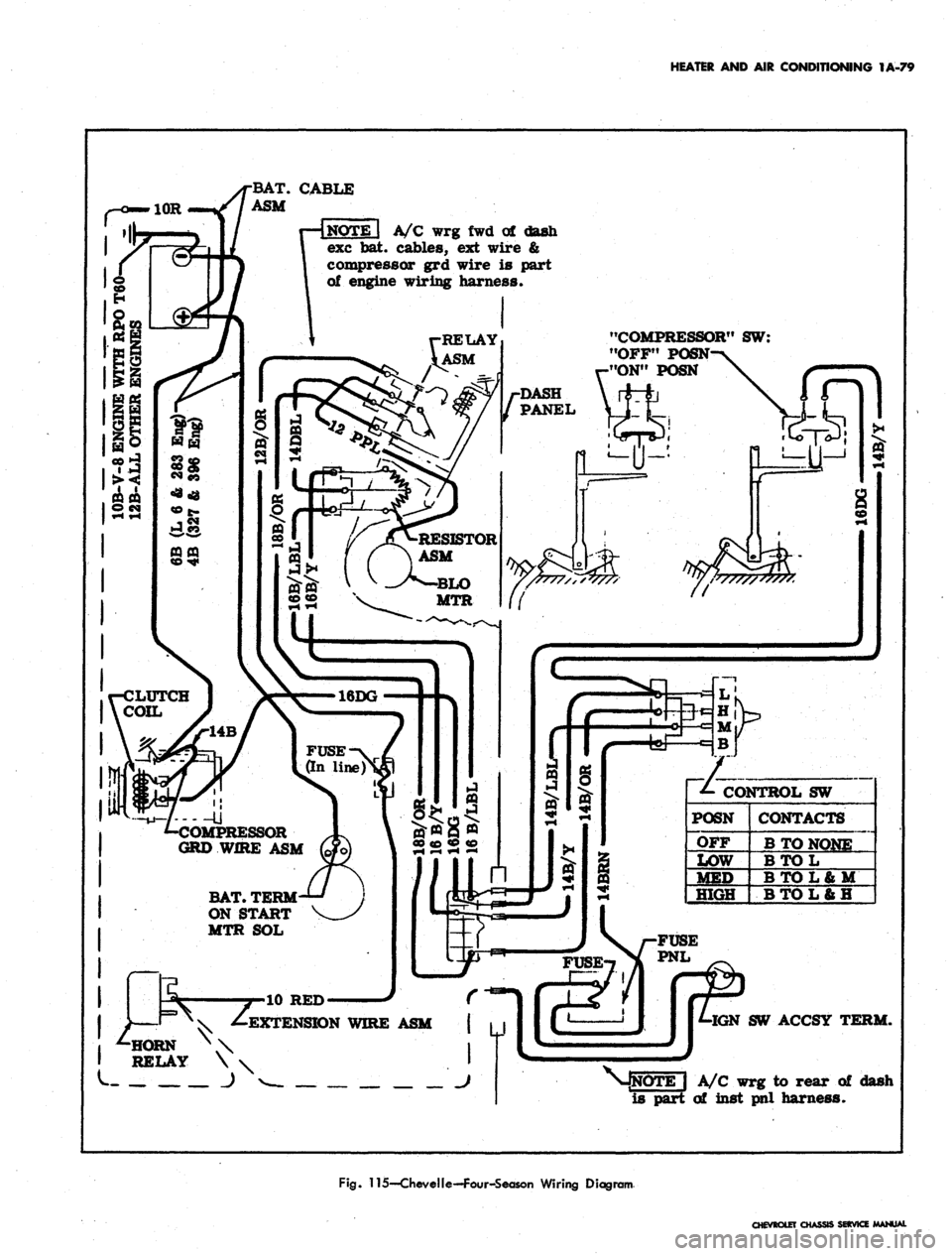
HEATER
AND AIR CONDITIONING IA-79
BAT.
CABLE
ASM
A/C
wrg fwd of
dash
exc
bat.
cables,
ext
wire
&
compressor
grd
wire
is
part
of engine wiring harness.
"COMPRESSOR"
SW:
"OFF" POSN
"ON"
POSN
RELAY
ASM
/-DASH
/
PANEL
RESISTOR
ASM
LUTCH
COIL
:OMI
GRD
WIRE
ASM
MPRESSOR
BAT.
TERM
ON START
MTR SOL
EXTENSION WIRE ASM
._
J
J
^-CONTROL
SW
CONTACTS
B TO NONE
BTOL
BTOL&M
BTOL6H
•IGN SW ACCSY TERM.
A/C wrg
to
rear
of
dash
of
inst pnl harness.
Fig.
115—CheveIle—Four-Season Wiring Diagram
CHEVROLET
CHASSIS SERVICE MANUAL