1965 CHEVROLET CORVAIR light
[x] Cancel search: lightPage 22 of 56
Downloaded from www.Manualslib.com manuals search engine REAR DOORS
• Rear doors, on 4-door models are operated from the
outside by means of a push button door handle in the
same
manner as the front doors. No key lock is pro
vided On the outside of either rear door.
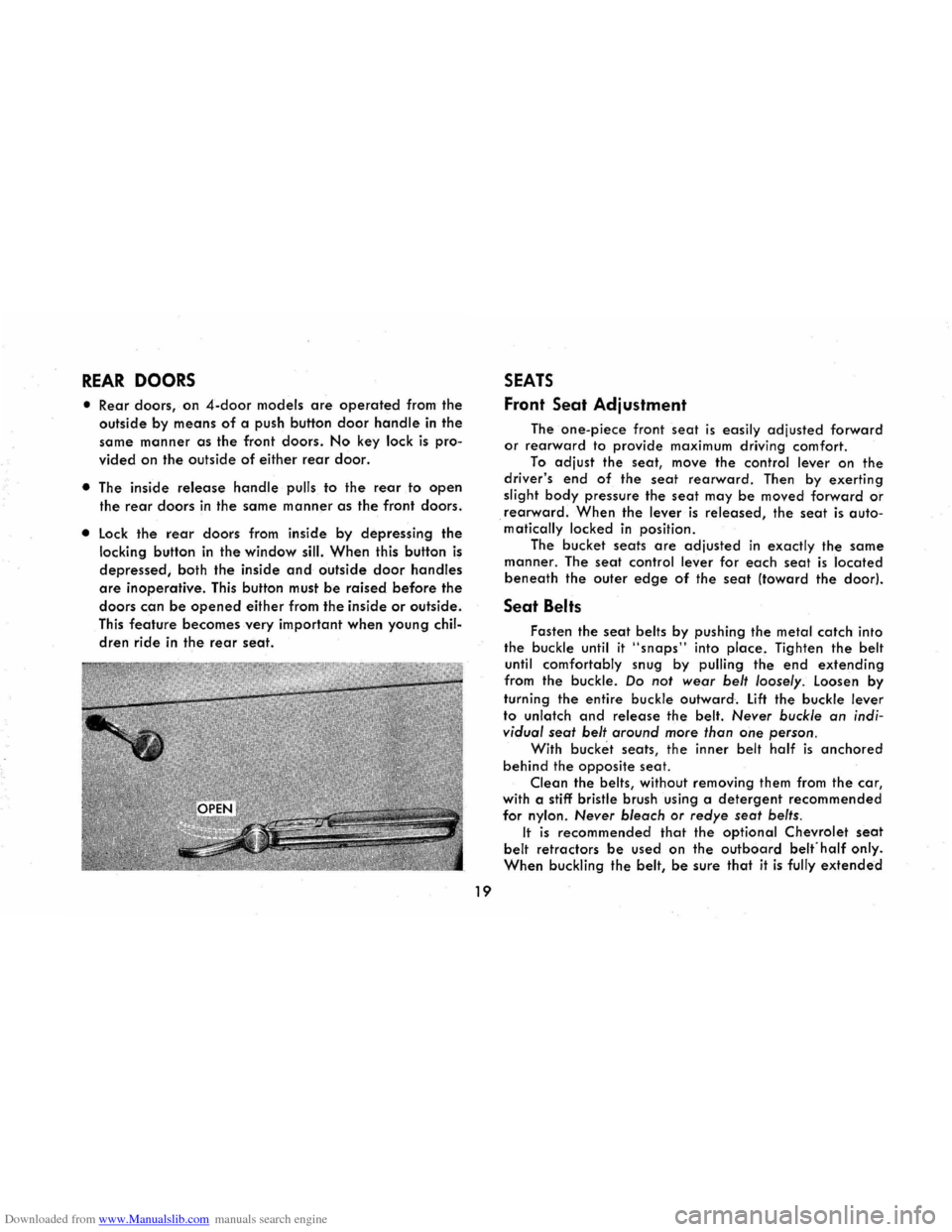
• The inside release handle pulls to the rear to open
the rear doors in the same manner as the front doors.
• lock the rear doors from inside by depressing the
locking button in the window sill. When this button is
depressed ,
both the inside and outside door handles
are inoperative. This button must be raised before the
doors can be opened either from the inside or outside.
This
feature becomes very important when young chil
dren ride in the rear seat.
19
SEATS
Front Seat Adjustment
The one-piece front seat is easily adjusted forward or rearward to provide maximum driving comfort.
To adjust the seat, move the control lever on the
driver's end of the seat rearward. Then by exerting
slight body pressure the seat may be moved forward or
rearward. When the lever is released, the seat is auto. matically locked in position.
The
bucket seats are adjusted in exactly the same
manner. The seat control lever for each seat is located
beneath the outer edge of the seat (toward the door).
Seat Belts
Fasten the seat belts by pushing the metal catch into
the buckle until it "snaps" into place, Tighten the belt
until comfortably snug by pulling the end extending
from the buckle. Do not wear belt loosely . loosen by
turning the entire buckle outward. lift the buckle lever
to unlatch and release the belt. Never buckle an indi
vidual seat belt around more than
one person .
With bucket seats, the inner belt half is anchored
behind the opposite seat.
Clean the belts, without removing them from the car,
with a stiff bristle brush using a detergent recommended
for nylon. Never bleach or redye seat belts .
It is recommended that the optional Chevrolet seat
belt retractors be used on the outboard belfhalf only.
When buckling the belt, be sure that it is fully extended
Page 26 of 56
Downloaded from www.Manualslib.com manuals search engine YOUR CORVAIR CORSA INSTRUMENT PANEL
We feel that you, as owner of the Cor-
vair Corsa, will be more interested in a
constant check on
engine operation than
would the average driver. Therefore the
following instruments have been provided
for your use and information.
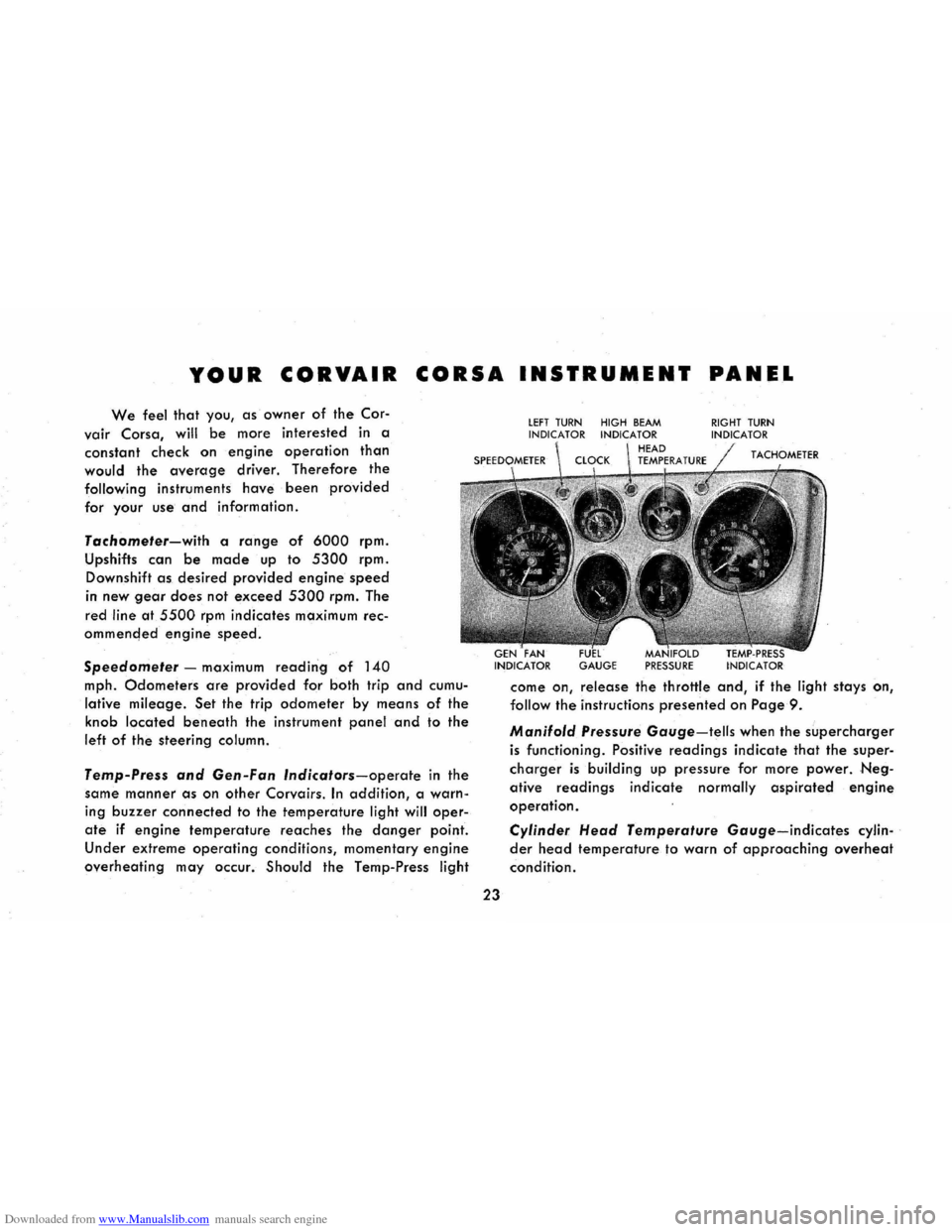
Tachometer-with a range of 6000 rpm.
Upshifts can
be made up to 5300 rpm.
Downshift as desired provided engine speed
in
new gear does not exceed 5300 rpm. The
red
line at 5500 rpm indicates maximum rec
ommencled
engine speed.
Speedometer -maximum reading of 140
mph. Odometers are provided for both trip and cumu
lative mileage. Set the trip odometer by means of the
knob located beneath the instrument panel and to the
left of the steering column.
Temp-Press and Gen-Fan Indicators-operate in the
same
manner as on other Corvairs. In addition, a warn
ing buzzer connected to the temperature light will oper
ate if engine temperature reaches the danger point.
Under extreme operating conditions, momentary engine
overheating may occur. Should the Temp-Press light
23
lEFT TURN HIGH BEAM INDICATOR INDICATOR
GAUGE PRESSURE
RIGHT TURN INDICATOR
come on, release the throttle and, if the light stays on,
follow the instructions presented on Page 9 .
Manifold Pressure Gauge-tells when the supercharger
is functioning. Positive readings indicate that the super
charger is building up pressure for more power. Neg
ative readings indicate normally aspirated engine
operation.
Cylinder Head Temperature Gauge-indicates cylin
der head temperature to warn of approaching overheat
condition.
Page 34 of 56
Downloaded from www.Manualslib.com manuals search engine Cleaning White Sidewall Tires
Use soap, warm water or a tire cleaner and a stiff
brush
to remove road grime and dirt from white sidewall
tires. A flne grade of steel wool will remove severe curb
scrapes.
Do not use gasoline, kerosene or any oil product
which would discolor or deteriorate the rubber.
CAUTION: Some white sidewall cleaners will cause
serious
damage to aluminum trim. Use caution
when cleaning tires with this
type of cleaner.
CORVAIR MODELS
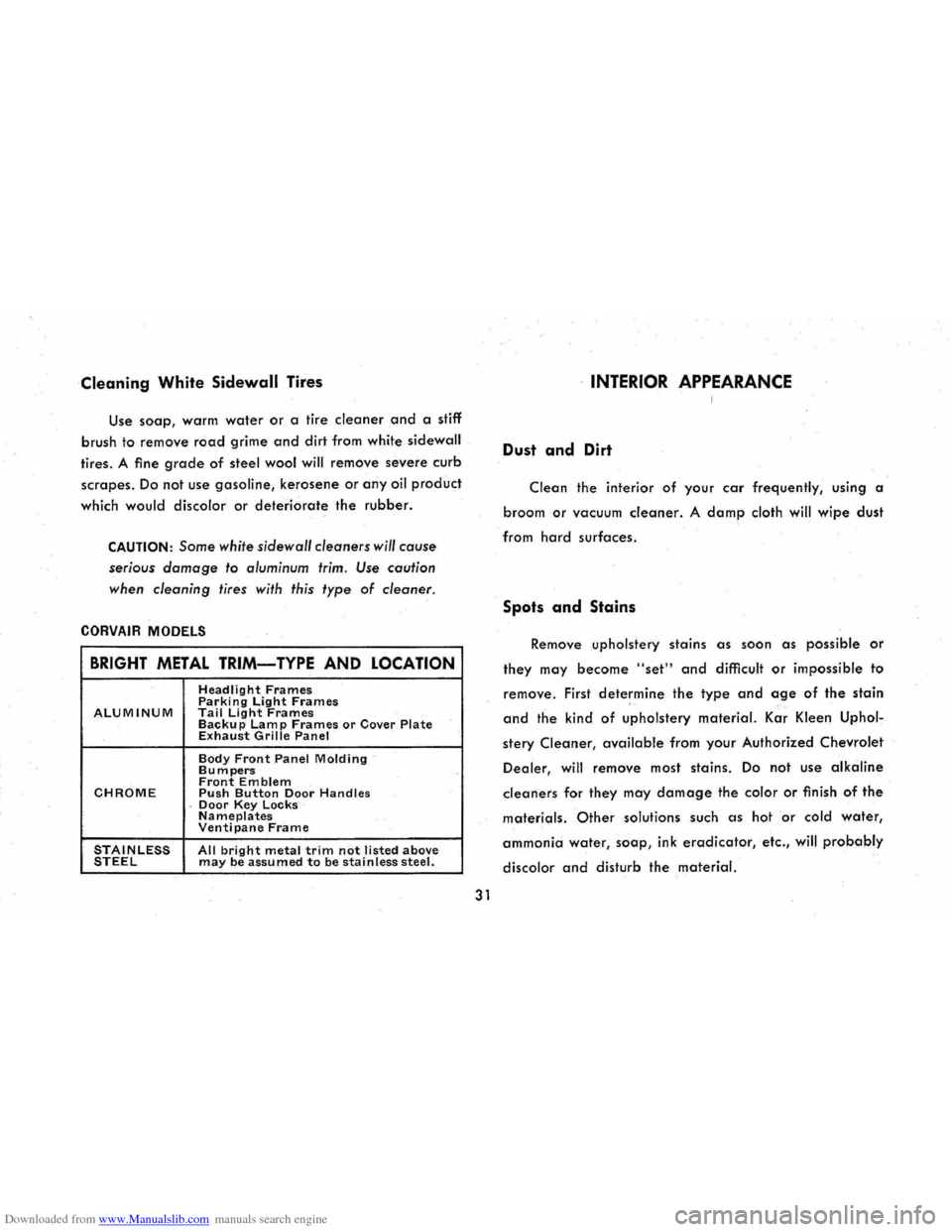
BRIGHT METAL TRIM-TYPE AND LOCATION
Headlight Frames Parking light Frames ALUMINUM Tail light Frames Backup Lamp Frames or Cover Plate Exhaust Grille Panel
Body Front .Panel Molding Bumpers Front Emblem CHROME Push Button Door Handles Door Key Locks Nameplates Venti pane Frame
STAINLESS All bright metal trim not listed above STEEL may be assumed to be stainless steel.
31
INTERIOR APPEARANCE
Dust and Dirt
Clean the interior of your car frequently, using a
broom or vacuum cleaner. A damp cloth will wipe dust
from hard surfaces.
Spots and Stains
Remove upholstery stains as soon as possible or
they may become "set" and difficult or impossible to
remove . First determine the type and age of the stain
and the kind of upholstery material. Kar Kleen Uphol
stery Cleaner, available from your Authorized Chevrolet
Dealer, will remove most stains. Do not use alkaline
cleaners for they may damage the color or flnish of the
materials. Other solutions such as hot or cold water,
ammonia water, soap, ink eradicator, etc., will probably
discolor and disturb the material.
Page 37 of 56
Downloaded from www.Manualslib.com manuals search engine TIRE CARE
Keep your tires inflated to the recommended pres
sures.
Over-inflation can adversely affect riding comfort,
quietness and tire life while under-inflation affects vehicle
handling and tire life.
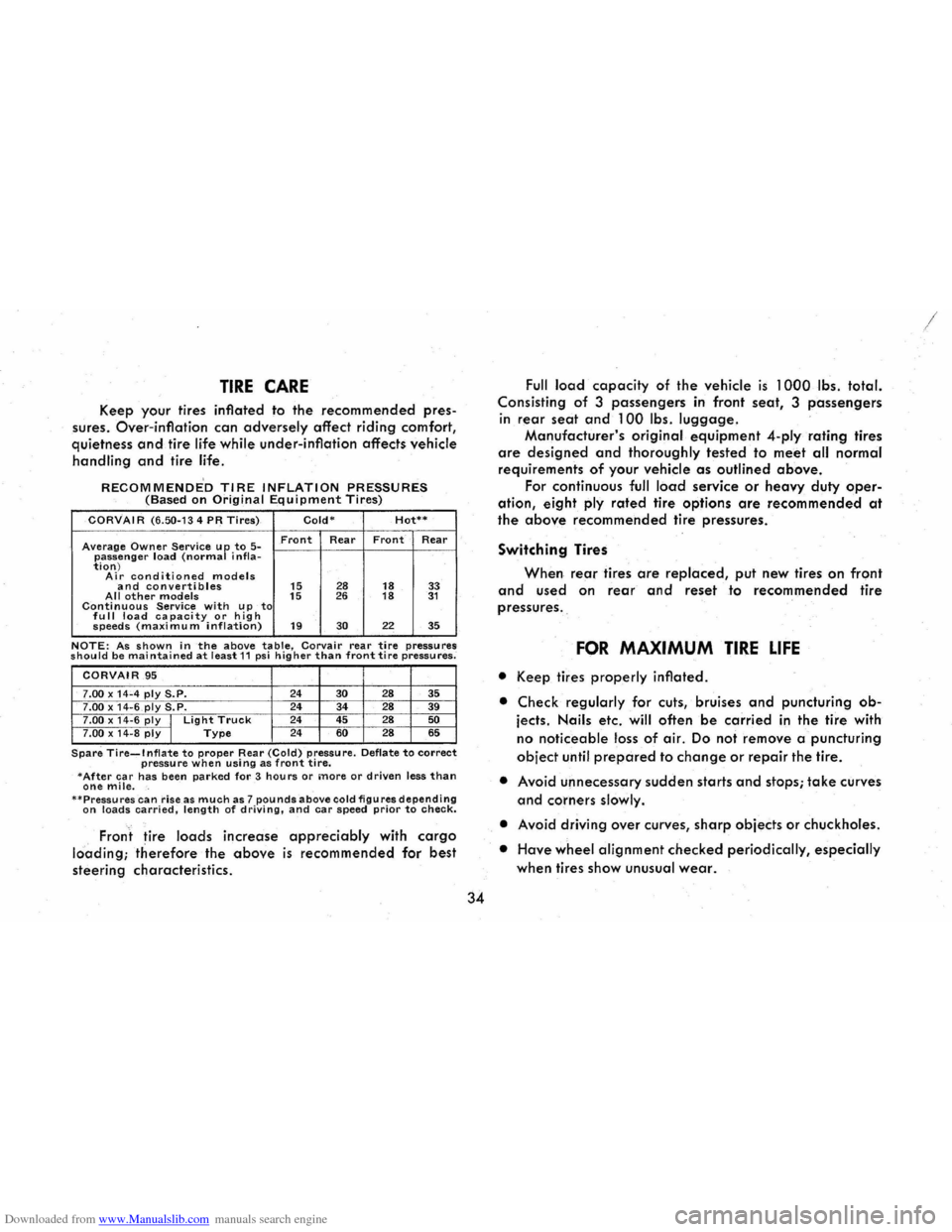
RECOMMENDED TIRE INFLATION PRESSURES (Based on Original Equipment Tires)
CORVAIR (6.50-134 PR Tires) Cold-Hot**
Average Owner Service up to 5-Front Rear Front Rear
passenger load (normal i nfla-tion) Air conditioned models and convertibles 15 28 18 33 All other models 15 26 18 31 Continuous Service with up to fu II load ca pacity or h ig h speeds (maximu m inflation) 19 30 22 35
NOTE: As shown in the above table, Corvair rear tire pressures should be maintained at least 11 psi higher than front tire pressures;
CORVAIR .95
7.00 x 14"4 ply S.P. 24 30 28 35 7.00 x 14-6 ply S.P. 24
34 28 39 7.00 x 14-6 ply I Light Truck 24
45 28 50
7 .00 x 14 -8 ply I Type 24 60 28 65
Spare Tire...,.lnflate to proper Rear (Cold) pressure. Deflate to correct pressure when using as front tire. -After car has been parked for 3 hours or more or driven less than one mile. --Pressures can riseas much as 7 pounds above cold figures depending on loads carried, length of driving, and car speed prior to check.
, Fron t tire loads increase appreciably with cargo
lci'ading; therefore the above is recommended for best
steering characteristics.
34
Full load capacity of the vehicle is 1 OOOlbs. total.
Consisting of 3 passengers in front seat, 3 passengers
in
rear seat and 100 Ibs . luggage.
Manufacturer's original equipment 4-plyrating tires
are designed and thoroughly tested to meet all normal
requirements of your vehicle as outlined above.
For continuous full load service or heavy duty oper
ation, eight ply rated tire options are recommended at
the above recommended tire pressures.
Switching Tires
When rear tires are replaced, put new tires on front
and used on rear and reset to recommended tire
pressures. ,
FOR MAXIMUM TIRE LIFE
• Ke.ep tires properly inflated.
• Check regularly for cuts, bruises and puncturing ob
jects. Nails etc. will often be carried in the tire with
no noticeable loss of air. Do not remove a puncturing
object until prepared to change or repair the tire.
• Avoid unnecessary sudden starts and stops; take curves
and corners slowly.
•
Avoid driving over curves, sharp objects or chuckholes.
•
Have wheel alignment checked periodically, especially
when tires show unusual wear.
Page 48 of 56
Downloaded from www.Manualslib.com manuals search engine Idle Speed: 95 hp Turbo-Air 164 w/monuol trans. (In Neutral) .... 450-500 rpm 110 hp Turbo-Air 164 w/manual trans. (In Neutral) .... 600-650 rpm 140 hp Turbo-Air 164 w/manualtrans. (In Neutral) .... 600-650 rpm 180 hp Turbocharged 164 (In Neutral) .................. 850 rpm All Powerglide (In Drive) .............. , .......... 450-500 rpm
Ignition Timing:. 95 hp Turbo-Air 164 (manual transmission) ............ 6° BTDC 110 hp Turbo-Air 164 (manual transmission) ............ 14° BTDC 140 hp Turgo-Air 164 .............................. 18°BTDC
180 hp Turbocharged 164 .......................... 24° BTDC All Powerglide ...........................••....•• . 14° BTDC
Axle Ratios: Engine 95 hp Turbo-Air 164 110 hp Turbo-Air 164
140 hp Turbo-Air 164 180 hp Turbocharged 164
Transmission All 3-and 4-Speed Powerglide
3 -and 4-Speed All
Standard Ratio "
3.27:1
3.27:1
3.55:1 3.55:1
3.55: 1 'Standard Ratio For Corvair Greenbrier and Air Conditioning Equipped Vehicles 3.55:1.
BULB SPECIFICATIONS
Headllamp Unit (Sealed Beam)
Candle Power
Outer-High Beam ......•.........•...... 37% W low Beam ....•.............•..... 55W Inner-High Beam Only ................... 37'!z W
Parking lamp-Directional Signal and Tail-Stap-D irectional Signal lamps ... ...•... 4-32
Back-Up lamps ............................ 32 Instrument lamps ....................••.... 3
Temp. Press., Gen. Fan., and Glove Compartment lamps ..•.............•..... 2 Headlamp High Beam Indicator,' Directional Signal Indicator , and Heater Control Panel lamps •.....•..................•.. 1
Number
4002
4001
1157
1156
GE 1816
1895
1445
45
Dome Lomp ' ................... .. ......... 12 Courtesy lamp .........••.................. 6 license Plate lamp .....•..............•.... 4
Radio Dial lamp ........•.......•.......... 2
BATTERY RATINGS
Corvair-12 volt; 54 plate; 44 amp/hr . Corvoir 95 and Greenbrier-12 volt; 54 plate; 42 amp/hr .
FUSES AND CIRCUIT BREAKER
211 631
67
1893
A circuit breaker in the light control switch protects
the head lamp circuit, thus eliminating one fuse. Where
current load is too heavy, the circuit breaker intermittently
opens and closes, protecting the circuit until the cause
is found and eliminated.
Fuses, located in the junction block beneath the
dash are:
1. Healer Blower
Glove Comparlment lamp ........ 3AG/ AGC-1 0 amp
2. Tail and Slop lamps,
Dome lamp ................. .. 3AG / AGC-1 0 amp.
3.
Heater (Total System) Back-up lamp ................. 3AG/ AGC-20 amp.
4. Radio (AM or AM-FM) ........... 3AG/ AGC-2 Y2 amp.
(AM-FM Stereo) .. . .... 3AG/ AGC-71/2 amp.
5. Instrument Panel lamps Radio Panel lamp Heater Conlrol Panel lamp ........ 3AG/ AGC-3 amp. 6. Windshield Wiper Molor ......... 3AG/ AGC-20 amp.
Air Conditioner Fuses ........... 3AG! AGC-15 amp. (Located in 14GA red and 12GA gray wires in area of
ignition switch.)
Page 49 of 56
Downloaded from www.Manualslib.com manuals search engine Corvair passenger cars are designed primarily for
passenger conveyance. However, it is well known that
many owners do use the Corvair to pull trailers, and
when available trailer hauling options have been used,
the owners
have experienced very satisfactory service.
When a trailer is attached to a car, the car becomes
not only a load-carrying vehicle, but a load-pulling
vehicle. The demands of this type of operation are very
different from those for which the automobile is pri
marily designed and may present problems, such as
spring
and tire loading, braking, cooling, lighting, and
steering. However, careful driving practices and the use
of factory-recommended options will better satisfy the
requirements
of trailer hauling.
If in the opinion of the manufacturer a part or com
ponent of a motor vehicle has been adversely affected
46
by misuse of the vehicle with trailer loads, such part or
component will not be covered by the manufacturer's
warranty.
The size of and equipment for trailers, including
such items as hitches and safety chains, brakes, lights,
power-weight ratios and over-all length, are generally
subject to safety regulations in all states, and it is the
responsibility of the user to make certain that he is in
full
compliance with the regulations of the states in
which he plans to operate with a trailer of the Interstate
Commerce Commission,
if applicable, before doing so.
Further, when
operating a car with a trailer attached,
the driver must realize that the performance, steering
characteristics,
and braking distance of his car have
been altered, and that he must exercise greater caution
to safely handle his car and trailer.
Page 51 of 56
Downloaded from www.Manualslib.com manuals search engine MINOR TROUBLE SHOOTING PROCEDURES
The chart on the previous page, and the information on the pages
which follow, contains information designed to aid the average
driver to discover, and possibly correct, conditions resulting in minor
mechanical difficulties
in his cor. The chart, designed to point out
possible solutions to severol of the most common automotive mal
functions and point out a logical checking sequence, will lead step
by step to the most
likely causes and corrective procedures. If, after
making the checks and adjustments suggested, the source of the
trouble has not been found and corrected, it is strongly recom.
mended that on Authorized Chevrolet Dealer inspect the vehicle and
make whatever repairs or adjustments are necessary.
FUEL SYSTEM AND ENGINE
If the ignition switch will couse the engine to "turn over" or
"cronk" but the cor will not start, check Steps A through D below.
NOTE: If continual "flooding" of the carburetor is evidenced by a
carburetor wet with fuel or black exhaust smoke, perform the
operation suggested in paragraph D only.
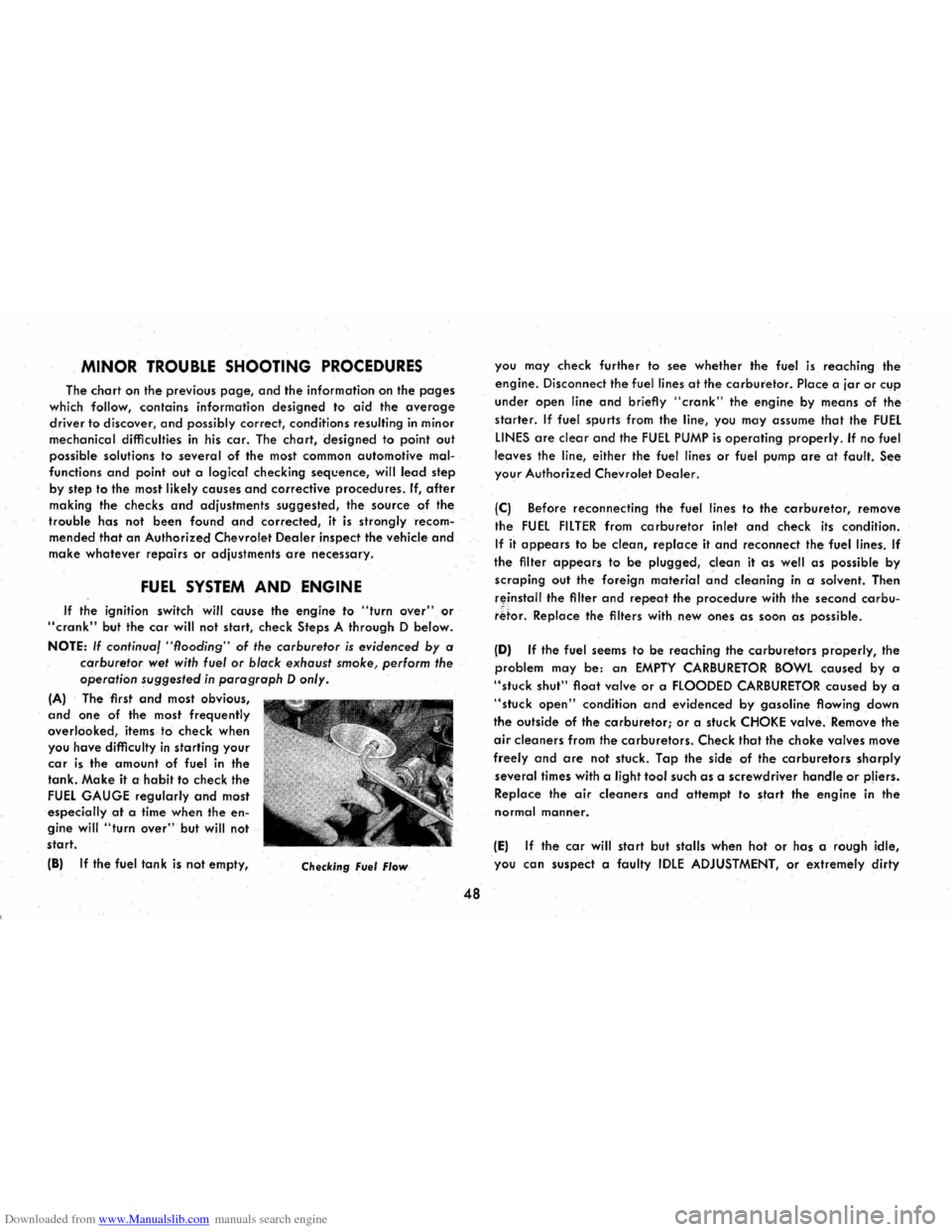
(A) The first and most obvious,
and one of the most frequently overlooked, items to check when
you
have difficulty in starting your
cor is the amount of fuel in the
tonk.
Make it a habit to check the
FUEL GAUGE regularly and most especially at a time when the en
gine will "turn over" but will not
start.
(8) If the fuel tank is not empty, Checking Fuel Flow
48
you may check further to see whether the fuel is reaching the
engine. Disconnect the fuel lines at the carburetor. Place a jar or CliP
under open line and briefly "crank" the engine by means of the
starter. If fuel spurts from the line, you may assume that the FUEL
LINES are dear and the FUEL PUMP is operating properly. If no fuel
leaves the line, either the fuel lines or fuel pump are at fault. See
your Authorized Chevrolet Dealer.
(C) Before reconnecting the fuel lines to the carburetor, remove
the
FUEL FILTER from carburetor inlet and check its condition.
If it appears to be clean, replace it.and reconnect the fuel lines. If
the filter appears to be plugged, clean it as well as possible by
scraping out the foreign material and cleaning in a solvent. Then
r~install the filter and repeat the procedure with the second carbu
r~ior. Replace the filters with new ones as soon as possible .
(0) If the fuel seems to be reaching the carburetors properly, the
problem may
be: an EMPTY CARBURETOR BOWL caused by a
"stuck shut" float valve or a FLOODED CARBURETOR caused by a
"stuck open" condition and evidenced by gasoline flowing down
the outside of the carburetor; or a stuck CHOKE valve. Remove the
air cleaners from the carburetors. Check that the choke valves move
freely and are not stuck. Tap the side of the carburetors sharply
several times with a light tool such as a screwdriver handle or pliers.
Replace the air cleaners and attempt to start the engine in the
normal manner.
(E) If the car will start but stalls when hot or has a rough idle,
you can suspect a faulty IDLE ADJUSTMENT, or extremely dirty
Page 52 of 56
Downloaded from www.Manualslib.com manuals search engine and blocked AIR CLEANER ELEMENTS. Clean and reoil the air
cleaner elements if necessary. Idle adjustment should be performed
by your Chevrolet Dealer.
If the above Fuel System checks and the checks suggested under
the Electrical System following do not correct the malfunction, it is
recommended that you turn to your Authorized Chevrolet Dealer
for further checks , adjustments or repairs.
ELECTRICAL SYSTEM
If, when the ignition key is turned to START, the engine will not
turn
over, you have good reason to suspect electrical trouble.
(F) When there .is no response at all to attempts to start the car,
check the obvious-your AUTOMATIC TRANSMISSION SElECTOR
LEVER must be in neutral position before the engine can be started.
Turning the IGNITION SWITCH rapidly back and forth several
times will sometimes correct a poor internal switch contact.
(G) The
BATTERY may be discharged. If so, lights will be dim and
the horn will have a poor tone if it will blow at all.
Usually a
garage recharge will be necessary to return the battery
to operation. Occasionally, however , a push start and a long drive
will
recharge the battery.
NOTE : If the battery is determined to be dead, and for no apparent
reason , have your Authorized Chevrolet Dealer check the
battery, the GENERATOR and the VOLTAGE REGULATOR .
GENERA TOR trouble should already have been indicated by
the indicator on the instrument panel. Never remove generator
"BAT" lead without first disconnecting battery ground cable.
49
POOR BATTERY CONNECTIONS may be suspected if the car has operated properly a short time before and now not even the horn
will operate. Check both ends of both battery cables. If the con
nections are corroded, a car may sometimes be restored to opera
tion by removing all cable ends, scraping all contacting surfaces clean with a pen knife , and reassembling . If the cables are broken, they must be replaced. The power supply should now be restored unless the battery is dead.
(H) If, however, the lights and horn work properly but the starter will still not turn over, check the STARTER connections. A "click" from the starter solenoid indicates that the wiring to the starter is properly installed . If the wiring seems to be clean and tightly installed, the trouble is probably in the starter itself and should be referred to your Authorized Chevrolet Dealer.
When the engine will "turn over" but will not start, the following
items may be checked along with Fuel System Checks listed
previously .
(I) With a clean dry cloth wipe the ceramic portions of the spark plugs dry. In particularly damp or rainy wellthe'r dampness may be the cause of not starting, especi-: . ally when the engine is cold.
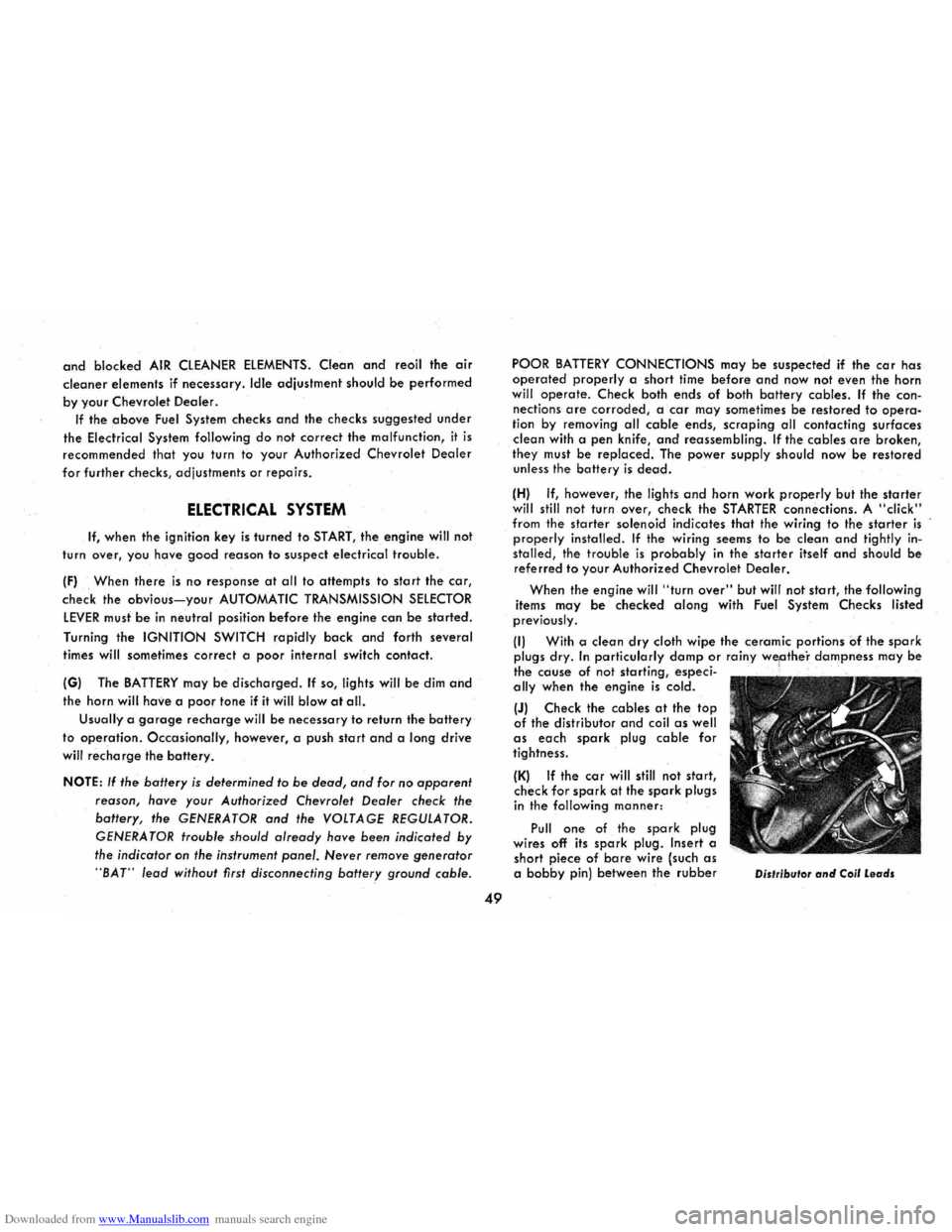
(J) Check the cables at the top of the distributor and coil as well as each spark plug cable for tightness.
(K) If the car will still not start, check for spark at the spark plugs in the following manner:
Pull
one of the spark plug
wires off its spark plug. Insert a
short piece of bare wire (such as a bobby pin) between the rubber Oislribulor and Coil Leads