1953 JEEP DJ service
[x] Cancel search: servicePage 93 of 376

'Jeep'
UNIVERSAL
SERIES SERVICE
MANUAL
Dl Caution:
Oil ports of the rocker arm shaft must
coincide with oil return passages of the rocker
arms.
If they do not,
engine
oil has no return path
from
the cylinder head to the crankcase; in that
case,
engine
oil flows down the valve
stems
and
burns
in the cylinders.
There
is a notch at one end of each rocker arm shaft. When rocker arms
are
properly installed on the shaft, this notch
will
be at front of right rocker arm shaft and at
rear
of left rocker arm shaft. Refer to
Figs.
Dl-25 and
Dl-26.
a.
Position center support on rocker arm shaft;
insert
one shaft assembly attaching bolt through
support and shaft to hold support in position.
b.
Install
center
pair
of rocker arms with notched
faces touching support.
Install
front and
rear
spacer
FIG.
Dl-25—FRONT
OF RIGHT
ROCKER
ARM SHAFT
1—Alignment Notch
FIG.
Dl-26—REAR OF
LEFT
ROCKER
ARM SHAFT 2—Alignment Notch springs and one rocker arm each of front and
rear
rocker
arm pairs on shaft. Be certain that notched
faces of rocker arms are outward.
Install
outer shaft supports on shaft; compress spacer springs
to position supports. Insert one shaft assembly bolt
through each support and shaft to hold supports in
position.
c.
Install
remaining rocker arms of front and
rear
pairs,
each with notched face touching shaft sup
port.
Install
a spring retaining ring and flat washer at each end of shaft; secure each of
these
with a
new cotter pin.
D1 -61.
Valve Removal
a.
Place cylinder head on clean, smooth surface.
b.
Remove each valve assembly from cylinder
head as follows. Using suitable spring compressor, compress valve spring and remove two valve re
tainers
from valve stem. Release spring compressor,
and
remove spring retainer and valve spring from
valve stem. Refer to Fig. Dl-27.
Note:
Valve retainers are copper-colored for identi
fication purposes only.
c.
Withdraw valve from
bottom
of cylinder head.
Valves
should be identified so they can be installed
in
original location.
D1-62.
Cylinder
Head and Valve Cleaning
and
Inspection
a.
Remove carbon from combustion chamber of
cylinder
heads, using care to avoid scratching the head of valve seat surfaces. A
soft
wire brush is
suitable for this purpose.
b.
Clean
carbon and gum
deposits
from valve guide
bores with a standard-size valve guide reamer.
Refer
to Fig. Dl-28.
c.
Clean
valves with a wire
brush.
Inspect valve
faces and
seats
for pits, burned
spots
or other evi dence of poor seating.
FIG.
D1 -2 7—REMOVING
VALVE
RETAINERS
1—
Valve
Stem 3—Valve Spring Retainer
2—
Valve
Lock
4—Valve Spring
93
Page 95 of 376

'Jeep*
UNIVERSAL
SERIES
SERVICE
MANUAL
Dl
Dl-65.
Rocker Arm Cover Cleaning
and Inspection
a.
Clean
both rocker arm covers with suitable
cleaning solvent and dry thoroughly.
b.
Inspect each rocker arm cover visually for
scratches,
bends, dents, and tears. Replace cover
if
unserviceable.
Dl-66.
Timing Chain
and
Sprocket Inspection
Inspect
the timing chain and both sprockets for
damage or excessive wear. Replace unserviceable
parts.
Dl-67.
Timing Chain Cover Cleaning and Inspection
a.
Clean
the timing chain cover with suitable clean
ing solvent and dry with compressed air.
b.
Inspect the cover visually for breaks,
cracks,
and
other damage.
With
a straightedge, check cylinder
block, water pump, and oil pump faces for bends
and
distortion.
c.
Install
oil pump gears in oil pump cavity of
timing gear cover.
With
a straightedge and feeler
gauge,
check gear and clearance. Refer to Fig.
Dl-30.
Clearance
should be
between
.0023"
[0,0584
mm.] and .0058"
[0,1358
mm.]. If it is lower
than
.0018" [0,0457 mm.], inspect thrust surfaces
of cover which touch gears for wear.
d.
Replace the timing chain cover if unserviceable.
FIG.
Dl-30—CHECKING
OIL
PUMP
GEAR
END
CLEARANCE
1—
Feeler
Gauge
2—
Straight
Edge
3—
Pump
Body
4—
Pump
Gears
Dl-63.
Oil Pump Cleaning and
Inspection
a.
Clean
gears with suitable cleaning solvent and
dry
thoroughly. Inspect for wear, scoring, and other damage. Replace either or both gears if unservice
able.
b.
Remove the oil pressure relief valve cap, spring
and
plunger. Refer to Fig. Dl-31. Oil filter bypass
valve plunger and spring are staked in place and should not be removed. 12719
FIG.
Dl-31—OIL
PUMP
PRESSURE
RELIEF
VALVE
1—
Valve
Cap
2—
Gasket
3—
Spring
4—Valve
5—
Oil
Pump
Cover
c.
Wash valve parts thoroughly. Inspect the relief
valve plunger for wear or scoring.
Check
the spring to see that it is not worn or collapsed. Replace any
relief
valve spring that is questionable. Thoroughly
clean
the screen staked in the cover.
d.
Insert the relief valve plunger into its bore in
the cover. The plunger should have no more clear ance than an easy slip fit. If there is any perceptible
sideways movement, the plunger and/or the cover should be replaced.
e.
Check
oil filter bypass valve plunger for
cracks,
nicks,
or warping. The plunger should be flat and free of nicks or scratches.
f.
Lubricate
and install pressure relief valve plung
er
and spring in bore of oil pump cover.
Install
cap and gasket. Torque cap to 30 to 40 lb-ft. [4,1 a 5,5 kg-m.]. Do not over-tig1 n.
Note:
Pressure relief valve cap has no tapped
hole
for installation of oil pressure switch.
H1
-69.
Crankshaft Vibration
Damper
Inspection
Inspect
the crankshaft vibration damper for
cracked,
broken, distorted, or otherwise damaged
condition. If damaged, replace.
Dl-70.
Crankshaft Pulley Inspection
Inspect
the crankshaft pulley for damage or exces
sive wear. Replace if visibly worn or damaged.
Dl-71.
ENGINE REASSEMBLY
The
engine
assembly procedure in the following
paragraphs
is given in the sequence to be followed
when the
engine
is being completely overhauled.
Individual
inspection,
repair,
and fitting operations
previously covered in detail are made throughout
the assembly procedure. The assembly procedure
does
not cover accessories. If a new cylinder block
fitted with pistons is used, many of the operations
will
not be required.
Mount
the cylinder block in an
engine
repair stand.
If
an
engine
stand is not available, perform the
following assembly operation in a manner designed to protect personnel against an accident, and the
engine
and its parts against damage. 95
Page 97 of 376

'Jeep'
UNIVERSAL
SERIES SERVICE
MANUAL
Dl
size have
been
selected. If necessary, check or
select
connecting rod bearings as described in Par. Dl-49.
Note:
When a piston and connecting rod assembly
is properly installed, the oil spurt
hole
in the con necting rod
will
face the camshaft. The rib on the
edge
of the bearing cap
will
be on the same side
as the conical
boss
on the connecting rod web;
these
marks (rib and boss)
will
be toward the other
connecting rod on the same crankpin. The notch
on the piston
will
face the front of the
engine.
a.
Be certain that cylinder bores, pistons, connect
ing rod bearings and crankshaft journals are absolutely clean. Coat all bearing surfaces with
engine
oil.
b. Before installing a piston and connecting rod as
sembly into its bore, rotate the crankshaft so that
the corresponding crankpin is moved downward, away from the cylinder bore.
c. Remove bearing cap from connecting rod. With
upper bearing half seated in connecting rod, install connecting rod guides. These
guides
hold the upper
bearing half in place and prevent damage to the
crankshaft
crankpin during installation of the con
necting rod and piston assembly.
d.
Be certain that the gap in the oil ring rails faces
upward,
toward center of
engine.
Gaps of the com
pression rings shall not be aligned with each other
or
with the oil ring
rails.
e. Lubricate the piston and rings. Compress the
rings with a suitable piston ring compressor; install
the piston and connecting rod assembly from top of cylinder bore. Refer to Fig. Dl-33.
f.
Install
bearing cap, with lower bearing half, on connecting rod. Torque bolt nuts to 30 to 40 lb-ft. [4,1 a 5,5 kg-m.].
g.
Install
all other piston and connecting rod as
semblies in same manner.
h.
Check
end clearance
between
connecting rods
on each crankpin with a feeler
gauge.
Clearance should be .005,/ to .012" [0,127 a
0,305
mm.].
Dl-76.
Install
Oil
Pump
Intake
Pipe
and
Screen Assembly
Check
mating surfaces of oil pump intake pipe
and
engine
cylinder block to be certain that they
are
clean. Secure the pipe and screen assembly,
with a new gasket, to
engine
cylinder block with two attaching screws. See Fig. Dl-34. Torque screws 6 to 9 lb-ft. [0,83 a 1,24 kg-m.].
Dl-77.
Install
Oil Pan
Refer
to Fig. Dl-35.
Be
certain the flange surface of oil pan and cor
responding surface of
engine
cylinder block are
clean.
Install
a new oil pan gasket on the cylinder
block.
Secure
oil pan to cylinder block with mount ing bolts. Torque
bolts
10 to 15 lb-ft [1,4 a 2,1
kg-m.].
Dl-78.
Install
Flywheel
Refer
to Fig. Dl-7.
a.
Check
flywheel flange of
engine
crankshaft and corresponding surface of flywheel to
be
certain that
FIG.
Dl-33—INSTALLING
PISTON
AND
CONNECTING
ROD
ASSEMBLY
1—Ring
Compressor
FIG.
Dl-34-^-OIL
PUMP
INTAKE PIPE
AND
SCREEN
INSTALLATION
1—Pipe and Screen
97
Page 99 of 376

'Jeep'
UNIVERSAL SERIES SERVICE
MANUAL
Dl
both are clean. Any foreign material on either of
these
surfaces
will
cause flywheel run out and en
gine
vibration. Position flywheel to crankshaft and
secure with six mounting bolts. Torque mounting
bolts
50 to 65 lb-ft. [6,91 a 8,98 kg-m.].
Note:
Flywheel mounting
bolts
are unevenly
spaced so that flywheel can be installed in only
one position.
This
assures correct balance of fly
wheel and crankshaft.
b.
Mount a
dial
indicator on flywheel housing
flange of cylinder block and index its plunger to
the flywheel surface. Measure flywheel run out.
Maximum
allowable run out is .015"
[0,381
mm.].
Dl-82.
Install
Cylinder
Head Assembly
Refer
to Fig. Dl-9.
a.
Wipe cylinder head face of
engine
cylinder
block, and be certain no foreign material has fallen
into the cylinder bores, bolt holes, or in the valve
lifter
area.
It is
good
practice to clean out bolt
holes
with compressed air.
b.
Install
a new cylinder head gasket on the
cylin
der
block. Dowels in the block
will
hold the gasket
in
position. Always handle gaskets carefully to
avoid
kinking or damage to the surface treatment
of the gasket. Apply Perfect Seal Aerosol
Spray
Sealer
Part
No.
994757
on cylinder head gaskets.
Dl-79.
Install
Clutch
and Flywheel Housing
a.
Note
marks made on clutch assembly and fly
wheel during
engine
disassembly. Position clutch
assembly to flywheel, according to
marks,
and
fasten
loosely
with six attaching bolts. Torque
bolts
in rotation, one
turn
at a time, to 30 to 40 lb-ft. [4,1 a 5,5 kg-m.].
b.
Engage fork of clutch linkage to clutch and
position flywheel housing to
engine
cylinder block.
Secure
housing to block with six mounting bolts.
Torque
bolts
30 to 40 lb-ft. [4,1 a 5,5 kg-m.].
D1-80.
Install
Camshaft
Insert
camshaft into camshaft bearings of
engine
cylinder
block carefully to avoid damage to bear
ing surfaces. Make certain camshaft journals are
properly
seated in bearings.
12695
FIG.
D1-36—CAMSHAFT
AND
VALVE LINKAGE
1—
Rocker
Arm
2—
Push
Rod 3—
Valve
Lifter
4—
Camshaft
14203
FIG.
Dl-37—CYLINDER
HEAD
BOLT TIGHTENING SEQUENCE c.
Clean
gasket surface of cylinder head and care
fully
place on the
engine
block dowel pins.
d.
Clean
and lubricate the cylinder head
bolts
with
a
sealing compound
(Part
No. 994757, or equiv
alent).
e.
Install,
and alternately tighten the head bolts,
a
little at a time, in the sequence shown in Fig.
Dl-37.
Torque
bolts
65 to 85 lb-ft. [9,0 a 11,8
kg-m.].
f.
Tilt
the rocker arms toward the push rods and locate the top of each push rod in its rocker arm
seat.
g.
Mount the rocker arm and shaft assembly, tightening the bracket
bolts
a little at a time.
Torque
the bracket
bolts
25 to 35 lb-ft. [3,5 a 4,8
kg-m.].
Do not overtighten.
h.
See Section Fl and F2 for
engines
equipped
with
exhaust emission control.
D1-81.
Install
Valve Lifter
and Push Rod
Make
certain valve lifter guide
holes
and adjacent
area
of cylinder block are clean.
Liberally
lubricate
the camshaft and valve lifter bores with
engine
oil,
and install valve lifters.
Each
valve lifter must slide freely in its guide hole. See Fig. Dl-36.
Dl-83.
Install
Rocker Arm Cover
Install
a new gasket on each rocker arm cover.
Secure
each rocker arm cover to corresponding
cylinder
head with four attaching screws.
Install
the positive crankcase ventilation valve on right
rocker
arm cover. 99
Page 101 of 376

'Jeep*
UNIVERSAL
SERIES SERVICE
MANUAL
Dl
of packing are at top. Drive in a new shedder with
a
suitable punch. Stake the shedder in at least three places to secure it in position. Size the pack-
FIG.
Dl-39—INSTALLATION
OF
TIMING
CHAIN
AND
SPROCKET
1—
Camshaft
Sprocket 3—Timing
Chain
2—
Crankshaft
Sprocket 4—Timing
Marks
FIG.
Dl-40—FUEL
PUMP
ECCENTRIC
AND
DISTRIBUTOR
DRIVE GEAR
1—
Fuel
Pump
Eccentric
3—Camshaft
2—
Oil
Groove 4—Distributor Drive
Gear
ing by rotating a hammer handle, or similar smooth
tool, around it, as necessary, to obtain clearance
for the crankshaft vibration damper hub.
Dl-86.
Install
Timing
Chain
Cover
Note:
There
are five
bolts
which attach the timing
chain
cover directly to the cylinder block, and seven
bolts
which attach both the timing chain
cover and water pump to the cylinder block.
a.
If oil pump has not been removed from timing
chain
cover, remove fine slotted attaching screws,
oil
pump cover, gasket from timing chain cover. Completely pack the space around the oil pump gears with petroleum jelly.
There
must be no air
space left inside the pump. Secure oil pump cover
and
a new gasket to timing chain cover with five slotted attaching screws. Torque screws, alternately
and
evenly, 8 to 12 lb-ft [1,10 a 1,66 kg-m.].
Note:
Unless oil pump gears are packed with petro
leum jelly, pump may not prime itself when
engine
is started.
b.
The gasket surfaces of the cylinder block and
timing chain cover must be smooth and clean. In
stall
a new timing chain cover gasket and position
it
correctly on the cylinder block.
Note:
Two different timing chain cover gaskets
have been installed in production on V-6 engines.
At
any time the timing chain cover gasket is
replaced,
make sure the correct gasket is installed.
c.
Position timing chain cover to cylinder block.
Use
timing cover aligner and oil seal remover tool J-22248. Be certain that dowel pins
engage
dowel
pin
holes
before installing bolts.
d.
Lubricate
bolt threads before installation.
Install
the mounting
bolts
and torque 25 to 33 lb-ft. [3,5
a
4,6 kg-m.].
Note:
Some timing chain covers have two additional
bolts, one in each upper corner. If the timing chain
cover being installed on a crankcase with
these
two
holes
does
not have matching holes, the
holes
in
the crankcase must be plugged with two hex
socket screw plugs. The plug should be driven past
the face of the case to prevent interference with the timing chain cover. These
bolts
are not shown
in
Fig. Dl-41.
D1-87.
Install
Oil Pump
a.
Pack
•
oil pump gear pocket of timing chain
cover with petroleum jelly. Do not use chassis
lubricant.
b.
Install
gears so that petroleum jelly is forced
into every cavity of gear pocket and
between
the
teeth
of the gears.
Install
a new oil pump cover gasket.
Note:
Unless the pump is packed with petroleum
jelly,
it may not prime itself when the
engine
is
started.
c.
Mount oil pump cover on timing gear cover
with
five slotted attaching screws. Torque screws 101
Page 103 of 376

'Jeep1
UNIVERSAL
SERIES
SERVICE
MANUAL
Dl
FIG.
D1-43—INTAKE
MANIFOLD
SEAL
INSTALLATION
1—Seal 2—Cylinder Head ing
hole
at left side of timing chain cover. If timing
chain
and sprockets have not been removed from
engine, install distributor with rotor in position
noted during distributor removal. Fasten distributor
to timing chain cover with retaining bracket and
mounting screws. If distributor is aligned, torque
screw
18 to 20 lb-ft. [2,5 a 2,8 kg-m.].
Dl-100.
Install Spark Plugs
Install
spark
plugs in cylinder heads. Torque 25
to 33 lb-ft. [3,5 a 4,6 kg-m.].
Install
spark
plug cable retainers on brackets welded to rocker arm
covers. Fit cables into retainers and connect to
spark
plugs, as indicated by cable numbers molded
into distributor cap and by
spark
plug firing order
pressed into each rocker arm cover.
Dl-101.
Install Intake Manifold
and
Carburetor
Assembly
a.
Install
a new rubber intake manifold seal at
front and
rear
rails
of cylinder block. Be sure
pointed ends of seals fit snugly against block and
cylinder
heads. See Fig. Dl-43.
b.
Set intake manifold in place on cylinder block
between
cylinder heads.
Thread
two cap
bolts
through manifold into each cylinder head as guide
bolts.
Lift
the manifold slightly and insert each
of two gaskets into position
between
manifold
and
corresponding cylinder head. Be certain that
the gasket is installed with its three apertures
FIG.
Dl-44—INTAKE
MANIFOLD
GASKET
INSTALLATION
1—Gasket
2—Guides Bolts aligned with ports of the head and manifold. One
gasket should be installed in position on the left
side, as shown in Fig. Dl-44, and its counterpart
reversed
for right side installation.
c.
Install
manifold attaching bolt in open bolt
hole
at right side of intake manifold. See
Fig.
Dl-46.
Open
bolt
hole
is held to
close
tolerances, so that
the bolt in this location serves to locate the mani
fold front and
rear.
d.
Install
remaining manifold-to-cylinder head bolts, with longer
bolts
at forward location. Begin
ning
with the number 1 and 2 bolts, see
Fig.
Dl-45,
tighten gradually and equally until both
bolts
are
snug.
This
will
prevent the manifold from shifting due to
full
torque being applied to only one bolt.
Then
continue in the sequence illustrated in Fig.
Dl-45
until the rest of the
bolts
are also snug.
Finally,
using the same sequence, torque all
bolts
to 45 to 55 lb-ft. [6,2 a 7,6 kg-m.].
12750
FIG.
Dl-45—INTAKE
MANIFOLD
BOLT
TIGHTENING
SEQUENCE
103
Page 104 of 376

Dl
DAUNTLESS
V-6
ENGINE
e.
Connect electrical wiring harness to coolant
temperature sending unit. Connect two distributor leads to ignition coil. Connect fuel line
between
fuel pump and carburetor, vacuum
hose
between
distributor and carburetor, and crankcase vent
hose
to intake manifold
below
rear
of carburetor.
FIG.
D1-46—-INTAKE
MANIFOLD
INSTALLATION
1—Long Bolt 2—Open Bolt Hole
Dl-102.
ENGINE INSTALLATION
Install
the
engine
in the vehicle in the following
procedure listed
below:
a.
Attach suitable sling to
engine
lifting
eyes
and,
using a hoist, lift the
engine
from blocks or
engine
stand.
b. When
engine
is free of the stand lower it slowly
into
the
engine
compartment of the vehicle.
Note:
The
engine
and transmission must be lined
up to
engage
the main shaft and clutch plate spline
while sliding the
engine
rearward
into
the mounting
position.
c.
Install
and tighten up
bolts
securing
engine
to
flywheel housing.
d.
Install
and tighten front
engine
mounting bolts.
e.
Remove sling from the
engine.
I.
Connect exhaust pipes to right and
left
engine
manifolds.
g. Connect choke cable support bracket to
car
buretor.
h.
Connect
engine
fuel
hoses
and fuel lines at right
frame
rail.
I.
Connect fuel lines.
j.
Mount
engine
starter motor assembly to
engine.
k.
Connect battery cable and wiring to
engine
starter
motor.
I.
Connect
engine
wiring harnesses to connectors
located on
engine
firewall.
Note:
On
engines
equipped with exhaust emission
control, replace the air pump, air distributor mani
fold, and anti-backfire (gulp) valve. See Section F2.
m. Replace radiator, and secure with bolts,
n.
Replace and tighten right and
left
radiator sup
port rods.
0. Connect upper and lower radiator
hoses
to the
engine.
p. Connect alternator wiring harness from connec
tor at regulator,
q.
Replace air cleaner.
r.
Connect battery ground cable from the battery
to the
engine
and the
engine
ground strap,
s.
Replace the hood.
After
the
engine
is installed in the vehicle,
fill
radiator
with coolant and
engine
with oil (Refer to
Lubrication
Section B), then perform an
engine
Tune-up
and road
test
(Refer to Tune-up Sec
tion C).
Dl-103.
FINAL IN-VEHICLE ADJUSTMENTS
a.
Clean
battery terminals and check battery.
b.
Check
ignition wires and connections.
c. Service carburetor air cleaner.
d.
Service positive crankcase ventilation valve.
e.
Check
fuel lines.
f. Gap and install new
spark
plugs.
g.
Check
distributor
points
and capacitor; replace
if
necessary.
h.
Check
ignition (distributor) timing; reset if
necessary. 1.
Check
carburetor adjustments; reset if necessary,
j.
With
engine
fully warmed up, tighten cylinder
head and manifold
bolts
and nuts to specified
torque.
Check
cylinder head
gaskets
and
bolts
for
air
or coolant leaks.
Note:
Tightness of cylinder head
bolts
should be
checked and corrected after 500 miles [800 km.]
of normal operation and again at 1000 miles [1600
km.].
k.
Check
fan belt tension; adjust if necessary.
I.
Check
for and correct any oil leak, fuel leak or
coolant leak. 104
Page 105 of 376
'Jeep'
UNIVERSAL
SERIES SERVICE
MANUAL
Dl
Dl-104.
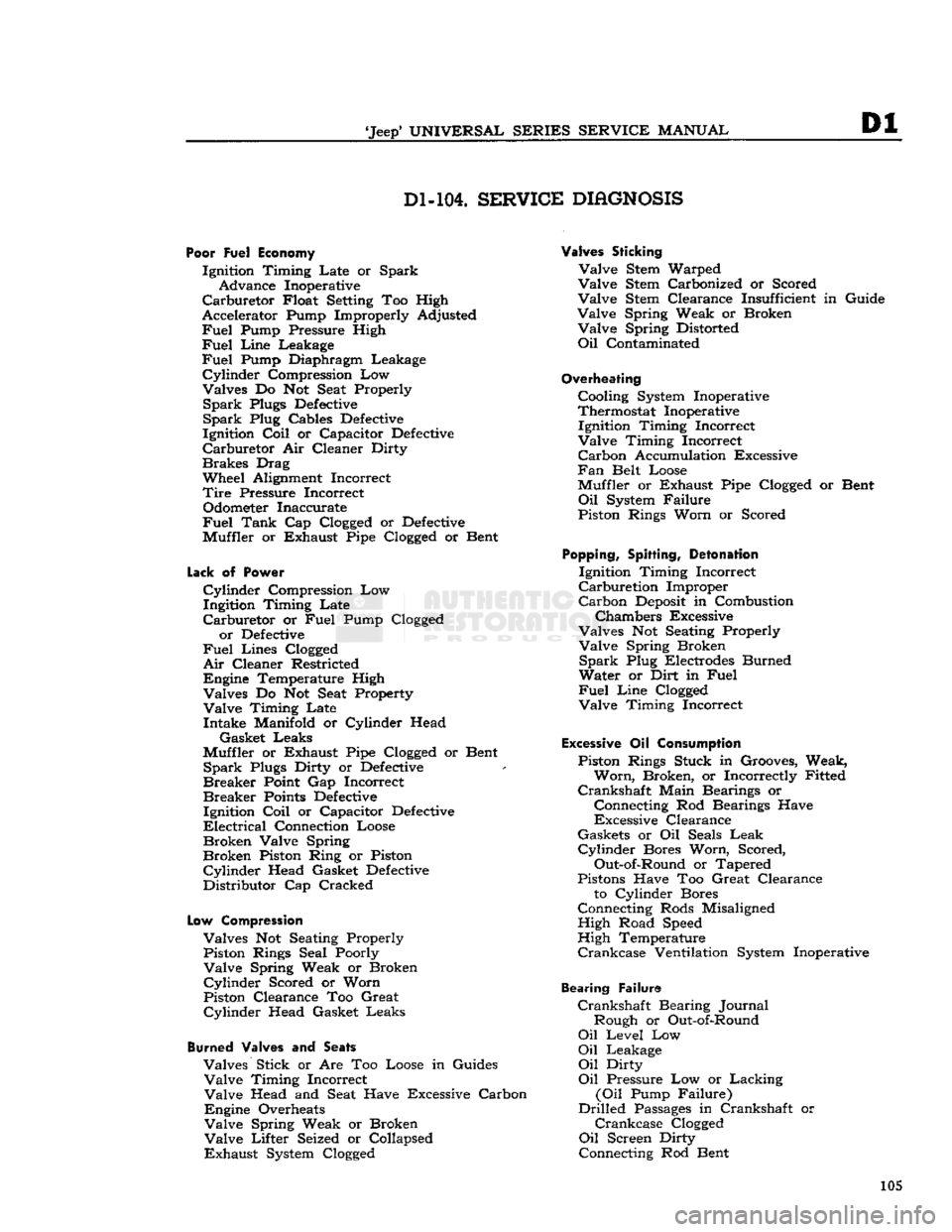
SERVICE
DIAGNOSIS
Poor Fuel Economy
Ignition Timing Late or Spark Advance Inoperative
Carburetor
Float Setting Too High
Accelerator Pump Improperly Adjusted
Fuel
Pump Pressure High
Fuel
Line
Leakage
Fuel
Pump Diaphragm Leakage
Cylinder
Compression Low
Valves Do Not Seat Properly
Spark
Plugs
Defective
Spark
Plug Cables
Defective
Ignition
Coil
or Capacitor
Defective
Carburetor
Air Cleaner Dirty
Brakes
Drag
Wheel Alignment Incorrect
Tire
Pressure Incorrect Odometer Inaccurate
Fuel
Tank
Cap Clogged or
Defective
Muffler or Exhaust Pipe Clogged or Bent
Lack
of
Power
Cylinder
Compression Low
Ingitdon Timing Late
Carburetor
or
Fuel
Pump Clogged or
Defective
Fuel
Lines Clogged
Air
Cleaner Restricted
Engine Temperature High Valves Do Not Seat Property
Valve
Timing Late Intake Manifold or Cylinder Head
Gasket Leaks
Muffler or Exhaust Pipe Clogged or Bent
Spark
Plugs Dirty or
Defective
Breaker
Point Gap Incorrect
Breaker
Points
Defective
Ignition
Coil
or Capacitor
Defective
Electrical
Connection Loose
Broken
Valve Spring
Broken
Piston Ring or Piston
Cylinder
Head Gasket
Defective
Distributor Cap Cracked
Low
Compression
Valves Not Seating Properly Piston Rings Seal Poorly
Valve
Spring Weak or Broken
Cylinder
Scored or Worn
Piston Clearance Too Great
Cylinder
Head Gasket Leaks
Burned
Valves and
Seats
Valves Stick or Are Too Loose in Guides
Valve
Timing Incorrect
Valve
Head and Seat Have Excessive Carbon
Engine Overheats
Valve
Spring Weak or Broken
Valve
Lifter Seized or Collapsed
Exhaust
System Clogged
Valves Sticking
Valve
Stem Warped
Valve
Stem Carbonized or Scored
Valve
Stem Clearance Insufficient in Guide
Valve
Spring Weak or Broken
Valve
Spring Distorted
Oil
Contaminated
Overheating
Cooling System Inoperative
Thermostat Inoperative Ignition Timing Incorrect
Valve
Timing Incorrect
Carbon
Accumulation Excessive
Fan
Belt Loose
Muffler or Exhaust Pipe Clogged or Bent
Oil
System Failure
Piston Rings Worn or Scored
Popping,
Spitting,
Detonation
Ignition Timing Incorrect
Carburetion
Improper
Carbon
Deposit
in Combustion
Chambers Excessive
Valves Not Seating Properly
Valve
Spring Broken
Spark
Plug Electrodes Burned
Water or Dirt in
Fuel
Fuel
Line
Clogged
Valve
Timing Incorrect
Excessive
Oil
Consumption
Piston Rings Stuck in Grooves, Weak,
Worn,
Broken, or Incorrectly Fitted
Crankshaft
Main Bearings or
Connecting Rod Bearings Have
Excessive Clearance
Gaskets or Oil Seals
Leak
Cylinder
Bores Worn, Scored,
Out-of-Round or Tapered
Pistons Have Too Great Clearance to Cylinder Bores
Connecting Rods Misaligned High Road Speed
High Temperature
Crankcase
Ventilation System Inoperative
Bearing Failure
Crankshaft
Bearing Journal Rough or Out-of-Round
Oil
Level Low
Oil
Leakage
Oil
Dirty
Oil
Pressure Low or Lacking
(Oil
Pump Failure)
Drilled
Passages
in Crankshaft or
Crankcase
Clogged
Oil
Screen Dirty
Connecting Rod Bent 105