1953 JEEP CJ lock
[x] Cancel search: lockPage 178 of 376

H
ELECTRICAL
SYSTEM
14365
FIG.
H-5—WIRING
DIAGRAM—F4
ENGINE
CURRENT
MODEL
1—
Left
Headlamp
2—
Left
Parking and Signal Lamp
3—
Right
Parking and Signal Lamp
4—
Right
Headlamp
5—
Marker
Lamp
— Amber
6—
Generator
7—
Distributor
8—
Ignition
Coil
9— Starting Motor
10— Battery Ground Cable
11—
12
Volt
Battery
12—
Flasher
(Directional Signal)
13— Instrument Cluster
A—Hi-Beam
Indicator
B—Auxiliary
C—Instrument Lights
D—Oil
Pressure
Indicator
E—Charging Indicator
F—Temperature Indicator
G—Fuel
Gauge
Indicator
H—Instrument Voltage Regulator
14—
Ignition
and
Starter
Switch
15—
Horn
Button 16—
Directional
Signal Switch 17— 4-Way
Flasher
Switch
18—
Flasher
(4-Way)
19—
Windshield
Wiper Motor Switch
20—
Main
Light
Switch
21—
Fuel
Gauge
Tank
Unit
22—
Back-Up
Light
Switch
23—
Marker
Lamp — Red 24—
Right
Tail
and Stop Lamp
25—
Right
Back-Up Lamp
26—
Left
Back-Up Lamp
27—
Right
Tail
and Stop Lamp
28—
Marker
Lamp — Red 29— Stop
Light
Switch
30— Foot Dimmer Switch
31—
Windshield
Wiper Motor Assembly
32—
Voltage Regulator
33— Temperature Sending
Unit
34—
Oil
Pressure
Sending
Unit
35— Spark
Plugs
&
Cables
36—
Horn
37— Junction Block
38—
Marker
Lamp — Amber
through a
two-position
push-pull switch located on
the
left
side
of the control panel.
The
foot-operated
headlight dimmer switch is
mounted on the floorboard to the
left
of the steering
column.
H-9.
PRESTOLITE
DISTRIBUTOR
—
DAUNTLESS
V-6 and
HURRICANE
F4
ENGINE
The
Prestolite distributor on the F4
engine
is
mounted on the right
side
of the
engine
and is op
erated by a coupling on the oil pump shaft, see Fig.
D-l,
which is driven by a spiral gear on the cam
shaft. The spark advance is fully automatic, being controlled by built-in centrifugal
weights.
The Pres
tolite
distributor on the V-6
engine
(Fig. H-8) is mounted at the
left
front of the
engine
on the tim
ing chain cover. It is driven by a spiral gear on the
camshaft. The spark advance is fully automatic,
being controlled by built-in centrifugal
weights,
and by a vacuum advance system. While
some
parts of the distributor may be checked or replaced
with the unit mounted on the
engine,
it is
best
to periodically remove it for a thorough check. Infor mation covering the parts which can be serviced
without removal is
given
below.
The
Prestolite distributor installed on the V-6 en
gine
is similar in construction to the distributor in
stalled on the F4
engines
except
for the addition of
a
vacuum advance mechanism.
The
same checking procedures outlined in Par. C- 10a, are used for the Prestolite V-6 distributor with
exception
of specifications.
H-10. Distributor Cap
The
distributor cap should be inspected for cracks,
carbon runners and
evidence
of arcing. If any of
these
conditions
exists, the cap should be replaced.
Clean
any corroded high
tension
terminals.
H-11.
Rotor
Inspect the rotor for cracks or
evidence
of
excessive
burning at the end of the metal strip.
After a distributor rotor has had normal use the
end of the rotor will
become
burned. If burning is found on top of the rotor it indicates the rotor is
too short and
needs
replacing. Usually when this condition is found the distributor cap
segment
will 178
Page 179 of 376

'Jeep'
UNIVERSAL
SERIES
SERVICE
MANUAL
H
12967
FIG.
H-6—WIRING
DIAGRAM—LATE
V6
ENGINE
1—Left Headlamp
2—
Left
Parking and Signal Lamp
3—
Right
Parking and Signal Lamp
4—
Right
Headlamp
5— Voltage Regulator
6—
Alternator
7—
Oil
Pressure
Sender
8— Temperature
Sender
9—
Ignition
Distributor
10— Junction Block
11—
Horn
12—
Ignition
Coil
13— Starting Motor
14— Battery Ground Cable 15— Foot Dimmer Switch 21-
16— Stop
Light
Switch — Front 22-
17— Ballast 23-
18—
Flasher
(Directional Signal) 24-
19—
Fuse
25-
20— Instrument Cluster 26-
A—Hi-Beam
Indicator 27-
B—Auxiliary
28- C—Instrument Lights 29-
D—Oil
Pressure
Indicator 30-
E—Charging Indicator 31-F—Temperature Indicator 32-
G—Fuel
Gauge
33-
H—Instrument Voltage Regulator 34-
-Ignition
and
Starter
Switch
-Horn
Button
-Directional
Signal Switch
-4-Way
Flasher
Switch
-Flasher
(4-Way)
-Fuse
-Main
Light
Switch
-Stop
Light
Switch —
Rear
-Fuel
Gauge
Tank
Unit
-Back-Up
Light
Switch
-Right
Tail
and Stop Lamp
-Right
Back-Up Lamp
-Left
Back-Up Lamp
-Left
Tail
and Stop Lamp
be burned on the horizontal
face
and the cap will
also
need
replacing. H-12. Condenser
The
condenser
prolongs
the
life
of the distributor
points
by
preventing
arcing at the
contacts.
It
also
provides
a
hotter
spark by creating a reverse
surge
of current which rapidly breaks
down
the
magnetic
field of the coil by
demagnetizing
the core. Should
the
condenser
be leaky, a weak spark will result.
Check
the
condenser
lead for broken wires or
frayed insulation. Clean and
tighten
the
connec-
179
Page 180 of 376

H
ELECTRICAL
SYSTEM
ffKHs)
3—<§)
FIG.
H-7—WIRING
DIAGRAM—V6
ENGINE
CURRENT
MODEL
1—
Left
Headlamp
2—Left Parking and Signal Lamp
3— Right Parking and Signal Lamp
4—Right Headlamp 5—
Marker
Lamp — Amber
6— Alternator 7— Voltage Regulator
8— Starting Motor
9— Battery Ground Cable
10— 12 Volt Battery
11—
Flasher
(Directional Signal)
12— Instrument Cluster
A—Hi-Beam
Indicator
B—Auxiliary
C—Instrument
Lights
D—Oil
Pressure Indicator
E—Charging
Indicator
F—Temperature
Indicator
G—Fuel
Gauge Indicator
H—Instrument Voltage Regulator
13— Ignition and Starter Switch
14—
Horn
Button
15— Directional Signal Switch
16— 4-Way Flasher Switch 17—
Flasher
(4-Way)
18— Windshield Wiper Motor Switch
19—
Main
Light Switch
20—
Fuel
Gauge
Tank
Unit
21—
Back-Up
Light Switch
22—
Marker
Lamp — Red
23— Right
Tail
and
Stop
Light 24— Right Back-Up Lamp
25—
Left
Back-Up Lamp 26—
Left
Tail
and
Stop
Light
27—
Marker
Lamp — Red
28—
Stop
Light Switch
29— Foot Dimmer Switch
30— Windshield Wiper Motor Assembly
31—
Ballast
Resistor 32— Ignition
Coil
33—
Spark
Plugs and Cables 34— Temperature Sending Unit
35—
Oil
Pressure Sending Unit 36—
Horn
37— Junction Block
38—
Marker
Lamp — Amber
lions
on the terminal
posts.
Be sure
condenser
is
mounted
firmly on the distributor for a
good
ground
connection.
Should a
condenser
tester
be available the capacity for
both
F4 and Prestolite V6
condenser
should
check from .25 to .28 microfarads. In the
absence
of
tester,
check by substituting a new
condenser.
H-13. Distributor Points
a. Examine the distributor
points.
If
they
show
wear,
poor
mating, transferred metal, or pitting,
then
new
ones
should be installed. Clean the
points
with a suitable
solvent
and a stiff bristled brush.
b. Check the
alignment
of the
point
for a full,
square
contact.
If not correctly aligned, bend the
stationary
contact
bracket slightly to provide align
ment.
c. The
contact
gap should be set at .020"
[0,508
mm.],
on the F4 and .016"
[0,406
mm.] on the
Prestolite V6. Adjustment of the gap is accom plished by
loosening
the lock screw and turning adjusting eccentric screw until correct gap is
secured. Be sure that the fiber block on the breaker
arm
is resting on the
highest
point
on the cam while the adjustment is
being
made. Recheck the gap
after locking the adjustment.
d. Apply a thin film of cam lubricant to the cam to
lessen
fiber block wear.
e. Using Tool C-4094, check
point
contact
spring
pressure, which should be
between
17 and 20
ounces
[0,487
a
0,567
kg.] on the F4 and 17 to 22 oz.
[0,487
a
0,624
kg.] on the Prestolite V6.
Check
with a spring scale
hooked
on the breaker
arm
at the
contact
and pull at right
angle
to the
breaker arm. Make the reading just as the
points
separate. Adjust the
point
pressure by
loosening
the stud holding the end of the
contact
arm spring
and slide the end of the spring in or out as
neces
sary.
Retighten the stud and recheck the pressure. Too low a- pressure will
cause
engine
missing at
high
speeds.
Too high a pressure will
cause
rapid
wear of the cam, block, and
points.
180
Page 182 of 376

H
ELECTRICAL
SYSTEM
FIG.
H-9—DISTRIBUTOR ASSEMBLY- HURRICANE F4 ENGINE 1—
Cap
6—Advance Plate
Lock
Screw
2—
Rotor
7—Oiler and
Felt
Wick
3—
Primary
Wire
8—Drive Shaft
4—
Breaker
Plate 9—Drive Shaft
Collar
and
Thrust
Washer 5—
Governor
Weights
attaching screws; remove vacuum advance unit
from housing.
e. Remove the two clamp
hinge
to breaker plate
screws; remove breaker plate from housing.
f. Remove the shaft assembly. To do this, file off
the upset end of the pin which is placed through
the collar and shaft at the lower end of the housing
and
drive out the pin with a suitable punch. Re
move
the collar and washer.
Pull
the shaft from
the housing.
g. Should it be necessary to remove the cam as
sembly, first remove the
felt
wick from the upper
end. Use
long-nose
pliers to compress and remove the spring locking clip located at the
bottom
of the
drilled
center opening of the cam. Remove the cam.
H-17.
Distributor Inspection
If
the shaft and bearings are worn sufficiently
to allow .005" or more
looseness
of the shaft,
they
must be replaced. Before installing new bearings,
soak them in medium grade
engine
oil and allow
them to
drain.
Wipe all oil from the upper part of
the housing.
Important:
After new bearing installation,
drill
a
y%"
[3,2 mm.] lubrication
hole
through the upper bearing
before
installing the drive shaft. Refer
to Fig. H-8 item 16.
At
assembly, apply a film of grease to the upper
drive
shaft washer and put a small amount of
grease in the bearing bore just
above
the bearings.
Lubricate
the governor mechanism sparingly with
medium grade
engine
oil in the oiler mounted on
the side of the housing and 5 drops on the
left
located in the center opening of the cam directly
below
the rotor. Place a very light smear of grease
on the cam and 1 drop of oil on the breaker arm pivot.
Before installing the distributor, check the friction
spring
mounted on the lower end of the drive shaft
and
replace it if worn or damaged. Inspect rod end of vacuum advance mechanism
for
excessive
wear. Push rod
into
unit as far as
possible, hold finger tightly over nipple, then release rod. After about 15 seconds, remove finger
from nipple, and
notice
if air is drawn
into
unit.
If
not, diaphragm is leaking and unit must be
replaced.
H-18.
Installation and Ignition
Timing
If
the
engine
crankshaft has
been
rotated, with the
distributor off, it
will
be necessary to place No. 1
piston in firing position to correctly install the distributor. Refer to
Pars.
C-10 and
C-ll. Oil
the distributor housing where it bears in the
cylinder
block and install the distributor on the
cylinder
block. Mount the rotor on distributor shaft
and
turn
the shaft until the rotor
points
towards No. 1
spark
terminal tower position (when cap is installed) with the contact
points
just breaking. Move the rotor back and forth slightly until the
driving
lug on the end of the shaft enters the
slot
cut in the oil pump gear and slide the distributor
assembly down
into
place. Rotate the distributor
body
until the contact
points
are just breaking.
Install
the hold down screw.
H-19.
Ignition
Coil
— F4 Engine
The
sealed coil
does
not require any special service
other than keeping the terminals and wire con nection clean and tight.
The
positive (+) terminal of the coil is connected
to the ignition switch and is also connected directly
to the starter solenoid to by-pass the resistance
during
cranking of
engine.
The
negative
(—) terminal is connected to the
distributor. The secondary (High tension) terminal
is connected by a short cable to the center terminal
in
the distributor cap.
Note:
Always make certain the coil wires are con
nected to the proper coil terminals to ensure cor
rect coil polarity.
H-20. DELCO DISTRIBUTOR
—
DAUNTLESS
V-6
ENGINE
The
distributor (Fig. H-10) is mounted at the
left
front of the
engine
on the timing chain cover. It
is driven by a
spiral
gear on the camshaft. The
spark
advance is fully automatic, being controlled 182
Page 183 of 376

'Jeep*
UNIVERSAL
SERIES SERVICE
MANUAL
H
|
13399
FIG.
H-10—DELCO
DISTRIBUTOR—
DAUNTLESS
V-6
ENGINE
1—
Rotor
8—Vacuum
Unit
2—
Window
9—Breaker Cam
3—
All
Weather Cap
10—Drive
Gear
4—
Cap
Latch
11—Primary Lead 5—
Rotor
Mounting
Screw 12—Contact Set
6—
Lock
Washer 13—Condenser
7—
Advance
Mechanism
by
built-in
centrifugal weights, and by a vacuum
advance
system. Contact point opening is adjusted
through
a window in the distributor cap
while
the engine is
idling.
Some
parts
of the distributor may be checked or replaced
with
the distributor mount
ed on the engine, but it is
best
to remove it periodi
cally
for a thorough check. Information on
parts
which
can be serviced without removal is given
below.
Note:
Prestolite and Delco distributors are inter
changeable
on V-6 engine equipped vehicles.
H-21.
Distributor Cap
The distributor cap should be inspected for cracks,
carbon runners and evidence of arcing. If any of
these
conditions exist, the cap should be replaced. Clean any corroded high tension terminals.
H-22.
Rotor
Inspect the rotor for cracks or evidence of
exces
sive burning at the end of the metal strip.
After
a distributor rotor has had normal use, the
end of the rotor
will
become
burned. If burning is
found
on top of the rotor it indicates the rotor is too short and
needs
replacing. Usually when this
condition
is found the distributor cap
segment
will
be burned on the horizontal face and the cap
will
also
need
replacing.
H-23.
Condenser
The
condenser
prolongs the
life
of the distributor
points by preventing arcing at the contacts. It
also
provides a hotter spark by creating a
reverse
surge
of
current
which
rapidly
breaks
down the magnetic
field
of the
coil
by demagnetizing the core. Should
the
ccnaenser
be leaky a weak spark
will
result. Check the
condenser
lead for broken wires or
frayed
insulation.
Clean and tighten the connections
on
the terminal
posts.
Be
sure
the
condenser
is mounted
firmly
on the distributor for a good ground
connection.
Should
a
condenser
tester
be available the capacity
should check
from
.18 to .23 microfarads. In the
absence
of a
tester
check by substituting new con
denser.
H-24. Distributor Points
a-
Examine distributor points. Using
Tool
C-4094, check point contact spring
pressure,
should be 19 to 23 oz. [0,538 a 0,652 kg.]. Install new points
if
they are
worn,
pitted,
mate
poorly, or show
signs
of
metal transfer. Should premature
ignition
point
failure
occur
because
of dust entering the
distri
butor cap and causing
excessive
wear to the
ignition
point
fiber block, perform the
following
correc
tions after installing new distributor points.
FIG. H-l
1—SEALING
DISTRIBUTOR
CAP
1—Caulking
Compound
183
Page 184 of 376
H
ELECTRICAL
SYSTEM
14237
FIG.
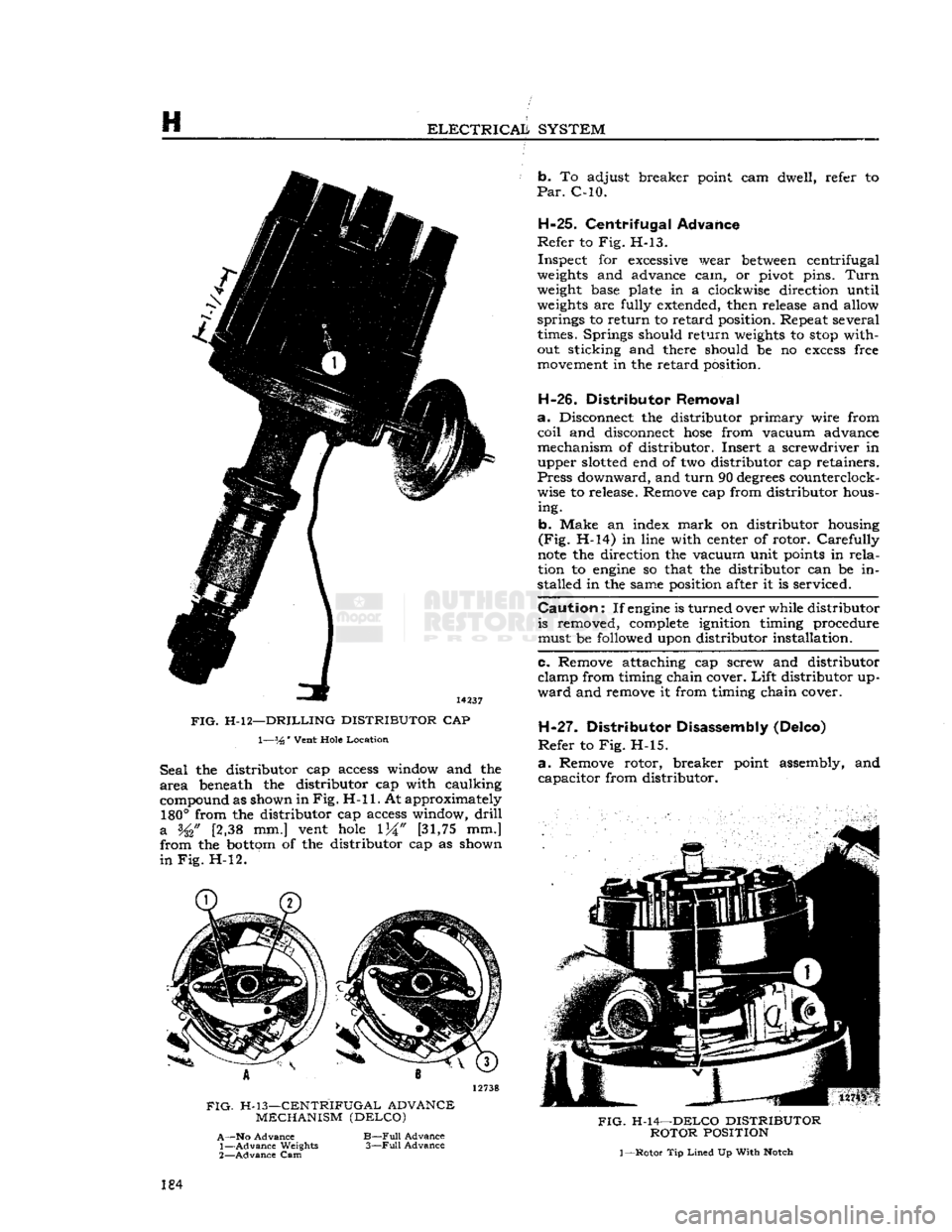
H-l2—DRILLING DISTRIBUTOR
CAP 1—%'
Vent
Hole
Location
Seal
the distributor cap access window and the
area
beneath the distributor cap with caulking
compound as shown in
Fig. H-ll.
At approximately
180°
from the distributor cap access window,
drill
a
[2,38 mm.] vent
hole
[31,75
mm.]
from the
bottom
of the distributor cap as shown
in
Fig. H-l2. b. To adjust breaker point cam dwell, refer to
Par.
C-10.
H-25.
Centrifugal Advance
Refer
to Fig. H-13.
Inspect for
excessive
wear
between
centrifugal
weights
and advance cam, or pivot pins.
Turn
weight
base plate in a clockwise direction until
weights
are fully extended, then release and allow springs to return to retard position. Repeat several times. Springs should return
weights
to
stop
without sticking and there should be no
excess
free
movement
in the retard position.
H-26.
Distributor Removal
a.
Disconnect the distributor primary wire from
coil
and disconnect
hose
from vacuum advance
mechanism of distributor. Insert a screwdriver in upper
slotted
end of two distributor cap retainers.
Press
downward, and turn 90
degrees
counterclock
wise to release. Remove cap from distributor hous ing.
b. Make an index
mark
on distributor housing
(Fig.
H-14) in line with center of rotor. Carefully
note
the direction the vacuum unit
points
in
rela
tion to
engine
so that the distributor can be in
stalled in the same position after it is serviced.
Caution:
If
engine
is turned over while distributor is removed,
complete
ignition timing procedure
must be followed upon distributor installation.
c. Remove attaching cap screw and distributor
clamp from timing chain cover.
Lift
distributor up
ward
and remove it from timing chain cover.
H-27.
Distributor Disassembly (Delco)
Refer
to Fig. H-l5.
a.
Remove rotor, breaker point assembly, and capacitor from distributor.
FIG.
H-13—CENTRIFUGAL ADVANCE
MECHANISM (DELCO)
A—No
Advance
1—
Advance
Weights
2—
Advance
Cam
B—Full
Advance
3—Full
Advance
FIG.
H-14—DELCO DISTRIBUTOR
ROTOR
POSITION
1
—Rotor
Tip
Lined
Up
With
Notch
184
Page 185 of 376
'Jeep*
UNIVERSAL
SERIES SERVICE
MANUAL
H
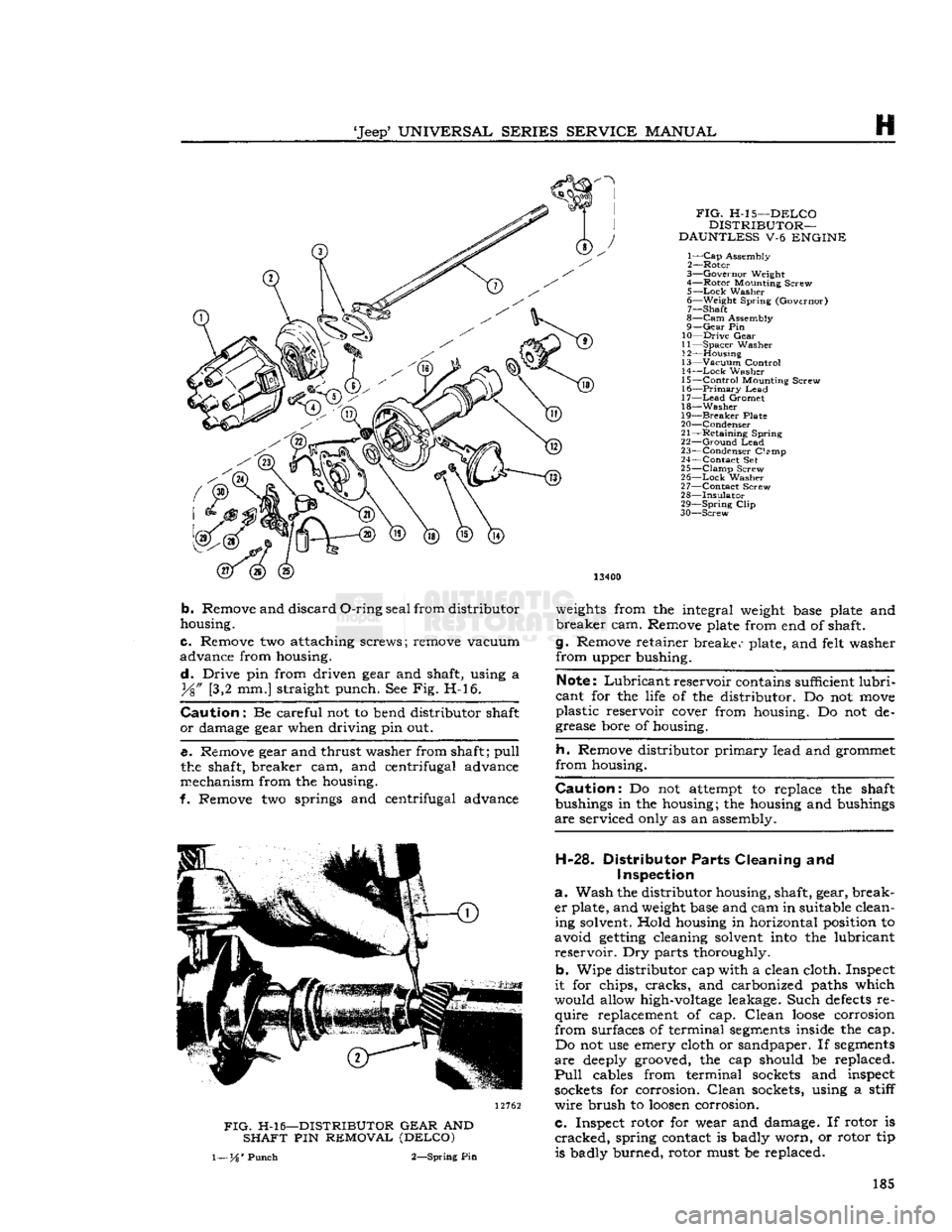
FIG.
H-l 5 -DELCO
DISTRIBUTOR—
DAUNTLESS V-6 ENGINE
1—
Cap Assembly
2— Rotor
3— Governor Weight
4— Rotor
Mounting
Screw 5—
Lock
Washer
6—
Weight
Spring (Governor) 7— Shaft
8— Cam Assembly
9—
Gear
Pin
10—
Drive
Gear
11—
Spacer
Washer
12—
Housing
13—
Vacuum
Control
14—
Lock
Washer
15—
Control
Mounting
Screw
16—
Primary
Lead
17— Lead Gromet
18— Washer
19—
Breaker
Plate
20—
Condenser
21—
Retaining
Spring
22—
Ground
Lead
23—
Condenser
Clsmp
24— Contact Set
25— Clamp Screw
26—
Lock
Washer
27— Contact Screw
28—
Insulator 29—
Spring
Clip
30—
Screw 13400
b.
Remove and discard
O-ring
seal from distributor
housing.
c. Remove two attaching screws; remove vacuum
advance from housing.
d.
Drive pin from driven gear and shaft, using a
y%"
[3,2 mm.] straight punch. See Fig. H-l6.
Caution:
Be careful not to bend distributor shaft
or damage gear when driving pin out.
e.
Remove gear and thrust washer from shaft; pull the shaft, breaker cam, and centrifugal advance
mechanism from the housing.
f. Remove two springs and centrifugal advance
weights
from the integral
weight
base plate and
breaker
cam. Remove plate from end of shaft.
g. Remove retainer breaker plate, and
felt
washer from upper bushing.
Note:
Lubricant
reservoir contains sufficient
lubri
cant for the life of the distributor. Do not
move
plastic reservoir cover from housing. Do not de-
grease bore of housing.
h. Remove distributor primary lead and grommet
from housing.
Caution:
Do not attempt to replace the shaft
bushings in the housing; the housing and bushings
are
serviced only as an assembly.
FIG.
H-l6—DISTRIBUTOR GEAR AND
SHAFT PIN REMOVAL (DELCO) 1— H' Punch
2—Spring
Pin
H-28.
Distributor Parts
Cleaning
and
Inspection
a.
Wash the distributor housing, shaft, gear, break
er
plate, and
weight
base and cam in suitable clean ing solvent. Hold housing in horizontal position to
avoid
getting
cleaning solvent
into
the lubricant
reservoir.
Dry parts thoroughly.
b.
Wipe distributor cap with a clean cloth. Inspect
it for chips,
cracks,
and carbonized paths which
would allow
high-voltage
leakage. Such
defects
re
quire
replacement of cap.
Clean
loose
corrosion
from surfaces of terminal
segments
inside the cap. Do not use emery cloth or sandpaper. If
segments
are
deeply
grooved, the cap should be replaced.
Pull
cables from terminal
sockets
and inspect
sockets
for corrosion.
Clean
sockets, using a stiff
wire
brush to
loosen
corrosion.
c.
Inspect rotor for wear and damage. If rotor is
cracked,
spring contact is badly worn, or rotor tip is badly burned, rotor must be replaced. 185
Page 186 of 376

ELECTRICALJ
SYSTEM
d.
Inspect for
excessive
wear
between
centrifugal
weights
and advance cam and pivot pins.
Turn
weight
base plate in a clockwise direction until
weights
are fully extended. Release and allow
springs to return
weights
to
retard
position. Repeat several times. Springs should return
weights
to
stop
without sticking and there should be no
excessive
free
movement
in the
retard
position. Inspect
springs for distortion and fatigue.
e. Inspect cam
lobes
for scoring or
excessive
wear.
Check
weight
base plate for binding or
excessive
looseness
on distributor shaft.
f.
Check
breaker plate for
excessive
looseness
on
outside
diameter of upper distributor shaft bushing.
Check
breaker plate ground lead for poor
spot
we
Id
at plate end and for
loose
or frayed terminal con
nections.
g.
Check
for
excessive
wear
between
distributor
shaft and bushings in housing. Inspect shaft for distortion. Inspect gear for scoring of
teeth
or
excessive
wear.
h.
Inspect rod end of vacuum advance mechanism
for
excessive
wear. Push rod
into
unit as far as
possible, hold finger tightly over nipple, then re
lease
rod. After about 15 seconds, remove finger
from nipple, and
notice
if air is drawn
into
unit.
If
not, diaphragm is leaking and unit must be
replaced.
H-29.
Distributor Reassembly
Refer
to Fig. H-l5.
a.
Install
distributor
primary
lead and rubber grommet in distributor housing. Mount vacuum
advance unit on housing with two
slotted
attaching
screws; insert ground lead terminal of breaker plate under outer mounting screw.
b.
Install
felt
washer over upper shaft bushing of
distributor housing and apply a few drops of light
oil.
Secure breaker plate to upper bushing with re tainer. See Fig. H-17.
12767
FIG.
H-17—INSTALLING
BREAKER
PLATE
ON
DISTRIBUTOR
HOUSING
(DELCO)
1—
Breaker
Plate
2—
Retainer
3—
Retainer
Groove
4—
Lubricant
Reservoir c.
Install
distributor cam and
weight
base plate
on distributor shaft.
d.
Insert distributor shaft
into
distributor housing.
Install
centrifugal advance
weights
and springs on
cam
and
weight
base plate. e. Fasten driven gear to shaft with pin. Be care
ful
not to damage gear.
f.
Secure condenser and bracket to breaker plate
with
slotted
screw.
g.
Install
breaker point assembly over
boss
on
breaker
plate; secure with two
slotted
screws and
lock washers. Apply one drop of light oil to breaker
arm
pivot. Connect condenser and coil
primary
leads to breaker point assembly.
h.
Apply a small amount of high temperature cam
and
ball
bearing lubricant to a clean cloth; hold cloth against distributor cam while turning
distri
butor shaft.
Caution:
Do not apply
excessive
grease. Petro
leum jelly is not suitable as a distributor cam
lubri
cant.
i.
Make preliminary adjustment of breaker point
gap, as described in Par. C-10.
].
Secure rotor to centrifugal timing advance mech
anism with two screws, lock washers, and flat
washers.
Note:
The square and round
lugs
on the rotor must
be positioned in the corresponding
holes
in the
weight
base plate.
k. If a reliable distributor tester is available, check
the distributor to make certain that the centrifugal
and
vacuum advance mechanisms are operating
according to specifications.
Note:
Mount distributor in tester with all end play
of the distributor shaft in upward position; this
will
eliminate any possible drag
between
the centri fugal advance cam and
weight
base plate.
I.
Install
new
O-ring
seal on distributor housing.
H-30.
Distributor
Installation
and
Timing
a.
Insert distributor shaft
into
timing gear cover
of
engine
so that rotor is pointing to
mark
made on distributor base (Fig. H-14), with vacuum advance
unit pointing in exact, original direction (Fig.
H-18).
b.
Install
distributor clamp and
bolt
with lock
washer, leaving
bolt
just
loose
enough
to permit
movement
of the distributor with heavy hand
pressure.
C.
Connect
primary
wire to distributor side of coil.
Install
distributor cap on distributor housing. Press
screwdriver
into
upper
slotted
ends
of two cap
retainers.
Turn
retainers clockwise to secure cap to distributor.
d.
If
spark
cables were disconnected from
distri
butor cap, connect them. Wires must be pushed
all
the way down
into
the distributor cap terminals
and
onto
the
spark
plugs. Nipples must be pushed
firmly
over the terminals;
boots
must be pushed
firmly
over the
spark
plugs. 186