2024 FORD F650/750 park assist
[x] Cancel search: park assistPage 7 of 386
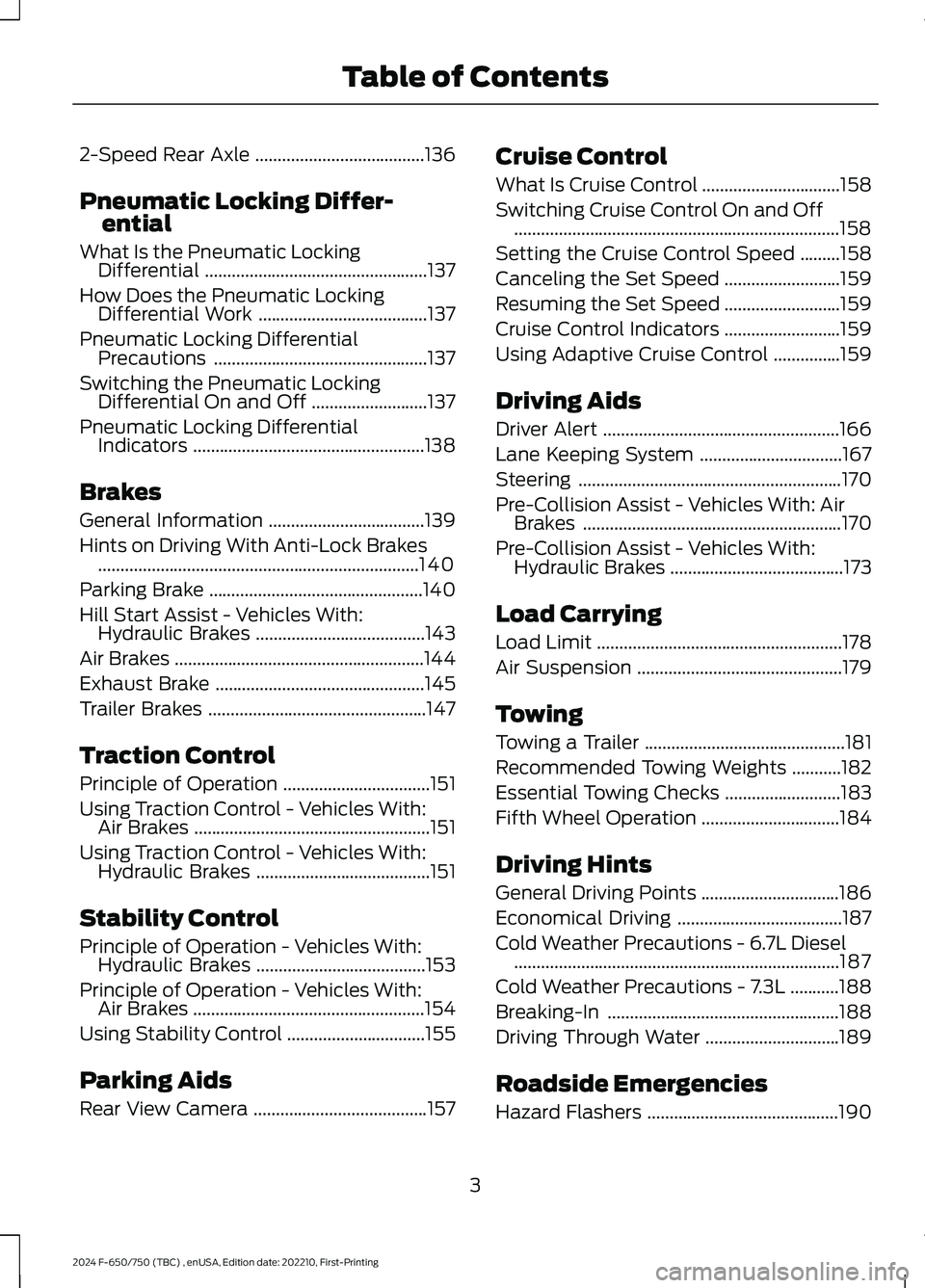
2-Speed Rear Axle......................................136
Pneumatic Locking Differ-ential
What Is the Pneumatic LockingDifferential..................................................137
How Does the Pneumatic LockingDifferential Work......................................137
Pneumatic Locking DifferentialPrecautions................................................137
Switching the Pneumatic LockingDifferential On and Off..........................137
Pneumatic Locking DifferentialIndicators....................................................138
Brakes
General Information...................................139
Hints on Driving With Anti-Lock Brakes........................................................................140
Parking Brake................................................140
Hill Start Assist - Vehicles With:Hydraulic Brakes......................................143
Air Brakes........................................................144
Exhaust Brake...............................................145
Trailer Brakes.................................................147
Traction Control
Principle of Operation.................................151
Using Traction Control - Vehicles With:Air Brakes.....................................................151
Using Traction Control - Vehicles With:Hydraulic Brakes.......................................151
Stability Control
Principle of Operation - Vehicles With:Hydraulic Brakes......................................153
Principle of Operation - Vehicles With:Air Brakes....................................................154
Using Stability Control...............................155
Parking Aids
Rear View Camera.......................................157
Cruise Control
What Is Cruise Control...............................158
Switching Cruise Control On and Off.........................................................................158
Setting the Cruise Control Speed.........158
Canceling the Set Speed..........................159
Resuming the Set Speed..........................159
Cruise Control Indicators..........................159
Using Adaptive Cruise Control...............159
Driving Aids
Driver Alert.....................................................166
Lane Keeping System................................167
Steering...........................................................170
Pre-Collision Assist - Vehicles With: AirBrakes..........................................................170
Pre-Collision Assist - Vehicles With:Hydraulic Brakes.......................................173
Load Carrying
Load Limit.......................................................178
Air Suspension..............................................179
Towing
Towing a Trailer.............................................181
Recommended Towing Weights...........182
Essential Towing Checks..........................183
Fifth Wheel Operation...............................184
Driving Hints
General Driving Points...............................186
Economical Driving.....................................187
Cold Weather Precautions - 6.7L Diesel.........................................................................187
Cold Weather Precautions - 7.3L...........188
Breaking-In....................................................188
Driving Through Water..............................189
Roadside Emergencies
Hazard Flashers...........................................190
3
2024 F-650/750 (TBC) , enUSA, Edition date: 202210, First-PrintingTable of Contents
Page 14 of 386

•The gearshift lever must be in P (Park)or N (Neutral) in order for the starterto operate.
•Try operating the starter switch severaltimes. This operation may cleanpotentially corroded contacts or makethe switch temporarily operable untilyou can reach the dealer.
•If all electrical connections are tightand you need assistance to start, SeeJump Starting the Vehicle (page 190).
If engine cranks but won’t start
Prolonged starter cranking (in excess of 10seconds) could cause damage to thestarter motor or the high-pressure fuelpump.
•Check the fuel gauge. You may be outof fuel. If the gauge shows that thereis fuel in the tank, the trouble may bein the electrical system or the fuelsystem. If equipped with an auxiliarytank, be sure that the tank controlswitch is set for the tank with fuel andnot on an empty tank.
•Leaving your ignition key turned to onfor over two minutes without startingmay make starting difficult becausethe glow plugs will cease activation.Reset the system by turning the ignitionkey to off and then back to on again.
Note:If the system is out of fuel and theengine will not start, do not continuecranking the engine. Continued cranking candamage the high-pressure fuel pump.
If the engine runs hot
The following could cause the engine tooverheat:
•Lack of coolant
•Dirty cooling system.
•Plugged radiator fins, A/C condenserand/or oil cooler
•Malfunctioning fan drive
•Driving with frozen coolant
•Sticking thermostat
•Overloading or pulling heavy trailersduring hot weather
•Grill or radiator air blockage
•Slipping or missing drive belt
•Plugged or very dirty air filter
If fuses burn out
WARNING: Replacement fuses andcircuit breakers must always be thesame rating as the original equipmentshown. Never replace a fuse or circuitbreaker with one of a higher rating.Higher rated fuses or circuit breakerscould allow circuit overloading in theevent of a circuit malfunction, resultingin severe vehicle damage or personalinjury due to fire.
Burned-out or blown fuses usually indicatean electrical short-circuit, although a fusemay occasionally burn out from vibration.Insert a second fuse. If this fuseimmediately burns out and you cannotlocate the cause, return your vehicle toyour dealer for a circuit check. SeeChanging a Fuse (page 211).
Selective catalytic reduction systemspeed limit and Idle-only modes
If the vehicle’s speed is limited or in anidle-only mode, the selective catalyticreduction system may be limiting thevehicle’s functions due to low orcontaminated DEF. Check the DEF. SeeSelective Catalytic Reductant System(page 120).
10
2024 F-650/750 (TBC) , enUSA, Edition date: 202210, First-PrintingIntroduction
Page 106 of 386

Note:When you switch the ignition off andleave your vehicle, do not leave your key inthe ignition. This could cause your vehiclebattery to lose charge.
I (accessory) - Allows the electricalaccessories, such as the radio, to operatewhile the engine is not running.
Note:Do not leave the ignition key in thisposition for too long. This could cause yourvehicle battery to lose charge.
II (on) - All electrical circuits areoperational and the warning lamps andindicators illuminate.
III (start) - Cranks the engine.
STARTING A GASOLINE
ENGINE
When you start the engine, the idle speedincreases helping to warm up the engine.If the engine idle speed does not slowdown, have your vehicle checked as soonas possible.
Before starting the engine check thefollowing:
•Make sure all occupants fasten theirseatbelts.
•Make sure the headlamps andelectrical accessories are off.
•Make sure the parking brake is on.
•Make sure the transmission is in park(P) or neutral (N).
•Turn the ignition key to the on position.
Note:Do not press the accelerator pedal.
1.Fully press the brake pedal.
2.Turn the key to the start position tostart the engine. Release the key whenthe engine starts.
Note:The engine may continue crankingfor up to 15 seconds or until it starts.
Note:If you cannot start the engine on thefirst try, wait for a short period and try again.
Failure to Start
If you cannot start the engine after threeattempts, wait 10 seconds and follow thisprocedure:
1.Fully press the brake pedal.
2.Shift into park (P).
3.Fully press and hold the acceleratorpedal.
4.Attempt to start your vehicle and waituntil the engine stops cranking.
5.Release the accelerator pedal.
6.Start the engine.
Stopping the Engine When YourVehicle is Stationary
1.Shift into park (P) or neutral (N).
2.Turn the key to the off position.
3.Apply the parking brake.
Stopping the Engine When YourVehicle is Moving
WARNING: Switching off theengine when your vehicle is still movingresults in a significant decrease inbraking assistance. Higher effort isrequired to apply the brakes and to stopyour vehicle. A significant decrease insteering assistance could also occur. Thesteering does not lock, but higher effortcould be required to steer your vehicle.When you switch the ignition off, someelectrical circuits, for example airbags,also turn off. If you unintentionally switchthe ignition off, shift into neutral (N) andrestart the engine.
1.Switch the ignition off to stop theengine.
102
2024 F-650/750 (TBC) , enUSA, Edition date: 202210, First-PrintingStarting and Stopping the Engine
Page 147 of 386

5.Tighten the nut until the spring is fullycaged and brakes released. Do notloosen or remove the release stud andnut unless you completely assembleand securely clamp the brake chamber.
6.After restoring the air pressure,unscrew and remove the release studand install in the carrying pocket. Installthe access plug.
HILL START ASSIST -
VEHICLES WITH: HYDRAULIC
BRAKES
WARNING: The system does notreplace the parking brake. When youleave your vehicle, always apply theparking brake.
WARNING: You must remain inyour vehicle when the system turns on.At all times you are responsible forcontrolling your vehicle, supervising thesystem, and intervening if required.Failure to follow this instruction couldresult in the loss of control of yourvehicle, personal injury or death.
WARNING: The system will turnoff if a malfunction is apparent or if yourev the engine excessively. Failure to takecare may result in the loss of control ofyour vehicle, serious personal injury ordeath.
The system makes it easier to pull awaywhen your vehicle is on a slope withoutneeding to use the parking brake.
When the system is active, your vehicleremains stationary on the slope for two tothree seconds after you release the brakepedal. This allows time to move your footfrom the brake to the accelerator pedal.The brakes release when the engine has
developed sufficient torque to prevent yourvehicle from rolling down the slope. Thisis an advantage when pulling away on aslope, for example from a car park ramp,traffic lights or when reversing uphill intoa parking space.
When the vehicle is on a slope, the systemwill turn on automatically to preventvehicle rollback.
Note:There is no warning light to indicatethe system is either on or off.
Using Hill Start Assist
1.Press the brake pedal to bring yourvehicle to a complete standstill. Keepthe brake pedal pressed and shift intogear when facing uphill or reverse (R)when facing downhill.
2.If the sensors detect that your vehicleis on a slope, the system automaticallyactivates.
3.When you remove your foot from thebrake pedal, your vehicle remains onthe slope without rolling away forabout two to three seconds. This holdtime automatically extends if you arein the process of driving off.
4.Drive off in the normal manner. Thesystem releases the brakesautomatically.
Note:When you remove your foot from thebrake pedal and press the pedal again whenthe system is active, you will experiencesignificantly reduced brake pedal travel. Thisis normal.
Switching the System On and Off
Vehicles with Manual Transmission
You can switch this feature on or off in theinformation display. The systemremembers the last setting when you startyour vehicle.
143
2024 F-650/750 (TBC) , enUSA, Edition date: 202210, First-PrintingBrakes
Page 187 of 386
ESSENTIAL TOWING CHECKS
See Load limits in the Load Carryingchapter for load specification terms foundon the tire label and Safety Compliancelabel and instructions on calculating yourvehicle's load.
Remember to account for the trailertongue weight as part of your vehicle loadwhen calculating the total vehicle weight.
Hitches
Do not use a hitch that either clamps ontothe bumper or attaches to the axle. Youmust distribute the load in your trailer sothat 10-15% of the total weight of thetrailer is on the tongue.
Safety Chains
Note:Do not attach safety chains to thebumper.
Always connect the safety chains to theframe or hook retainers of your vehiclehitch.
To connect the safety chains, cross thechains under the trailer tongue and allowenough slack for turning tight corners. Donot allow the chains to drag on the ground.
Trailer Brakes
WARNING: Do not connect atrailer's hydraulic brake system directlyto your vehicle's brake system. Yourvehicle may not have enough brakingpower and your chances of having acollision greatly increase.
Electric brakes and manual, automatic orsurge-type trailer brakes are safe if youinstall them properly and adjust them tothe manufacturer's specifications. Thetrailer brakes must meet local and federalregulations.
The rating for the tow vehicle's brakingsystem operation is at the gross vehicleweight rating, not the gross combinedweight rating.
Trailer Lamps
WARNING: Never connect anytrailer lamp wiring to the vehicle's taillamp wiring; this may damage theelectrical system resulting in fire. Contactyour authorized dealer as soon aspossible for assistance in proper trailertow wiring installation. Additionalelectrical equipment may be required.
Trailer lamps are required on most towedvehicles. Make sure all running lights, brakelights, turn signals and hazard lights areworking.
Before Towing a Trailer
Practice turning, stopping and backing upto get the feel of your vehicle-trailercombination before starting on a trip.When turning, make wider turns so thetrailer wheels clear curbs and otherobstacles.
When Towing a Trailer
•Check your hitch, electrical connectionsand trailer wheel lug nuts thoroughlyafter you have traveled 50 mph(80 km/h).
•When stopped in congested or heavytraffic during hot weather, place thetransmission in park (P) or neutral (N)to aid engine and transmission coolingand to help air conditioningperformance.
•Turn off the speed control with heavyloads or in hilly terrain. The speedcontrol may turn off automaticallywhen you are towing on long, steepgrades.
183
2024 F-650/750 (TBC) , enUSA, Edition date: 202210, First-PrintingTowing
Page 203 of 386
GETTING ASSISTANCE
OUTSIDE THE U.S. AND
CANADA
Before exporting your vehicle to a foreigncountry, contact the appropriate foreignembassy or consulate. These officials caninform you of local vehicle registrationregulations and where to find diesel fuel.
If you cannot find diesel fuel or can onlyget fuel with an anti-knock index lowerthan is recommended for your vehicle,contact a regional office or ownerrelations/customer relationship office.
The use of low quality diesel fuel mayaffect your emissions control system andmay cause engine damage. Ford MotorCompany/Ford of Canada is notresponsible for any damage caused by useof improper fuel. In the United States, usingleaded fuel may also result in difficultyimporting your vehicle back into the U.S.
Ford dealerships outside of the U.S. andCanada may be unable to support theF-650/750 due to the specialized trainingand servicing requirements of thesevehicles. If your vehicle must be servicedwhile you are traveling or living in Centralor South America, the Caribbean, or theMiddle East, contact the nearest Forddealership. If the dealership cannot helpyou, write or call:
FORD MOTOR COMPANYCustomer Relationship Center1555 Fairlane DriveFairlane Business Park #3Allen Park, Michigan 48101U.S.A.Telephone: (313) 594-4857Fax: (313) 390-0804Email: [email protected]
For customers in Guam, theCommonwealth of the Northern MarianaIslands (CNMI), America Samoa, and theU.S. Virgin Islands, please feel free to callour Toll-Free Number: (800) 841-FORD(3673).
If your vehicle must be serviced while youare traveling or living in Puerto Rico,contact the nearest authorized dealer. Ifthe authorized dealer cannot help you,contact:
FORD MOTOR COMPANYCustomer Relationship Center1555 Fairlane DriveFairlane Business Park #3Allen Park, Michigan 48101U.S.A.Telephone: (800) 841-FORD (3673)FAX: (313) 390-0804Email: [email protected]
If your vehicle must be serviced while youare traveling or living in the Middle East,contact the nearest authorized dealer. Ifthe authorized dealer cannot help you,contact:
FORD MOTOR COMPANYCustomer Relationship Center1555 Fairlane DriveFairlane Business Park #3Allen Park, Michigan 48101U.S.A.
Ford: 80004443673Lincoln: 80004441067If calling from the UAE: 80004441066If calling from the Kingdom of SaudiArabia: 8008443673If calling from Kuwait: 22280384
FAX: +971 4 3327266Email: [email protected]
199
2024 F-650/750 (TBC) , enUSA, Edition date: 202210, First-PrintingCustomer Assistance
Page 262 of 386
any air tanks equipped with automaticmoisture ejector valves, as required, tomaintain a dry air system. Contact anauthorized dealer if you are unsure of theair reservoir locations or the drainingprocedure.
Hydraulic Brakes
Establish a regular schedule for periodiccleaning, lubrication and adjustmentinspection based on vehicle use. Exactmaintenance intervals are difficult topredetermine due to vehicle applicationsand operating conditions. If you areuncertain of the proper schedule for yourvehicle, contact an authorized dealer.
Regular inspections should include:
•Checking the brake lining (every serviceinterval). Establish inspection intervalsthat provide for lining replacementbefore damage to the disc occurs.Excessive lining wear may expose thebacking plate to the disc causingscoring of the disc faces. A qualifiedtechnician should perform this
inspection and keep to instructionsprovided by the service manual.Hydraulic brake systems arepower-assisted. There is a greatreduction in braking capabilitieswithout engine assist.
•Proper fluid level. The level should beat the bottom edge of the ring on eachreservoir fill port. Do not fill the mastercylinder to the top of the reservoir. Iffluid level requires attention tomaintain a proper master cylinder level,this is an indication of either severeoperation (pad wear) or fluid leakage.A more frequent and thorough brakeinspection is required.
•Brake lines, hoses and fittings. Repairor replace brake line tubes, hoses orfittings as required. Inspect thesecomponents every 4,000 mi(6,000 km) for the following.
•Lines for kinks, dents, corrosion orrupture.
•Hoses for abrasions, kinks, softspots or rupture, collapse, cracks,twists or loose frame supports.When replacing a hose, be surethere is adequate clearance to thehose to avoid an abrasion to thenew hose.
•All connections for leaks.
Driveline Parking Brake
WARNING: Use wheel chocks andexercise caution when inspecting underthe vehicle. A vehicle roll-away couldresult in property damage, personal injuryor death.
A qualified technician should adjust theparking brake and keep to the instructionsin the service manual.
258
2024 F-650/750 (TBC) , enUSA, Edition date: 202210, First-PrintingMaintenance
Page 328 of 386
Less Cost to Properly Maintain YourVehicle
Ford Protect extended service plan alsooffers a Premium Maintenance Plan thatcovers all scheduled maintenance, andselected wear items. The coverage isprepaid, so you never have to worry aboutthe cost of your vehicle’s maintenance.
Covered maintenance includes:
•Windshield wiper blades.
•Spark plugs.
•The clutch disc (if equipped).
•Brake pads and linings.
•Shock absorbers.
•Struts.
•Engine belts.
•Engine coolant hoses, clamps andO-rings.
•Diesel exhaust fluid replenishment (ifequipped).
•Cabin air filter replacement every20,000 mi (32,000 km) (electricvehicles only).
Interest Free Finance Options
Just a 5% down payment will provide youwith an affordable, no interest, no feepayment program allowing you all thesecurity and benefits Ford Protectextended service plan has to offer whilepaying over time. You are pre-approvedwith no credit check or hassles. To learnmore, call our Ford Protect extendedservice plan specialists at 800-367-3377.
Ford Protect Extended Service PlanP.O. Box 321067Detroit, MI 48232
Ford Protect Extended ServicePlan (CANADA ONLY)
You can get more protection for yourvehicle by purchasing a Ford Protectextended service plan. Ford Protectextended service plan is the only servicecontract backed by Ford Motor Companyof Canada, Limited. Depending on the planyou purchase, Ford Protect extendedservice plan provides benefits such as:
•Rental reimbursement.
•Coverage for certain maintenance andwear items.
•Protection against repair costs afteryour New Vehicle Limited WarrantyCoverage expires.
•Roadside Assistance benefits.
There are several Ford Protect extendedservice plans available in various time,distance and deductible combinations.Each plan is tailored to fit your own drivingneeds, including reimbursement for towingand rental. When you purchase FordProtect extended service plan, you receiveadded peace-of-mind protectionthroughout Canada, the United States andMexico, provided by a network ofparticipating authorized Ford MotorCompany dealers.
Note:Repairs performed outside of Canadaand the United States are not eligible forFord Protect extended service plancoverage.
This information is subject to change. Formore information; visit your local Ford ofCanada dealer or www.ford.ca to find theFord Protect extended service plan that isright for you.
324
2024 F-650/750 (TBC) , enUSA, Edition date: 202210, First-PrintingFord Protect