2024 FORD F650/750 ECO mode
[x] Cancel search: ECO modePage 11 of 386

ABOUT THIS MANUAL
Thank you for choosing Ford. Werecommend that you take some time toget to know your vehicle by reading thismanual. The more that you know aboutyour vehicle, the greater the safety andpleasure you will get from driving it.
WARNING: Driving while distractedcan result in loss of vehicle control, crashand injury. We strongly recommend thatyou use extreme caution when using anydevice that may take your focus off theroad. Your primary responsibility is thesafe operation of your vehicle. Werecommend against the use of anyhand-held device while driving andencourage the use of voice-operatedsystems when possible. Make sure youare aware of all applicable local lawsthat may affect the use of electronicdevices while driving.
Note: Always use and operate your vehiclein line with all applicable laws andregulations.
Note: Pass on this manual when sellingyour vehicle. It is an integral part of yourvehicle.
Note:Your vehicle’s powertrain controlsystems can detect and store informationabout vehicle modifications that increasehorsepower and torque output such aswhether or not performance-enhancingpowertrain components commonly referredto as performance chips have been used.This information will stay in the system’smemory and cannot be erased even if themodification is removed. Ford MotorCompany, Ford of Canada, Ford of Mexicoand service or repair facilities can retrievethis information when servicing your vehicle.Ford Motor Company may use thisinformation to determine if your warrantycovers any needed repairs.
Note:Some aftermarket products maycause severe engine/transmission and/orexhaust system damage; refer to yourwarranty information for more information.
Your new diesel engine will feel, drive andfunction somewhat differently than agasoline engine. Therefore it is veryimportant that you read and thoroughlyfamiliarize yourself and others operatingthe vehicle with this guide. There is aspecial procedure for turning off the dieselengine. See Starting a Diesel Engine(page 103). It is important to read andunderstand this material in order tomaintain the best service life for yourengine.
Ford may discontinue models or changespecifications without any notice andwithout incurring obligations.
Note:Either Ford Motor Company or anauthorized Ford dealer may have originallysold this incomplete vehicle to a vehiclemodifier who upfitted it. As a result, someof the options and features on this vehiclemay differ from what we describe in thismanual.
This manual may qualify the location of acomponent as left-hand side or right-handside. The side is determined when facingforward in the seat.
7
2024 F-650/750 (TBC) , enUSA, Edition date: 202210, First-PrintingIntroduction
Page 12 of 386

Right-hand side.A
Left-hand side.B
Warnings
WARNING: Throughout this guide,you will find warnings identified by thewarning symbol. Warnings remind youto be especially careful to reduce the riskof personal injury.
Diesel Engine Information
The diesel engine fuel system is apressurized two-stage filtration systemand consists of:
•A frame-mounted Fuel and WaterSeparator primary filter with an electricfuel pump and water drain
•An engine-mounted secondary fuelfilter
•A fuel injector for each cylinder (8total)
•A high-pressure fuel pump
•A high-pressure fuel rail for eachcylinder bank (2 total)
•Numerous high-pressure pipes fromthe high-pressure pump to the rails,and rails to the injectors
The fuel and water separator removesboth water and impurities from the fuel.The engine-mounted filter filters finerimpurities from the diesel fuel. Theengine-mounted fuel filter and theframe-mounted fuel filter should bechanged at the recommended serviceinterval or when indicated by theinformation display LOW FUEL PRESSUREmessage. See Scheduled Maintenance(page 325).
The fuel and water separator should bedrained at regular intervals (recommendedat every oil change) or when indicated bythe information display and water in fuelindicator light. See Fuel Quality (page108).
Proper fuel filter maintenance and promptwater draining when the water in fuel lightilluminates is essential to prevent injectionequipment damage. Ignoring the water infuel light or the information displaymessage WATER IN FUEL DRAIN FILTERcan cause your vehicle to go into a reducedpower mode.
A frame-mounted electric fuel pumplocated inside the fuel and water separatordraws fuel from the fuel tank to providepressurized fuel to the engine. The fuelpump contains a pressure relief valve foroverpressure protection in the event ofrestricted flow.
The fuel injection system is controlledthrough the powertrain control module.
Engine Protection Mode
Ford diesel engines are equipped withengine protection and emission controlsystems. These systems monitor criticaltemperatures and pressures, and modifyengine operation accordingly. Thesemodified engine performancecharacteristics are normal.
8
2024 F-650/750 (TBC) , enUSA, Edition date: 202210, First-PrintingIntroductionE154903
Page 13 of 386

If these modified engine performancecharacteristics persist for an extendedperiod and either the service engine soonor powertrain malfunction, reduced power,electronic throttle control light isilluminated, have the system checked byan authorized dealer.
Service engine soon
Powertrain malfunction, reducedpower, electronic throttle control
Diesel Lubrication System
It is important to change the engine oil atthe recommended service intervals orwhen indicated by the information displayto maintain oil viscosity. Extending the oiland filter change interval beyond therecommended interval can negativelyaffect engine performance, fuel economyand engine life. See Engine Oil Check(page 227).
Engine and secondary cooling system
The cooling system contains a primarycooling loop to cool the engine and asecondary cooling loop to cool thetransmission, charge air, and fuel. Thecoolant serves three primary purposes: toprovide heat transfer, freeze pointprotection, and corrosion protection usingadditives.
Vehicles with diesel engines typically areused to carry heavy loads and accumulatemileage rapidly. These two factors maycause the additives in the coolant to wearout in a shorter time. You can find moreinformation about coolant additives andcoolant change intervals in the coolantchapter. See General MaintenanceInformation (page 325). Operating theengine with insufficient coolant or coolantadditive can cause severe engine damage.
Selective catalytic reduction system
Your vehicle is equipped with a selectivecatalytic reduction system designed toreduce emission levels of nitrogen oxidesfrom the exhaust of your diesel engine. Thissystem relies on the use of Diesel ExhaustFluid (DEF) that you must replenish atcertain intervals. Failure to maintain properDEF levels or if the DEF becomescontaminated will result in vehicle speedlimitations or result in your vehicle enteringan idle-only mode. See SelectiveCatalytic Reductant System (page 120).
Minor Troubleshooting Guide
If the engine won’t crank
WARNING: Battery posts,terminals and related accessoriescontain lead and lead compounds. Washhands after handling.
Turn on the headlights. If the lights are dim,do not go on at all or when the ignition isturned to the start position, the lightsbecome dim or go out, the batteryconnections may be loose or corroded, orthe battery may be discharged. If there isa clicking or stuttering sound coming fromthe engine compartment when you turnthe key to the start position, this may alsoindicate a loose or corroded batteryconnection.
Check the battery connections at thebattery posts, cable connection to theengine grounding point and at the starterconnection.
If you suspect a discharged battery, haveit checked and corrected.
9
2024 F-650/750 (TBC) , enUSA, Edition date: 202210, First-PrintingIntroductionE67028
Page 14 of 386

•The gearshift lever must be in P (Park)or N (Neutral) in order for the starterto operate.
•Try operating the starter switch severaltimes. This operation may cleanpotentially corroded contacts or makethe switch temporarily operable untilyou can reach the dealer.
•If all electrical connections are tightand you need assistance to start, SeeJump Starting the Vehicle (page 190).
If engine cranks but won’t start
Prolonged starter cranking (in excess of 10seconds) could cause damage to thestarter motor or the high-pressure fuelpump.
•Check the fuel gauge. You may be outof fuel. If the gauge shows that thereis fuel in the tank, the trouble may bein the electrical system or the fuelsystem. If equipped with an auxiliarytank, be sure that the tank controlswitch is set for the tank with fuel andnot on an empty tank.
•Leaving your ignition key turned to onfor over two minutes without startingmay make starting difficult becausethe glow plugs will cease activation.Reset the system by turning the ignitionkey to off and then back to on again.
Note:If the system is out of fuel and theengine will not start, do not continuecranking the engine. Continued cranking candamage the high-pressure fuel pump.
If the engine runs hot
The following could cause the engine tooverheat:
•Lack of coolant
•Dirty cooling system.
•Plugged radiator fins, A/C condenserand/or oil cooler
•Malfunctioning fan drive
•Driving with frozen coolant
•Sticking thermostat
•Overloading or pulling heavy trailersduring hot weather
•Grill or radiator air blockage
•Slipping or missing drive belt
•Plugged or very dirty air filter
If fuses burn out
WARNING: Replacement fuses andcircuit breakers must always be thesame rating as the original equipmentshown. Never replace a fuse or circuitbreaker with one of a higher rating.Higher rated fuses or circuit breakerscould allow circuit overloading in theevent of a circuit malfunction, resultingin severe vehicle damage or personalinjury due to fire.
Burned-out or blown fuses usually indicatean electrical short-circuit, although a fusemay occasionally burn out from vibration.Insert a second fuse. If this fuseimmediately burns out and you cannotlocate the cause, return your vehicle toyour dealer for a circuit check. SeeChanging a Fuse (page 211).
Selective catalytic reduction systemspeed limit and Idle-only modes
If the vehicle’s speed is limited or in anidle-only mode, the selective catalyticreduction system may be limiting thevehicle’s functions due to low orcontaminated DEF. Check the DEF. SeeSelective Catalytic Reductant System(page 120).
10
2024 F-650/750 (TBC) , enUSA, Edition date: 202210, First-PrintingIntroduction
Page 33 of 386
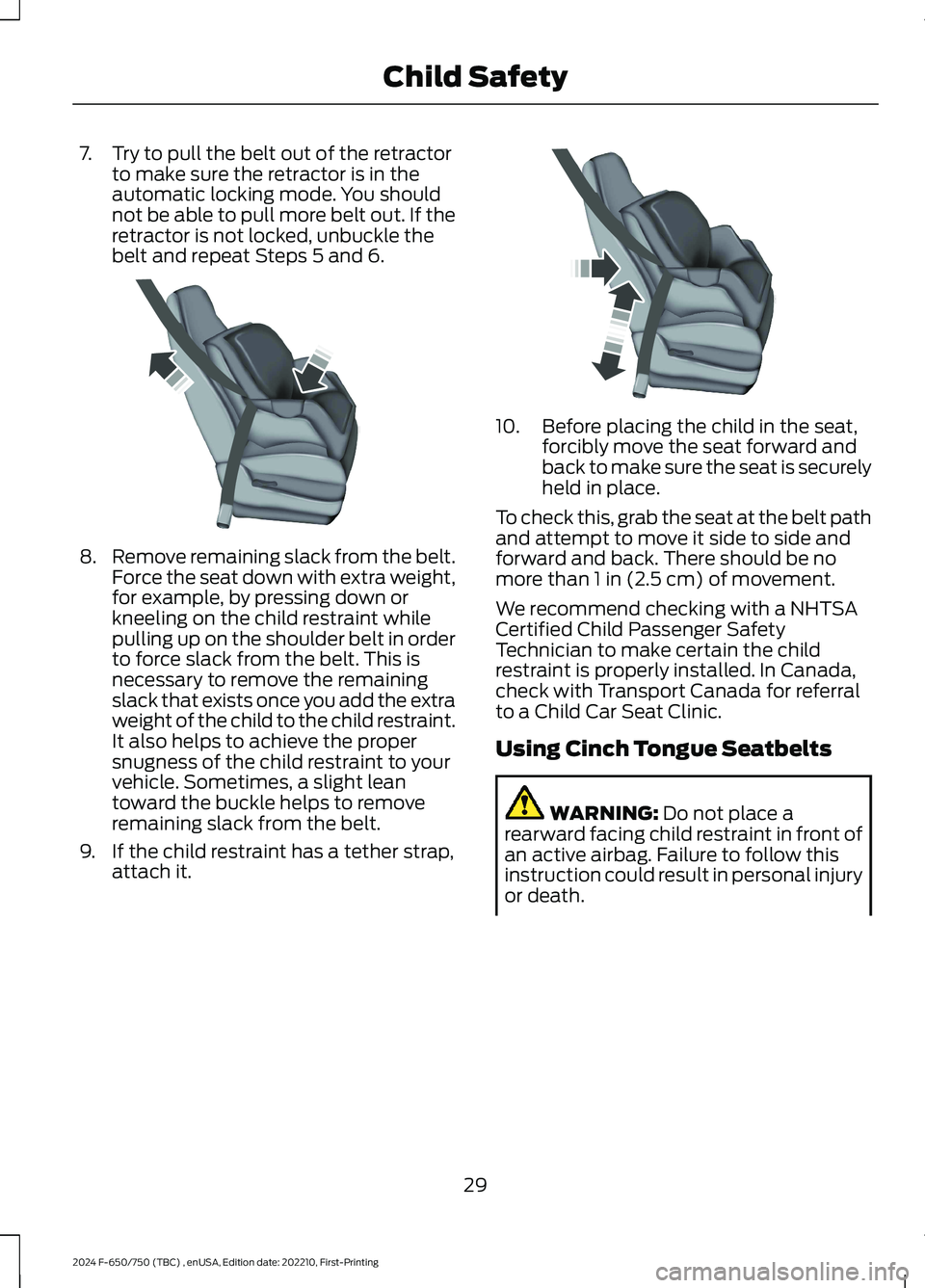
7.Try to pull the belt out of the retractorto make sure the retractor is in theautomatic locking mode. You shouldnot be able to pull more belt out. If theretractor is not locked, unbuckle thebelt and repeat Steps 5 and 6.
8.Remove remaining slack from the belt.Force the seat down with extra weight,for example, by pressing down orkneeling on the child restraint whilepulling up on the shoulder belt in orderto force slack from the belt. This isnecessary to remove the remainingslack that exists once you add the extraweight of the child to the child restraint.It also helps to achieve the propersnugness of the child restraint to yourvehicle. Sometimes, a slight leantoward the buckle helps to removeremaining slack from the belt.
9.If the child restraint has a tether strap,attach it.
10.Before placing the child in the seat,forcibly move the seat forward andback to make sure the seat is securelyheld in place.
To check this, grab the seat at the belt pathand attempt to move it side to side andforward and back. There should be nomore than 1 in (2.5 cm) of movement.
We recommend checking with a NHTSACertified Child Passenger SafetyTechnician to make certain the childrestraint is properly installed. In Canada,check with Transport Canada for referralto a Child Car Seat Clinic.
Using Cinch Tongue Seatbelts
WARNING: Do not place arearward facing child restraint in front ofan active airbag. Failure to follow thisinstruction could result in personal injuryor death.
29
2024 F-650/750 (TBC) , enUSA, Edition date: 202210, First-PrintingChild SafetyE142533 E142534
Page 42 of 386
PRINCIPLE OF OPERATION
WARNING: Always drive and ridewith the seat backrest upright and thelap belt snug and low across the hips.
WARNING: To reduce the risk ofinjury, make sure children sit where theycan be properly restrained.
WARNING: Never let a passengerhold a child on his or her lap while yourvehicle is moving. The passenger cannotprotect the child from injury in a crashwhich may result in serious injury ordeath.
WARNING: All occupants of thevehicle, including the driver, shouldalways properly wear their safety belts,even when an airbag supplementalrestraint system is provided. Failure toproperly wear your safety belt couldseriously increase the risk of injury ordeath.
WARNING: It is extremelydangerous to ride in a cargo area, insideor outside of a vehicle. In a crash, peopleriding in these areas are more likely to beseriously injured or killed. Do not allowpeople to ride in any area of your vehiclethat is not equipped with seats andsafety belts. Be sure everyone in yourvehicle is in a seat and using a safety beltproperly.
WARNING: In a rollover crash, anunbelted person is significantly morelikely to die than a person wearing asafety belt.
WARNING: Each seating positionin your vehicle has a specific safety beltassembly which is made up of onebuckle and one tongue that are designedto be used as a pair. 1) Use the shoulderbelt on the outside shoulder only. Neverwear the shoulder belt under the arm. 2)Never swing the safety belt around yourneck over the inside shoulder. 3) Neveruse a single belt for more than oneperson.
WARNING: When possible, allchildren 12 years old and under shouldbe properly restrained in a rear seatingposition. Failure to follow this couldseriously increase the risk of injury ordeath.
WARNING: Safety belts and seatscan become hot in a vehicle that hasbeen closed up in sunny weather; theycould burn a small child. Check seatcovers and buckles before you place achild anywhere near them.
WARNING: Front and rear seatoccupants, including pregnant women,should wear safety belts for optimumprotection in an accident.
All seating positions in this vehicle havelap and shoulder safety belts. Alloccupants of the vehicle should alwaysproperly wear their safety belts, even whenan airbag supplemental restraint systemis provided.
The safety belt system consists of:
•Lap and shoulder safety belts.
•Shoulder safety belt with automaticlocking mode, (except driver safetybelt).
38
2024 F-650/750 (TBC) , enUSA, Edition date: 202210, First-PrintingSeatbelts
Page 45 of 386
Using Seatbelts During Pregnancy
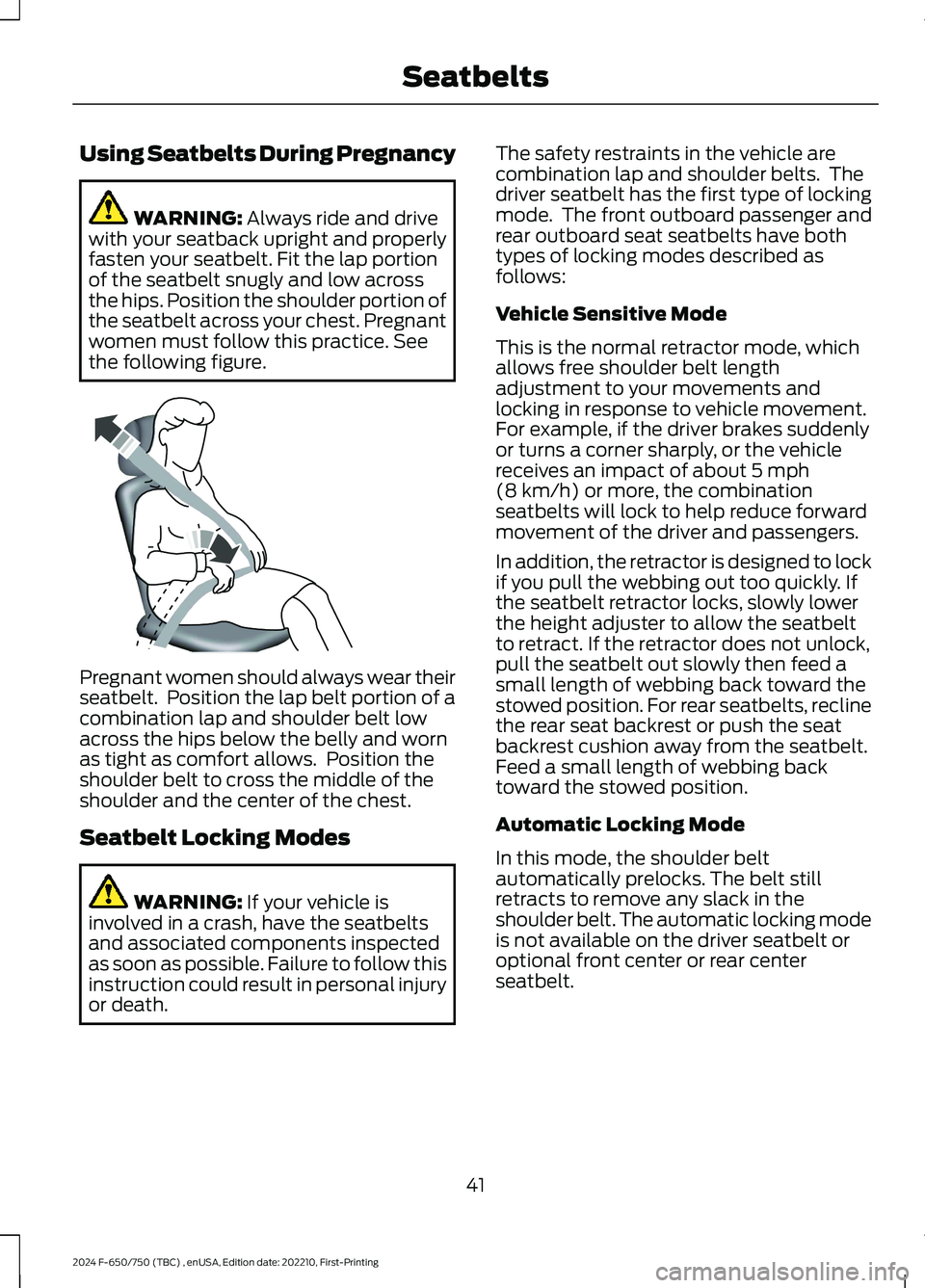
WARNING: Always ride and drivewith your seatback upright and properlyfasten your seatbelt. Fit the lap portionof the seatbelt snugly and low acrossthe hips. Position the shoulder portion ofthe seatbelt across your chest. Pregnantwomen must follow this practice. Seethe following figure.
Pregnant women should always wear theirseatbelt. Position the lap belt portion of acombination lap and shoulder belt lowacross the hips below the belly and wornas tight as comfort allows. Position theshoulder belt to cross the middle of theshoulder and the center of the chest.
Seatbelt Locking Modes
WARNING: If your vehicle isinvolved in a crash, have the seatbeltsand associated components inspectedas soon as possible. Failure to follow thisinstruction could result in personal injuryor death.
The safety restraints in the vehicle arecombination lap and shoulder belts. Thedriver seatbelt has the first type of lockingmode. The front outboard passenger andrear outboard seat seatbelts have bothtypes of locking modes described asfollows:
Vehicle Sensitive Mode
This is the normal retractor mode, whichallows free shoulder belt lengthadjustment to your movements andlocking in response to vehicle movement.For example, if the driver brakes suddenlyor turns a corner sharply, or the vehiclereceives an impact of about 5 mph(8 km/h) or more, the combinationseatbelts will lock to help reduce forwardmovement of the driver and passengers.
In addition, the retractor is designed to lockif you pull the webbing out too quickly. Ifthe seatbelt retractor locks, slowly lowerthe height adjuster to allow the seatbeltto retract. If the retractor does not unlock,pull the seatbelt out slowly then feed asmall length of webbing back toward thestowed position. For rear seatbelts, reclinethe rear seat backrest or push the seatbackrest cushion away from the seatbelt.Feed a small length of webbing backtoward the stowed position.
Automatic Locking Mode
In this mode, the shoulder beltautomatically prelocks. The belt stillretracts to remove any slack in theshoulder belt. The automatic locking modeis not available on the driver seatbelt oroptional front center or rear centerseatbelt.
41
2024 F-650/750 (TBC) , enUSA, Edition date: 202210, First-PrintingSeatbeltsE142590
Page 48 of 386
Then...If...
The Belt-Minder feature will not activate.You and the front seat passenger buckleyour safety belts before you switch theignition on or less than 1-2 minutes elapseafter you switch the ignition on...
The Belt-Minder feature activates, thesafety belt warning light illuminates and awarning tone sounds for 6 seconds every25 seconds, repeating for about 5 minutesor until you and the front seat passengerbuckle your safety belts.
You or the front seat passenger do notbuckle your safety belts before your vehiclereaches at least 6 mph (9.7 km/h) and 1-2minutes elapse after you switch the ignitionon...
The Belt-Minder feature activates, thesafety belt warning light illuminates and awarning tone sounds for 6 seconds every25 seconds, repeating for about 5 minutesor until you and the front seat passengerbuckle your safety belts.
The safety belt for the driver or frontpassenger is unbuckled for about 1 minutewhile the vehicle is traveling at least 6 mph(9.7 km/h) and more than 1-2 minuteselapse after you switch the ignition on...
Deactivating and Activating theBelt-Minder Feature
WARNING: While the systemallows you to deactivate it, this systemis designed to improve your chances ofbeing safely belted and surviving anaccident. We recommend you leave thesystem activated for yourself and otherswho may use the vehicle.
Note:The driver and front passengerwarnings switch on and off independently.When you perform this procedure for oneseating position, do not buckle the otherposition as this will terminate the process.
Read Steps 1 - 4 thoroughly beforeproceeding with the programmingprocedure.
Before following the procedure, make surethat:
•The parking brake is set.
•The transmission is in park (P) orneutral (N).
•The ignition is off.
•The driver and front passenger safetybelts are unbuckled.
1.Switch the ignition on. Do not start thevehicle.
2.Wait until the safety belt warning lightturns off (about one minute). AfterStep 2, wait an additional 5 secondsbefore proceeding with Step 3. Onceyou start Step 3, you must completethe procedure within 30 seconds.
3.For the seating position you areswitching off, buckle then unbuckle thesafety belt three times at a moderatespeed, ending in the unbuckled state.After Step 3, the safety belt warninglight turns on.
44
2024 F-650/750 (TBC) , enUSA, Edition date: 202210, First-PrintingSeatbelts