2024 FORD F650/750 water pump
[x] Cancel search: water pumpPage 12 of 386

Right-hand side.A
Left-hand side.B
Warnings
WARNING: Throughout this guide,you will find warnings identified by thewarning symbol. Warnings remind youto be especially careful to reduce the riskof personal injury.
Diesel Engine Information
The diesel engine fuel system is apressurized two-stage filtration systemand consists of:
•A frame-mounted Fuel and WaterSeparator primary filter with an electricfuel pump and water drain
•An engine-mounted secondary fuelfilter
•A fuel injector for each cylinder (8total)
•A high-pressure fuel pump
•A high-pressure fuel rail for eachcylinder bank (2 total)
•Numerous high-pressure pipes fromthe high-pressure pump to the rails,and rails to the injectors
The fuel and water separator removesboth water and impurities from the fuel.The engine-mounted filter filters finerimpurities from the diesel fuel. Theengine-mounted fuel filter and theframe-mounted fuel filter should bechanged at the recommended serviceinterval or when indicated by theinformation display LOW FUEL PRESSUREmessage. See Scheduled Maintenance(page 325).
The fuel and water separator should bedrained at regular intervals (recommendedat every oil change) or when indicated bythe information display and water in fuelindicator light. See Fuel Quality (page108).
Proper fuel filter maintenance and promptwater draining when the water in fuel lightilluminates is essential to prevent injectionequipment damage. Ignoring the water infuel light or the information displaymessage WATER IN FUEL DRAIN FILTERcan cause your vehicle to go into a reducedpower mode.
A frame-mounted electric fuel pumplocated inside the fuel and water separatordraws fuel from the fuel tank to providepressurized fuel to the engine. The fuelpump contains a pressure relief valve foroverpressure protection in the event ofrestricted flow.
The fuel injection system is controlledthrough the powertrain control module.
Engine Protection Mode
Ford diesel engines are equipped withengine protection and emission controlsystems. These systems monitor criticaltemperatures and pressures, and modifyengine operation accordingly. Thesemodified engine performancecharacteristics are normal.
8
2024 F-650/750 (TBC) , enUSA, Edition date: 202210, First-PrintingIntroductionE154903
Page 111 of 386
SAFETY PRECAUTIONS
WARNING: Do not overfill the fueltank. The pressure in an overfilled tankmay cause leakage and lead to fuel sprayand fire.
WARNING: The fuel system maybe under pressure. If you hear a hissingsound near the fuel filler inlet, do notrefuel until the sound stops. Otherwise,fuel may spray out, which could causeserious personal injury.
WARNING: Fuels can cause seriousinjury or death if misused or mishandled.
WARNING: Gasoline may containbenzene, which is a cancer-causingagent.
WARNING: When refueling alwaysshut the engine off and never allowsparks or open flames near the fuel tankfiller valve. Never smoke or use a cellphone while refueling. Fuel vapor isextremely hazardous under certainconditions. Avoid inhaling excess fumes.
WARNING: Flow of fuel through afuel pump nozzle can produce staticelectricity. This can cause a fire if you arefilling an ungrounded fuel container.
WARNING: Stop refueling after thefuel pump nozzle automatically shutsoff for the second time. Failure to followthis will fill the expansion space in thefuel tank and could lead to fueloverflowing.
Observe the following guidelines whenhandling automotive fuel:
•Extinguish all smoking materials andany open flames before refueling yourvehicle.
•Automotive fuels can be harmful orfatal if swallowed. Fuel such asgasoline is highly toxic and ifswallowed can cause death orpermanent injury. If swallowed, call aphysician immediately, even if nosymptoms are immediately apparent.The toxic effects of fuel may not bevisible for hours.
•Avoid inhaling fuel vapors. Inhaling toomuch fuel vapor of any kind can leadto eye and respiratory tract irritation.In severe cases, excessive or prolongedbreathing of fuel vapor can causeserious illness and permanent injury.
•Avoid getting fuel liquid in your eyes. Ifyou splash fuel in your eyes, removecontact lenses (if worn), flush withwater for 15 minutes and seek medicalattention. Failure to seek propermedical attention could lead topermanent injury.
•Fuels can also be harmful if absorbedthrough the skin. If you splash fuel onyour skin, clothing or both, promptlyremove contaminated clothing andwash your skin thoroughly with soapand water. Repeated or prolonged skincontact with fuel liquid or vapor causesskin irritation.
•Be particularly careful if you are taking“Antabuse” or other forms of disulfiramfor the treatment of alcoholism.Breathing gasoline vapors, or skincontact could cause an adversereaction. In sensitive individuals, serious
107
2024 F-650/750 (TBC) , enUSA, Edition date: 202210, First-PrintingFuel and Refueling
Page 117 of 386
WARNING: Wait at least fiveseconds before removing the fuel pumpnozzle to allow any residual fuel to draininto the fuel tank.
WARNING: Stop refueling after thefuel pump nozzle automatically shutsoff for the second time. Failure to followthis will fill the expansion space in thefuel tank and could lead to fueloverflowing.
WARNING: Do not remove the fuelpump nozzle from its fully insertedposition when refueling.
An engine that suddenly becomes noisy oroperates poorly after a fuel fill could beusing substandard fuel. We recommendthat you purchase diesel fuel from areputable fuel station.
Use only clean, approved containers thatprevent the entry of dirt or water wheneveryou store diesel fuel.
Do not store diesel fuel in a galvanizedcontainer. The fuel dissolves the zinc in thegalvanized container. The zinc will thenremain in the fuel. If you run thecontaminated fuel through the engine, thezinc damages the fuel injectors. Enginedamage caused may not be covered bythe vehicle warranty.
Use the following guidelines to avoidelectrostatic charge build-up when fillingan ungrounded fuel container:
•Place the approved fuel container onthe ground.
•Do not fill a fuel container while it is inthe vehicle (including the cargo area).
•Keep the fuel pump nozzle in contactwith the fuel container when filling.
•Do not use a device that would holdthe fuel pump handle in the fill position.
Fuel Filler Cap
WARNING: The fuel system maybe under pressure. If you hear a hissingsound near the fuel filler inlet, do notrefuel until the sound stops. Otherwise,fuel may spray out, which could causeserious personal injury.
Note:If you do not use the correct fuel fillercap, excessive pressure or vacuum in thefuel tank may damage the fuel system orcause the fuel cap to disengage in a crash.
The fuel tank has a threaded fuel filler cap.
Note:If you must replace the fuel filler cap,replace it with a fuel filler cap that isdesigned for your vehicle. The vehiclewarranty may be void for any damage to thefuel tank or fuel system if the correctgenuine Ford, Motorcraft or other certifiedfuel filler cap is not used.
When refueling the vehicle fuel tank do thefollowing:
1.Bring your vehicle to a complete stopand shift into neutral (N) or park (P).
2.Apply the parking brake and switch theignition off.
3.Turn the fuel filler capcounterclockwise and remove it.
4.Refuel your vehicle as required.
5.Replace the fuel filler cap, turn itclockwise until you feel a strongresistance.
Fuel Fill Rate
Your vehicle has a fuel fill inlet that is ableto accept fuel up to 20 gal (75 L) perminute from a fuel-dispensing nozzle.Pumping fuel at greater flow rates mayresult in premature nozzle shut off or spitback.
113
2024 F-650/750 (TBC) , enUSA, Edition date: 202210, First-PrintingFuel and Refueling
Page 125 of 386
WARNING: Only refill the dieselexhaust fluid tank in a well ventilatedarea. When you remove the dieselexhaust fluid tank filler cap or a dieselexhaust fluid container cap, ammoniavapors may escape. Ammonia vaporscan be irritating to skin, eyes and mucousmembranes. Inhaling ammonia vaporscan cause burning to the eyes, throat andnose and cause coughing and wateryeyes.
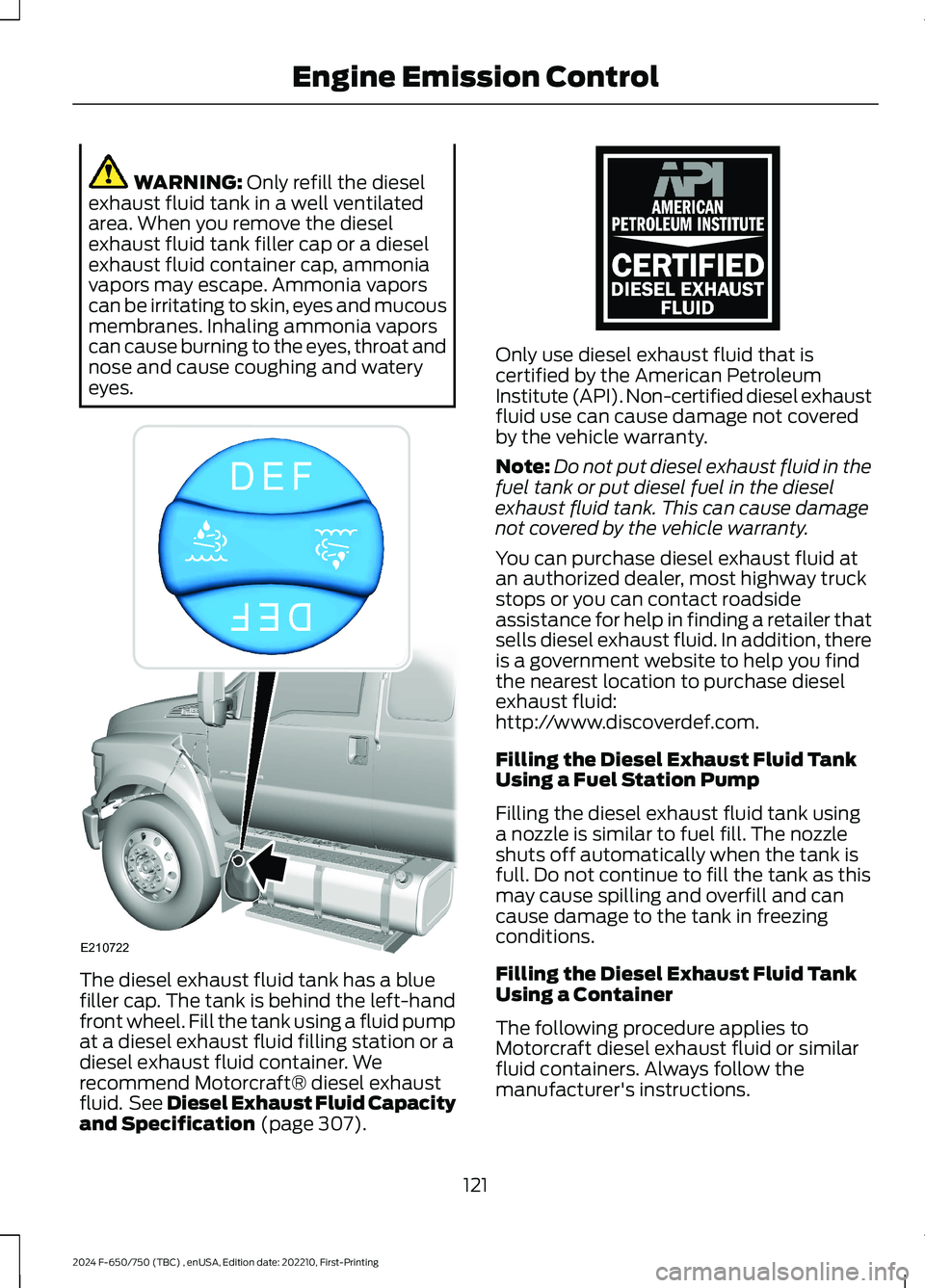
The diesel exhaust fluid tank has a bluefiller cap. The tank is behind the left-handfront wheel. Fill the tank using a fluid pumpat a diesel exhaust fluid filling station or adiesel exhaust fluid container. Werecommend Motorcraft® diesel exhaustfluid. See Diesel Exhaust Fluid Capacityand Specification (page 307).
Only use diesel exhaust fluid that iscertified by the American PetroleumInstitute (API). Non-certified diesel exhaustfluid use can cause damage not coveredby the vehicle warranty.
Note:Do not put diesel exhaust fluid in thefuel tank or put diesel fuel in the dieselexhaust fluid tank. This can cause damagenot covered by the vehicle warranty.
You can purchase diesel exhaust fluid atan authorized dealer, most highway truckstops or you can contact roadsideassistance for help in finding a retailer thatsells diesel exhaust fluid. In addition, thereis a government website to help you findthe nearest location to purchase dieselexhaust fluid:http://www.discoverdef.com.
Filling the Diesel Exhaust Fluid TankUsing a Fuel Station Pump
Filling the diesel exhaust fluid tank usinga nozzle is similar to fuel fill. The nozzleshuts off automatically when the tank isfull. Do not continue to fill the tank as thismay cause spilling and overfill and cancause damage to the tank in freezingconditions.
Filling the Diesel Exhaust Fluid TankUsing a Container
The following procedure applies toMotorcraft diesel exhaust fluid or similarfluid containers. Always follow themanufacturer's instructions.
121
2024 F-650/750 (TBC) , enUSA, Edition date: 202210, First-PrintingEngine Emission ControlE210722 E163354
Page 218 of 386
Engine compartment (with engine off)
Inspect for glazing, fraying or cracking. There should be nomore than 5-7 cracks per rib, per 1 in (2.5 cm)Belts (fan, alternator,water pump and airconditioningcompressor)
Inspect for signs of fluid puddles or dripping fluid on theground under the engine, or the underside of the engine.Fluid leaks
Inspect for debris that may have collected on the HVAC airinlet grille or inside the exterior module as this may reducesystem performance.
HVAC air inlet
Engine starting (with parking brake applied)
Before entering the cab, verify that the vehicle is equippedwith spare electrical fuses (if used), three red reflectivetriangles, a properly charged and rated fire extinguisher andwheel chocks.
Safety and emergencyequipment
Walk around the vehicle and verify all steps and grab handles,inside and out (as well as behind), are tight and clean. Useextreme caution and a three-point stance at all times.
Inspect door latches for proper closing, latching and locking.
Set the parking brake. Make sure the gearshift lever is inneutral (N) or park (P) (if equipped with a park position).Starting the engine
Diesel engine: Turn the key to the on position. Turn the keyto start when the wait to start indicator light in the instrumentcluster turns off.
Gasoline engine: Turn the key to start, and then release itas soon as the engine starts.
Verify pressure builds to normal operating range.Engine oil pressure
A tone indicating low air pressure should sound immediatelyafter the engine starts but before the compressor has built-up pressure. The tone should stop when the air pressurereaches 70 psi (483 kPa). Let the air pressure build togoverned cutout pressure, which should occur between115–130 psi (793–896 kPa).
Low air pressure warningtone (if equipped with anair compressor)
Press the accelerator and verify that it operates smoothly,without any binding or irregular feel. Release the pedal andverify the engine returns to idle speed immediately.
Accelerator
214
2024 F-650/750 (TBC) , enUSA, Edition date: 202210, First-PrintingVehicle Inspection Guide
Page 271 of 386
3.Remove tar and grease with a bug andtar remover. We recommend that youuse Ford approved bug and tar removerif available.
4.Thoroughly rinse the wheels with waterafter cleaning.
If you intend on parking your vehicle for anextended period after cleaning the wheelswith a wheel cleaner, drive your vehicle fora few minutes before doing so. Thisreduces the risk of corrosion of the brakediscs, brake pads and linings.
Do not clean the wheels when they are hot.
Note: Some car washes could damagewheel rims and covers.
Note: Using non-recommended cleaners,harsh cleaning products, chrome wheelcleaners or abrasive materials coulddamage wheel rims, covers and bolts.
VEHICLE STORAGE
If you plan on storing your vehicle for 30days or more, read the followingmaintenance recommendations to makesure your vehicle stays in good operatingcondition.
We engineer and test all motor vehiclesand their components for reliable, regulardriving. Under various conditions,long-term storage may lead to degradedengine performance or failure unless youuse specific precautions to preserve enginecomponents.
General
•Store all vehicles in a dry, ventilatedplace.
•Protect from sunlight, if possible.
•If vehicles are stored outside, theyrequire regular maintenance to protectagainst rust and damage.
Body
•Wash your vehicle thoroughly toremove dirt, grease, oil, tar or mud fromexterior surfaces, rear-wheel housingand the underside of front fenders.
•Periodically wash your vehicle if it isstored in exposed locations.
•Touch-up exposed or primed metal toprevent rust.
•Cover chrome and stainless steel partswith a thick coat of auto wax to preventdiscoloration. Re-wax as necessarywhen you wash your vehicle.
•Lubricate all hood, door and luggagecompartment hinges and latches witha light grade oil.
•Cover interior trim to prevent fading.
•Keep all rubber parts free from oil andsolvents.
Engine
•Change the engine oil and filter prior tostorage because used engine oilcontains contaminates which maycause engine damage.
•Start the engine every 15 days for aminimum of 15 minutes. Run at fastidle with the climate controls set todefrost until the engine reaches normaloperating temperature.
•With your foot on the brake, shiftthrough all the gears while the engineis running.
•We recommend that you change theengine oil before you use your vehicleagain.
Fuel system
•Fill the fuel tank with high-quality fueluntil the first automatic shutoff of thefuel pump nozzle.
267
2024 F-650/750 (TBC) , enUSA, Edition date: 202210, First-PrintingVehicle Care