2024 FORD F650/750 check engine
[x] Cancel search: check enginePage 265 of 386

2.Set the parking brake and shift intoposition neutral (N) or park (P). Turnthe engine off.
3.Clean any dirt from around the axlefiller plug.
4.Remove the filler plug and inspect thelubricant level. It should be at thebottom of the filler plug opening.
5.Add lubricant, if necessary, through thefiller plug opening.
6.Clean and install the filler plug securely.
Changing the Fluid
Note:Drain the rear axle while the lubricantis warm.
1.Park your vehicle on level ground.
2.Set the parking brake and shift intoposition neutral (N) or park (P). Turnthe engine off.
3.Clean any dirt from around the axlefiller and drain plugs.
4.Remove the filler and drain plugs. Drainthe lubricant into a suitable container.Dispose of all used automotive fluidsin a responsible manner following yourlocal authorized standards.
5.Clean and install the drain plugsecurely.
6.Add lubricant through the filler plugopening.
7.Clean and install the filler plug securely.
SPRING U-BOLT CHECK
Check and tighten the U-bolt nuts afteryour vehicle has been operated under loadfor 1,000 mi (1,600 km) or six months,whichever occurs first.
Check and tighten the U-bolt nuts every37,000 mi (60,000 km).
Check and tighten the U-bolt nuts withyour vehicle at curb height and unloaded.
Inspect the U-bolt threads for rust anddebris. Clean the threads if contaminated.
U-bolt Nut Torque
Front Axle
Note:Check and tighten the U-bolt nutsevenly using a criss-cross pattern in thefollowing stages.
lb.ft (Nm)Stage
40 (60)1.
90 (125)2.
170 (225)3.
240 (325)4.
Rear Axle
Note:Check and tighten the U-bolt nutsevenly using a criss-cross pattern in thefollowing stages.
lb.ft (Nm)Stage
60 (75)1.
90 (125)2.
170 (225)3.
240 (325)4.
320 (440)5.
261
2024 F-650/750 (TBC) , enUSA, Edition date: 202210, First-PrintingMaintenance
Page 317 of 386
VEHICLE IDENTIFICATION
NUMBER
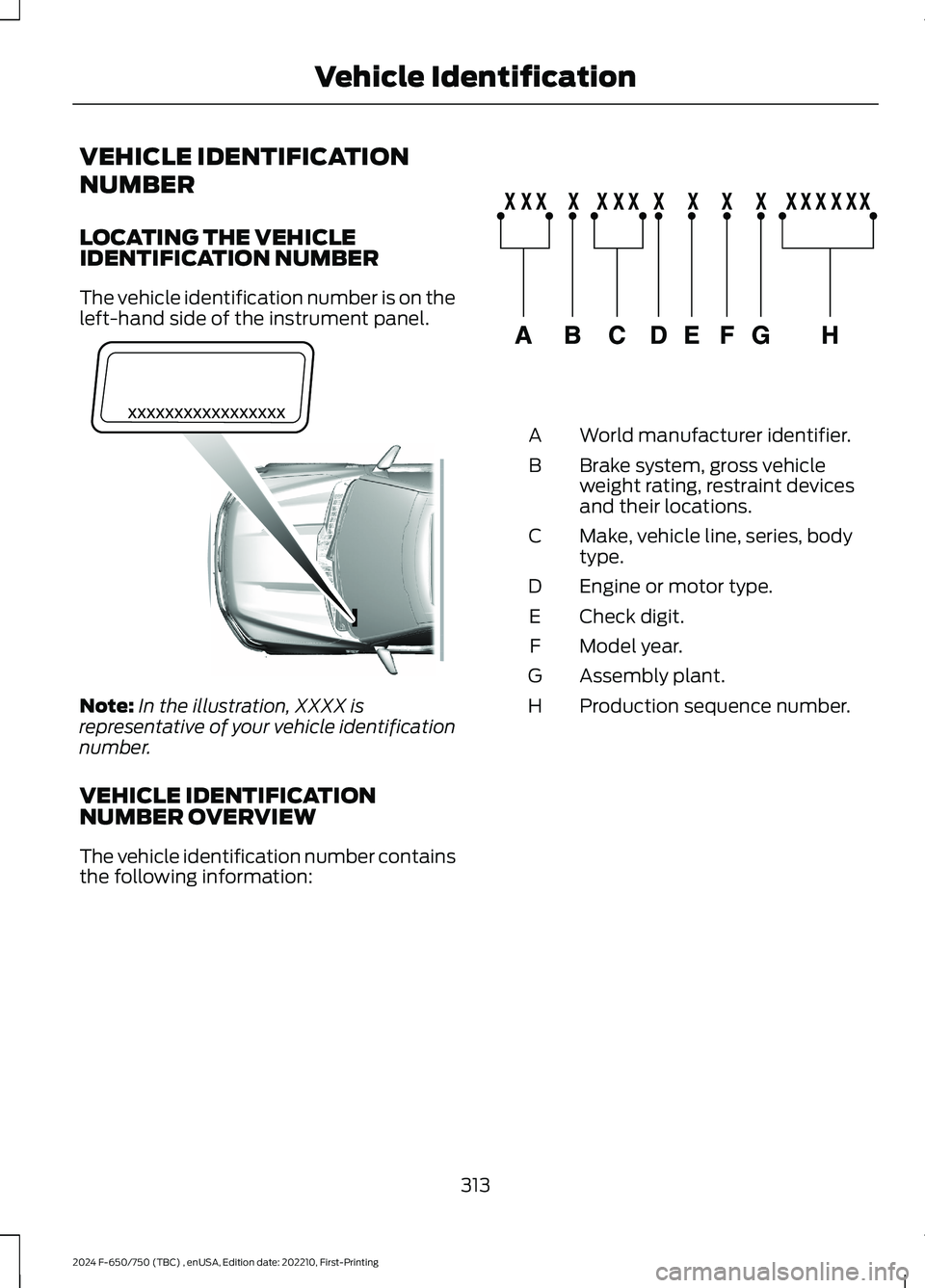
LOCATING THE VEHICLEIDENTIFICATION NUMBER
The vehicle identification number is on theleft-hand side of the instrument panel.
Note:In the illustration, XXXX isrepresentative of your vehicle identificationnumber.
VEHICLE IDENTIFICATIONNUMBER OVERVIEW
The vehicle identification number containsthe following information:
World manufacturer identifier.A
Brake system, gross vehicleweight rating, restraint devicesand their locations.
B
Make, vehicle line, series, bodytype.C
Engine or motor type.D
Check digit.E
Model year.F
Assembly plant.G
Production sequence number.H
313
2024 F-650/750 (TBC) , enUSA, Edition date: 202210, First-PrintingVehicle IdentificationE311767 E142477
Page 328 of 386
Less Cost to Properly Maintain YourVehicle
Ford Protect extended service plan alsooffers a Premium Maintenance Plan thatcovers all scheduled maintenance, andselected wear items. The coverage isprepaid, so you never have to worry aboutthe cost of your vehicle’s maintenance.
Covered maintenance includes:
•Windshield wiper blades.
•Spark plugs.
•The clutch disc (if equipped).
•Brake pads and linings.
•Shock absorbers.
•Struts.
•Engine belts.
•Engine coolant hoses, clamps andO-rings.
•Diesel exhaust fluid replenishment (ifequipped).
•Cabin air filter replacement every20,000 mi (32,000 km) (electricvehicles only).
Interest Free Finance Options
Just a 5% down payment will provide youwith an affordable, no interest, no feepayment program allowing you all thesecurity and benefits Ford Protectextended service plan has to offer whilepaying over time. You are pre-approvedwith no credit check or hassles. To learnmore, call our Ford Protect extendedservice plan specialists at 800-367-3377.
Ford Protect Extended Service PlanP.O. Box 321067Detroit, MI 48232
Ford Protect Extended ServicePlan (CANADA ONLY)
You can get more protection for yourvehicle by purchasing a Ford Protectextended service plan. Ford Protectextended service plan is the only servicecontract backed by Ford Motor Companyof Canada, Limited. Depending on the planyou purchase, Ford Protect extendedservice plan provides benefits such as:
•Rental reimbursement.
•Coverage for certain maintenance andwear items.
•Protection against repair costs afteryour New Vehicle Limited WarrantyCoverage expires.
•Roadside Assistance benefits.
There are several Ford Protect extendedservice plans available in various time,distance and deductible combinations.Each plan is tailored to fit your own drivingneeds, including reimbursement for towingand rental. When you purchase FordProtect extended service plan, you receiveadded peace-of-mind protectionthroughout Canada, the United States andMexico, provided by a network ofparticipating authorized Ford MotorCompany dealers.
Note:Repairs performed outside of Canadaand the United States are not eligible forFord Protect extended service plancoverage.
This information is subject to change. Formore information; visit your local Ford ofCanada dealer or www.ford.ca to find theFord Protect extended service plan that isright for you.
324
2024 F-650/750 (TBC) , enUSA, Edition date: 202210, First-PrintingFord Protect
Page 331 of 386
Scheduled Maintenance Services
Maintenance service adjustments mustconform to specifications contained in thismanual, and those shown on the ImportantEngine Information decal. Perform thefollowing services at scheduled intervalsbecause they essential to the life andperformance of your vehicle. Fordrecommends that you performmaintenance on all designated items toachieve best vehicle operation.
There are three types of maintenanceintervals for general vehicle environments:On-Highway, City and Severe Service. Inall applications, monitoring miles(kilometers) and time and when the engineis due for an oil change determine theactual interval. When the engine oil changeis required before the truck lubricationinterval, perform the lubrication at thesame time in order to reduce your vehicle’stime out of service.
Air Brake Adjustment
WARNING: Failure to maintainproper air brake adjustment can resultin reduction or loss of braking ability.
A qualified service technician, keeping tothe instructions in the service manual,should perform air brake inspection andadjustment or repairs.
Cam Brakes - Automatic SlackAdjusters
WARNING: Do not manually adjustthe automatic slack adjusters to correctexcessive push rod stroke as it may resultin reduced brake effectiveness and avehicle crash. Excessive push rod strokeindicates that a problem exists with theautomatic adjuster, with the installationof the adjuster, or with foundation brakecomponents that manual adjustmentdoes not remedy. Seek service from aqualified facility for excessive push rodstroke.
Inspect standard air brakes equipped withautomatic slack adjusters for proper brakeadjustment as listed in the maintenanceschedule charts.
However, inspect the brakes morefrequently when subjecting them to heavyuse or adverse operating conditions suchas:
•Frequent brake applications while fullyloaded.
•Operation on hilly or mountainousterrain.
•Frequent operation on dirt, gravel ormud.
Some aftermarket brake linings alsorequire more frequent inspections.
Owner Checks and Services
Make sure you perform the following basicmaintenance checks and inspections everymonth or at six-month intervals.
327
2024 F-650/750 (TBC) , enUSA, Edition date: 202210, First-PrintingScheduled Maintenance
Page 332 of 386
Check Every Month
Air filter restriction gauge.1
Engine oil level.
Fuel and water separator. Drain if necessary, or if indicated by the information display.1
Function of all interior and exterior lights.
Holes and slots in the tail pipe to make sure they are functional and clear of debris.1
Tires (including spare) for wear and proper pressure.
Windshield washer fluid level.
1Diesel engine only.
Check Every Six Months
Battery connections. Clean if necessary.
Body and door drain holes for obstructions. Clean if necessary.
Cooling system fluid level and coolant concentration (freeze-point protection).
Door weatherstrips for wear. Lubricate if necessary.
Hinges, latches and outside locks for proper operation. Lubricate if necessary.
Parking brake for proper operation.
Air brake adjustment.1
Seatbelts and seat latches for wear and function.
Safety warning lamps (brake, ABS, airbag and seatbelt) for operation.
Washer spray and wiper operation. Clean or replace blades as necessary.
1 Diesel engine only.
328
2024 F-650/750 (TBC) , enUSA, Edition date: 202210, First-PrintingScheduled Maintenance
Page 333 of 386

Tightening Lug Nuts
Tighten the lug nuts to the specified torque1 at 500 mi(800 km) after any wheel disturbance (such as tire rota-tion, changing a flat tire or wheel removal).
Single rear wheels
Tighten the wheel lug nuts to the specified torque1 at100 mi (160 km), and again at 500 mi (800 km) of newvehicle operation and after any wheel disturbance (suchas tire rotation, changing a flat tire or wheel removal).
Dual rear wheels
1 See Technical Specifications (page 289).
Multi-point Inspection
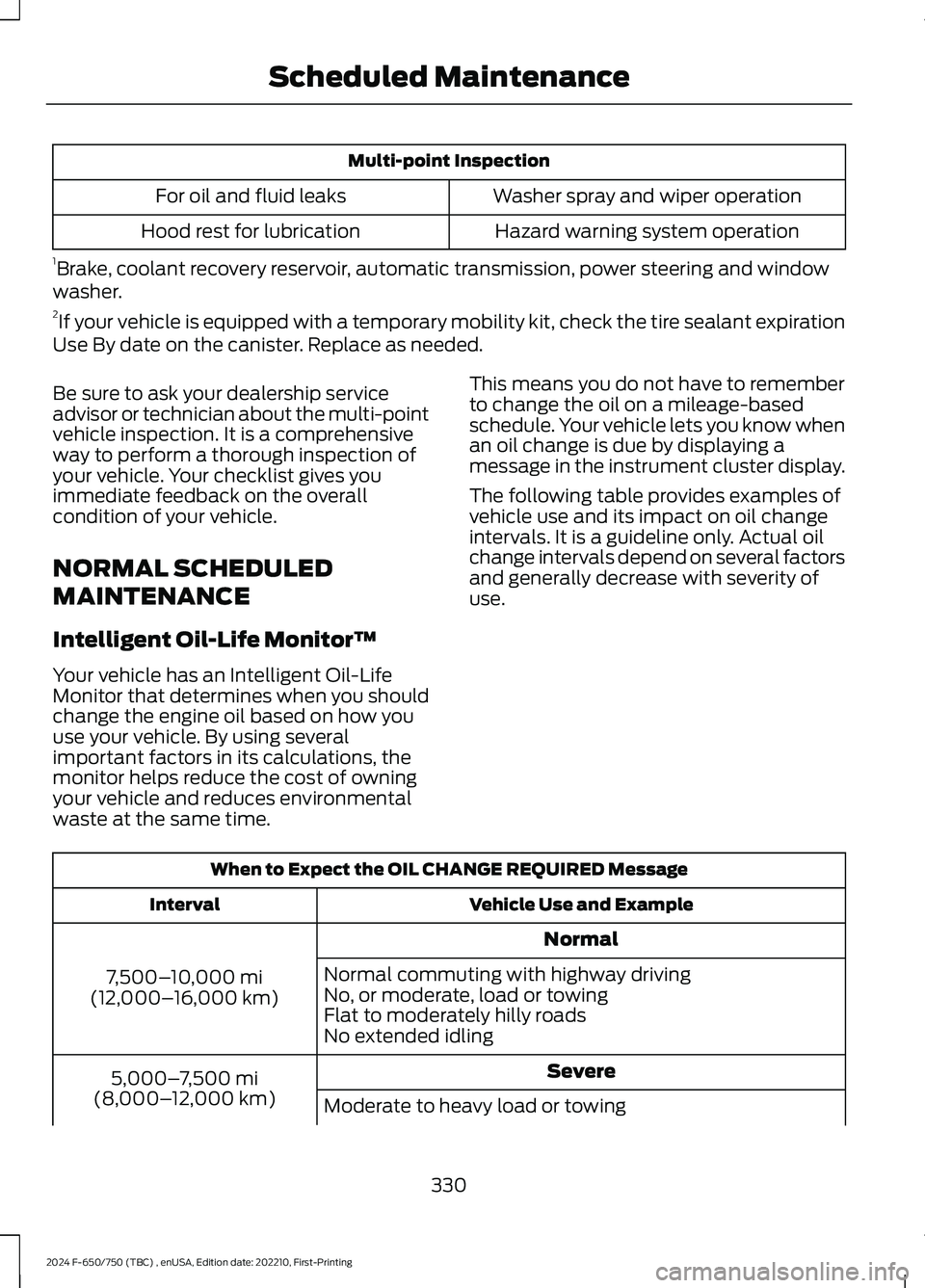
In order to keep your vehicle running right,it is important to have the systems on yourvehicle checked regularly. This can helpidentify potential issues and prevent majorproblems. We recommend having thefollowing multi-point inspection performedat every scheduled maintenance intervalto help make sure your vehicle keepsrunning great.
Multi-point Inspection
Horn operationAccessory drive belt(s)
Radiator, cooler, heater and A/C hosesBattery performance
Suspension component for leaks ordamageEngine air filter
Steering and linkageExhaust system
Tires (including spare) for wear and proper
pressure2Exterior lamps operation
Windshield for cracks, chips or pitsFluid levels1; fill if necessary
329
2024 F-650/750 (TBC) , enUSA, Edition date: 202210, First-PrintingScheduled Maintenance
Page 334 of 386
Multi-point Inspection
Washer spray and wiper operationFor oil and fluid leaks
Hazard warning system operationHood rest for lubrication
1Brake, coolant recovery reservoir, automatic transmission, power steering and windowwasher.2If your vehicle is equipped with a temporary mobility kit, check the tire sealant expirationUse By date on the canister. Replace as needed.
Be sure to ask your dealership serviceadvisor or technician about the multi-pointvehicle inspection. It is a comprehensiveway to perform a thorough inspection ofyour vehicle. Your checklist gives youimmediate feedback on the overallcondition of your vehicle.
NORMAL SCHEDULED
MAINTENANCE
Intelligent Oil-Life Monitor™
Your vehicle has an Intelligent Oil-LifeMonitor that determines when you shouldchange the engine oil based on how youuse your vehicle. By using severalimportant factors in its calculations, themonitor helps reduce the cost of owningyour vehicle and reduces environmentalwaste at the same time.
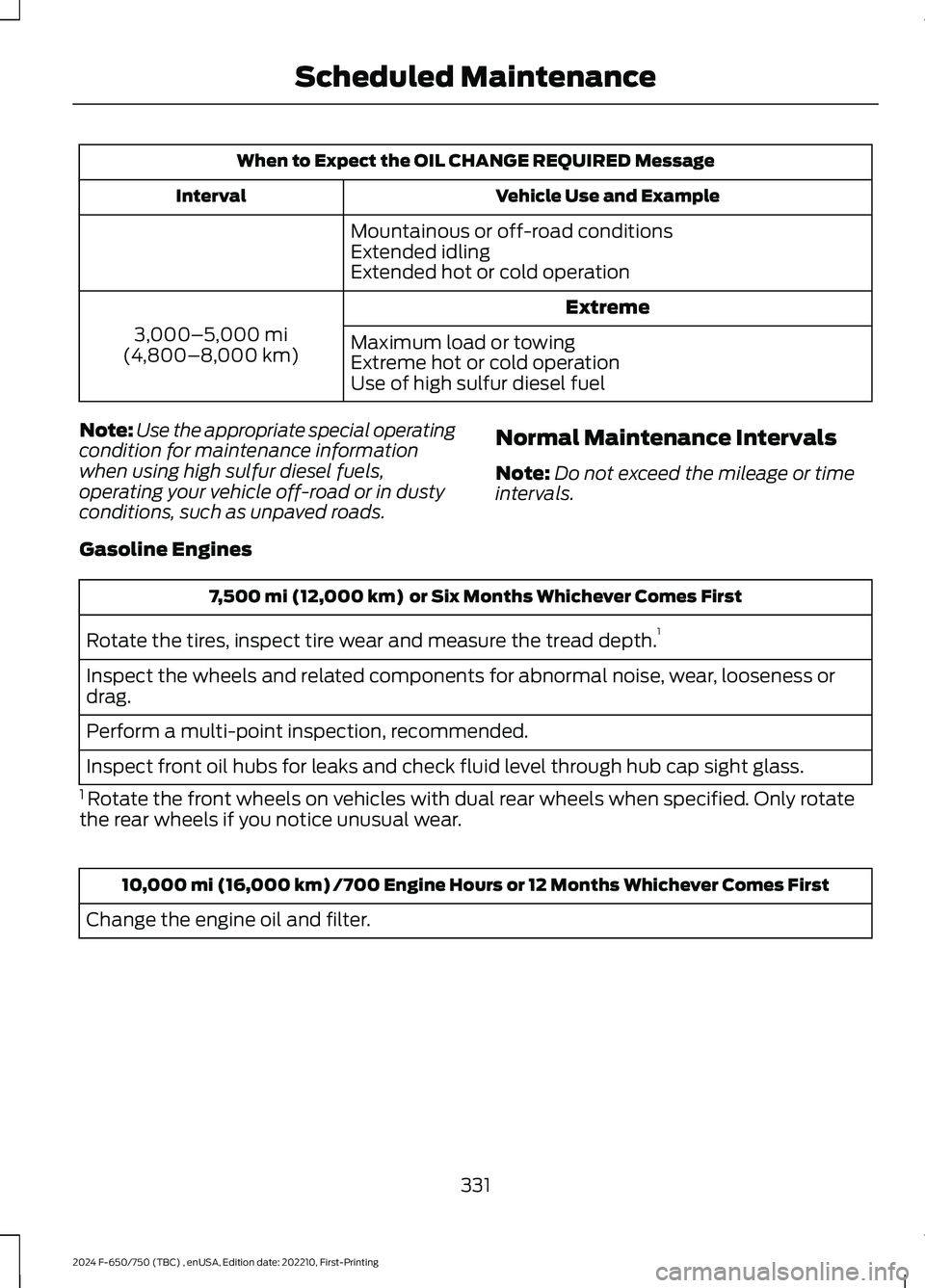
This means you do not have to rememberto change the oil on a mileage-basedschedule. Your vehicle lets you know whenan oil change is due by displaying amessage in the instrument cluster display.
The following table provides examples ofvehicle use and its impact on oil changeintervals. It is a guideline only. Actual oilchange intervals depend on several factorsand generally decrease with severity ofuse.
When to Expect the OIL CHANGE REQUIRED Message
Vehicle Use and ExampleInterval
Normal
7,500–10,000 mi(12,000–16,000 km)
Normal commuting with highway drivingNo, or moderate, load or towingFlat to moderately hilly roadsNo extended idling
Severe5,000–7,500 mi(8,000–12,000 km)Moderate to heavy load or towing
330
2024 F-650/750 (TBC) , enUSA, Edition date: 202210, First-PrintingScheduled Maintenance
Page 335 of 386
When to Expect the OIL CHANGE REQUIRED Message
Vehicle Use and ExampleInterval
Mountainous or off-road conditionsExtended idlingExtended hot or cold operation
Extreme
3,000–5,000 mi(4,800–8,000 km)Maximum load or towingExtreme hot or cold operationUse of high sulfur diesel fuel
Note:Use the appropriate special operatingcondition for maintenance informationwhen using high sulfur diesel fuels,operating your vehicle off-road or in dustyconditions, such as unpaved roads.
Normal Maintenance Intervals
Note:Do not exceed the mileage or timeintervals.
Gasoline Engines
7,500 mi (12,000 km) or Six Months Whichever Comes First
Rotate the tires, inspect tire wear and measure the tread depth.1
Inspect the wheels and related components for abnormal noise, wear, looseness ordrag.
Perform a multi-point inspection, recommended.
Inspect front oil hubs for leaks and check fluid level through hub cap sight glass.
1 Rotate the front wheels on vehicles with dual rear wheels when specified. Only rotatethe rear wheels if you notice unusual wear.
10,000 mi (16,000 km)/700 Engine Hours or 12 Months Whichever Comes First
Change the engine oil and filter.
331
2024 F-650/750 (TBC) , enUSA, Edition date: 202210, First-PrintingScheduled Maintenance