2023 TOYOTA RAV4 PRIME parking brake
[x] Cancel search: parking brakePage 3 of 662

3TABLE OF CONTENTS
1
2
3
4
5
6
7
8
9
10
4-1. Key informationKeys .............................. 218
4-2. Opening, closing and lock- ing the doors
Side doors ..................... 222
Back door ...................... 227
Smart key system ......... 241
4-3. Adjusting the seats Front seats .................... 247
Rear seats..................... 248
Driving position memory 250
Head restraints.............. 253
4-4. Adjusting the steering wheel and mirrors
Steering wheel .............. 256
Inside rear view mirror .. 257
Digital Rear-view Mirror 258
Outside rear view mirrors .................................... 268
4-5. Opening, closing the win- dows and moon roof
Power windows ............. 270
Moon roof ...................... 273
Panoramic moon roof.... 276
5-1. Before driving Driving the vehicle......... 282
Cargo and luggage ....... 289
Vehicle load limits ......... 292
Trailer towing ................ 293
Dinghy towing ............... 3035-2. Driving procedures
Power (ignition) switch .. 304
Hybrid transmission ....... 309
Turn signal lever ............ 313
Parking brake ................ 314
Brake Hold..................... 318
5-3. Operating the lights and wipers
Headlight switch ............ 321
AHB (Automatic High Beam) .................................... 324
Windshield wipers and washer ......................... 327
Rear window wiper and washer ......................... 330
5-4. Refueling Opening the fuel tank cap.................................... 332
5-5. Using the driving support systems
Toyota Safety Sense 2.5 +
.................................... 335
PCS (Pre-Collision System) .................................... 340
LTA (Lane Tracing Assist) .................................... 351
RSA (Road Sign Assist) 363
Dynamic radar cruise control with full-speed range ... 366
BSM (Blind Spot Monitor) .................................... 378
Intuitive parking assist ... 387
PKSB (Parking Support Brake) .......................... 395
Parking Suppo rt Bra
ke func-
tion (static objects) ...... 400
4Before driving
5Driving
Page 4 of 662

4TABLE OF CONTENTS
Parking Support Brake func-tion (rear-crossing vehicles).................................... 402
Driving mode select switch .................................... 404
Trail Mode ..................... 405
Driving assist systems .. 407
5-6. Driving tips Winter driving tips ......... 413
Utility vehicle precautions .................................... 416
6-1. Using the air conditioning
system and defogger
Automatic air conditioning
system ......................... 422
Remote Air Conditioning System ........................ 431
Heated steering wheel/Front seat heaters/Front seat
heaters and ventila-
tors/Rear seat heaters. 433
6-2. Using the interior lights Interior lights list ............ 436
6-3. Using the storage features List of storage features . 438
Luggage compartment fea- tures ............................ 442
6-4. Using the other interior fea- tures
Other interior features ... 445
Power outlet (AC 120 V/1500 W)................................ 455
When the power outlet (AC 120 V 1500 W) cannot be
used properly .............. 461Garage door opener ......
463
7-1. Maintenance and care Cleaning and protecting the vehicle exterior ............ 472
Cleaning and protecting the vehicle interior ............. 475
7-2. Maintenance Maintenance requirements.................................... 478
General maintenance .... 480
Emission inspection and maintenance (I/M) pro-
grams .......................... 482
7-3. Do-it-yourself maintenance Do-it-yourself service pre-cautions ....................... 484
Hood .............................. 486
Positioning a floor jack .. 487
Engine compartment ..... 489
12-volt battery................ 495
Tires .............................. 497
Tire inflation pressure .... 509
Wheels .......................... 511
Air conditioning filter ...... 513
Cleaning the DC/DC Con- verter air intake vent and fil-
ter ................................ 515
Wiper insert replacement .................................... 519
Electronic key battery .... 522
Checking and replacing fuses ............................ 524
Headlight aim ................ 527
Light bulb
s ..................... 528
6Interior features
7Maintenance and care
Page 21 of 662
21Pictorial index
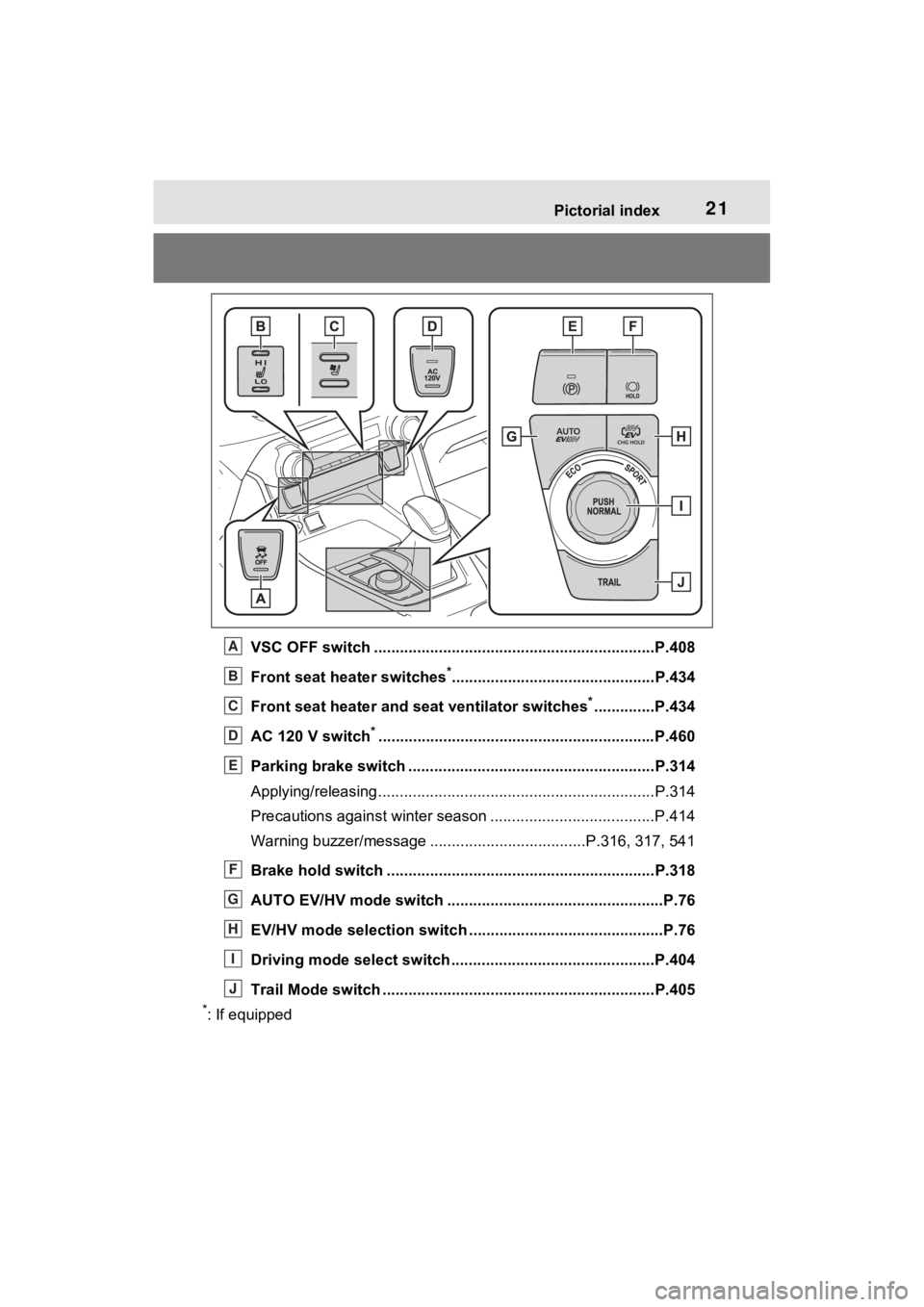
VSC OFF switch .................................................................P.408
Front seat heater switches
*...............................................P.434
Front seat heater and seat ventilator switches
*..............P.434
AC 120 V switch
*............................................................... .P.460
Parking brake switch ........................................... ..............P.314
Applying/releasing............................................. ...................P.314
Precautions against winter season .............................. ........P.414
Warning buzzer/message ....... .............................P.316, 317, 541
Brake hold switch .............................................. ................P.318
AUTO EV/HV mode switch ......................................... .........P.76
EV/HV mode selection switc h .............................................P.76
Driving mode select switch ..................................... ..........P.404
Trail Mode switch ...............................................................P.405
*: If equipped
A
B
C
D
E
F
G
H
I
J
Page 81 of 662

812-1. Plug-in hybrid system
2
Plug-in hybrid system
battery (traction battery) and EV
driving range (P.186, 199) is
being displayed on the multi-infor-
mation display, EV driving (driving
using only the electric motor) may
be canceled and both gasoline
engine and electric motor are used
depending on the situation (EV driv-
ing will be returned to automatically
after EV driving becomes possible
again).
EV driving may be canceled auto-
matically in the following circum-
stances
*1:
●When vehicle speed is more than
approximately 84 mph (135 km/h).
●When power is needed temporar-
ily, for example when the acceler-
ator pedal is depressed firmly or
when accelerating suddenly.
*2
●When the temperature of the
hybrid system is high.
The vehicle has been left in the
sun, driven on a hill, driven at high
speeds, etc.
●When the temperature of the
hybrid system is low.
●When the heater is switched on
when the outside temperature is
below about 14°F (-10°C).
●When the windshield defogger
switch is pressed. ( P.424)
●When the system determines that
the gasoline engine needs to be
started.
*1: The gasoline engine may also
operate in circumstances other
than those listed above, depend-
ing on conditions.
*2: When driving in AUTO EV/HV mode. Even in EV mode, the gas-
oline engine may start, depend-
ing on the condition of the hybrid
battery (traction battery).
■If “Engine Started to Protect
System EV driving unavailable”
is displayed on the multi-infor-
mation display
EV driving may be canceled in order
to protect the hybrid system, etc.
In this case, perform driving with the
gasoline engine until EV driving will
be returned to automatically.
■Conditions in which the gaso-
line engine may not stop
The gasoline engine starts and
stops automatically. However, it
may not stop automatically in the
following conditions
*:
●During gasoline engine warm-up
●During hybrid battery (traction bat-
tery) charging
●When the temperature of the
hybrid battery (traction battery) is
high or low
●When the windshield defogger
switch is pressed. ( P.424)
*: Depending on the circumstances,
the gasoline engine may also not
stop automatically in situations
other than those above.
■Sounds and vibrations specific
to a Plug-in Hybrid Electric
Vehicle
There may be no e ngine sound or
vibration even thoug h the vehicle is
able to move with the “READY” indi-
cator is illuminated. For safety,
apply the parking brake and make
sure to shift the shift lever to P when
parked.
The following sounds or vibrations
may occur when the hybrid system
is operating and are not a malfunc-
tion.
●Motor sounds may be heard from
the engine compartment.
●Sounds may be heard from the
hybrid battery (traction battery)
when the hybrid sy stem starts or
stops.
Page 87 of 662

872-1. Plug-in hybrid system
2
Plug-in hybrid system
WARNING
●Never touch, disassemble,
remove or replace the high volt-
age parts, cables or their con-
nectors.
●The hybrid system will become
hot after starting as the system
uses high voltage. Be careful of
both the high voltage and the
high temperature, and always
obey the caution labels
attached to the vehicle.
●Never try to open the service
plug access hole located in the
luggage compartment. The ser-
vice plug is used only when the
vehicle is serviced and is sub-
ject to high voltage.
■Road accident cautions
Observe the following precautions
to reduce the risk of death or seri-
ous injury:
●Pull your vehicle off the road,
apply the parking brake, shift
the shift lever to P, and turn the
hybrid system off.
●Do not touch the high voltage
parts, cables and connectors.
●If electric wires are exposed
inside or outside your vehicle,
an electric shock may occur.
Never touch exposed electric
wires.
●Do not touch the battery if liquid
is leaking from or adhering to it.
If electrolyte (carbonic-based
organic electrolyte) from the
hybrid battery (traction battery)
comes into contact with the
eyes or skin, it could cause
blindness or skin wounds. In the
unlikely event that it comes into
contact with the eyes or skin,
wash it off immediately with a
large amount of water, and seek
immediate medical attention.
●If electrolyte is leaking from the
hybrid battery (traction battery),
do not approach the vehicle.
Even in the unlikely event that
the hybrid battery (traction bat-
tery) is damaged, the internal
construction of the battery will
prevent a large amount of elec-
trolyte from leaking out. How-
ever, any electrolyte that does
leak out will give off a vapor.
This vapor is an irritant to skin
and eyes and could cause acute
poisoning if inhaled.
●Do not bring burning or high-
temperature items close to the
electrolyte. The electrolyte may
ignite and cause a fire.
●If a fire occurs in the Plug-in
Hybrid Electric Vehicle, leave
the vehicle as soon as possible.
Never use a fire extinguisher
that is not meant for electric
fires. Using even a small
amount of water may be dan-
gerous.
●If your vehicle needs to be
towed, do so with front wheels
raised. If the wheels connected
to the electric motor (traction
motor) are on the ground when
towing, the motor may continue
to generate electricity. This may
cause a fire. ( P.538)
Page 91 of 662

912-1. Plug-in hybrid system
2
Plug-in hybrid system
Shift the shift lever to D when
stopped at a traffic light, or driv-
ing in heavy traffic etc. Shift the
shift lever to P when parking.
When using the N, there is no
positive effect on fuel consump-
tion. In the N, the gasoline
engine operates but electricity
cannot be generated. Also,
when using the air conditioning
system, etc., the hybrid battery
(traction battery) power is con-
sumed.
Drive your vehicle smoothly.
Avoid abrupt acceleration and
deceleration. Gradual accel-
eration and deceleration will
make more effective use of
the electric motor (traction
motor) without having to use
gasoline engine power.
Avoid repeated acceleration.
Repeated acceleration con-
sumes hybrid battery (trac-
tion battery) power, resulting
in poor fuel consumption. Bat-
tery power can be restored by
driving with the accelerator
pedal slightly released.
Make sure to operate the brakes
gently and a timely manner. A greater amount of electrical
energy can be regenerated
when slowing down.
Repeated acceleration and
deceleration, as well as long
waits at traffic lights, will lead to
high fuel and electricity con-
sumption. Check traffic reports
before leaving and avoid delays
as much as possible. When driv-
ing in a traffic jam, gently
release the brake pedal to allow
the vehicle to move forward
slightly while avoiding overuse
of the accelerator pedal. Doing
so can help control excessive
electricity and fuel consumption.
Control and maintain the vehi-
cle at a constant speed.
Before stopping at a toll booth
or similar, allow plenty of time
to release the accelerator and
gently apply the brakes. A
greater amount of electrical
energy can be regenerated
when slowing down.
Electricity consumption will
increase significantly when
driving at high speeds in EV
mode or AUTO EV/HV mode.
If there will be a long distance
to the next external charging
point after leaving a freeway,
it is recommended to drive in
Shift lever operation
Accelerator pedal/brake
pedal operation
When braking
Delays
Highway driving
Page 118 of 662
1182-2. Charging
This vehicle has been designed
to allow charging from an exter-
nal power source using a AC
charging cable for exclusive use
with standard household AC
outlets.
However, the vehicle differs
greatly from standard household
electrical goods in the following
ways, and incorrect usage could
cause fire or electric shock, pos-
sibly leading to death or serious
injury.
When charging, a large
amount of current will flow for
a long time.
Charging can be conducted
outdoors.
To charge properly, follow the
procedure after reading the
explanation below. Charging is
intended to be carried out by
licensed drivers only who prop-
erly understand the charging
procedure.
Do not allow children to use
the AC charging cable without supervision. Also, keep the
AC charging cable out of
reach of infants.
When charging with a char-
ger, follow the procedures for
using each charger.
When charging using a public
charging facility, check the
setting of the charging sched-
ule function.
• When the charging schedule is
registered, temporarily turn off
the function or turn “Charge Now”
on. ( P.135, 141, 147)
• When the charging schedule is set to on, charging will not start
even if the AC charging cable is
connected. Also, charging fee
may occur due to connection of
the AC charging cable.
Before charging, always check
the following items.
The parking brake is applied.
( P.314)
Lights such as the head-
lights, emergency flashers
and interior lights etc. are
turned off.
If these light swit ches are turned
on, then these features will con-
sume electricity, and charging time
will increase.
The power switch is turned to
OFF. ( P.307)
WARNING
■When the AC charging cable
is connected to the vehicle
Do not operate the shift lever.
In the unlikely event that the AC
charging cable has been dam-
aged, the shift position may
change from P to another position
and the vehicle could move, pos-
sibly leading to an accident.
Charging precautions
Confirm the following
before charging
Page 169 of 662
1693-1. Instrument cluster
3
Vehicle status information and indicators
*1: These lights turn on when the
power switch is turned to ON to
(Yellow)
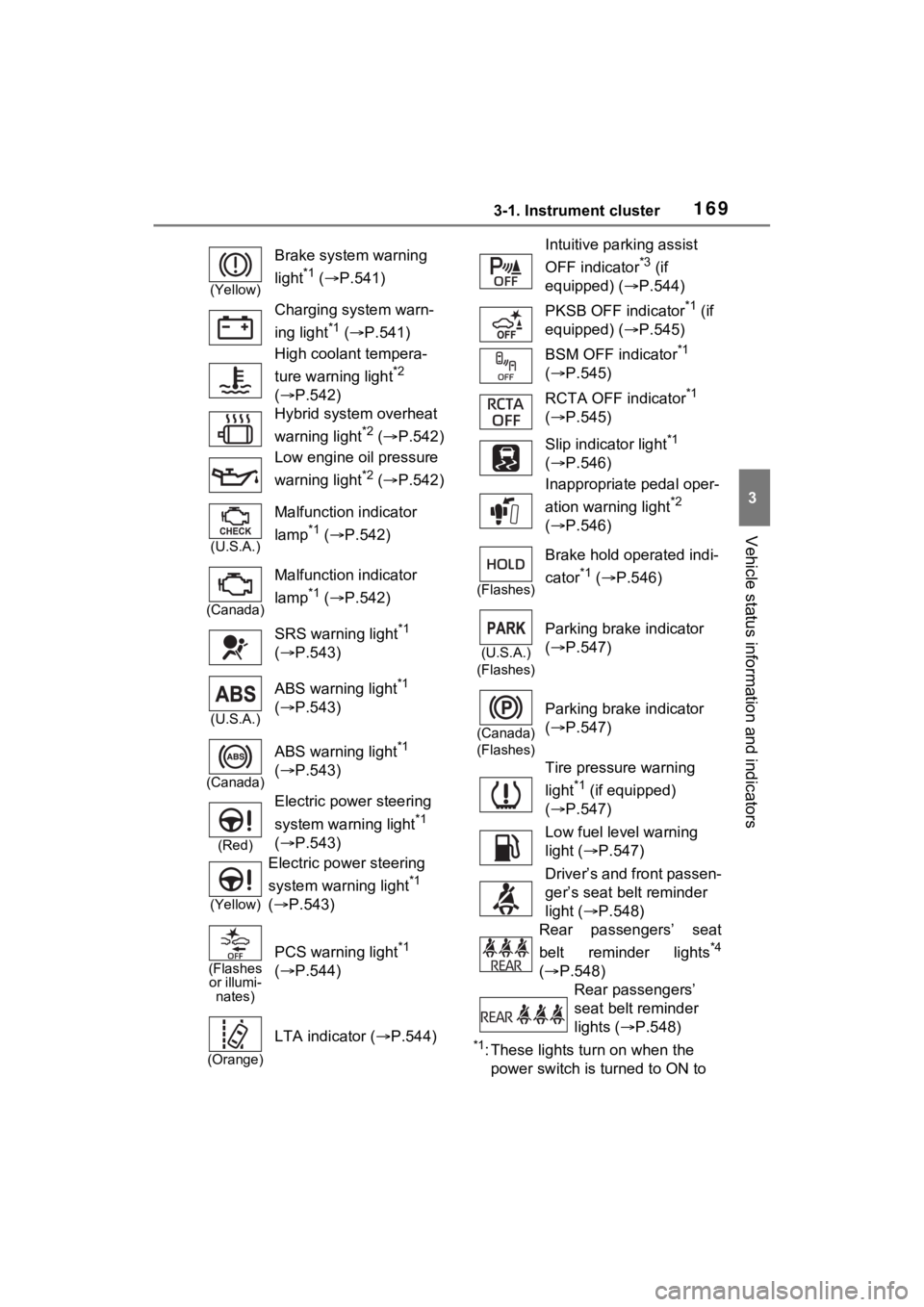
Brake system warning
light
*1 ( P.541)
Charging system warn-
ing light
*1 ( P.541)
High coolant tempera-
ture warning light
*2
( P.542)
Hybrid system overheat
warning light
*2 ( P.542)
Low engine oil pressure
warning light
*2 ( P.542)
(U.S.A.)
Malfunction indicator
lamp
*1 ( P.542)
(Canada)
Malfunction indicator
lamp
*1 ( P.542)
SRS warning light
*1
( P.543)
(U.S.A.)
ABS warning light*1
( P.543)
(Canada)
ABS warning light*1
( P.543)
(Red)
Electric power steering
system warning light
*1
( P.543)
(Yellow)
Electric power steering
system warning light
*1
( P.543)
(Flashes
or illumi- nates)
PCS warning light*1
( P.544)
(Orange)
LTA indicator ( P.544)
Intuitive parking assist
OFF indicator
*3 (if
equipped) ( P.544)
PKSB OFF indicator
*1 (if
equipped) ( P.545)
BSM OFF indicator
*1
( P.545)
RCTA OFF indicator
*1
( P.545)
Slip indicator light
*1
( P.546)
Inappropriate pedal oper-
ation warning light
*2
( P.546)
(Flashes)
Brake hold operated indi-
cator
*1 ( P.546)
(U.S.A.)
(Flashes)
Parking brake indicator
( P.547)
(Canada)
(Flashes)
Parking brake indicator
( P.547)
Tire pressure warning
light
*1 (if equipped)
( P.547)
Low fuel level warning
light ( P.547)
Driver’s and front passen-
ger’s seat belt reminder
light ( P.548)
Rear passengers’ seat
belt reminder lights
*4
( P.548)
Rear passengers’
seat belt reminder
lights ( P.548)