2023 TOYOTA RAIZE spare tire
[x] Cancel search: spare tirePage 227 of 516

2254-5. Using the driving support systems
RAIZE_OM_General_BZ358E
Driving
4
WARNING
⬛Before using the front corner sensors or reverse sensors
Make sure to observe the following precautions.
Failure to do so is dangerous, as it may lead to an unforeseen accident.
⚫Do not let the vehicle speed exceed approx. 10 km/h (6 mph).
⚫There is a limit to the sonar’s recognition range and activation speed. When
you move your vehicle forward or backward, make sure to check the safety
around the vehicle, which is outside the sonar’s recognition range (especially
the sides of the vehicle), use the brak e pedal to control the speed adequately
and drive slowly.
⚫Do not paste stickers or install accesso ries on the sonar sensors or their sur-
rounding areas.
⚫Vehicles with TFT color multi-informa tion display: If the warning message
“Sonar Sensor Function Stop” appears, check the sonar conditions. If the
warning message appears even when the sonar is not covered with rain,
snow, ice, or dirt, it could be due to a malfunction of the front corner sensors
or reverse sensors. Have the vehicl e inspected at your Toyota dealer.
⬛Front corner sensors and reverse sensors
In the following situations, the front corner sensors or reverse sensors may
not work normally and could lead to an unforeseen accident. Make sure to
drive carefully.
⚫Road conditions (slopes, unevenness, etc.)
⚫Vehicle’s maintenance conditions (brake-r elated issues, worn out tires, infla-
tion pressure, driving on a spare tire, etc.)
⚫Bad weather (heavy rain, snowstorm, fog, etc.)
⚫When the vehicle is signif icantly tilted by carrying a heavy load or being on
the surface with different height, or when the vehicle height has significantly
changed
⚫Distance from the obstacle, orientatio n or position (the obstacle is located
near the center of the vehicle)
⚫When driving on a steep slope
⚫When the sonar system cannot recognize the obstacle correctly (the follow-
ing cases in particular)
⦁ When an obstacle is extremely clos e to the sonar (when approaching too
close to the obstacle, the buzzer may change from continuous sound to
intermittent sound)
⦁ When an obstacle is located at a high position from the ground
⦁ Short obstacles
⦁ Small obstacles (such as small animals and infants), narrow obstacles
RAIZE_OM_General_BZ358E.book 225 ページ 2022年5月17日 火曜日 午後1時59分
Page 232 of 516
2304-5. Using the driving support systems
RAIZE_OM_General_BZ358E
WARNING
⬛Rear-view camera
Failure to observe the following may cause death or serious injury.
⚫Do not overly rely on the rear-view camera. Just as when you drive a vehicle
without the rear-view camera, make su re to check the safety around and
behind your vehicle and drive carefully. Be particularly careful not to collide
with the parked vehicles nearby, obstacles, or people.
⚫When you back up, make sure to check the safety around and behind your
vehicle and drive carefully.
⚫Never drive the vehicle while looking at the screen only.
The image displayed on the screen ma y be different from the actual situa-
tion. Note that the projection range of the camera is limited. Never back up
while looking at the screen only. Doing so could get your vehicle hit or lead
to an unforeseen accident. Be sure to confirm the safety around by visually
checking the surroundings with your ey es or using the inside rear view mir-
ror and the outside rear view mirrors before driving.
⚫Never use it in the situations listed below.
⦁ Frozen, slippery or snowy roads
⦁ When tire chains or spare tires are used
⦁ When the back door is not closed fully
⦁ On a non-flat road surface such as slopes
⚫If the outside temperature is low, the screen may be come dark and the
image may become blurry. Especially since the moving objects may appear
blurred or disappear from the screen, always check the safety around you
directly with your eyes while driving.
RAIZE_OM_General_BZ358E.book 230 ページ 2022年5月17日 火曜日 午後1時59分
Page 329 of 516
3276-3. Do-it-yourself maintenance
RAIZE_OM_General_BZ358E
Maintenance and care
6
Tires
Replace or rotate tires in accordance with maintenance schedules
and treadwear.Checking tires
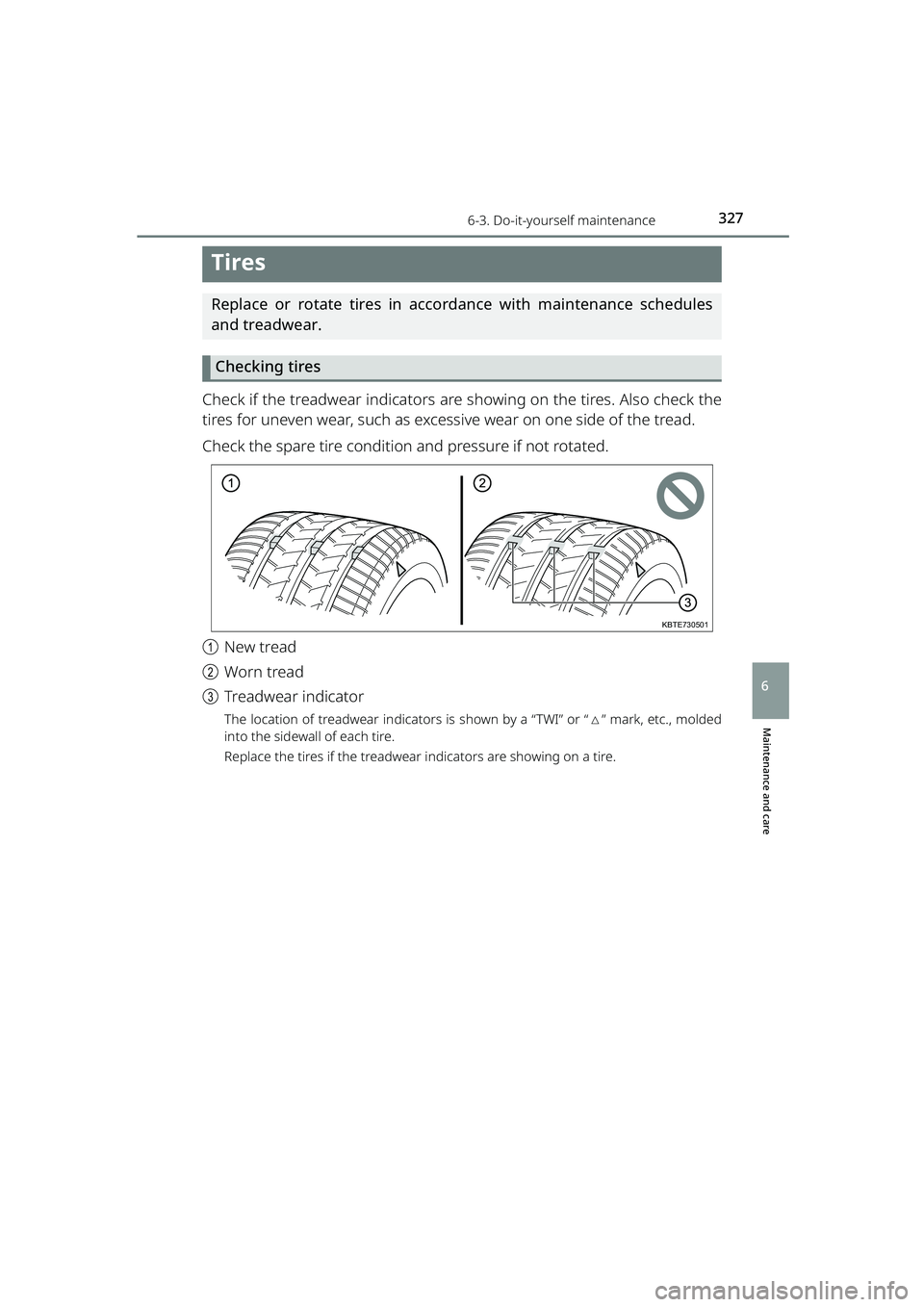
Check if the treadwear indicators are showing on the tires. Also check the
tires for uneven wear, such as excessi ve wear on one side of the tread.
Check the spare tire condition and pressure if not rotated.
a New tread
b Worn tread
c Treadwear indicator
The location of treadwear indicators is shown by a “TWI” or “ △” mark, etc., molded
into the sidewall of each tire.
Replace the tires if the treadwear indicators are showing on a tire.
KBTE730501
RAIZE_OM_General_BZ358E.book 327 ページ 2022年5月17日 火曜日 午後1時59分
Page 330 of 516
3286-3. Do-it-yourself maintenance
RAIZE_OM_General_BZ358E✽
: If equipped
Tire rotation
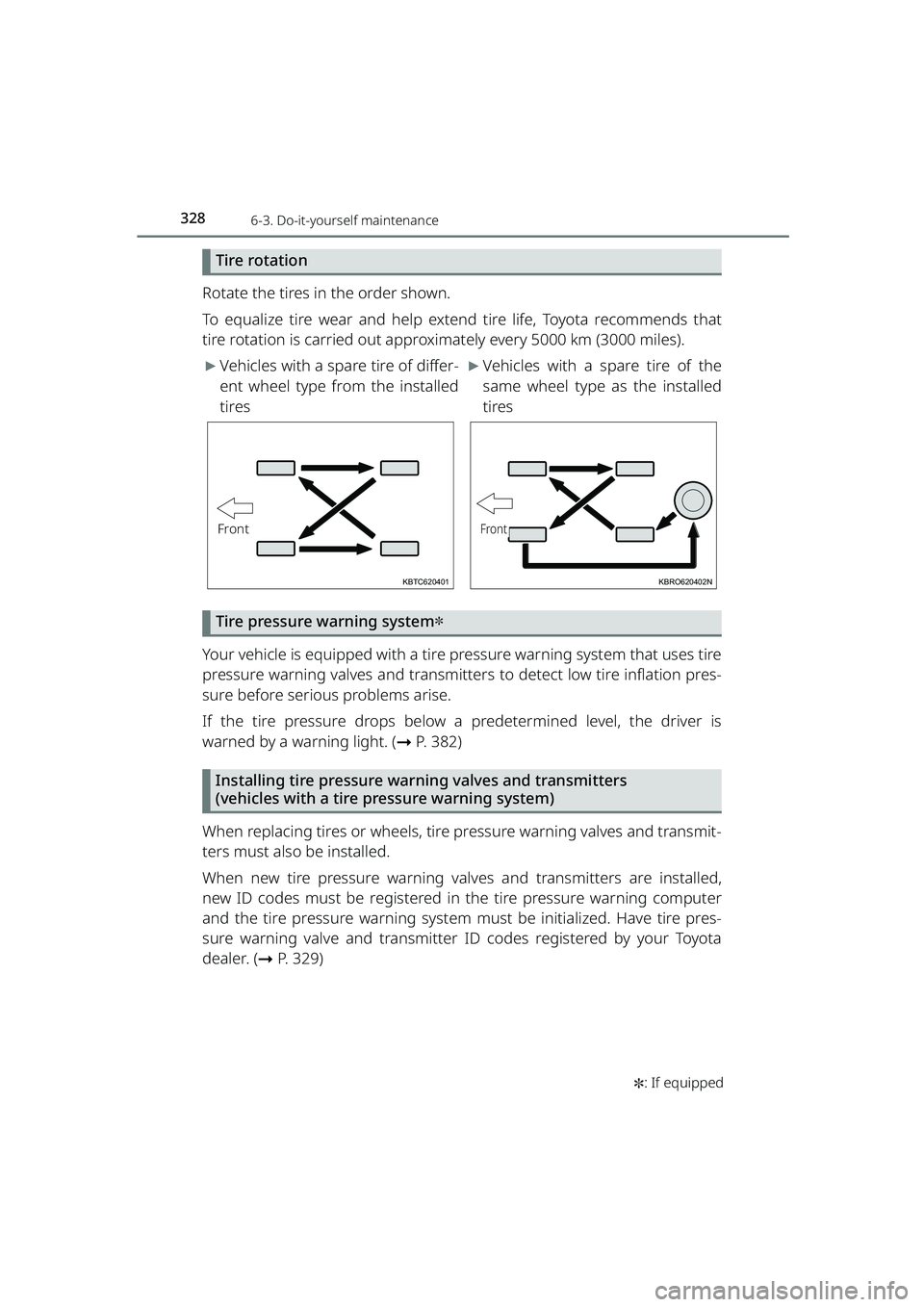
Rotate the tires in the order shown.
To equalize tire wear and help exte nd tire life, Toyota recommends that
tire rotation is carried out appr oximately every 5000 km (3000 miles).
▶Vehicles with a spare tire of differ-
ent wheel type from the installed
tires▶Vehicles with a spare tire of the
same wheel type as the installed
tires
Tire pressure warning system✽
Your vehicle is equipped with a tire pressure warning system that uses tire
pressure warning valves and transmitters to detect low tire inflation pres-
sure before serious problems arise.
If the tire pressure drops below a predetermined level, the driver is
warned by a warning light. (➞P. 382)
Installing tire pressure warning valves and transmitters
(vehicles with a tire pressure warning system)
When replacing tires or wheels, tire pressure warning valves and transmit-
ters must also be installed.
When new tire pressure warning valv es and transmitters are installed,
new ID codes must be registered in the tire pressure warning computer
and the tire pressure warning system must be initialized. Have tire pres-
sure warning valve and transmitter ID codes registered by your Toyota
dealer. ( ➞P. 329)
KBTC620401
Front
KBRO620402N
Front
RAIZE_OM_General_BZ358E.book 328 ページ 2022年5月17日 火曜日 午後1時59分
Page 333 of 516

3316-3. Do-it-yourself maintenance
RAIZE_OM_General_BZ358E
✽: If equipped
Maintenance and care
6
⬛Situations in which the tire pressure warning system may not operate properly✽
⚫In the following cases, the tire pressure warning system may not operate
properly.
⦁ If non-genuine Toyota wheels are used.
⦁A tire has been replaced with a tire that is not an OE (Original Equipment) tire.
⦁A tire has been replaced with a tire that is not of the specified size.
⦁ Tire chains, etc., are equipped.
⦁ An auxiliary-supported run-flat tire is equipped.
⦁ If a window tint that affects the radio wave signals is installed.
⦁ If there is a lot of snow or ice on th e vehicle, particularly around the wheels
or wheel housings.
⦁ If the tire inflation pressure is extr emely higher than the specified level.
⦁ If the spare tire is in a location subj ect to poor radio wave signal reception.
⦁ If a large metallic object which can in terfere with signal reception is put
near the spare tire.
⦁ If a wheel, not equipped with a tire pressure warning valve and transmit-
ter, is used.
⦁ If the ID code on the tire pressure warning valves and transmitters is not
registered in the tire pressure warning computer.
⚫Performance may be affected in the following situations.
⦁Near a TV tower, electric power plant, gas station, radio station, large display,
airport or other facility that generates strong radio waves or electrical noise
⦁ When carrying a portable radio, cellul ar phone, cordless phone or other
wireless communication device
⚫When the vehicle is parked, the time ta ken for the warning to start or go off
could be extended.
⚫When tire inflation pressure declin es rapidly for example when a tire has
burst, the warning may not function.
⬛The initialization operation (vehicles with the tire pressure warning system)
⚫Make sure to carry out init ialization after adjusting th e tire inflation pressure.
Also, make sure the tires are cold befo re carrying out initialization or tire
inflation pressure adjustment.
⚫If you have accidentally turned the engi ne switch to “OFF” during initializa-
tion, it is not necessary to press the reset switch again as initialization will
restart automatically when the engine switch has been turned to “ON” for
the next time.
⚫If you accidentally press the reset switch when initialization is not necessary,
adjust the tire inflation pressure to the specified level when the tires are
cold, and conduct initialization again.
RAIZE_OM_General_BZ358E.book 331 ページ 2022年5月17日 火曜日 午後1時59分
Page 384 of 516

3827-2. Steps to take in an emergency
RAIZE_OM_General_BZ358E ✽
: If equipped
*1Low brake fluid level warning buzzer:
The warning buzzer sounds when the vehicle has reached a speed of 5 km/h
(3 mph) or more while the warning light is on. If the buzzer sounds, the brake
fluid may be low.
*2Electric power steering system warning light (yellow):
If it does not turn off, or if it turns on repeatedly, have it inspected at your Toy-
ota dealer.
*3Open door warning light:
The open doors and/or hood are displa yed to the multi-information display
✽.
*4Open door warning buzzer:
The buzzer sounds when at least one of the doors or the hood of the vehicle is
not completely closed and the vehicle’s speed exceeds 5 km/h (3.1 mph).
Tire pressure warning light✽
When the light comes on:
Low tire inflation pressure such as
⦁Natural causes (➞P. 384)
⦁Flat tire ( ➞P. 396)
➞ Adjust the tire inflation pressure (including the spare tire) to
the specified level.
➞ The light will turn off after a few minutes. In case the light
does not turn off even if th e tire inflation pressure is
adjusted, have the system checked by your Toyota dealer.
When the light comes on af ter blinking for 1 minute:
Malfunction in the tire pressure warning system
➞ Have the system checked by your Toyota dealer.
(Flashing)
Engine oil deterioration warning light✽
The engine oil replacement is due soon
➞ Have the vehicle inspected at your Toyota dealer.
(Lit)
Engine oil deterioration warning light✽
The engine oil is deteriorated
➞ Have the vehicle inspected at your Toyota dealer immedi-
ately.
Parking brake non release warning light (warning buzzer*10)
When the parking brake is applied
➞ Release the parking brake
Warning
lightsWarning light name/Warning content/Action to take
RAIZE_OM_General_BZ358E.book 382 ページ 2022年5月17日 火曜日 午後1時59分
Page 386 of 516

3847-2. Steps to take in an emergency
RAIZE_OM_General_BZ358E ✽
: If equipped
⬛If the open door warning light✽ comes on
To avoid battery discharge, the warning light will automatically turn OFF after
about 10 minutes with the engine switch in “ACC” or “OFF”, and the door left
open.
⬛When the tire pressure warning light comes on (vehicles with a tire
pressure warning system)
Inspect the appearance of the tire to check that the tire is not punctured.
If the tire is punctured: ➞P. 3 9 6
If the tire is not punctured:
Carry out the following procedure after the tire temperature has lowered suffi-
ciently.
⚫Check the tire inflation pressure and adjust to the appropriate level.
⚫If the warning light does not go out even after several minutes, check that
the tire inflation pressure is at the sp ecified level and carry out initialization.
The warning light may come on again if the above operations are conducted
without first allowing the tire temperature to lower sufficiently.
⬛The tire pressure warning light may come on due to natural causes
(vehicles with a tire pressure warning system)
The tire pressure warning light may come on due to natural causes such as
natural air leaks and tire inflation pressure changes caused by temperature.
In this case, adjusting the tire inflatio n pressure will turn off the warning light
(after a few minutes).
⬛When a tire is replaced with a spare tire (vehicles with a tire pressure
warning system)
The spare tire is also equipped with a tire pressure warning valve and transmit-
ter. The tire pressure warning light will tu rn on if the tire inflation pressure of
the spare tire is low. If a tire goes flat, the tire pressure warning light will not
turn off even though the flat tire has been replaced with the spare tire. Replace
the spare tire with the repaired tire an d adjust the tire inflation pressure. The
tire pressure warning light will go off after a few minutes.
⬛If the tire pressure warning system is not functioning✽
The tire pressure warning system will be disabled in the following conditions:
(When the condition becomes normal, the system will work properly.)
⚫If tires not equipped with tire pressure warning valves and transmitters are
used
⚫If the ID code on the tire pressure warning valves and transmitters is not reg-
istered in the tire pressure warning computer
⚫If the tire inflation pressure is higher than the specified tire air pressure.
RAIZE_OM_General_BZ358E.book 384 ページ 2022年5月17日 火曜日 午後1時59分
Page 387 of 516

3857-2. Steps to take in an emergency
RAIZE_OM_General_BZ358E
When trouble arises
7
The tire pressure warning system may be disabled in the following conditions:
(When the condition becomes normal, the system will work properly.)
⚫If electronic devices or facilities us ing similar radio wave frequencies are
nearby
⚫If a radio set at a similar frequency is in use in the vehicle
⚫If a window tint that affects the radio wave signals is installed
⚫If there is a lot of snow or ice on th e vehicle, particularly around the wheels
or wheel housings
⚫If non-genuine Toyota wheels are used (Even if you use Toyota wheels, the
tire pressure warning system may no t work properly with some types of
tires.)
⚫If tire chains are used
⚫If the spare tire is in a location subject to poor radio wave signal reception.
⚫If a large metallic object which can in terfere with signal reception is put in
the luggage room.
⬛If the tire pressure warning light freq uently comes on after blinking for 1
minute (vehicles with a tire pressure warning system)
If the tire pressure warning light freque ntly comes on after blinking for 1 min-
ute when the engine switch is turned on, have it checked by your Toyota
dealer.
RAIZE_OM_General_BZ358E.book 385 ページ 2022年5月17日 火曜日 午後1時59分