Page 76 of 572
762-1. Fuel cell electric vehicle
Owners Manual_USA_M62064_en
2-1.Fuel cell electric vehicle
The illustration is an example for explanation and may differ from the actual
item.
Fuel cell stack
Fuel cell converter and auxiliary inverter
Hydrogen tanks
Traction battery
Fuel cell electric ve hicle characteristics
Fuel cell electric vehicle efficiently use electricity, which i s
generated by a chemical reaction between hydrogen and oxy-
gen in a fuel cell stack, and electricity charged in a traction
battery to drive the electric motor (traction motor).
The fuel is H2 (compressed hydrogen gas), so the exhaust is
only water and water vapor. As they do not release emissions
such as CO
2 (Carbon Dioxide) and NOx (Nitrogen Oxides),
fuel cell electric vehicles are environmentally friendly vehi-
cles.
Fuel cell electric vehicle components
Page 82 of 572
822-1. Fuel cell electric vehicle
Owners Manual_USA_M62064_en
■High-voltage and high-temperature components
The fuel cell electric vehicle has high-voltage components (abo ut
650 V maximum) such as a fuel c ell stack, traction battery, power
control unit, fuel cell converter, high-voltage cables (which a re distin-
guished from low-voltage cables b y their orange covers), electric
motor (traction motor), etc., and high-temperature parts such a s the
radiator for cooling. Pay attention to all warning labels attached to
the vehicle.
This diagram is for illustrative purposes only and may differ f rom the actual
vehicle.
Warning label
Radiator for inverter cooling
Radiator for fuel cell stack cooling
Fuel cell water pump
Fuel cell converter and auxiliary inverter
Power control unit
Cabin coolant heater
Traction battery
Service plug
Page 358 of 572
3586-3. Using the storage features
Owners Manual_USA_M62064_en
6-3.Using the storage features
Auxiliary boxes* ( P.360)
Cup holders ( P.359)
Console box ( P.360)
Glove box ( P.358)
*: If equipped
Pull up the lever to open.
List of storage features
Location of the storage features
WARNING
■Items that should not be left
in the storage spaces
Do not leave glasses, lighters or
spray cans in the storage spaces,
as this may cau se the following
when cabin temperature becomes
high:
●Glasses may be deformed by
heat or cracked if they come
into contact with other stored
items.
●Lighters or spray cans may
explode. If they come into con-
tact with other stored items, the
lighter may catch fire or the
spray can may release gas,
causing a fire hazard.
Glove box
Page 360 of 572
3606-3. Using the storage features
Owners Manual_USA_M62064_en
Press a button to open the con-
sole box.
Overhead (vehicles without
electronic sunshade)
Push in and release the auxiliary
box.
This box is useful for temporarily
storing the small items.
Rear seat (vehicles with rear
seat heater)
Pull the armrest down then push
the knob and lift the lid to open
it.Console box
WARNING
■Caution while driving
Keep the console box closed.
Injuries may result in the event of
an accident or sudden braking.
Auxiliary boxes
WARNING
■Caution while driving
Do not leave the auxiliary box
open while driving.
Items may fall out and cause
death or serious injury in case of
an accident or sudden stop.
■Items unsuitable for storing
(overhead)
Do not store items heavier than
0.4 lb. (0.2 kg).
Doing so may cause the auxiliary
box to open and the items inside
may fall out, resulting in an acci-
dent.
Page 406 of 572
4067-3. Do-it-yourself maintenance
Owners Manual_USA_M62064_en
1Pull the hood lock release
lever.
The hood will pop up slightly.
2Pull up the auxiliary catch
lever and lift the hood.■Front
Hood
Opening the hood
WARNING
■Pre-driving check
Check that the hood is fully closed
and locked.
If the hood is not locked properly,
it may open while the vehicle is in
motion and cause an accident,
which may result in death or seri-
ous injury.
Positioning a floor
jack
When using a floor jack, fol-
low the instructions in the
manual provided with the
jack and perform the opera-
tion safely.
When raising your vehicle
with a floor jack, position
the jack correctly. Improper
placement may damage
your vehicle or cause injury.
Location of the jack point
Page 466 of 572

4668-2. Steps to take in an emergency
Owners Manual_USA_M62064_en
■If a message that indicates the
need for visiting your Toyota
dealer is displayed
The system or part shown on the
multi-information display is malfunc-
tioning. Have the vehicle inspected
by your Toyota dealer immediately.
■If a message that indicates the
need for referring to Owner’s
Manual is displayed
●If any of the following messages
are shown on the multi-informa-
tion display, it may indicate a mal-
function. Have the vehicle
inspected by you r Toyota dealer
immediately.
• “Smart Key System Malfunction
See Owner’s Manual”
• “P Switch Malfunction Apply Park- ing Brake Securely When Parking
See Owner’s Manual”
• “Shift System Malfunction Apply Parking Brake Securely When
Parking See Owner’s Manual”
• “Shift System Unavailable Apply Parking Brake Securely When
Parking See Owner’s Manual”
• “Shift System Malfunction See Owner’s Manual”
• “Shift System Malfunction Stop in a Safe Place See Owner’s Man-
ual”
• “Battery Low Shifting Unavailable See Owner’s Manual”
• “FCV system malfunction”
• “Traction battery system malfunc-
tion”
• “Accelerator System Malfunction”
●If any of the following messages
are shown on the multi-informa-
tion display, it may indicate a mal-
function. Immediat ely stop the
vehicle and contact your Toyota
dealer.
• “Braking Power Low Stop in a Safe Place See Owner’s Manual”
• “FCV System Shutdown Due to
Hydrogen Leakage Stop in a Safe
Place See Owner’s Manual”
●If “FCV system stopped” is shown
on the multi-information display,
the vehicle may have run out of fuel. Stop the vehicle in a safe
place and, if the fuel level is low,
refuel the vehicle. (
P.83)
●If “Low Auxiliary Battery See
Owner’s Manual” is shown,
• When the display goes off after several seconds (displays for
about 6 seconds): Maintain the
fuel cell system operation for more
than 15 minutes and charge the
12-volt battery.
• When the display does not go off: Start up the fuel cell system using
the procedures: P. 4 8 5
●If “Maintenance Required for Trac-
tion Battery Cooling Parts See
Owner’s Manual” is shown, the fil-
ters may be clogged, the air intake
vents may be blocked, or there
may be a gap in the duct. There-
fore, perform the following correc-
tion procedure.
• Cleaning the traction battery air intake vents ( P.433)
If the warning message is shown
even if the vents are cleaned,
have the vehicle inspected by
your Toyota dealer.
■If “Ion Filter Maintenance
Required Visit Your Dealer” is
displayed
Ion filter replacement is necessary.
Contact your Toyota dealer.
NOTICE
■If “Low Auxiliary Battery See
Owner’s Manual” is displayed
frequently
The 12-volt battery may have
deteriorated. As the battery may
discharge in this state when left
unattended, have the battery
inspected by you r Toyota dealer.
Page 531 of 572
53110-1. For owners
Owners Manual_USA_M62064_en
10
For owners
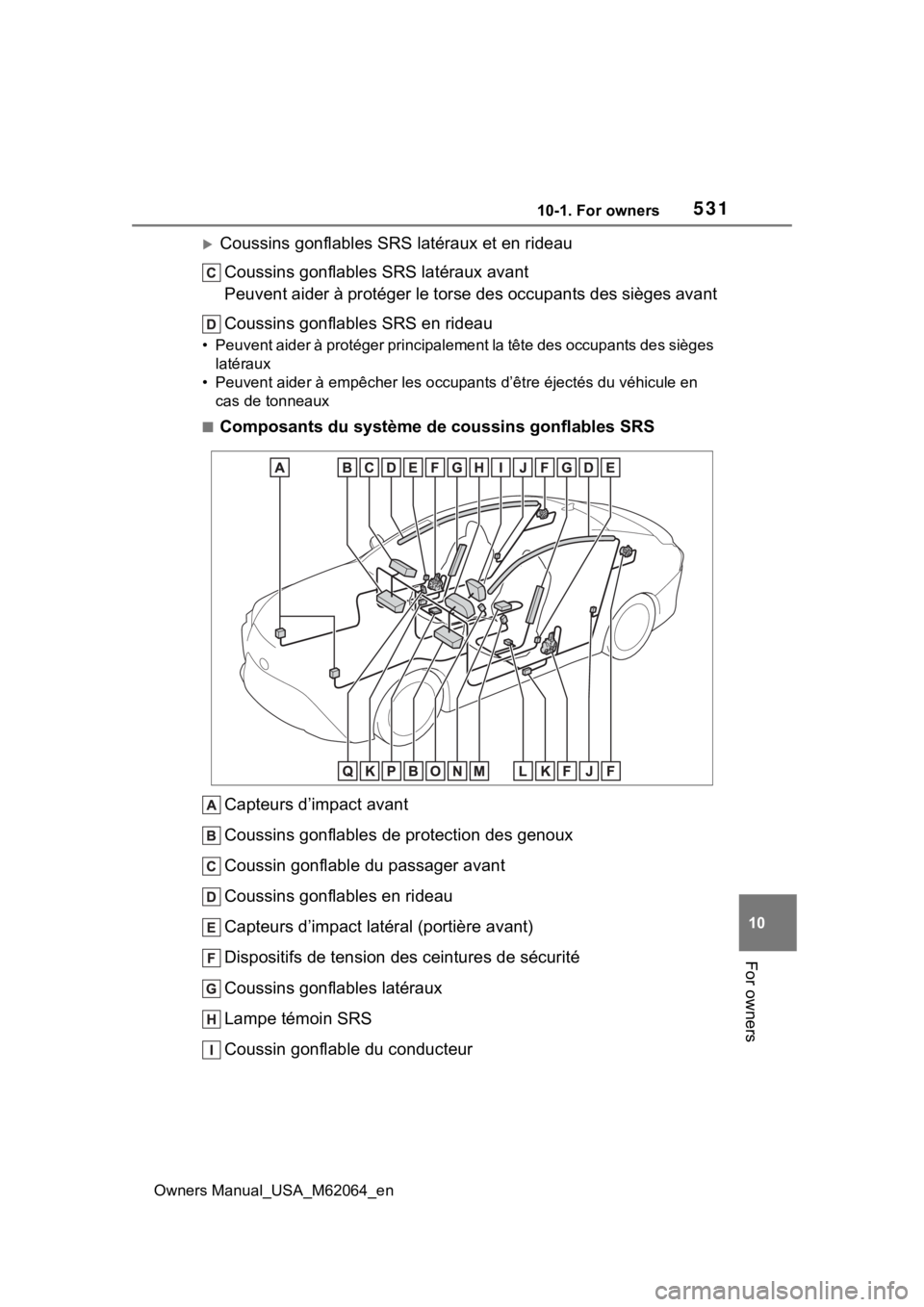
Coussins gonflables SRS latéraux et en rideau Coussins gonflables SRS latéraux avant
Peuvent aider à protéger le torse des occupants des sièges avan t
Coussins gonflables SRS en rideau
• Peuvent aider à protéger principalement la tête des occupants des sièges
latéraux
• Peuvent aider à empêcher les occu pants d’être éjectés du véhicule en
cas de tonneaux
■Composants du système de coussins gonflables SRS
Capteurs d’impact avant
Coussins gonflables de protection des genoux
Coussin gonflable du passager avant
Coussins gonflables en rideau
Capteurs d’impact latéral (portière avant)
Dispositifs de tension des ceintures de sécurité
Coussins gonflables latéraux
Lampe témoin SRS
Coussin gonflable du conducteur
Page 532 of 572

53210-1. For owners
Owners Manual_USA_M62064_en
Capteurs d’impact latéral (arrière)
Capteurs d’impact latéral (avant)
Capteur de position du siège du conducteur
Contacteur de boucle de ceinture de sécurité du conducteur
Module de capteur de coussin gonflable
Contacteur de boucle de ceinture de sécurité passager avant
Système de classification de l’occupant du siège du passager
avant (ECU et capteurs)
Voyants “AIRBAG ON” et “AIRBAG OFF”
Votre véhicule est doté de COUSSINS GONFLABLES ÉVOLUÉS
dont la conception s’appuie sur les normes de sécurité des véhi cules
à moteur américains (FMVSS208). Le module de capteur de coussin
gonflable (ECU) contrôle le déploiement des coussins gonflables en
fonction des informations obtenues des capteurs et d’autres élé-
ments affichés dans le diagramme des composants du système ci-
dessus. Ces informations comprennent des données relatives à la
gravité de l’accident et aux occupants. Au moment du déploiement
des coussins gonflables, une réaction chimique se produit dans les
gonfleurs de coussin gonflable et les coussins gonflables se remplis-
sent rapidement d’un gaz non toxique pour aider à limiter le mo uve-
ment des occupants.
AVERTISSEMENT
■Précautions relatives aux
coussins gonflables SRS
Observez les pré cautions suiva-
ntes en ce qui concerne les cous-
sins gonflables SRS.
Négliger de le faire pourrait occa-
sionner des blessures graves,
voire mortelles.
●Le conducteur et tous les pas-
sagers du véhicule doivent por-
ter leur ceinture de sécurité de
la manière appropriée.
Les coussins gonflables SRS
sont des disposit ifs supplémen-
taires qui doivent être utilisés
avec les ceintures de sécurité.