2023 TOYOTA MIRAI tire type
[x] Cancel search: tire typePage 329 of 572
![TOYOTA MIRAI 2023 Owners Manual 3295-6. Driving tips
Owners Manual_USA_M62064_en
5
Driving
Use the correct tire chain size
when mounting the tire chains.
Chain size is regulated for each
tire size. Side chain (0.12 in. [3 mm] in](/manual-img/14/67081/w960_67081-328.png "TOYOTA MIRAI 2023 Owners Manual 3295-6. Driving tips
Owners Manual_USA_M62064_en
5
Driving
Use the correct tire chain size
when mounting the tire chains.
Chain size is regulated for each
tire size. Side chain (0.12 in. [3 mm] in")
3295-6. Driving tips
Owners Manual_USA_M62064_en
5
Driving
Use the correct tire chain size
when mounting the tire chains.
Chain size is regulated for each
tire size. Side chain (0.12 in. [3 mm] in
diameter)
Cross chain (0.16 in. [4 mm]
in diameter)
Regulations regarding the use
of tire chains vary depending on
location and type of road.
Always check local regulations
before installing chains.
■Tire chain installation
Observe the following precautions
when installing and removing
chains:
●Install and remove tire chains in a
safe location.
●Install tire chains on the rear tires.
Do not install tire chains on the
front tires.
●Install tire chains on the rear tires
as tightly as possible. Retighten
chains after driving 1/4 1/2 mile (0.5
1.0 km).
●Install tire chains following the
instructions provided with the tire
chains.
To enable the windshield wipers
to be lifted when heavy snow or
icy conditions are expected,
change the rest position of the
windshield wipers from the
retracted position below the
hood to the service position
using the wiper lever. ( P.208)
Selecting tire chains
Regulations on the use of
tire chains
NOTICE
■Fitting tire chains
The tire pressure warning valves
and transmitters may not function
correctly when tire chains are fit-
ted.
Windshield wipers
Page 416 of 572

4167-3. Do-it-yourself maintenance
Owners Manual_USA_M62064_en
Check if the treadwear indica-
tors are showing on the tires.
Also check the tires for uneven
wear, such as excessive wear
on one side of the tread.
New tread
Worn tread
Treadwear indicator
The location of treadwear indicators
is shown by a “TWI” or “ ” mark,
etc., molded into the sidewall of
each tire. Replace the tires if the treadwear
indicators are s
howing on a tire.
■When to replace your vehicle’s
tires
Tires should be replaced if:
●The treadwear indicators are
showing on a tire.
●You have tire damage such as
cuts, splits, cracks deep enough
to expose the fabric, and bulges
indicating internal damage
●A tire goes flat repeatedly or can-
not be properly repaired due to the
size or location of a cut or other
damage
If you are not sure, consult with your
Toyota dealer.
■Tire life
Any tire over 6 years old must be
checked by a qualified technician
even if it has seldom or never been
used or damage is not obvious.
■Maximum load of tire
Check that the maximum load of the
replacement tire is greater than 1/2
of the Gross Axle Weight Ratings
(GAWR) of either the front axle or
the rear axle, whi chever is greater.
For the GAWR, see the Certification
Label.
For the maximum load of the tire,
see the load limit at maximum cold
tire inflation pressure mentioned on
the sidewall of the tire. ( P.502)
■Tire types
●Summer tires
Summer tires are high-speed perfor-
Tires
Replace or rotate tires in
accordance with mainte-
nance schedules and tread-
wear.
Checking tires
Page 430 of 572

4307-3. Do-it-yourself maintenance
Owners Manual_USA_M62064_en
When replacing wheels, care
should be taken to ensure that
they are equivalent to those
removed in load capacity, diam-
eter, rim width and inset
*.
Replacement wheels are avail-
able at your Toyota dealer.
*: Conventionally referred to as off- set.
Toyota does not recommend
using the following:
Wheels of different sizes or
types
Used wheels
Bent wheels that have been
straightened
■When replacing wheels
The wheels of your vehicle are
equipped with tire pressure warning
valves and transmitters that allow
the tire pressure warning system to
provide advance warning in the
event of a loss in tire inflation pres-
sure. Whenever wheels are
replaced, the tire pressure warning
valves and transmitters must be
installed. ( P.419)
WARNING
●Greater possibility of tire dam-
age while driving (due to road
hazards, expansion joints,
sharp edges in the road, etc.)
NOTICE
■When inspecting and adjust-
ing tire inflation pressure
Be sure to put the tire valve caps
back on.
If a valve cap is not installed, dirt
or moisture may get into the valve
and cause an air leak, resulting in
decreased tire inflation pressure.
Wheels
If a wheel is bent, cracked or
heavily corroded, it should
be replaced. Otherwise, the
tire may separate from the
wheel or cause a loss of
handling control.
Wheel selection
Page 449 of 572

4498-2. Steps to take in an emergency
Owners Manual_USA_M62064_en
8
When trouble arises
8-2.Steps to take in an emergency
If your vehicle needs
to be towed
If towing is necessary, we
recommend having your
vehicle towed by your Toy-
ota dealer or commercial
towing service, using a
wheel-lift type truck or flat-
bed truck.
Use a safety chain system
for all towing, and abide by
all state/provincial and local
laws.
WARNING
Observe the following precau-
tions.
Failure to do so m ay result in
death or serious injury.
■When towing the vehicle
Be sure to transp ort the vehicle
with all four wheels raised off the
ground. If the vehicle is towed
with the tires co ntacting the
ground, the drivetrain and related
parts may be damaged, an acci-
dent may occur due to a change
in direction of the vehicle or elec-
tricity generated by the operation
of the motor may cause a fire to
occur depending o n the nature of
the damage or malfunction.
■While towing
●When towing using cables or
chains, avoid sudden starts, etc.
which place excessive stress on
the towing eyelets, cables or
chains. The towing eyelets,
cables or chains may become
damaged, broken debris may hit
people, and cause serious dam-
age.
●Do not perform any of the fol-
lowing as doing so may cause
the parking lock mechanism to
engage, locking the rear wheels
and possibly leading to an acci-
dent resulting in death or seri-
ous injury:
• Unfasten the driv er’s seat belt
and open the driver’s door.
Page 451 of 572

4518-2. Steps to take in an emergency
Owners Manual_USA_M62064_en
8
When trouble arises
rear wheels.
From the rear
Use a towing dolly under the
front wheels.
■Towing with a sling-type truck
Do not tow with a sling-type truck to
prevent body damage.
When using a flatbed truck to
transport the vehicle, use tire
strapping belts. Refer to the
owner’s manual of the flatbed
truck for the tire strapping
method.
In order to suppress vehicle
movement during transporta-
tion, set the parking brake and
turn the power switch off. If a tow truck is not available in
an emergency, your vehicle may
be temporarily towed using
cables or chains secured to the
emergency towing eyelets. This
should only be attempted on
hard surfaced roads for short
distances at under 18 mph (30
km/h).
A driver must be in the vehicle to
steer and operate the brakes.
The vehicle’s wheels, drive train,
axles, steering and brakes must
be in good condition.
To have your vehicle towed by
another vehicle, the towing eye-
let must be installed to your
vehicle. Install the towing eyelet
using the following procedure.
1
Take out the screwdriver and
towing eyelet.
Type A
Screwdriver
To w i n g e y e l e t
Using a flatbed truck
Emergency towing
Emergency towing proce-
dure
Page 471 of 572

4718-2. Steps to take in an emergency
Owners Manual_USA_M62064_en
8
When trouble arises
■Note for checking the emer-
gency tire puncture repair kit
Check the sealant expiry date occa-
sionally.
The expiry date is shown on the bot-
tle. Do not use sealant whose expiry
date has already passed. Other-
wise, repairs conducted using the
emergency tire puncture repair kit
may not be performed properly.
■Emergency tire puncture repair
kit
●The emergency tire puncture
repair kit is for filling the car tire
with air.
●The sealant has a limited life
span. The expiry date is marked
on the bottle. The sealant should
be replaced before the expiry
date. Contact your Toyota dealer
for replacement.
●The sealant stored in the emer-
gency tire puncture repair kit can
be used only once to temporarily
repair a single tire. If the sealant
has been used and needs to be
replaced, purchase a new bottle at
your Toyota dealer. The compres-
sor is reusable.
●The sealant can be used when the
outside temperature is from -22°F
(-30°C) to 140°F (60°C).
●The kit is exclusively designed for
size and type of tires originally
installed on your vehicle. Do not
use it for tires that a different size
than the original ones, or for any
other purposes.
●If the sealant gets on your clothes,
it may stain.
●If the sealant adheres to a wheel
or the surface of the vehicle body,
the stain may not be removable if
it is not cleaned at once. Immedi-
ately wipe away the sealant with a
wet cloth.
●During operation of the repair kit,
a loud operation noise is pro-
duced. This does not indicate a malfunction.
●Do not use to check or to adjust
the tire pressure.
WARNING
■Caution while driving
●Store the repair kit in the lug-
gage compartment.
Injuries may result in the event
of an accident or sudden brak-
ing.
●The repair kit is exclusively only
for your vehicle.
Do not use repair kit on other
vehicles, which could lead to an
accident causing death or seri-
ous injury.
●Do not use repair
kit for tires
that are differen t size than the
original ones, or for any other
purpose. If the tires have not
been completely repaired, it
could lead to an accident caus-
ing death or serious injury.
■Precautions for use of the
sealant
●Ingesting the sealant is hazard-
ous to your health. If you ingest
sealant, consume as much
water as possible, and then
immediately consult a doctor.
●If sealant gets in eyes or
adheres to skin, immediately
wash it off with water. If discom-
fort persists, consult a doctor.
Page 477 of 572

4778-2. Steps to take in an emergency
Owners Manual_USA_M62064_en
8
When trouble arises
3 Disconnect the hose from the
valve, remove the air release cap
from the hose and then recon-
nect the hose.
4 Turn the compressor switch on
and wait for several seconds,
and then turn it off. Check that
the air pressure indicator shows
the specified air pressure.
( P.501)
If the air pressure is under the des-
ignated pressure, turn the compres-
sor switch on again and repeat the
inflation procedure until the speci-
fied air pressure is reached.
■The valve of a tire that has been
repaired
After a tire is repaired with the emer-
gency tire puncture repair kit, the
valve should be replaced.
■After a tire is repaired with the
emergency tire puncture repair
kit
●The tire pressure warning valve
and transmitter should be
replaced.
●Even if the tire inflation pressure is
at the recommended level, the tire
pressure warning light may come
on/flash.
■Note for checking the emer-
gency tire puncture repair kit
Check the sealant expiry date occa-
sionally.
The expiry date is shown on the bot-
tle. Do not use sealant whose expiry
date has already passed. Other-
wise, repairs conducted using the
emergency tire puncture repair kit
may not be performed properly.
■Emergency tire puncture repair
kit
●The emergency tire puncture
repair kit is for filling the car tire
with air.
●The sealant has a limited life
span. The expiry date is marked
on the bottle. The sealant should
be replaced before the expiry date. Contact your Toyota dealer
for replacement.
●The sealant stored in the emer-
gency tire puncture repair kit can
be used only once to temporarily
repair a single tire. If the sealant in
the bottle and other parts of the kit
have been used and need to be
replaced, contact your Toyota
dealer.
●The compressor can be used
repeatedly.
●The sealant can be used when the
outside temperature is from -40°F
(-40°C) to 140°F (60°C).
●The kit is exclusi
vely designed for
size and type of ti res originally
installed on your vehicle. Do not
use it for tires that a different size
than the original ones, or for any
other purposes.
●If the sealant gets on your clothes,
it may stain.
●If the sealant adhe res to a wheel
or the surface of the vehicle body,
the stain may not be removable if
it is not cleaned at once. Immedi-
ately wipe away the sealant with a
wet cloth.
●During operation of the repair kit,
a loud operation noise is pro-
duced. This does not indicate a
malfunction.
●Do not use to check or to adjust
the tire pressure.
WARNING
■Do not drive the vehicle with
a flat tire
Do not continue driving with a flat
tire.
Driving even a short distance with
a flat tire can damage the tire and
the wheel beyond repair.
Driving with a flat tire may cause a
circumferential groove on the side
wall. In such a cas e, the tire may
explode when using a repair kit.
Page 502 of 572
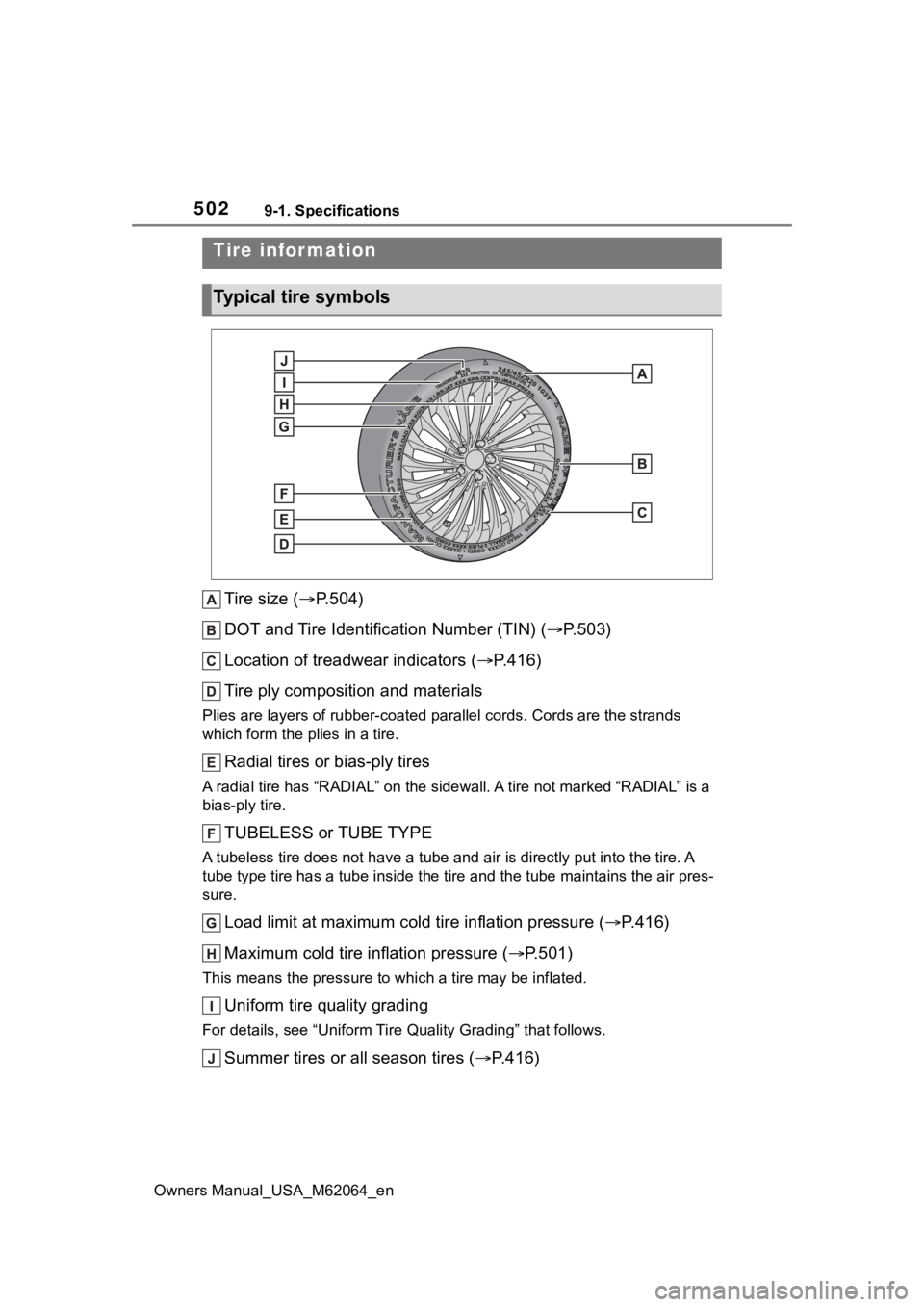
5029-1. Specifications
Owners Manual_USA_M62064_en
Tire size (P.504)
DOT and Tire Identification Number (TIN) ( P.503)
Location of treadwear indicators ( P.416)
Tire ply composition and materials
Plies are layers of rubber-coat ed parallel cords. Cords are the strands
which form the pl ies in a tire.
Radial tires or bias-ply tires
A radial tire has “RADIAL” on the sidewall. A tire not marked “ RADIAL” is a
bias-ply tire.
TUBELESS or TUBE TYPE
A tubeless tire does not have a tube and air is directly put into the tire. A
tube type tire has a tube inside t he tire and the tube maintains the air pres-
sure.
Load limit at maximum cold tire inflation pressure (P.416)
Maximum cold tire inflation pressure ( P.501)
This means the pressure to w hich a tire may be inflated.
Uniform tire quality grading
For details, see “Uniform Tire Quality Grading” that follows.
Summer tires or all season tires ( P.416)
Tire information
Typical tire symbols