2023 TOYOTA COROLLA change wheel
[x] Cancel search: change wheelPage 354 of 468
3547-2. Steps to take in an emergency
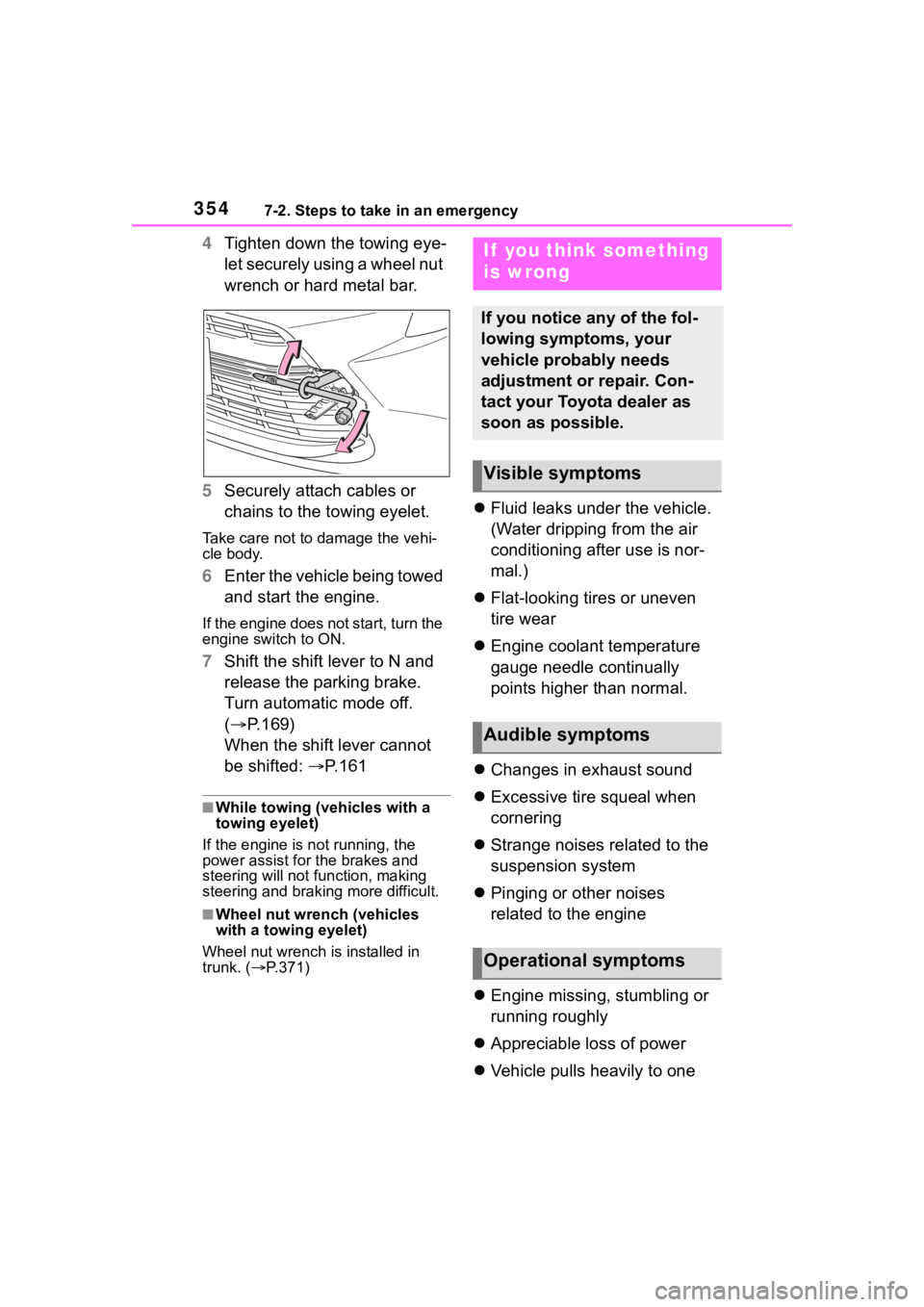
4Tighten down the towing eye-
let securely using a wheel nut
wrench or hard metal bar.
5 Securely attach cables or
chains to the towing eyelet.
Take care not to damage the vehi-
cle body.
6Enter the vehicle being towed
and start the engine.
If the engine does not start, turn the
engine switch to ON.
7Shift the shift lever to N and
release the parking brake.
Turn automatic mode off.
( P.169)
When the shift lever cannot
be shifted: P. 1 6 1
■While towing (vehicles with a
towing eyelet)
If the engine is not running, the
power assist for the brakes and
steering will not function, making
steering and braking more difficult.
■Wheel nut wrench (vehicles
with a towing eyelet)
Wheel nut wrench is installed in
trunk. ( P.371)
Fluid leaks under the vehicle.
(Water dripping from the air
conditioning after use is nor-
mal.)
Flat-looking tires or uneven
tire wear
Engine coolant temperature
gauge needle continually
points higher than normal.
Changes in exhaust sound
Excessive tire squeal when
cornering
Strange noises related to the
suspension system
Pinging or other noises
related to the engine
Engine missing, stumbling or
running roughly
Appreciable loss of power
Vehicle pulls heavily to one
If you think something
is wrong
If you notice any of the fol-
lowing symptoms, your
vehicle probably needs
adjustment or repair. Con-
tact your Toyota dealer as
soon as possible.
Visible symptoms
Audible symptoms
Operational symptoms
Page 364 of 468

3647-2. Steps to take in an emergency
system warning light may come on
and the warning buzzer may sound.
■When the tire pressure warning
light comes on (vehicles with a
tire pressure warning system)
Inspect the tires to check if a tire is
punctured.
If a tire is punctured: P.370
If none of the tires are punctured:
Turn the engine switch off then turn
it to ON. Check if the tire pressure
warning light comes on or blinks.
If the tire pressure warning light
blinks for approximately 1 minute
then stays on
There may be a malfunction in the
tire pressure warning system. Have
the vehicle inspected by your Toyota
dealer immediately.
If the tire pressure warning light
comes on
1 After the temperature of the tires
has lowered sufficiently, check
the inflation pressure of each tire
and adjust them to the specified
level.
2 If the warning light does not turn
off even after several minutes
have elapsed, check that the
inflation pressure of each tire is
at the specified level and perform
initialization. ( P.318)
■The tire pressure warning light
may come on due to natural
causes (vehicles with a tire
pressure warning system)
The tire pressure warning light may
come on due to natural causes such
as natural air leaks and tire inflation
pressure changes caused by tem-
perature. In this case, adjusting the
tire inflation pressure will turn off the
warning light (after a few minutes).
■When a tire is replaced with a
spare tire (vehicl es with a tire
pressure warning system)
The compact spare tire is not
equipped with a tire pressure warn-
ing valve and transmitter. If a tire goes flat, the tire pressure warning
light will not turn off even though the
flat tire has been replaced with the
spare tire. Replace the spare tire
with the repaired tire and adjust the
tire inflation pressure. The tire pres-
sure warning light will go off after a
few minutes.
■Conditions that the tire pres-
sure warning system may not
function properly (vehicles with
a tire pressure warning system)
P.315
WARNING
■If both the ABS and the brake
system warning lights remain
on
Stop your vehicle in a safe place
immediately and contact your Toy-
ota dealer.
The vehicle will become
extremely unstable during brak-
ing, and the ABS system may fail,
which could cause an accident
resulting in death o r serious injury.
■When the electric power
steering system warning light
comes on
When the light comes on yellow,
the assist to the power steering is
restricted. When the light comes
on red, the assis t to the power
steering is lost and handling oper-
ations of the steering wheel
become extremely heavy.
When steering wheel operations
are heavier than usual, grip the
steering wheel firmly and operate
it using more fo rce than usual.
■If the tire pressure warning
light comes on ( vehicles with
a tire pressure warning sys-
tem)
Be sure to observe the following
precautions.
Failure to do so could cause a
loss of vehicle control and result
in death or serious injury.
Page 365 of 468
3657-2. Steps to take in an emergency
7
When trouble arises
WARNING
●Stop your vehicle in a safe place
as soon as possible. Adjust the
tire inflation pressure immedi-
ately.
●If the tire pressure warning light
comes on even after tire infla-
tion pressure adjustment, it is
probable that you have a flat
tire. Check the tires. If a tire is
flat, change it with the spare tire
and have the flat tire repaired by
the nearest Toy ota dealer.
●Avoid abrupt maneuvering and
braking.
If the vehicle tires deteriorate,
you could lose control of the
steering wheel or the brakes.
■If a blowout or sudden air
leakage should occur (vehi-
cles with a tire pressure warn-
ing system)
The tire pressure warning system
may not activate immediately.
■Maintenance of the tires
Each tire, including the spare (if
provided), should be checked
monthly when cold and inflated to
the inflation pressure recom-
mended by the vehicle manufac-
turer on the vehicle placard or tire
inflation pressure label (tire and
load information label). (If your
vehicle has tires of a different size
than the size indicated on the
vehicle placard or tire inflation
pressure label [tire and load infor-
mation label], you should deter-
mine the proper tire inflation
pressure for those tires.)
As an added safety feature, your
vehicle has been equipped with a
tire pressure monitoring system
(TPMS-tire pressure warning sys-
tem) that illuminates a low tire
pressure telltale (tire pressure
warning light) w hen one or more
of your tires is significantly
under-inflated. Accordingly, when
the low tire pressure telltale (tire
pressure warning light) illumi-
nates, you should stop and check
your tires as soon as possible,
and inflate them to the proper
pressure. Driving on a signifi-
cantly under-inflated tire causes
the tire to overhea t and can lead
to tire failure. Under-inflation also
reduces fuel efficiency and tire
tread life, and may affect the vehi-
cle’s handling and stopping ability.
Please note that the TPMS (tire
pressure warning system) is not a
substitute for proper tire mainte-
nance, and it is the driver’s
responsibility to m aintain correct
tire pressure, even if under-infla-
tion has not reached the level to
trigger illumination of the TPMS
low tire pressure te lltale (tire pres-
sure warning light).
Your vehicle has also been
equipped with a TPMS (tire pres-
sure warning system) malfunc-
tion indicator to indicate when the
system is not operating properly.
The TPMS (tire pressure warning
system) malfunction indicator is
combined with the low tire pres-
sure telltale (tire pressure warning
light). When the system detects a
malfunction, the te lltale will flash
for approximately one minute and
then remain continuously illumi-
nated. This sequence will con-
tinue upon subsequent vehicle
start-ups as long as the malfunc-
tion exists. When the malfunction
indicator is illuminated, the sys-
tem may not be ab le to detect or
signal low tire pressure as
intended.
Page 377 of 468
3777-2. Steps to take in an emergency
7
When trouble arises
disc wheel seat .
3Lower the vehicle.
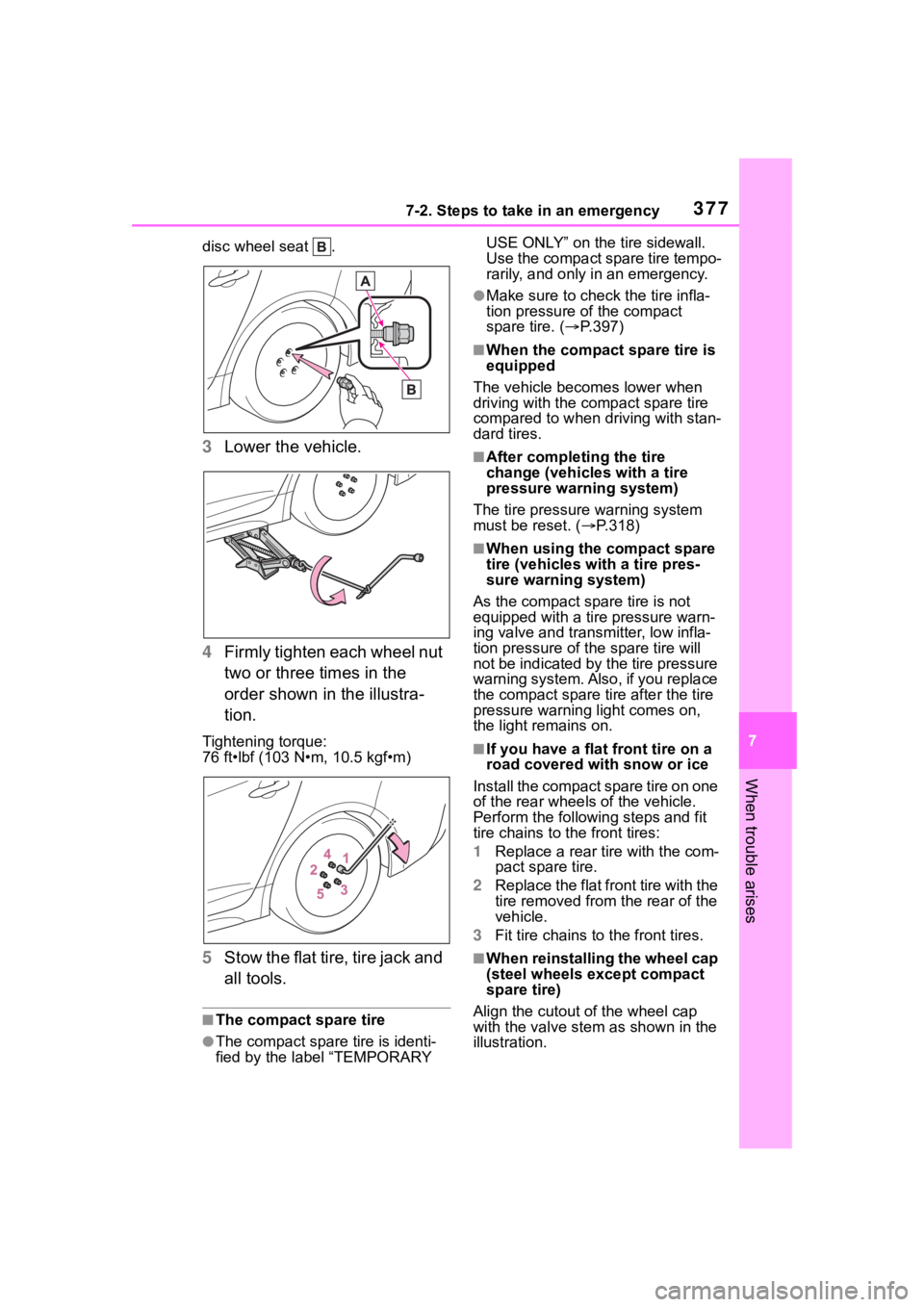
4 Firmly tighten each wheel nut
two or three times in the
order shown in the illustra-
tion.
Tightening torque:
76 ft•lbf (103 N•m, 10.5 kgf•m)
5Stow the flat tire, tire jack and
all tools.
■The compact spare tire
●The compact spare tire is identi-
fied by the label “TEMPORARY USE ONLY” on the tire sidewall.
Use the compact spare tire tempo-
rarily, and only in an emergency.
●Make sure to check the tire infla-
tion pressure of the compact
spare tire. (
P.397)
■When the compact spare tire is
equipped
The vehicle becomes lower when
driving with the compact spare tire
compared to when driving with stan-
dard tires.
■After completing the tire
change (vehicles with a tire
pressure warning system)
The tire pressure warning system
must be reset. ( P.318)
■When using the compact spare
tire (vehicles with a tire pres-
sure warning system)
As the compact spare tire is not
equipped with a tire pressure warn-
ing valve and transm itter, low infla-
tion pressure of t he spare tire will
not be indicated by the tire pressure
warning system. Also , if you replace
the compact spare ti re after the tire
pressure warning light comes on,
the light remains on.
■If you have a flat front tire on a
road covered with snow or ice
Install the compact spare tire on one
of the rear wheels of the vehicle.
Perform the following steps and fit
tire chains to the front tires:
1 Replace a rear tire with the com-
pact spare tire.
2 Replace the flat front tire with the
tire removed from the rear of the
vehicle.
3 Fit tire chains to the front tires.
■W h e n r e i n s t a l l i n g t h e w h e e l c a p
(steel wheels except compact
spare tire)
Align the cutout of the wheel cap
with the valve stem as shown in the
illustration.
Page 422 of 468
4228-3. Initialization
8-3.Initialization
*: If equipped
Items to initialize
The following items must be initialized for normal system
operation after such cases as the battery being reconnected,
or maintenance being performed on the vehicle:
List of items to initialize
ItemWhen to initializeReference
Message indicat-
ing maintenance is
required
• After maintenance is performedP. 2 9 5
Tire pressure warn-
ing system
*
• When rotating front and rear tires which have different tire
inflation pressures
• When the tire inflation pressure is changed such as when the
tire size is changed.
• When the tire inflation pressure is changed such as when
changing traveling speed or load
weight
• When changing between two registered wheel sets
P. 3 1 6
Page 447 of 468

447Alphabetical Index
Shift lock system............ 161, 164
Side airbags .............................. 31
Side marker lightsLight switch .......................... 173
Replacing light bulbs ............ 342
Wattage ................................ 398
Side mirrors Adjustment ........................... 132
BSM (Blind Spot Monitor)..... 232
Folding ................................. 133
RCTA function ...................... 237
Side turn signal lights Replacing light bulbs ............ 341
Turn signal lever ................... 167
Side windows ...... ................... 134
Smart key system Antenna location .................. 120
Entry functions ..................... 111
Starting the engine ............... 155
Snow tires ............................... 253
Spare tire ................................. 370 Inflation pressure.................. 397
Storage location ................... 371
Spark plug ............................... 395
Specifications ......................... 392
Speedometer ...................... 86, 89
Steering lock Column lock release............. 154
Steering wheel Adjustment ........................... 130
Heated steering wheel ......... 269
Meter control switches ..... 92, 97
Stop lights Replacing light bulbs ............ 341
Storage features ..................... 273
Stuck If the vehicle becomes stuck 389
Sun visors ............................... 284
Sunshade Roof...................................... 137 Switches
AHB (Automatic High Beam) 175
Brake Hold switch .................171
Display change button ......87, 90
Door lock switches ............... 115
Driving mode select switch ...247
Dynamic radar cruise control switch .................................222
Emergency flashers switch...348
Engine switch ...............154, 155
Heated steering wheel switch ...........................................269
Ignition switch ...............154, 155
Instrument panel light control switches..........................88, 91
Light switches .......................173
LTA (Lane Tracing Assist) switch ...........................................204
Meter control switches......92, 97
Moon roof switches ..............137
Outside rear v iew mirror
switches..............................132
Paddle shift switches ....164, 165
Parking brake switch ............168
Power door lock switch......... 115
Power window switches .......134
RCTA switch .........................238
Rear window and outside rear view mirror defoggers switch...........................................263
Seat heater switches ............269
“SOS” button ..........................72
Vehicle-to-vehicle distance switch .................................224
VSC OFF switch ...................249
Window lock switch ..............136
Windshield wiper and washer switch .................................178
T
Tachometer ...............................86