2023 SUBARU SOLTERRA battery
[x] Cancel search: batteryPage 74 of 628
742-1. Electric vehicle system
Owners Manual_USA_M42C01_en
■Charging the traction battery
Be sure to maintain the traction bat-
tery charge level suitable for your
driving needs.
If the traction battery fully dis-
charges, the vehicle cannot be
driven at all. When the battery
becomes low, charge it as soon as
possible.
■If the traction battery becomes
low
●If the traction battery becomes
low, the traction battery charge
warning light comes on or flashes
and a message will be displayed
on the multi-information display.
( P.515)
●If the traction batte ry is completely
discharged, the EV system cannot
be started and dri ving will not be
possible. When the traction bat-
tery becomes low, charge it as
soon as possible.
■Sounds and vibrations specific
to an battery electric vehicle
Because there is no engine sound
or vibration, it is easy to mistake the
battery electric vehi cle for being off
when it is actually still running, as
indicated by the “READY” indicator
being illuminated. F or safety, make
sure to always shift the shift position
to P and apply the parking brake
when parked.
Before and after the EV system is
started, the following sounds and
vibrations may occur. However,
these sounds and/o r vibrations are
not signs of malfunctions:
●The brake system operation
sound may be heard from the
front of the vehicle when the
driver’s door is opened.
●Motor sounds may be heard from
the motor compartment or lug-
gage compartment.
●Electrical relay sounds may be
heard from the motor compart-
ment when the EV system starts or stops.
●Relay operating sounds such as a
snap or soft clank will be emitted
from the traction b
attery in the fol-
lowing situations:
• When the EV system is started or stopped
• When charging starts or com-
pletes
• When the vehicle is driven the first time after the traction battery has
been charged using DC charging
●Sounds may be heard due to
regenerative braking when the
brake pedal is depressed or as
the accelerator pedal is released.
●Cooling fan operating sounds
from the radiator.
●The operation sound of the air
conditioning system (air condition-
ing compressor, blower motor).
■Maintenance, repair, recycling,
and disposal
Contact your Toyota dealer regard-
ing maintenance, repair, recycling
and disposal. Do n ot dispose of the
vehicle yourself.
A sound which changes in
accordance with the driving
speed, will be played in order to
warn people nearby of the vehi-
cle’s approach. This sound may
be heard inside the vehicle. The
sound will stop when the vehicle
speed exceeds approximately
23 mph (37 km/h).
■Acoustic Vehicle Alerting Sys-
tem
In the following cases, the Acoustic
Vehicle Alerting System may be dif-
ficult for surrounding people to hear.
Acoustic Vehicle Alerting
System
Page 76 of 628
762-1. Electric vehicle system
Owners Manual_USA_M42C01_enThe illustration is an example fo
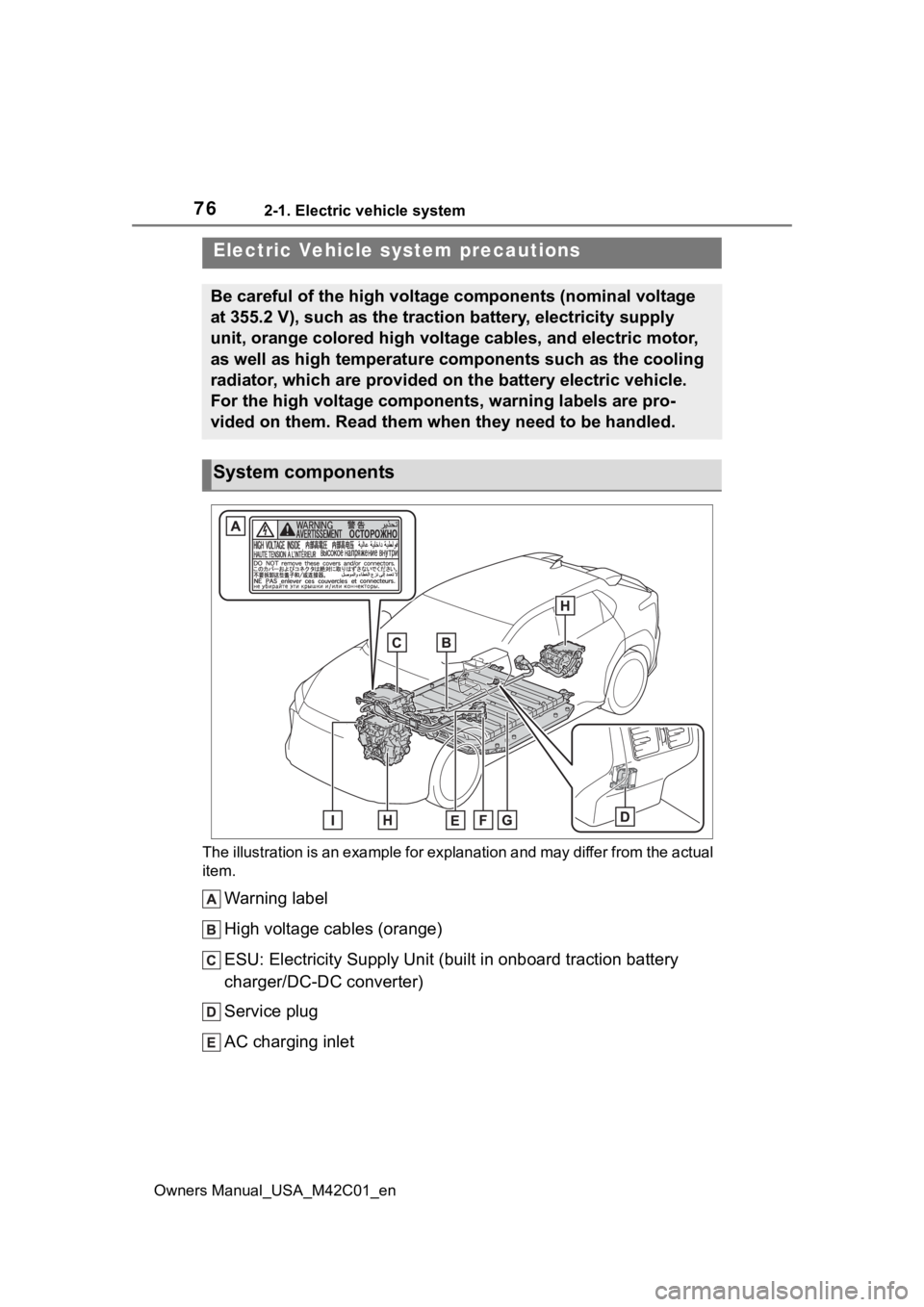
r explanation and may differ from the actual
item.
Warning label
High voltage cables (orange)
ESU: Electricity Supply Unit (built in onboard traction battery
charger/DC-DC converter)
Service plug
AC charging inlet
Electric Vehicle system precautions
Be careful of the high voltage components (nominal voltage
at 355.2 V), such as the traction battery, electricity supply
unit, orange colored high voltage cables, and electric motor,
as well as high temperature components such as the cooling
radiator, which are provided on the battery electric vehicle.
For the high voltage components, warning labels are pro-
vided on them. Read them when they need to be handled.
System components
Page 77 of 628
772-1. Electric vehicle system
Owners Manual_USA_M42C01_en
2
Electric Vehicle system
DC charging inlet
Traction battery
Electric motor (traction motor)/Inverter (front/rear
*)
Air conditioning compressor
*: AWD models only
■Electromagnetic waves
●High-voltage parts and cables on
the battery electric vehicles incor-
porate electro-magnetic shield-
ing, and the refore emit
approximately the same amount
of electromagnetic waves as con-
ventional gasoli ne-powered vehi-
cles or home electronic
appliances.
●Your vehicle may cause sound
interference in so me third party-
produced radio parts.
■Traction battery (Lithium-ion
battery)
The traction batte ry has a limited
service life.
The traction battery capacity (the
ability to store ene rgy) reduces with
time and use in the same way as
other rechargeable batteries. The
extent at which capacity reduces
changes drastically depending on
the environment (outside tempera-
ture, etc.) and us age conditions,
such as how the vehicle is driven
and how the traction battery is
charged.
This is a natural characteristic of
lithium-ion batteries, and is not a
malfunction. Also, even though the
driving range decreases when the
traction battery capacity reduces,
vehicle performance does not sig-
nificantly become worse. In order to
reduce the possibility of the capacity
reducing, follow the directions listed
on P.103, “Capacity reduction of the
traction battery”.
■Starting the EV system in an
extremely cold environment
When the traction battery is
extremely cold (below approxi-
mately -22°F [-30°C]) due to the
temperature outside of the vehicle, it
may not be possible to start the EV
system. In this case, try to start the
EV system again after the tempera-
ture of the traction battery increases
due to the outside temperature
increasing, etc.
WARNING
■High-voltage precautions
The vehicle has high voltage DC
and AC systems as well as a 12-
volt system.
DC and AC high voltage systems
are very dangerous and can
cause severe burns and electric
shock that may result in death or
serious injury.
●Never touch, disassemble,
remove, or replace the high volt-
age parts, cables (orange) or
their connectors.
●The EV system will become hot
after starting as the system
uses high voltage. Be careful of
both the high voltage and the
high temperature, and always
obey the warning labels
attached to the vehicle.
Page 78 of 628
782-1. Electric vehicle system
Owners Manual_USA_M42C01_en
WARNING
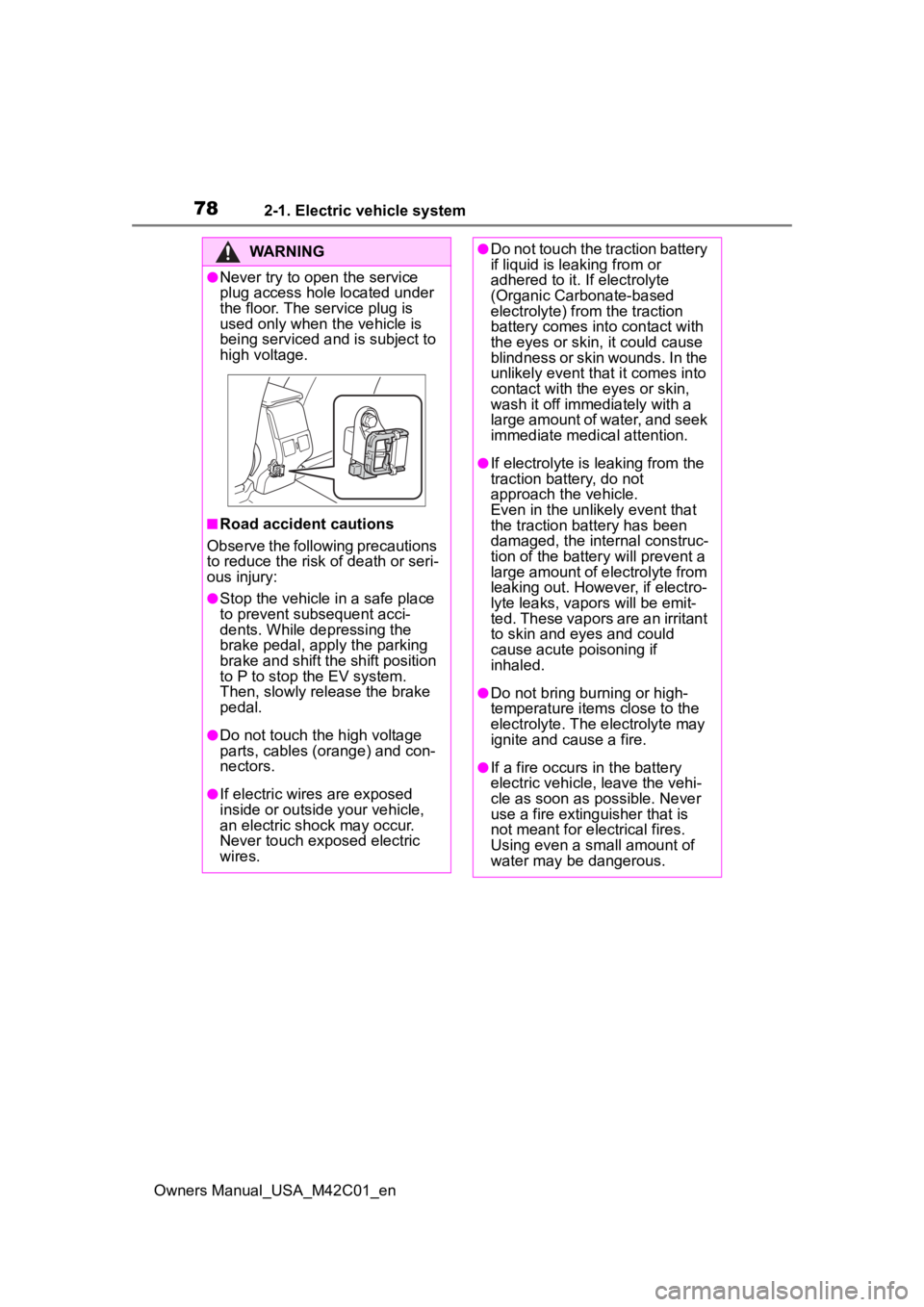
●Never try to open the service
plug access hole located under
the floor. The service plug is
used only when the vehicle is
being serviced and is subject to
high voltage.
■Road accident cautions
Observe the following precautions
to reduce the risk of death or seri-
ous injury:
●Stop the vehicle i n a safe place
to prevent subsequent acci-
dents. While depressing the
brake pedal, apply the parking
brake and shift the shift position
to P to stop the EV system.
Then, slowly release the brake
pedal.
●Do not touch the high voltage
parts, cables (orange) and con-
nectors.
●If electric wires are exposed
inside or outside your vehicle,
an electric shock may occur.
Never touch exposed electric
wires.
●Do not touch the traction battery
if liquid is leaking from or
adhered to it. If electrolyte
(Organic Carbonate-based
electrolyte) from the traction
battery comes into contact with
the eyes or skin, it could cause
blindness or skin wounds. In the
unlikely event that it comes into
contact with the eyes or skin,
wash it off immediately with a
large amount of water, and seek
immediate medical attention.
●If electrolyte is leaking from the
traction battery, do not
approach the vehicle.
Even in the unlikely event that
the traction battery has been
damaged, the internal construc-
tion of the batter y will prevent a
large amount of electrolyte from
leaking out. However, if electro-
lyte leaks, vapors will be emit-
ted. These vapors are an irritant
to skin and eyes and could
cause acute poisoning if
inhaled.
●Do not bring burning or high-
temperature items close to the
electrolyte. The electrolyte may
ignite and cause a fire.
●If a fire occurs in the battery
electric vehicle, leave the vehi-
cle as soon as possible. Never
use a fire extinguisher that is
not meant for electrical fires.
Using even a small amount of
water may be dangerous.
Page 79 of 628
792-1. Electric vehicle system
Owners Manual_USA_M42C01_en
2
Electric Vehicle system
WARNING
●If your vehicle needs to be
towed, be sure to transport the
vehicle with the front wheels
(2WD models) or four wheels
(AWD models) raised. If the
vehicle is towed with the wheels
which are connected to the
electric motor (traction motor)
contacting the ground, electric-
ity generated by the operation of
the motor may cause a fire to
occur depending on the nature
of the damage or malfunction.
( P.507)
●Carefully inspect the ground
under the vehicle. If leaked liq-
uid (other than water from the
air conditioning) is found on the
ground, the traction battery may
have been damaged. Leave the
vehicle as soon as possible.
In addition, contact your Toyota
dealer with regard to the leak-
age found on the ground.
Even in the event of a minor
accident, the traction battery
and surrounding parts may be
damaged. In case of an acci-
dent, have the traction battery
inspected at a Toyota dealer.
■Traction battery
●Your vehicle contains a sealed
lithium-ion battery.
●Never resell, hand over or mod-
ify the traction battery. To pre-
vent accidents, traction
batteries that have been
removed from a disposed vehi-
cle are collected through your
Toyota dealer. Do not dispose of
the battery yourself. Unless the
battery is properly collected, the
following may occur, resulting in
death or serious injury:
• Do not illegally dispose of or
dump the traction battery, and it
is hazardous to the environment
or someone may touch a high
voltage part, resulting in an
electric shock.
• The traction battery is intended to be used exclusively with your
battery electric vehicle. If the
traction battery is used outside
of your vehicle or modified in
any way, accidents such as
electric shock, heat generation,
smoke generation, an explo-
sion and electrolyte leakage
may occur. When reselling or
handing over your vehicle, the
possibility of an accident is
extremely high because the per-
son receiving the vehicle may
not be aware of the dangers
from these modifications.
●If your vehicle is disposed of
without the traction battery hav-
ing been removed, there is a
danger of serious electric shock
if high voltage parts, cables and
their connectors are touched. In
the event that your vehicle must
be disposed of, the traction bat-
tery must be disposed of by
your Toyota dealer or a qualified
service shop. If the traction bat-
tery is not disposed of properly,
it may cause electric shock that
can result in dea th or serious
injury.
●For information about traction
battery collection locations, con-
tact information, or the recycling
process, contact your Toyota
dealer.
Page 80 of 628

802-1. Electric vehicle system
Owners Manual_USA_M42C01_en
When a certain level of impact is
detected by the impact sensors,
the emergency shut off system turns off the EV system and
blocks the high voltage current.
If the emergency shut off system
activates, your vehicle will not
restart. To restart the EV sys-
tem, contact your Toyota dealer.
A message is automatically dis-
played when a malfunction
occurs in the EV system or an
improper operation is attempted.
If a warning message is shown
on the multi-information display,
read the message and follow the
instructions. (
P.140, 522)
■If a warning light comes on, a
warning message is displayed,
or the 12-volt battery is discon-
nected
The EV system may not start.
In that case, try to start the system
again. If the “READY” indicator does
not come on, contact your Toyota
dealer.
■When the traction battery is
completely discharged
When the EV system cannot be
started due to the traction battery
being completely discharged, restart
the system after AC charging or DC
charging. When charging, it is rec-
WARNING
■Caution while driving
●Pay special attention to the area
around the vehicle. Because
there is no engine noise, pedes-
trians, people riding bicycles or
other people and vehicles in the
area may not be aware of the
vehicle starting off or approach-
ing them, so take extra care
while driving. Therefore, take
extra care while driving even if
the Acoustic Vehicle Alerting
System is active.
●If the vehicle under floor area
receives strong shock or impact
while driving, stop the vehicle in
a safe place and check around
the bottom of the vehicle. If
there is damage to the traction
battery or liquid leakage, it may
lead to a vehicle fire, etc. Do not
touch the vehicle and immedi-
ately contact your Toyota dealer.
Even if no damage can be seen
under the floor, the traction bat-
tery may be damaged. If the
vehicle received an impact
under the floor, have the traction
battery inspected at a Toyota
dealer.
■Modifications
Do not make modifications that
lower the height of the vehicle.
The traction battery in the under
floor area may come into contact
with the ground when the height
of vehicle is lowered. If the trac-
tion battery is damaged, a vehicle
fire may occur, possibly resulting
in death or serious injury.
Emergency shut off sys-
tem
Warning message
Page 81 of 628

812-1. Electric vehicle system
Owners Manual_USA_M42C01_en
2
Electric Vehicle system
ommended to charge the traction
battery until the tr action battery
charge warning light turns off in
order to ensure sufficient driving dis-
tance.
Shift the shift position to D when
stopped at a traffic light, or driv-
ing in heavy traffic, etc. Shift the
shift position to P when parking.
When shifting the shift position
to N while driving, there is no
positive effect on electricity con-
sumption. In the N, the traction
Batter y Electric Vehi-
cle driving tips
Unlike the conventional
vehicles, the electricity con-
sumption efficiency of bat-
tery electric vehicles will
decline if they continue
driving on highways (or
freeways) or at high aver-
age speeds, causing the
possible driving distance to
reduce. Therefore, if the
remaining charge of the
traction battery is low, avoid
relying on the displayed
possible driving distance
too much as well as driving
on highways (or freeways).
Driving the vehicle at mod-
erate speeds, the traction
battery’s electricity con-
sumption can be controlled.
The following driving tips
will contribute to reduction
in the battery consumption
and increase in the driving
range.
Shift position operation
Page 82 of 628

822-1. Electric vehicle system
Owners Manual_USA_M42C01_en
battery cannot be charged. Also,
when using the air conditioning
system, etc., the traction battery
electricity is consumed.
(P.237)
Repeated acceleration and
deceleration due to traffic con-
gestion, long waits at traffic
lights, and driving on steep
inclines will lead to poor electric-
ity consumption. In order to
avoid those situations as much
as possible, check traffic reports
before leaving. If the vehicle is
driven in traffic congestion, gen-
tly release the brake pedal to
allow the vehicle to move for-
ward slightly, avoid overuse of
the accelerator pedal. Doing so
can help minimize unnecessary
electricity consumption.
Make sure to operate the brakes
gently and a timely manner. A
greater amount of electrical
energy can be regenerated
when slowing down.
Control and maintain the vehicle
at a constant speed. Before
stopping at a toll booth or simi-
lar, allow plenty of time to release the accelerator and gen-
tly apply the brakes. A greater
amount of electrical energy can
be regenerated when slowing
down.
Use the air conditioning only
when necessary. Doing so
can help reduce excessive
electricity consumption.
In summer: When the ambient tem-
perature is high, use the recircu-
lated air mode. Doing so will help to
reduce the burden on the air condi-
tioning system and reduce electric-
ity consumption as well.
In winter: Exce ssive or unneces-
sary heating should be avoided.
Also, electricity consumption can
be improved by avoiding overuse of
the heater.
When using the Remote Air
Conditioning System
( P.409) while the AC
charging cable is connected
to the vehicle, electricity con-
sumption immediately after
starting off will be reduced
because air conditioning is
operated mainly using elec-
tricity from an external power
source.
Make sure to check the tire infla-
tion pressure frequently.
Delays
When braking
Highway (or freeways)
driving
Air conditioning
Checking tire inflation
pressure