2023 SUBARU BRZ steering
[x] Cancel search: steeringPage 272 of 432

Rear View Camera
266Range of view
Image from cameraThe area above the camera cannot be
viewed. If there is an object that has a
wide projection on its upper part such as a
sign pole behind the vehicle, the projec-
tion cannot be seen on the screen.■ Help LinesThe help lines are a guide to help you
realize the actual distance from the screen
image.NOTEIf you shift to the “R” range within sev-
eral seconds after turning on the igni-
tion switch, the warning message may
not be displayed. Wait for several sec-
onds after turning on the ignition switch before shif
ting to the “R”
range. Then, the warning message will
be displayed.
Help lines
1) Vehicle width line (oblique vertical line)
2) Approx. 10 ft (3 m) from the bumper
(green horizontal line)
3) Approx. 6 ft (2 m) from the bumper
(green horizontal line)
4) Approx. 3 ft (1 m) from the bumper
(yellow horizontal line)
5) Approx. 1.5 ft (0.5 m) from the bumper
(red horizontal line)
6) Vehicle centerline
7) Dynamic guidelinesWhen the shift lever/se lect lever is set to
“R”, the monitor screen displays the help
lines together with the rear view image.
NOTEWhen “Steering Angle Lines” is off,
the dynamic guidelines will be disap-
pear on the center information display.
To turn the dynamic guidelines on and
off, refer to "G eneral settings" P161.
▼ Difference between screen image
and actual roadThe distance markers show the distance
for a level road when the vehicle is not
loaded. It may be different from the actual
distance depending on the loading condi-
tions or road conditions.
601105
702392
5 4
3
2 1
6 7
Check Surroundings Before Backing Up
CAUTION
When moving backward, always
check the back with your eyes
without relying on the help lines.
Otherwise, it may cause an acci-
dent or injury. The actual position may be
different from the indication of
the help lines. Differences may oc cur due to the
number of passengers or the
loaded cargo. When the vehicle is on a slope or
inclined against the road, the
indication is diffe rent from the
actual position.
BRZ_U.book 266 ページ 2022年3月29日 火曜日 午後3時59分
Page 300 of 432
Winter Driving
294the one used previously, purge the old
fluid from the piping between the wind-
shield washer tank and washer nozzles by
operating the washer for a certain period
of time. Otherwise, if the concentration of
the fluid remaining in the piping is too low
for the outside temperature, it may freeze
and block the nozzles.
▼ Before driving your vehicle
Before entering the vehicle, remove any
snow or ice from your shoes because that
could make the pedals slippery and
driving dangerous.
While warming up the vehicle before
driving, check that the accelerator pedal,
brake pedal, and all other controls operate
smoothly.
Clear away ice and snow that has accu-
mulated under the fenders to avoid
making steering difficult. During severe
winter driving, stop when and where it is
safe to do so and check under the fenders
periodically.
▼ Parking in cold weather
CAUTION
Adjust the washer fluid concen-
tration appropriately for the
outside temperature. If the
concentration is inappropriate,
sprayed washer fluid may freeze
on the windshield and obstruct
your view, and the fluid may
freeze in the windshield washer
tank. State or local regulations on vola-
tile organic compounds may
restrict the use of methanol, a
common windshield washer anti-
freeze additive. Washer fluids
containing non-methanol anti-
freeze agents should be used
only if they provide cold weather
protection without damaging
your vehicle’s paint, wiper blades
or washer system.
WARNING
Snow can trap dangerous exhaust
gases under your vehicle. Keep
snow clear of the exhaust pipe and
from around your vehicle if you
park the vehicle in snow with the
engine running.
CAUTION
Do not use the parking brake
when parking for long periods in
cold weather since it could freeze
in that position. When the vehicle is parked in
snow or when it snows, raise the
wiper blades off the glass to
prevent damage to them. Under either of the following
conditions, icing may develop on
the brake system, which could
cause poor braking action.
- When the vehicle has been left
parked after use on roads
heavily covered with snow- When the vehicle has been left
parked during a snowstormCheck for snow or ice buildup on
the suspension, disc brakes and
brake hoses underneath the vehi-
cle. If there is caked snow or ice,
remove it, being careful not to
damage the disc brakes and
brake hoses and ABS harness.
BRZ_U.book 294 ページ 2022年3月29日 火曜日 午後3時59分
Page 313 of 432
Flat Tires
307
In Case of Emergency9
– CONTINUED –
If the tire is punctured, you can seal the
flat tire temporarily by using the flat tire
repair kit. You can seal a flat tire caused,
for example, by nails or similar objects
with less than 0.2 in (4 mm). However,
depending on the type and extent of tire
damage, some tires can only be partially
sealed or not sealed at all, and this condi-
tion may cause a loss of tire pressure. A
loss of tire pressure can affect vehicle
handling, leading to the loss of vehicle
control.
After sealing the flat tire temporarily,
change the tires with new ones as soon as
possible. We recommend that you have
the sealed tire changed by your nearest
SUBARU dealer. You may reuse the
wheel if the attached sealant is wiped off,
but the valve of the wheel must be
replaced with a new one. If you reuse the
wheel without replacing the valve, air may
leak from the valve. For tire replacement, refer to "Tire
Replacement" P365.
▼ Safety precautions when sealing a
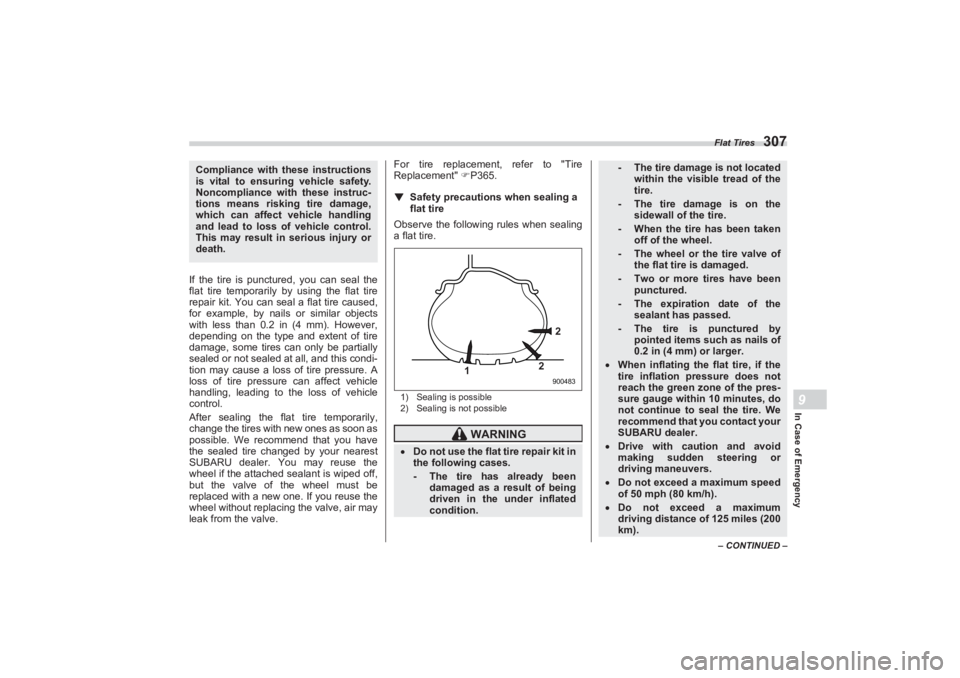
flat tireObserve the following rules when sealing
a flat tire.1) Sealing is possible
2) Sealing is not possible
Compliance with these instructions
is vital to ensuring vehicle safety.
Noncompliance with these instruc-
tions means risking tire damage,
which can affect vehicle handling
and lead to loss of vehicle control.
This may result in serious injury or
death.
WARNING
Do not use the flat tire repair kit in
the following cases.
- The tire has already been
damaged as a result of being
driven in the under inflated
condition.
900483
1 2
2
- The tire damage is not located
within the visible tread of the
tire.- The tire damage is on the
sidewall of the tire.- When the tire has been taken
off of the wheel.- The wheel or the tire valve of
the flat tire is damaged.- Two or more tires have been
punctured.- The expiration date of the
sealant has passed.- The tire is punctured by
pointed items such as nails of
0.2 in (4 mm) or larger.
When inflating the flat tire, if the
tire inflation pressure does not
reach the green zone of the pres-
sure gauge within 10 minutes, do
not continue to seal the tire. We
recommend that you contact your
SUBARU dealer. Drive with caution and avoid
making sudden steering or
driving maneuvers. Do not exceed a maximum speed
of 50 mph (80 km/h). Do not exceed a maximum
driving distance of 125 miles (200
km).
BRZ_U.book 307 ページ 2022年3月29日 火曜日 午後3時59分
Page 318 of 432
Flat Tires
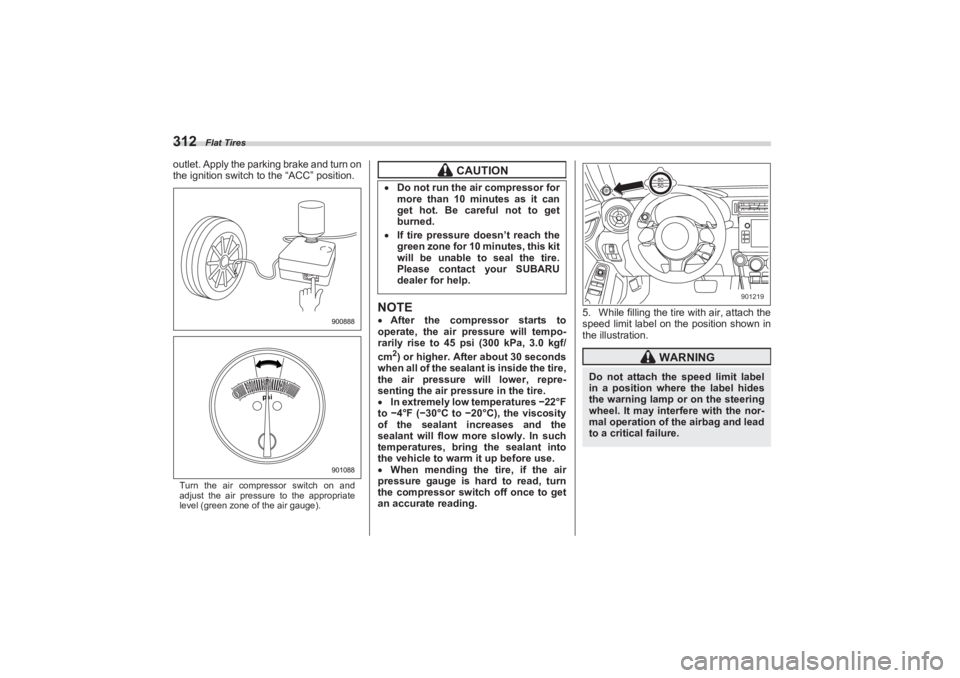
312outlet. Apply the parking brake and turn on
the ignition switch to the “ACC” position.Turn the air compressor switch on and
adjust the air pressure to the appropriate
level (green zone of the air gauge).
NOTE After the compressor starts to
operate, the air pressure will tempo-
rarily rise to 45 psi (300 kPa, 3.0 kgf/
cm
2) or higher. After about 30 seconds
when all of the sealant is inside the tire,
the air pressure will lower, repre-
senting the air pressure in the tire.
In extremely low temperatures −22°F
to −4°F ( −30°C to − 20°C), the viscosity
of the sealant increases and the
sealant will flow more slowly. In such
temperatures, bring the sealant into
the vehicle to warm it up before use.
When mending the tire, if the air
pressure gauge is hard to read, turn
the compressor switch off once to get
an accurate reading. 5. While filling the tire with air, attach the
speed limit label on the position shown in
the illustration.
900888
psi
40 40
20 20
30 30
0 0 0 0
901088
CAUTION
Do not run the air compressor for
more than 10 minutes as it can
get hot. Be care ful not to get
burned. If tire pressure doesn’t reach the
green zone for 10 minutes, this kit
will be unable to seal the tire.
Please contact your SUBARU
dealer for help.
WARNING
Do not attach the speed limit label
in a position where the label hides
the warning lamp or on the steering
wheel. It may interfere with the nor-
mal operation of the airbag and lead
to a critical failure.
901219
BRZ_U.book 312 ページ 2022年3月29日 火曜日 午後3時59分
Page 320 of 432

Flat Tires
3148. After driving for 10 minutes or 3 miles
(5 km), whichever comes first, stop the vehicle in a safe place to recheck the air
pressure (see step 4).
If necessary, fill the tire with air to the
appropriate air pressure again and drive
carefully to the nearest SUBARU dealer
for tire, valve stem and sealant bottle
replacement.
NOTEConnect the air compressor only to
the tire valve.
Before the tire is removed from the rim,
inform your SUBARU dealer or other tire
dealer that the tire contains sealant.
NOTENew sealant and replacement parts
can be purchased from your autho-
rized repair shop or SUBARU dealer,
and they should also be installed into
the kit by a specialist. Empty sealant
bottles and replacement parts must be
returned to your SUBARU dealer or
disposed of in compliance with local
waste disposal regulations.▼ Technical data of air compressor
If heavy vibrations, unsteady
steering behavior or noises occur
while driving, reduce your speed
and drive with caution to a loca-
tion where it is safe for you to
stop the vehicle. Recheck the tire
and its pressure. If the tire pres-
sure is in the red zone of the air
gauge or if there are any cracks,
bumps or similar tire damage
visible, temporary repairs cannot
be performed with the repair kit.
We recommend that you consult
with your SUBARU dealer or road
service provider.
psi40 40
20 2030 30
0 0 0 0
901089
CAUTION
If the air pressure is in red zone of
the air gauge, the kit did not
successfully seal the puncture. In
this case, please stop driving and
contact your SUBARU dealer for
help. Do not drive your vehicle with the
sealed tire for more than 125
miles (200 km). Failure to replace
the valve stem may result in air
leakage at the valve stem.
CAUTION
The sealant bottle and speed limit
label need to be replaced after
using the flat ti re repair kit.Line voltage DC 12 V
Operating voltage DC 10 – 15 V
Amperage Max. 10 A
BRZ_U.book 314 ページ 2022年3月29日 火曜日 午後3時59分
Page 330 of 432

Towing
324holes, return the plugs to their original
places.■Using a Flat-Bed Truck
This is the best way to transport your
vehicle. Use the following procedures to
ensure safe transportation.
1. Shift the select lever into the “P” posi-
tion for AT models. Sh ift the shift lever into
the 1st position for MT models.
2. Apply the parking brake firmly.
3. Secure the vehicle onto the carrier
properly with safety chains. Each safety
chain should be equally tightened and
care must be taken not to pull the chains
so tightly that the suspension bottoms out.
■ Towing with All Wheels on
the Ground
WARNING
Use the rear tie-down holes only for
downward anchoring. If they are
used to anchor the vehicle in any
other direction, cables may slip out
of the holes, possibly causing a
dangerous situation.
900488
CAUTION
Transport by flat -bed truck may
cause the headlights to become
misaligned. In such a case, have the
headlight alignment checked by a
SUBARU dealer after transporting
the vehicle by flat-bed truck.
WARNING
Never turn the ignition switch to
the “OFF” position while the
vehicle is being towed because
the steering wheel and the direc-
tion of the wheels will be locked. Remember that the brake booster
and power steering do not func-
tion when the engine is not
running. Because the engine is
turned off, it w ill take greater
effort to operate the brake pedal
and steering wheel.
900489
BRZ_U.book 324 ページ 2022年3月29日 火曜日 午後3時59分
Page 338 of 432
Exterior Care
33210-1. Exterior Care■Washing
NOTE
When having your vehicle washed in
an automatic car wash, make sure
beforehand that the car wash is of
suitable type.
The best way to preserve your vehicle’s
beauty is frequent washing. Wash the
vehicle at least once a month to avoid
contamination by road grime.
Wash dirt off with a wet sponge and plenty
of lukewarm or cold water. Do not wash
the vehicle with hot water and in direct
sunlight.
Salt, chemicals, insects, tar, soot, tree
sap, and bird droppings should be washed
off by using a light detergent, as required.
If you use a light detergent, make certain
that it is a neutral detergent. Do not use
strong soap or chemical detergents. All
cleaning agents should be promptly
flushed from the surface and not allowed
to dry there. Rinse the vehicle thoroughly with plenty of lukewarm water. Wipe the
remaining water off with a chamois or soft
cloth. Wear rubber gloves and use a hand
brush when washing down underbody,
inner fenders and suspension to effec-
tively remove mud and dirt off.
▼ Washing the underbody
Chemicals, salts and gravel used for
deicing road surfaces are extremely corro-
sive, accelerating the corrosion of under-
body components, such as the exhaust
system, fuel and brake lines, brake
cables, floor pan and fenders, and
suspension.
Thoroughly flush the underbody and
inside of the fenders with lukewarm or
cold water at frequent intervals to reduce
the harmful effects of such agents.
Mud and sand adhering to the underbody
components may accelerate their corro-
sion.
After driving off-road or on muddy or
sandy roads, wash the mud and sand off
the underbody.
Carefully flush the suspension and axle
parts, as they are particularly prone to
mud and sand buildup. Do not use a
sharp-edged tool to remove caked mud.
CAUTION
When washing the vehicle, the
brakes may get wet. As a result,
the brake stopping distance will
be longer. To dry the brakes,
drive the vehicle at a safe speed
while lightly pressing the brake
pedal to heat up the brakes. Do not wash the engine compart-
ment and areas adjacent to it. If
water enters the engine air intake
or electrical parts, it will cause
engine trouble or a malfunction of
the power steering. When washing inner fenders,
underbody, bumpers and
protruding objects such as
exhaust pipes and exhaust
finishers, be careful to prevent
injuries from contacting sharp
ends.
Do not use any organic solvents
when washing the surface of the
bulb assembly cover. However, if
a detergent with organic solvents
is used to wash the cover surface,
completely rinse off the detergent
with water. Otherwise, the cover
surface may be damaged.
BRZ_U.book 332 ページ 2022年3月29日 火曜日 午後3時59分
Page 340 of 432
Corrosion Protection
334Do not use detergent on the wheels
when they are hot, such as after driving or
parking in hot weather.■ Alloy Wheels (Vehicles with
Matte Painted Wheels)As matte painted wheels require different
cleaning methods than conventional alloy
wheels, be sure to observe the following.
For details, consult your SUBARU dealer.
Remove dirt using water. If the wheels
are excessively dirty, use a sponge or soft
cloth dampened with a diluted neutral
detergent to remove the dirt.
To prevent the matte paint from being
damaged, make sure to observe the
following precautions:
- Do not scrub or polish the wheels
using a brush or dry cloth.
- Do not use any wheel coatings or
abrasive detergents.
10-2. Corrosion ProtectionYour SUBARU has been designed and
built to resist corrosi on. Special materials
and protective finishes have been used on
most parts of the vehicle to help maintain
fine appearance, strength, and reliable
operation.■ Most Common Causes of
CorrosionThe most common causes of corrosion
are:
The accumulation of moisture retaining
dirt and debris in body panel sections,
cavities, and other areas.
Damage to paint and other protective
coatings caused by gravel and stone
chips or minor accidents.
Corrosion is accelera ted on the vehicle
when:
It is exposed to road salt or dust control
chemicals, or used in coastal areas where
there is more salt in the air, or in areas
where there is considerable industrial
pollution.
It is driven in areas of high humidity,
especially when temperatures range just
above freezing.
Dampness in certain parts of the
vehicle remains for a long time, even though other parts of the vehicle may be
dry.
High temperatures will cause corrosion
to parts of the vehicle which cannot dry
quickly due to lack of proper ventilation.
■ To Help Prevent CorrosionWash the vehicle regularly to prevent
corrosion of the body and suspension
components. Also, wash the vehicle
promptly after driving on any of the
following surfaces.
Roads that have been salted to prevent
them from freezing in winter
Mud, sand, or gravel
Coastal roads
After the winter has ended, it is recom-
mended that the underbody be given a
very thorough washing.
Before the beginning of winter, check the
condition of underbody components, such
as the exhaust system, fuel and brake
lines, brake cables, suspension, steering
system, floor pan, and fenders. If any of
them are found to be rusted, they should
be given an appropriate rust prevention
treatment or should be replaced. Contact
your SUBARU dealer to perform this kind
of maintenance and treatment if you need
assistance.
Repair chips and scratches in the paint as
soon as you find them.
BRZ_U.book 334 ページ 2022年3月29日 火曜日 午後3時59分