2023 SUBARU BRZ steering
[x] Cancel search: steeringPage 239 of 432
Manual Transmission
233
Starting and Operating7
– CONTINUED –
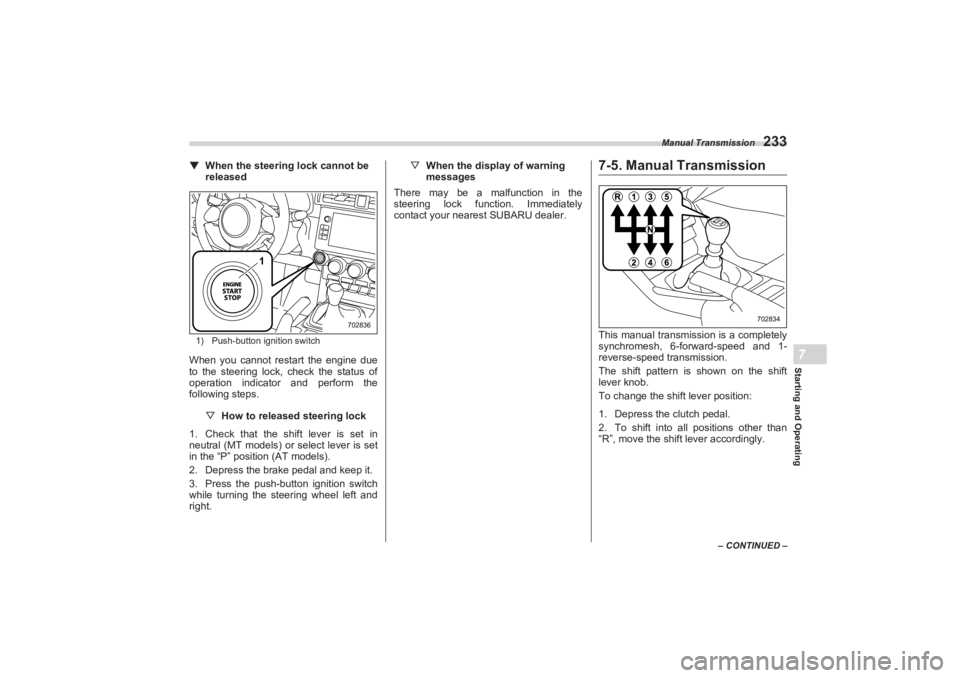
▼When the steering lock cannot be
released1) Push-button ignition switchWhen you cannot restart the engine due
to the steering lock, check the status of
operation indicator and perform the
following steps.
▽How to released steering lock
1. Check that the shift lever is set in
neutral (MT models) or select lever is set
in the “P” position (AT models).
2. Depress the brake pedal and keep it.
3. Press the push-button ignition switch
while turning the steering wheel left and
right. ▽
When the display of warning
messages
There may be a malfunction in the
steering lock function. Immediately
contact your nearest SUBARU dealer.
7-5. Manual TransmissionThis manual transmission is a completely
synchromesh, 6-forward-speed and 1-
reverse-speed transmission.
The shift pattern is shown on the shift
lever knob.
To change the shift lever position:
1. Depress the clutch pedal.
2. To shift into all positions other than
“R”, move the shi ft lever accordingly.
1
702836
702834
BRZ_U.book 233 ページ 2022年3月29日 火曜日 午後3時59分
Page 243 of 432
Automatic Transmission
237
Starting and Operating7
– CONTINUED –
▼P (Park)
This position is for parking the vehicle and
starting the engine. In this position, the
transmission is mechanically locked to
prevent the vehicle from rolling freely.
When you park the vehicle, first apply the
parking brake, then shift into the “P” posi-
tion. Do not hold the vehicle with only the
mechanical friction of the transmission.
To shift the select lever from the “P” to any
other position, you should depress the
brake pedal fully then move the select
lever. This prevents the vehicle from
lurching when it is started.
▼ R (Reverse)
This position is for backing the vehicle. To
shift from the “N” to “R” position, stop the
vehicle completely th en move the lever to
the “R” position.
▼ N (Neutral)
This position is for restarting a stalled
engine. In this position, the transmission is
neutral, meaning that the wheels and
transmission are not locked. Therefore,
the vehicle will roll freely, even on the
slightest incline unless the parking brake
or foot brake is applied. ▼
D (Drive)
This position is for normal driving. The
transmission shifts automatically into a
suitable gear according to the vehicle
speed and the acceleration you require.
Also, while driving up and down a hill, the
transmission assists and controls the
driving performance and engine braking
while corresponding to the road grade.
When more acceleration is required in “D”
position, depress the accelerator pedal
fully to the floor and hold that position. The
transmission will auto matically downshift.
When you release the pedal, the transmis-
sion will return to the original gear posi-
tion.
To use the manual mode, move the lever
from this position into the manual gate.
If one of the shift paddles behind the
steering wheel is operated while driving in
the “D” position, the transmission will
temporarily switch to the manual mode. In
this mode, you can shift into any gear position using the shift paddles. For
details about the manual mode, refer to
"Selection of Manual Mode" P239.
Once the vehicle speed stabilizes, the
transmission will switch from the manual
mode back to the “D” position for normal
driving.
▽ While climbing a grade
When driving up a hill, undesired upshift is
prevented from taking place when the
accelerator is releas ed. This minimizes
the chance of subsequent downshifting to
a lower gear when accelerating again.
This prevents repeated upshifting and
downshifting resulting in a smoother oper-
ation of the vehicle.
NOTEThe transmission may downshift,
depending on the way the accelerator
pedal is depressed to accelerate the
vehicle again.■ Adaptive ControlIn order to realize smoother driving while
driving in “D” position, an appropriate gear
is automatically selected by limiting
upshifting and performing downshifting
operations according to driver operations
and driving conditions.
WARNING
Do not drive the vehicle with the
select lever in the “N” (neutral)
position. Engine braking has no
effect in this co ndition and the risk
of an accident is consequently
increased.
BRZ_U.book 237 ページ 2022年3月29日 火曜日 午後3時59分
Page 248 of 432
Active Sound Control
242NOTEIn the following situations, the driving
mode will automatically change to nor-
mal mode:
When the engine is turned off after
driving in Sport mode or Snow mode.
When adaptive cruise control/cruise
control is activated while driving in
Sport mode.
If a malfunction occurs in the engine
or automatic transmission electrical
control system while Sport mode or
Snow mode is selected.
When in Sport mode and the idling
speed is high during warm-up or when
the road surface is slippery and stop-
ping/starting off is automatically
performed in second gear.
7-8. Active Sound ControlThe active sound control provides
dynamic engine sounds. When driving
with Sport mode selected, the engine
sounds will be particularly loud.NOTEThe operational/non-operational set-
ting of the Active Sound Control can
be changed by a SUBARU dealer. Con-
tact your SUBARU dealer for details.
When the driving mode is changed,
the sound of the active sound control
will be stopped for approximately 1
second, this is not a malfunction.
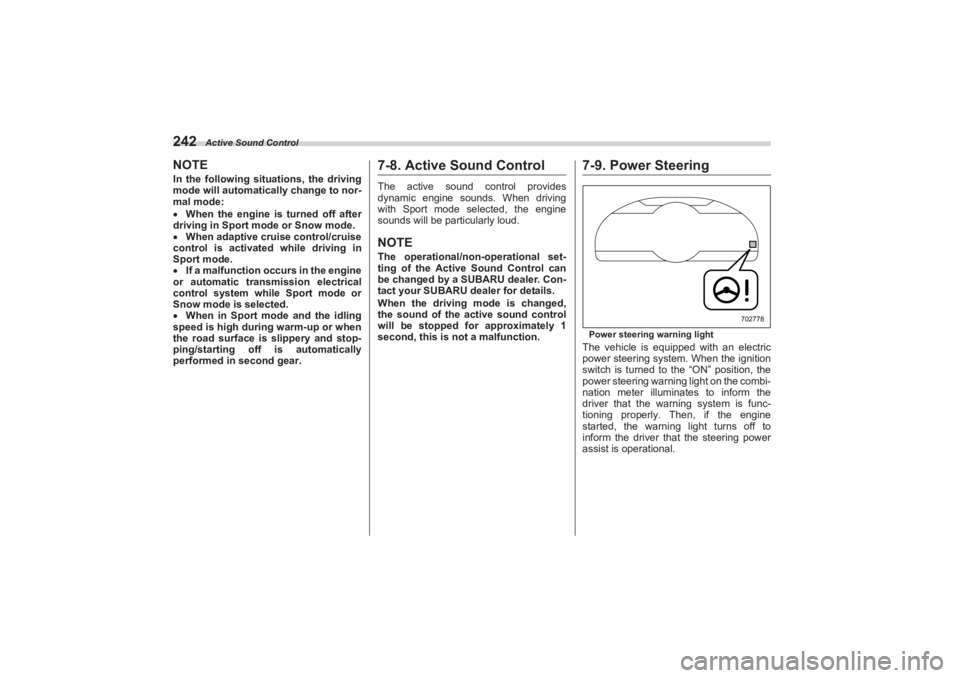
7-9. Power SteeringPower steering warning lightThe vehicle is equipped with an electric
power steering system. When the ignition
switch is turned to the “ON” position, the
power steering warning light on the combi-
nation meter illuminates to inform the
driver that the warn ing system is func-
tioning properly. Then, if the engine
started, the warni ng light turns off to
inform the driver that the steering power
assist is operational.
702778
BRZ_U.book 242 ページ 2022年3月29日 火曜日 午後3時59分
Page 249 of 432
Braking
243
Starting and Operating7
– CONTINUED –
NOTEIf the steering wheel is operated in the
following ways, the power steering
control system may temporarily limit
the power assist in order to prevent
the system components, such as the
control computer and drive motor,
from overheating.
The steering wheel is operated
frequently and turned sharply while the
vehicle is maneuvered at extremely low
speeds, such as while frequently
turning the steering wheel during
parallel parking.
The steering wheel remains in the
fully turned position for a long period
of time.
At this time, there will be more resis-
tance when steering. However this is
not a malfunction. Normal steering
force will be restored after the steering
wheel is not operated for a while and the power steering control system has
an opportunity to cool down. However,
if the power steering is operated in a
non-standard way which causes
power assist limitation to occur too
frequently, this may result in a mal-
function of the power steering control
system.
7-10. Braking■ Braking Tips▼ When the brakes get wet
When driving in rain or after washing the
vehicle, the brakes may get wet. As a
result, brake stopping distance will be
longer. To dry the brakes, drive the
vehicle at a safe speed while lightly
depressing the brake pedal to heat up the
brakes.
▼ Use of engine brakingRemember to make use of engine braking
in addition to foot braking. When
descending a grade, if only the foot brake
is used, the brakes may start working
improperly because of brake fluid over-
heating, caused by overheated brake
pads. To help prevent this, shift into a
lower gear to get stronger engine braking.
CAUTION
While the power steering warning
light is illuminated, there may be
more resistance when the steering
wheel is operated. Drive carefully to
the nearest SUBARU dealer and
have the vehicle inspected immedi-
ately.
WARNING
Never rest your foot on the brake
pedal while driving. This can cause
dangerous overheating of the
brakes and needless wear on the
brake pads.
BRZ_U.book 243 ページ 2022年3月29日 火曜日 午後3時59分
Page 251 of 432
ABS (Anti-Lock Brake System)
245
Starting and Operating7
■Disc Brake Pad Wear
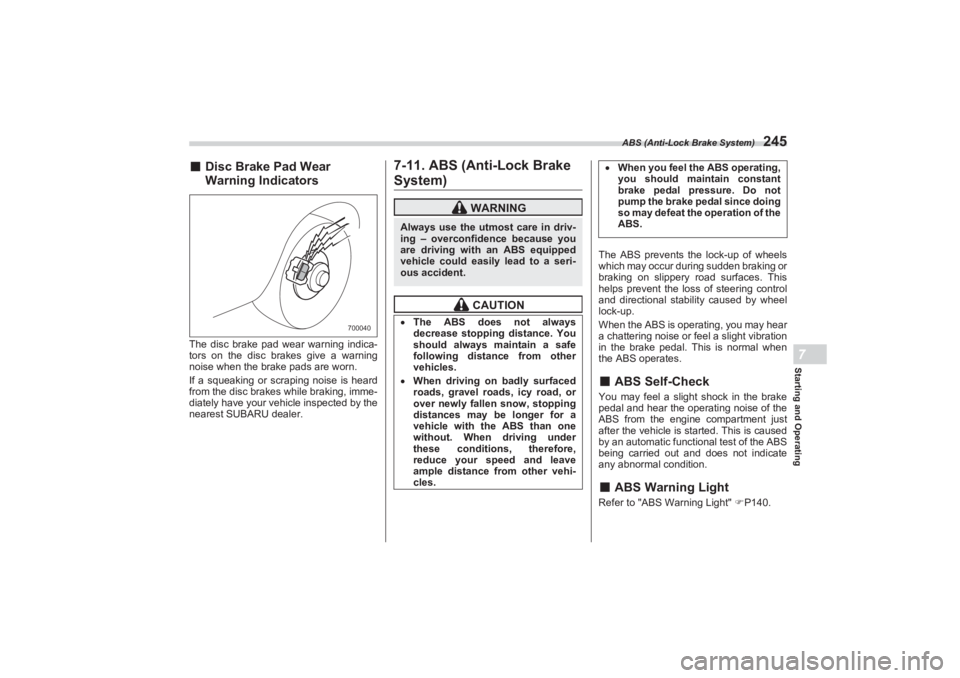
Wa rning IndicatorsThe disc brake pad wear warning indica-
tors on the disc brakes give a warning
noise when the brake pads are worn.
If a squeaking or scraping noise is heard
from the disc brakes while braking, imme-
diately have your vehicle inspected by the
nearest SUBARU dealer.
7-11. ABS (Anti-Lock BrakeSystem)
The ABS prevents the lock-up of wheels
which may occur during sudden braking or
braking on slippery road surfaces. This
helps prevent the loss of steering control
and directional stability caused by wheel
lock-up.
When the ABS is operating, you may hear
a chattering noise or f eel a slight vibration
in the brake pedal. This is normal when
the ABS operates.■ ABS Self-CheckYou may feel a slight shock in the brake
pedal and hear the operating noise of the
ABS from the engine compartment just
after the vehicle is started. This is caused
by an automatic functional test of the ABS
being carried out and does not indicate
any abnormal condition.■ ABS Warning LightRefer to "ABS Warning Light" P140.
700040
WARNING
Always use the utmost care in driv-
ing – overconfidence because you
are driving with an ABS equipped
vehicle could easily lead to a seri-
ous accident.
CAUTION
The ABS does not always
decrease stopping distance. You
should always maintain a safe
following distance from other
vehicles. When driving on badly surfaced
roads, gravel roads, icy road, or
over newly fallen snow, stopping
distances may be longer for a
vehicle with the ABS than one
without. When driving under
these conditions, therefore,
reduce your speed and leave
ample distance from other vehi-
cles.
When you feel the ABS operating,
you should maintain constant
brake pedal pressure. Do not
pump the brake pedal since doing
so may defeat the operation of the
ABS.
BRZ_U.book 245 ページ 2022年3月29日 火曜日 午後3時59分
Page 253 of 432

Vehicle Stability Control (VSC)/TRAC System
247
Starting and Operating7
– CONTINUED –
7-13. Vehicle Stability Control (VSC)/TRAC System■Vehicle Stability Control
(VSC) SystemIn the event of wheelspin and/or skidding
on a slippery road surface and/or during
cornering and/or an evasive maneuver,
the Vehicle Stability Control (VSC) system
adjusts the engine’s output and the
wheels’ respective braking forces to help
maintain traction and directional control.
The skid suppression function is designed
to help maintain directional stability by
suppressing the wheels’ tendency to slide
sideways during steering operations. Acti-
vation of this function is indicated by
flashing of the Vehicle Stability Control
(VSC) operation indicator light.NOTE In the following circumstances, the
vehicle may be less stable than it feels
to the driver. The Vehicle Stability
Control (VSC) system may therefore
operate. Such operation does not indi-
cate a system malfunction. - On gravel-covered or rutted
roads
- On unfinished roads
- When the vehicle is fitted with
snow tires or winter tires
Activation of the Vehicle Stability
Control (VSC) system will cause opera-
tion of the steering wheel to feel
slightly different compared to that for
normal conditions.
It is always important to reduce
speed when approaching a corner,
even if the vehicle is equipped with
Vehicle Stability Control (VSC) system.
Always turn off the engine before
replacing a tire as failure to do so may
render the Vehicle Stability Control
(VSC) system unable to operate
correctly.
■ TRAC SystemThe TRAC system is designed to prevent
spinning of the driving wheels on slippery
road surfaces, thereby helping to maintain
traction and directional control. Activation
of this function is indicated by flashing of
the Vehicle Stability Control (VSC) opera-
tion indicator light. The TRAC system is
also equipped with the brake LSD func-
tion.
WARNING
Directional control and power
may not be achievable while
driving on slippery road surfaces,
even if the TRAC system is oper-
ating. Do not drive the vehicle in
conditions where stability and
power may be lost. Always use the utmost care in
driving – overconfidence
because you are driving with a
Vehicle Stability Control (VSC)
system and TRAC system
equipped vehicle could easily
lead to a serious accident.
CAUTION
Even if your vehicle is equipped
with Vehicle Stability Control
(VSC) system and TRAC system,
winter tires should be used when
driving on snow-covered or icy
roads; in addition, vehicle speed
should be reduced considerably.
Simply having a Vehicle Stability
Control (VSC) system and TRAC
system does not guarantee that
the vehicle will be able to avoid
accidents in any situation.
BRZ_U.book 247 ページ 2022年3月29日 火曜日 午後3時59分
Page 254 of 432
Vehicle Stability Control (VSC)/TRAC System
248
NOTEThe Vehicle Stability Control (VSC)
system and TRAC system may be con-
sidered normal when the following
conditions occur.
Slight twitching of the brake pedal is
felt.
The vehicle or steering wheel
shakes to a small degree.
An operating noise from the engine
compartment is heard briefly when
starting the engine and when driving
off after starti ng the engine.
The brake pedal seems to jolt when
driving off after st arting the engine.
■Vehicle Stability Control
(VSC) System MonitorRefer to "Vehicle Stability Control (VSC)
Warning Light/Vehicle Stability Control
(VSC) Operation Indicator Light" P142
and "Vehicle Stability Control (VSC) OFF
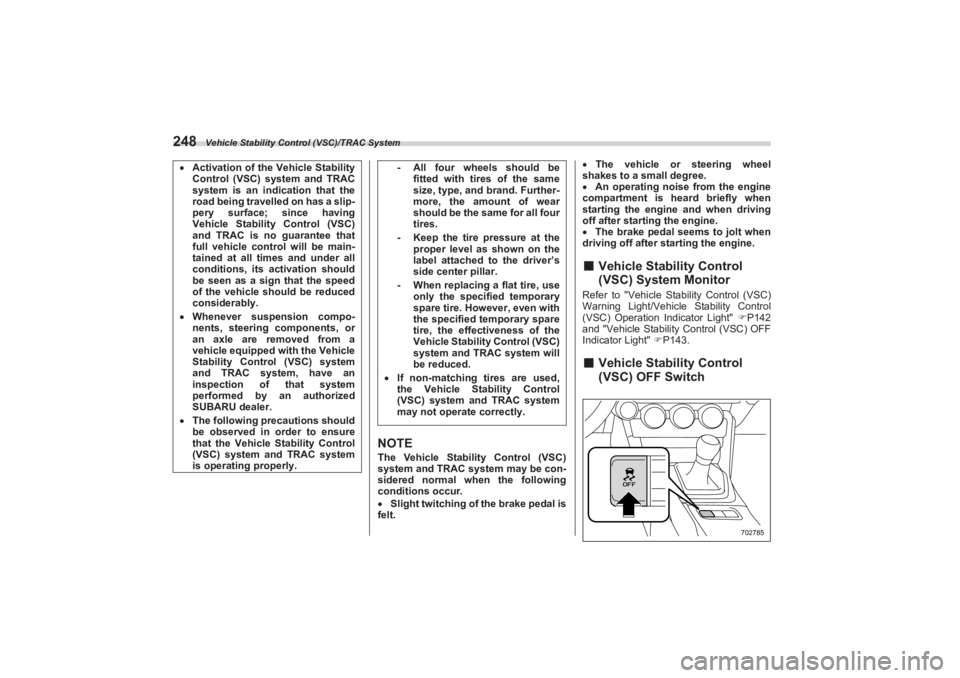
Indicator Light" P143.■ Vehicle Stability Control
(VSC) OFF Switch
Activation of the Vehicle Stability
Control (VSC) system and TRAC
system is an indication that the
road being travelled on has a slip-
pery surface; since having
Vehicle Stability Control (VSC)
and TRAC is no guarantee that
full vehicle control will be main-
tained at all times and under all
conditions, its activation should
be seen as a sign that the speed
of the vehicle should be reduced
considerably. Whenever suspension compo-
nents, steering components, or
an axle are removed from a
vehicle equipped with the Vehicle
Stability Control (VSC) system
and TRAC system, have an
inspection of that system
performed by an authorized
SUBARU dealer. The following precautions should
be observed in order to ensure
that the Vehicle Stability Control
(VSC) system and TRAC system
is operating properly.
- All four wheels should be
fitted with tires of the same
size, type, and brand. Further-
more, the amount of wear
should be the same for all four
tires.- Keep the tire pressure at the
proper level as shown on the
label attached to the driver’s
side center pillar.- When replacing a flat tire, use
only the specified temporary
spare tire. However, even with
the specified temporary spare
tire, the effectiveness of the
Vehicle Stability Control (VSC)
system and TRAC system will
be reduced.
If non-matching tires are used,
the Vehicle Stability Control
(VSC) system and TRAC system
may not operate correctly.
702785
BRZ_U.book 248 ページ 2022年3月29日 火曜日 午後3時59分
Page 262 of 432
Parking Your Vehicle
256To release the parking brake, pull the
lever up slightly, press the release button,
then lower the lever while keeping the
button pressed.
When the parking brake is set while the
engine is running, the parking brake
warning light illuminates. After starting the
vehicle, be sure that the warning light has
turned off before the vehicle is driven.
Refer to "Brake System Warning Light"
P140.
■ Parking TipsWhen parking your vehicle, always
perform the following items.
Apply the parking brake firmly.
For MT models, put the shift lever in the
“1” (1st) for upgrade or “R” (Reverse) for a
downgrade.
For AT models, put the select lever in
the “P” (Park) position.
Never rely on the mechanical friction of
the transmission alone to hold the vehicle.
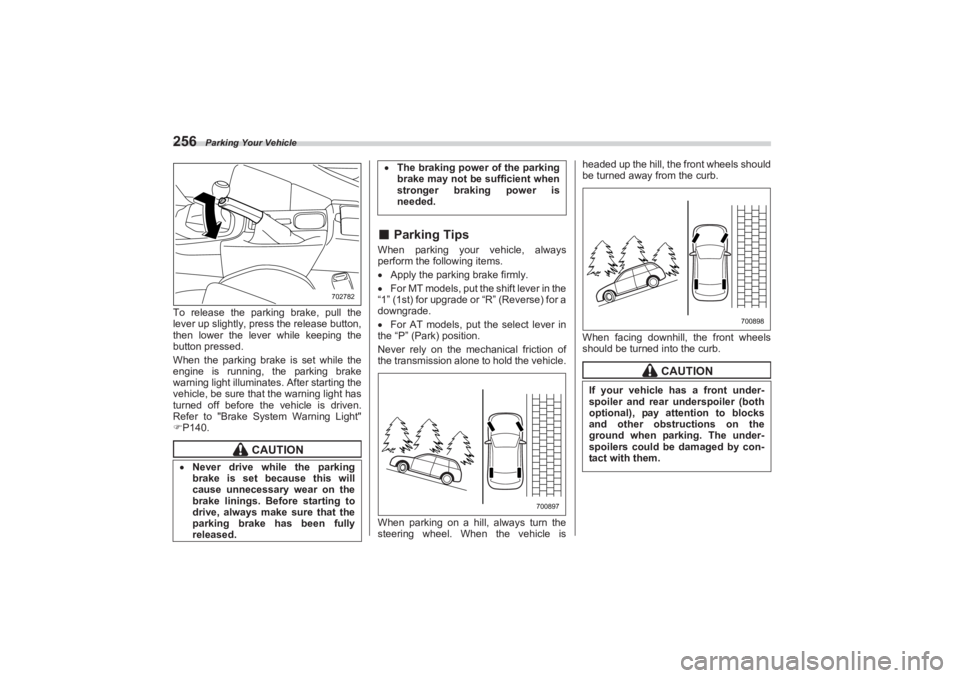
When parking on a hill, always turn the
steering wheel. When the vehicle is headed up the hill, the front wheels should
be turned away from the curb.
When facing downhill, the front wheels
should be turned into the curb.
CAUTION
Never drive while the parking
brake is set because this will
cause unnecessary wear on the
brake linings. Before starting to
drive, always make sure that the
parking brake has been fully
released.
702782
The braking power of the parking
brake may not be sufficient when
stronger braking power is
needed.
700897
CAUTION
If your vehicle has a front under-
spoiler and rear underspoiler (both
optional), pay attention to blocks
and other obstructions on the
ground when parking. The under-
spoilers could be damaged by con-
tact with them.
700898
BRZ_U.book 256 ページ 2022年3月29日 火曜日 午後3時59分