2023 NISSAN PATHFINDER spare tire
[x] Cancel search: spare tirePage 592 of 665

Doors and engine hood:Check that the
doors and engine hood operate properly.
Also ensure that all latches lock securely.
Lubricate hinges, latches, latch pins, rollers
and links if necessary. Make sure that the
secondary latch keeps the hood from
opening when the primary latch is
released.
When driving in areas using road salt or
other corrosive materials, check lubrica-
tion frequently.
Check that the gas stays or struts properly
and securely hold the hood, trunk, or rear
hatch fully open. If the hood, trunk, or rear
hatch is not held open, have the gas stays
or struts replaced.
Lights*: Clean the headlights on a regular
basis. Make sure that the headlights, stop
lights, tail lights, turn signal lights, and other
lights are all operating properly and in-
stalled securely. Also check headlight aim.
Road wheel nuts (lug nuts)*: When check-
ing the tires, make sure no wheel nuts are
missing, and check for any loose wheel
nuts. Tighten if necessary.
Tire rotation*: Rotate tires at the specified
interval shown in the maintenance
schedule. Tires*:
Check the pressure with a gauge
of ten and always prior to long distance
trips. If necessary, adjust the pressure in all
tires, including the spare, to the pressure
specified. Check carefully for damage, cuts
or excessive wear.
Tire Pressure Monitoring System (TPMS)
tire pressure sensor: It is recommended
that you replace the TPMS tire pressure
sensor assembly when the tires are re-
placed due to wear or age.
Wheel alignment and balance: If the ve-
hicle should pull to either side while driving
on a straight and level road, or if you detect
uneven or abnormal tire wear, there may
be a need for wheel alignment. If the steer-
ing wheel or seat vibrates at normal high-
way speeds, wheel balancing may be
needed.
For additional information regarding tires,
refer to “Important Tire Safety Information”
(US) or “Tire Safety Information” (Canada) in
the Warranty Information Booklet.
Windshield: Clean the windshield on a
regular basis. Check the windshield at least
every six months for cracks or other dam-
age. Have a damaged windshield repaired
by a qualified repair facility. It is recom-
mended that you have a damaged wind- shield repaired by a NISSAN dealer, or a
NISSAN Certified Collision Center. To locate
a collision center in your area, refer to
http://collision.nissanusa.com.
Windshield wiper blades*:
Check for
cracks or wear if they do not wipe properly.
Inside the vehicle
The maintenance items listed here should
be checked on a regular basis, such as
when performing scheduled maintenance,
cleaning the vehicle, etc.
Accelerator pedal: Check the pedal for
smooth operation and make sure the
pedal does not catch or require uneven
effort. Keep the floor mat away from the
pedal.
Brake pedal: Check the pedal for smooth
operation. If the brake pedal suddenly goes
down further than normal, the pedal feels
spongy or the vehicle seems to take longer
to stop, have your vehicle checked imme-
diately. It is recommended that you visit a
NISSAN dealer for this service. Keep the
floor mat away from the pedal.
Brakes: Check that the brakes do not pull
the vehicle to one side when applied.
Maintenance and schedules9-3
Page 621 of 665
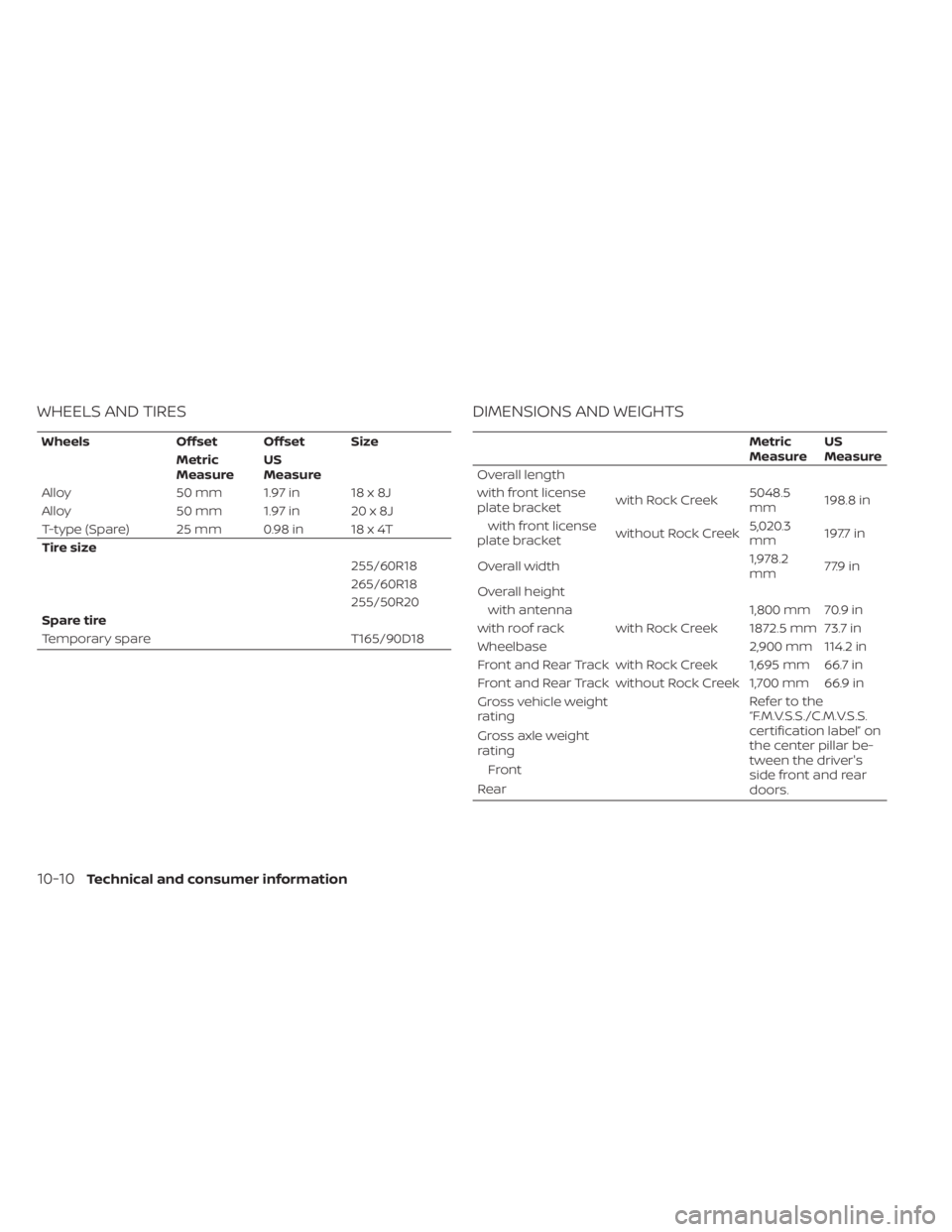
WHEELS AND TIRES
WheelsOffset Offset Size
Metric
Measure US
Measure
Alloy 50mm 1.97in 18x8J
Alloy 50mm 1.97in 20x8J
T-type (Spare) 25 mm 0.98 in 18 x 4T
Tire size 255/60R18
265/60R18
255/50R20
Spare tire
Temporary spare T165/90D18
DIMENSIONS AND WEIGHTS
Metric
MeasureUS
Measure
Overall length
with front license
plate bracket with Rock Creek5048.5
mm198.8 in
with front license
plate bracket without Rock Creek5,020.3
mm197.7 in
Overall width 1,978.2
mm77.9 in
Overall height with antenna 1,800 mm 70.9 in
with roof rack with Rock Creek 1872.5 mm 73.7 in
Wheelbase 2,900 mm 114.2 in
Front and Rear Track with Rock Creek 1,695 mm 66.7 in
Front and Rear Track without Rock Creek 1,700 mm 66.9 in
Gross vehicle weight
rating Refertothe
“F.M.V.S.S./C.M.V.S.S.
certification label” on
the center pillar be-
tween the driver's
side front and rear
doors.
Gross axle weight
rating
Front
Rear
10-10Technical and consumer information
Page 627 of 665
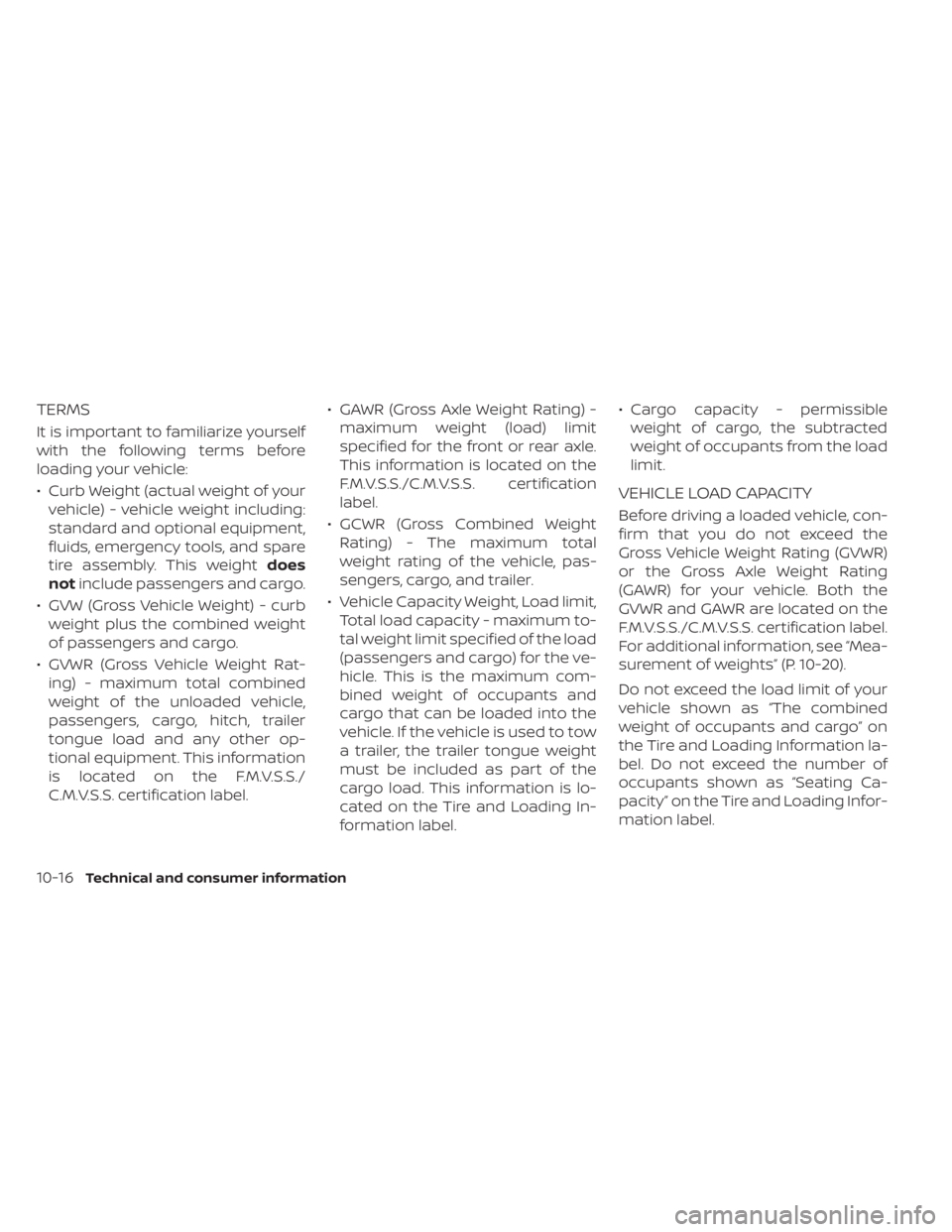
TERMS
It is important to familiarize yourself
with the following terms before
loading your vehicle:
• Curb Weight (actual weight of yourvehicle) - vehicle weight including:
standard and optional equipment,
fluids, emergency tools, and spare
tire assembly. This weight does
not include passengers and cargo.
• GVW (Gross Vehicle Weight) - curb weight plus the combined weight
of passengers and cargo.
• GVWR (Gross Vehicle Weight Rat- ing) - maximum total combined
weight of the unloaded vehicle,
passengers, cargo, hitch, trailer
tongue load and any other op-
tional equipment. This information
is located on the F.M.V.S.S./
C.M.V.S.S. certification label. • GAWR (Gross Axle Weight Rating) -
maximum weight (load) limit
specified for the front or rear axle.
This information is located on the
F.M.V.S.S./C.M.V.S.S. certification
label.
• GCWR (Gross Combined Weight Rating) - The maximum total
weight rating of the vehicle, pas-
sengers, cargo, and trailer.
• Vehicle Capacity Weight, Load limit, Total load capacity - maximum to-
tal weight limit specified of the load
(passengers and cargo) for the ve-
hicle. This is the maximum com-
bined weight of occupants and
cargo that can be loaded into the
vehicle. If the vehicle is used to tow
a trailer, the trailer tongue weight
must be included as part of the
cargo load. This information is lo-
cated on the Tire and Loading In-
formation label. • Cargo capacity - permissible
weight of cargo, the subtracted
weight of occupants from the load
limit.
VEHICLE LOAD CAPACITY
Before driving a loaded vehicle, con-
firm that you do not exceed the
Gross Vehicle Weight Rating (GVWR)
or the Gross Axle Weight Rating
(GAWR) for your vehicle. Both the
GVWR and GAWR are located on the
F.M.V.S.S./C.M.V.S.S. certification label.
For additional information, see “Mea-
surement of weights” (P. 10-20).
Do not exceed the load limit of your
vehicle shown as “The combined
weight of occupants and cargo” on
the Tire and Loading Information la-
bel. Do not exceed the number of
occupants shown as “Seating Ca-
pacity” on the Tire and Loading Infor-
mation label.
10-16
Technical and consumer information
Page 655 of 665

Front power seat adjustment.......1-4Rear seat adjustment............1-6Seat beltChild safety................ .1-30Infants and small children........1-31Injured person................1-23Larger children...............1-31Precautions on seat belt usage.....1-20Pregnant women..............1-23Rear center seat belt...........1-26Seat belt extenders............1-29Seat belt maintenance..........1-30Seat belts................1-20,7-6Three-point type with retractor.....1-24Seat belt extenders..............1-29Seat belt warning light.........1-23,2-16Seatback pockets..............2-108Seats
Adjustment..................1-2Armrests...................1-10Front seats..................1-2Heated seats................2-90Manual front seat adjustment......1-3Security system (NISSAN Vehicle Immobilizer
System), engine start..........2-77,5-16Security systemsVehicle security system..........2-76Self-adjusting brakes.............8-20Service manual order form........10-38Servicing air conditioner...........4-39Spark plug replacement...........8-16Spark plugs...................8-16Specifications................ .10-9Speedometer...............2-6, 2-7
Spotlights (See map light).........2-123SRS warning label...............1-80Standard maintenance............9-9Starting
Before starting the engine........5-16Jump starting.............6-11,8-14Precautions when starting and driving.5-4Push starting................6-13Starting the engine............5-16Starting the engine..............5-16SteeringPower steering system.........5-174Steering Assist switch (for vehicles
with ProPILOT Assist).............2-95Steering wheel................ .3-34Stop light....................8-26Storage.....................2-107Storage tray..................2-109Sun visors................... .3-36Sunglasses case...............2-111Sunglasses holder..............2-111Sunroof..................2-121, 7-5Supplemental air bag warning labels. . .1-80Supplemental air bag warning
light................... .1-80, 2-16Supplemental front impact air bag
system..................... .1-67Supplemental restraint system
Information and warning labels. . . .1-80Precautions on supplemental restraint
system................... .1-59Supplemental restraint system (Supplemen-
tal air bag system)..............1-59Switch Autolight switch
..............2-83Automatic power window switch. . .2-119Fog light switch..............2-89Hazard warning flasher switch......6-2Headlight and turn signal switch. . . .2-82Headlight control switch.........2-82Hill descent control switch........2-94Instrument brightness control.....2-88Power door lock switch..........3-6Rear window and outside mirror defroster
switch...................
.2-81Rear window wiper and washer
switches...................2-80Turn signal switch.............2-88
T
Tachometer...................2-8Temperature gauge
Engine coolant temperature gauge. . .2-9Thef t (NISSAN Vehicle Immobilizer System),
engine start...............2-77,5-16Three-way catalyst...............5-4TireFlat tire................. .6-3, 6-4Spare tire...............6-5, 8-42Tire and Loading Information label. .10-13Tire chains.................8-38Tire pressure................8-28Tire rotation.................8-39Tires of 4-wheel drive...........8-41Types of tires................8-37Uniform tire quality grading......10-33
11-6