2023 NISSAN MURANO tire pressure
[x] Cancel search: tire pressurePage 486 of 518
5. Determine the combined weightof luggage and cargo being
loaded on the vehicle. That weight
may not safely exceed the avail-
able cargo and luggage load ca-
pacity calculated in step 4.
6. If your vehicle will be towing a trailer, load from your trailer will be
transferred to your vehicle. Con-
sult this manual to determine
how this reduces the available
cargo and luggage load capacity
of your vehicle.
Before driving a loaded vehicle, con-
firm that you do not exceed the
GVWR or the GAWR for your vehicle.
For additional information, see “Mea-
surement of weights” (P. 10-19).
Also check tires for proper inflation
pressures. For additional informa-
tion, see “Tire and Loading Informa-
tion label” (P. 8-30).
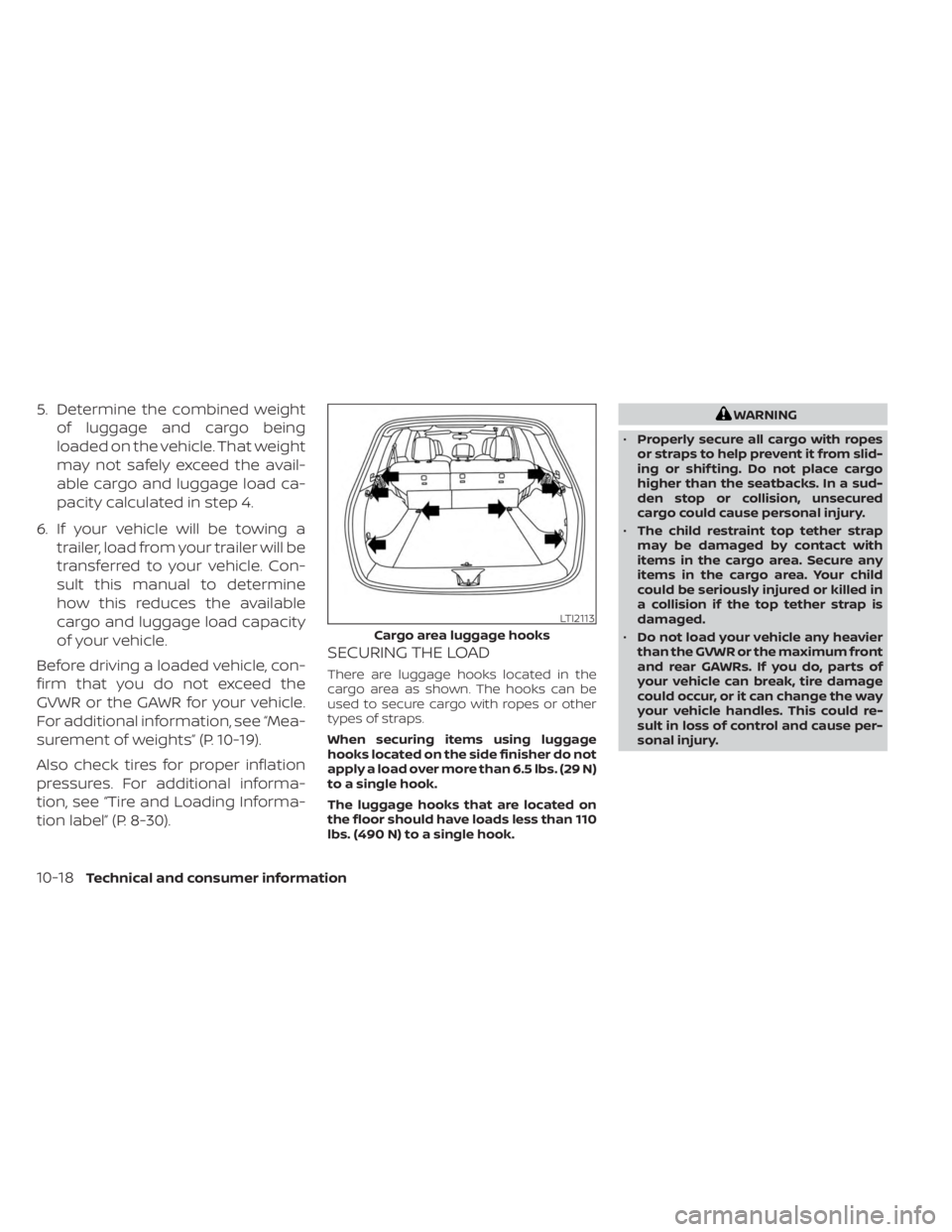
SECURING THE LOAD
There are luggage hooks located in the
cargo area as shown. The hooks can be
used to secure cargo with ropes or other
types of straps.
When securing items using luggage
hooks located on the side finisher do not
apply a load over more than 6.5 lbs. (29 N)
to a single hook.
The luggage hooks that are located on
the floor should have loads less than 110
lbs. (490 N) to a single hook.
WARNING
• Properly secure all cargo with ropes
or straps to help prevent it from slid-
ing or shif ting. Do not place cargo
higher than the seatbacks. In a sud-
den stop or collision, unsecured
cargo could cause personal injury.
• The child restraint top tether strap
may be damaged by contact with
items in the cargo area. Secure any
items in the cargo area. Your child
could be seriously injured or killed in
a collision if the top tether strap is
damaged.
• Do not load your vehicle any heavier
than the GVWR or the maximum front
and rear GAWRs. If you do, parts of
your vehicle can break, tire damage
could occur, or it can change the way
your vehicle handles. This could re-
sult in loss of control and cause per-
sonal injury.
LTI2113
Cargo area luggage hooks
10-18Technical and consumer information
Page 494 of 518
Class I hitch
Class I trailer hitch equipment (receiver, ball
mount and hitch ball) can be used to tow
trailers of a maximum weight of 2,000 lbs.
(907 kg).
Tire pressures
• When towing a trailer, inflate thevehicle tires to the recommended
cold tire pressure indicated on the
Tire and Loading Information label.
• Trailer tire condition, size, load rat- ing and proper inflation pressure
should be in accordance with the
trailer and tire manufacturer's
specifications.
Safety chains
Always use suitable safety chains between
your vehicle and the trailer. The safety
chains should be crossed and should be
attached to the hitch, not to the vehicle
bumper or axle. The safety chains can be
attached to the bumper if the hitch ball is
mounted to the bumper. Be sure to leave
enough slack in the chains to permit turn-
ing corners.
Trailer lights
CAUTION
When splicing into the vehicle electrical
system, a commercially available
power-type module/converter must
be used to provide power for all trailer
lighting. This unit uses the vehicle bat-
tery as a direct power source for all
trailer lights while using the vehicle tail
light, stop light and turn signal circuits
as a signal source. The module/
converter must draw no more than 15
milliamps from the stop and tail lamp
circuits. Using a module/converter that
exceeds these power requirements
may damage the vehicle's electrical
system. It is recommended that you
visit a reputable trailer retailer to ob-
tain the proper equipment and to have
it installed.
Trailer lights should comply with federal
and/or local regulations. For assistance in
hooking up trailer lights, it is recommended
that you contact a NISSAN dealer or repu-
table trailer retailer. Vehicles equipped with
the optional trailer tow package are
equipped with a flat 4-pin connector, an
adapter will be needed to connect the trailer lights to the vehicle. Adapters are
available at auto parts stores and hitch
retailers.
Pre-towing tips
• Be certain your vehicle maintains a level
position when a loaded and/or unloaded
trailer is hitched. Do not drive the vehicle if
it has an abnormal nose-up or nose-
down condition; check for improper
tongue load, overload, worn suspension
or other possible causes of either
condition.
• Always secure items in the trailer to pre- vent load shif t while driving.
• Keep the cargo load as low as possible in the trailer to keep the trailer center of
gravity low.
• Load the trailer so approximately 60% of the trailer load is in the front half and 40%
is in the back half. Also make sure the load
is balanced side to side.
• Check your hitch, trailer tire pressure, ve- hicle tire pressure, trailer light operation,
and trailer wheel lug nuts every time you
attach a trailer to the vehicle.
• Be certain your rearview mirrors conform to all federal, state or local regulations. If
not, install any mirrors required for towing
before driving the vehicle.
10-26Technical and consumer information
Page 503 of 518
11 Index
A
Air bag (See supplemental restraint
system)........................ .1-48
Air bag system ....................1-56
Front (See supplemental front impact air
bag system) ...................1-56
Air bag warning labels ..............1-69
Air bag warning light, supplemental . . . .1-70
Airbagwarninglight.............. .1-70
Air cleaner housing filter .............8-17
Air cleaner .......................8-17
Air conditioner ....................4-30
Air conditioner operation ..........4-30
Air conditioner specification label . . .10-13
Air conditioner system refrigerant and oil
recommendations ...............10-8
Air conditioner system refrigerant
recommendations ...............10-8
Heater and air conditioner (automatic)
(if so equipped) .................4-29
Heater and air conditioner controls . .4-30
Servicing air conditioner ..........4-32
Alarm system (See vehicle security
system) .........................2-32
All-Wheel Drive ...................5 -117
Anchor point locations ..............1-32
Antenna ........................4-33
Anti-lock brake warning light .........2-10
Anti-lock Braking System (ABS) .......5-121
Antifreeze .......................5-131 Armrests........................
.1-6
Autolightswitch ..................2-39
Automatic anti-glare inside mirror .....3-34
Automatic door locks ...............3-6
Automatic Emergency Braking (AEB) with
Pedestrian Detection ..............5-88
Automatic Emergency Braking (AEB) . . .2-12
Automatic.......................2-66 Automatic power window switch . . .2-66
AWD...........................5 -117
B
Battery replacement...............8-23
Keyfob.......................8-23
NISSAN Intelligent Key® ...........8-24
Battery.........................5-131 Charge warning light .............2-10
Before starting the engine ...........5-16
Belt(Seedrivebelt) ................8-16
Blind Spot Warning (BSW) ............5-39
Booster seats ................... .1-44
Brake Assist .....................5-123
Brakefluid.......................8-11
Brake system ....................5-121
Brake..........................5-121 Anti-lock Braking System (ABS) .....5-121
Brakefluid.....................8-11
Brakelight(Seestoplight).........8-26
Brake system ..................5-121 Brakewarninglight..............2-10
Brakewearindicators ........2
-17, 8-20
Self-adjustingbrakes ............8-20
Brakes .........................8-20
Break-in schedule .................5-115
Brightness control .................2-43
Instrument panel ...............2-43
Bulb check/instrument panel ........2-10
Bulb replacement .................8-26
C
C.M.V.S.S. certification label ..........10-12
Capacities and recommended
fuel/lubricants....................10-2
Car phone or CB radio ..............4-33
Cargo (See vehicle loading
information).....................10-15
Cargoareastoragebin .............2-61
Check tire pressure ................2-29
Child restraint with top tether strap . . . .1-31
Childrestraints .................. .1-24
LATCH (Lower Anchors and Tethers for
CHildren)System................1-28
Precautions on child
restraints..............1-34, 1-40, 1-45
Top tether strap anchor point
locations..................... .1-32
Child safety rear door lock ............3-7
Cleaningexteriorandinterior .........7-2
Page 504 of 518
Coat hooks.......................2-62
Coldweatherdriving...............5-131
Console box ......................2-59
Console light ......................2-70
Continuously Variable Transmission
(CVT) ............................5-19
Continuously Variable Transmission (CVT)
fluid ..........................8-10
Driving with Continuously Variable
Transmission (CVT) ...............5-19
Controls.........................4-30 Heater and air conditioner controls. . .4-30
Coolant..........................10-2 Capacities and recommended
fuel/lubricants ..................10-2
Changing engine coolant ...........8-5
Checking engine coolant level .......8-5
Engine coolant temperature gauge . . .2-6
Corrosionprotection.................7-7
Cruisecontrol.....................5-56
Cupholders......................2-60
D
Daytime Running Light System ........2-43
Defrosterswitch...................2-37 Rear window and outside mirror defroster
switch.........................2-37
Dimensions and weights ............10-10
Dimmer switch for instrument panel . . .2-43
Door locks ........................3-5
Drivebelt ........................8-16
Drivingthevehicle..................5-18 Driving..........................5
-131
Cold weather driving .............5-131
Driving with Continuously Variable
Transmission (CVT) ...............5-19
Precautions when starting and
driving......................5-4,5-11
Dynamic driver assistance switch ......2-50
E
Eco Drive Report....................2-8
Economy - fuel ...................5 -116
Emergency call (SOS) button ..........2-51
Emergency engine shutoff ...........5-15
Emission control information label .....10-12
Emission control system warranty . . . .10-30
Engine coolant temperature gauge .....2-6
Engine ..........................5-16
Before starting the engine ..........5-16
Capacities and recommended
fuel/lubricants ..................10-2
Changing engine coolant ...........8-5
Changing engine oil filter ...........8-6
Changing engine oil ...............8-6
Checking engine coolant level .......8-5
Checking engine oil level ...........8-6
Engine compartment check
locations .......................8-3
Engine coolant temperature gauge . . .2-6
Engine cooling system .............8-4
Engine oil and oil filter
recommendation ................10-7
Engine oil pressure warning light .....2-11Engine oil viscosity
...............10-7
Engine oil .......................8-6
Engine serial number .............10-12
Engine specifications .............10-9
Starting the engine ...............5-17
EventDatarecorders...............10-32
Exhaust gas (Carbon monoxide) ........5-4
Explanation of maintenance items ......9-2
Explanation of scheduled maintenance
items........................... .9-5
Extended storage switch ............2-55
Eyeglasscase.....................2-59
F
F.M.V.S.S. certification label ...........10-12
Flashers (See hazard warning flasher
switch)...........................6-2
Flattire...........................6-3
Floor mat positioning aid .............7-6
Fluid ............................8-11 Brakefluid......................8-11
Capacities and recommended
fuel/lubricants ..................10-2
Continuously Variable Transmission (CVT)
fluid ..........................8-10
Engine coolant ...................8-4
Engine oil .......................8-6
Powersteeringfluid...............8-11
Windshield-washer fluid ...........8-12
Foglightswitch ...................2-44
Front air bag system (See supplemental
restraintsystem)...................1-56
11-2
Page 506 of 518
K
Key fob battery replacement.........8-23
Key..............................3-2
Keylessentry......................3-12 With Intelligent Key system
(See Intelligent Key system) .........3-12
Keys.............................3-2 NISSAN Intelligent Key® ..........3-2, 3-7
NISSAN Vehicle Immobilizer System
keys...........................3-4
L
Label ...........................10-13
Tire and Loading Information label . . .10-13
Labels ..........................10-13
Air conditioner specification label . . . .10-13
C.M.V.S.S. certification label .........10-12
Emission control information label . . .10-12
Engine serial number .............10-12
F.M.V.S.S. certification label .........10-12
Tire and Loading Information label . . .10-13
Vehicle identification number (VIN)
plate .........................10-11
Warning labels (for SRS) ............1-69
Lane Departure Warning (LDW) ........5-28
LATCH (Lower Anchors and Tethers for
CHildren)System.................. .1-28
License plate .....................10-14
Installing the license plate .........10-14
Liftgaterelease....................3-26
Liftgate..........................3-21 Light...........................
.1-70
Airbagwarninglight..........1-70, 2-12
Brakelight(Seestoplight) .........8-26
Bulb check/instrument panel .......2-10
Bulb replacement ................8-26
Charge warning light ..............2-10
Console light ....................2-70
ExteriorandInteriorlights .........8-26
Foglightswitch .................2-44
Foglights......................8-25
Headlight and turn signal switch .....2-38
Headlightcontrolswitch...........2-38
Headlights.....................8-25
Interiorlight....................2-69
Lightbulbs.....................8-25
Low tire pressure warning light ......2-13
Low windshield-washer fluid warning
light..........................2-28
Personal lights ..................2-70
Security indicator light .............2-11
Spotlights(Seemaplight)..........2-70
Warning/indicator lights and audible
reminders ..................2-10,2-12
Lights...........................8-25 Maplights......................2-70
Lock............................ .3-7
Child safety rear door lock ..........3-7
Door locks ......................3-5
Fuel-filler door lock opener lever .....3-28
Liftgaterelease..................3-26
Power door locks .................3-6
Loose fuel cap warning ..............2-27
Lowfuelwarninglight...............2-11
Low tire pressure warning light ........2-13Low windshield-washer fluid warning
light............................2-28
Luggage (See vehicle loading
information)......................10-15
Luggage hook
....................2-62
Luggage rack (see roof rack) ..........2-63
M
Maintenance requirements...........9-2
Maintenance schedules ..............9-7
Maintenance ......................9-2
General maintenance ..............9-2
Insidethevehicle.................9-3
Maintenance precautions ...........8-2
Outsidethevehicle................9-2
Seat belt maintenance ............1-23
Under the hood and vehicle .........9-4
Malfunctionindicatorlight........... .2-14
Manual front seat adjustment ..........1-3
Maplights........................2-70
Map pocket ......................2-56
Memory seat .....................3-36
Meters and gauges .................2-4
Instrument brightness control ......2-43
Mirror.......................... .3-34
Automatic anti-glare inside
mirror.....................3-34,3-35
Heatedmirrors..................3-36
Outsidemirrors .................3-35
Rearview...................... .3-34
Vanitymirror....................3-33
Mirrors..........................3-34
11-4
Page 508 of 518

Reporting safety defects (US only) . . .10-31
Seat adjustment ....................1-3
Front manual seat adjustment .......1-3
Front power seat adjustment ........1-4
Seat belt extenders .................1-23
Seatbeltwarninglight.............. .1-16
Seatbelt........................ .1-24
Childsafety.................... .1-24
Infants and small children ......1-24, 1-25
Injuredperson.................. .1-16
Largerchildren................. .1-25
Precautions on seat belt usage ......1-13
Pregnant women .................1-16
Rearcenterseatbelt..............1-19
Seat belt extenders ...............1-23
Seat belt maintenance ............1-23
Seatbelts ...................1-13, 7-6
Shoulder belt height adjustment .....1-22
Three-pointtypewithretractor......1-17
Seat............................3-36 Memory seat ...................3-36
Seatback pockets ..................2-57
Seats ........................... .1-2
Adjustment ..................... .1-2
Armrests....................... .1-6
Frontseats..................... .1-2
Heatedseats ...............2-45,2-47
Manual front seat adjustment ........1-3
Rearseat ...................... .1-6
Security indicator light ...............2-11
Security system (NISSAN Vehicle Immobilizer
System), engine start ...............2-34
Security systems ..................2-32
Vehicle security system ...........2-32Self-adjustingbrakes...............8-20
Service manual order form
..........10-33
Servicing air conditioner .............4-32
Shoulder belt height adjustment .......1-22
Spark plug replacement .............8-16
Spark plugs .......................8-16
Specifications .....................10-9
Speedometer ......................2-4
Spotlights(Seemaplight)............2-70
SRS warning label ..................1-69
Standard maintenance ..............9-9
Starting the engine .................5-17
Starting..........................5-16 Before starting the engine ..........5-16
Jumpstarting...............6-10,8-15
Pr
ecautions when starting and
driving......................5-4,5-11
Push starting ...................6-12
Starting the engine ...............5-17
Startupdisplay....................2-19
Steering wheel ................... .3-31
Steering.........................2-49 Heated steering wheel ............2-49
Powersteeringfluid...............8-11
Powersteeringsystem...........5-120
Stoplight........................8-26
Storagetray......................2-58
Storage .........................2-56
Sunvisors........................3-32
Sunglasses case ...................2-59
Sunglasses holder .................2-59
Sunroof (see Moonroof ) .............2-67
Sunroof .........................2-67
Supplemental air bag warning labels . . .1-69 Supplemental air bag warning light
.....1-70
Supplemental front impact air bag
system ......................... .1-56
Supplemental restraint system
(Supplemental air bag system) ........1-48
Supplemental restraint system ........1-69
Information and warning labels ......1-69
Precautions on supplemental restraint
system....................... .1-48
Switch ..........................2-39 Autolightswitch.................2-39
Automaticpowerwindowswitch....2-66
Foglightswitch .................2-44
Hazard warning flasher switch .......6-2
Headlight and turn signal switch .....2-38
Headlightcontrolswitch...........2-38
Instrument brightness control ......2-43
Power door lock switch ............3-6
Rear window and outside mirror defroster
switch........................ .2-37
Rear window wiper and washer
switches .......................2-36
Turn signal switch ................2-44
T
Tachometer.......................2-6
Temperature gauge .................2-6
Engine coolant temperature gauge . . .2-6
Thef t (NISSAN Vehicle Immobilizer System),
engine start ......................2-34
Three-waycatalyst..................5-4
Tire Pressure Monitoring System (TPMS) . .5-5
11-6
Page 509 of 518
Tire pressure......................2-13
Low tire pressure warning light ......2-13
Tire..............................6-3 Flattire......................6-3,6-4
Spare tire ...................6-5,8-40
Tire and Loading Information label . . .10-13
Tire chains .....................8-36
Tirepressure ...................8-28
Tirerotation....................8-37
Types of tires ...................8-35
Uniform tire quality grading ........10-29
Wheel/tire size ..................10-10
Wheels and tires ............8-28,10-10
Toptetherstrapchildrestraint........ .1-31
Towingatrailer...................10-20
Towing..........................6-15 2-wheel drive models .............6-15
All-wheel drive models ............6-14
Flattowing ...............10-28,10-29
Towtrucktowing ................6-13
Towing load/specification .........10-23
Trailertowing ..................10-20
Traffic Sign Recognition (TSR) .........5-25
Transceiver .......................2-71
HomeLink® Universal
Transceiver ......2-71,2-72,2-73,2-74,2-75
Transmission .....................8-10
Continuously Variable Transmission (CVT)
fluid ..........................8-10
Driving with Continuously Variable
Transmission (CVT) ...............5-19
Travel (See registering a vehicle in another
country) .........................10-11 Trip odometer
.....................2-5
Turn signal switch ..................2-44
U
Uniform tire quality grading ..........10-29
USB/iPod® Charging Ports ...........2-55
V
Vanitymirror......................3-33
Vehicle dimensions and weights ......10-10
Vehicle Dynamic Control (VDC) OFF
switch ..........................2-50
Vehicle Dynamic Control (VDC)
system .........................5-123
Vehicle identification number (VIN)
(Chassis number) ..................10-11
Vehicle identification number (VIN)
plate ...........................10-11
Vehicle identification ...............10-11
Vehicle immobilizer system ..........2-34
Vehicleinformationdisplay...........2-18
Vehicle loading information ..........10-15
Vehiclerecovery...................6-15
Vehicle security system (NISSAN Vehicle
Immobilizer System), engine start ......2-34
Vehicle security system .............2-32
Vents...........................4-27
Visors...........................3-32
W
Warning lights, indicator lights and audible
reminders ........................2-9
Warninglights.....................2-10
Warning/indicator lights and audible
reminders ........................2-10
Audible reminders ............2-10,2-12
Indicatorlights...............2-10, 2-12
Warninglights...............2-10,2-12
Warning ........................ .1-70
Airbagwarninglight..........1-70, 2-12
Anti-lock brake warning light ....2-10,2-12
Battery charge warning light ........2-10
Brakewarninglight.............. .2-10
Engine oil pressure warning light .....2-11
Hazard warning flasher switch .......6-2
Loose fuel cap warning ............2-27
Lowfuelwarninglight......2 -11, 2-15, 2-27
Lowtirepressurewarninglight......2-13
Low windshield-washer fluid warning
light..........................2-28
Seatbeltwarninglight.........1-16, 2-11
Supplemental air bag warning
light...................... .1-70, 2-12
Vehicle security system ...........2-32
Warning labels (for SRS) ............1-69
Warning/indicator lights and audible
reminders ..................2-10,2-12
Washer switch ....................2-36
Rear window wiper and washer
switches .......................2-36
11-7
Page 516 of 518
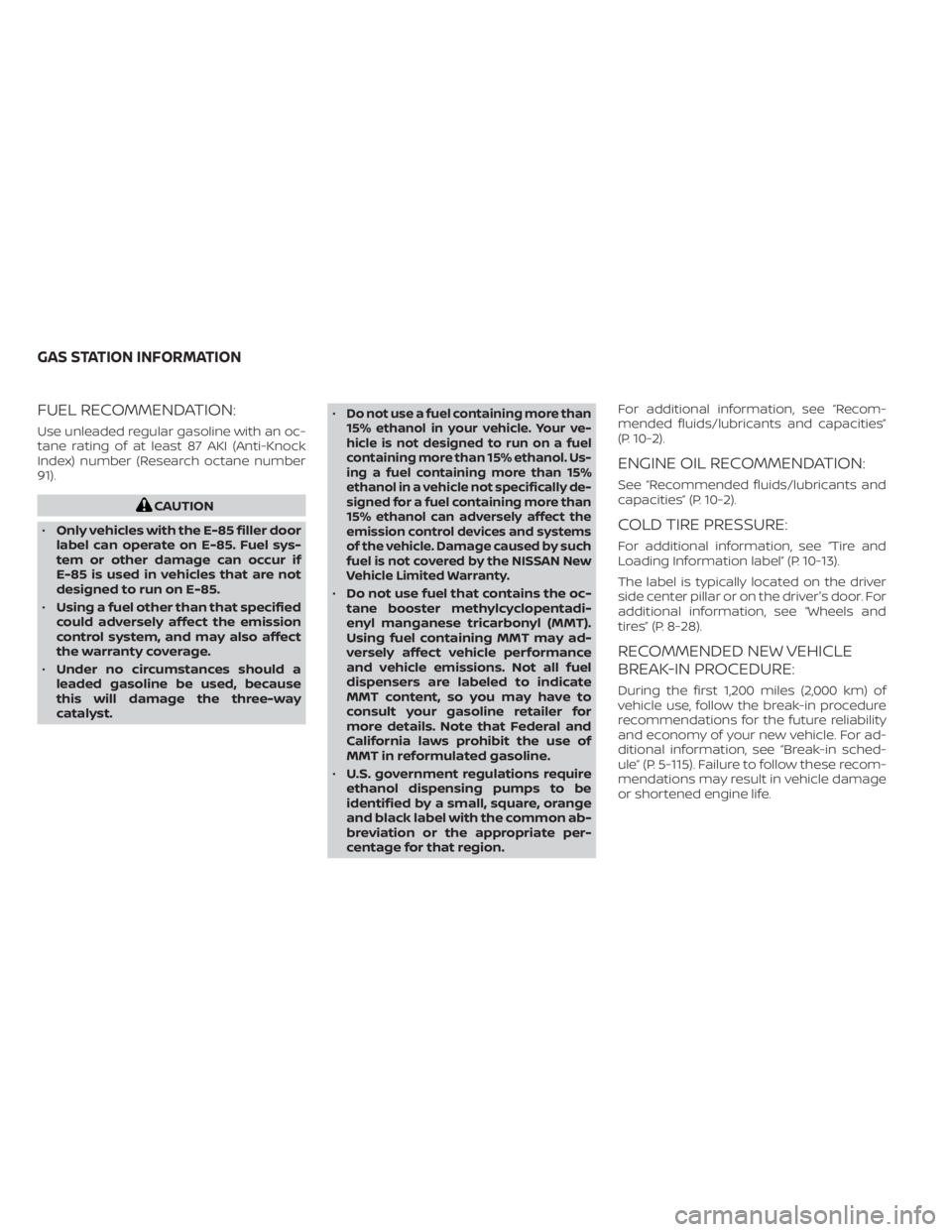
FUEL RECOMMENDATION:
Use unleaded regular gasoline with an oc-
tane rating of at least 87 AKI (Anti-Knock
Index) number (Research octane number
91).
CAUTION
• Only vehicles with the E-85 filler door
label can operate on E-85. Fuel sys-
tem or other damage can occur if
E-85 is used in vehicles that are not
designed to run on E-85.
• Using a fuel other than that specified
could adversely affect the emission
control system, and may also affect
the warranty coverage.
• Under no circumstances should a
leaded gasoline be used, because
this will damage the three-way
catalyst. •
Do not use a fuel containing more than
15% ethanol in your vehicle. Your ve-
hicle is not designed to run on a fuel
containing more than 15% ethanol. Us-
ing a fuel containing more than 15%
ethanol in a vehicle not specifically de-
signed for a fuel containing more than
15% ethanol can adversely affect the
emission control devices and systems
of the vehicle. Damage caused by such
fuel is not covered by the NISSAN New
Vehicle Limited Warranty.
• Do not use fuel that contains the oc-
tane booster methylcyclopentadi-
enyl manganese tricarbonyl (MMT).
Using fuel containing MMT may ad-
versely affect vehicle performance
and vehicle emissions. Not all fuel
dispensers are labeled to indicate
MMT content, so you may have to
consult your gasoline retailer for
more details. Note that Federal and
California laws prohibit the use of
MMT in reformulated gasoline.
• U.S. government regulations require
ethanol dispensing pumps to be
identified by a small, square, orange
and black label with the common ab-
breviation or the appropriate per-
centage for that region. For additional information, see “Recom-
mended fluids/lubricants and capacities”
(P. 10-2).
ENGINE OIL RECOMMENDATION:
See “Recommended fluids/lubricants and
capacities” (P. 10-2).
COLD TIRE PRESSURE:
For additional information, see “Tire and
Loading Information label” (P. 10-13).
The label is typically located on the driver
side center pillar or on the driver's door. For
additional information, see “Wheels and
tires” (P. 8-28).
RECOMMENDED NEW VEHICLE
BREAK-IN PROCEDURE:
During the first 1,200 miles (2,000 km) of
vehicle use, follow the break-in procedure
recommendations for the future reliability
and economy of your new vehicle. For ad-
ditional information, see “Break-in sched-
ule” (P. 5-115). Failure to follow these recom-
mendations may result in vehicle damage
or shortened engine life.
GAS STATION INFORMATION