2023 NISSAN LEAF Heat
[x] Cancel search: HeatPage 565 of 612
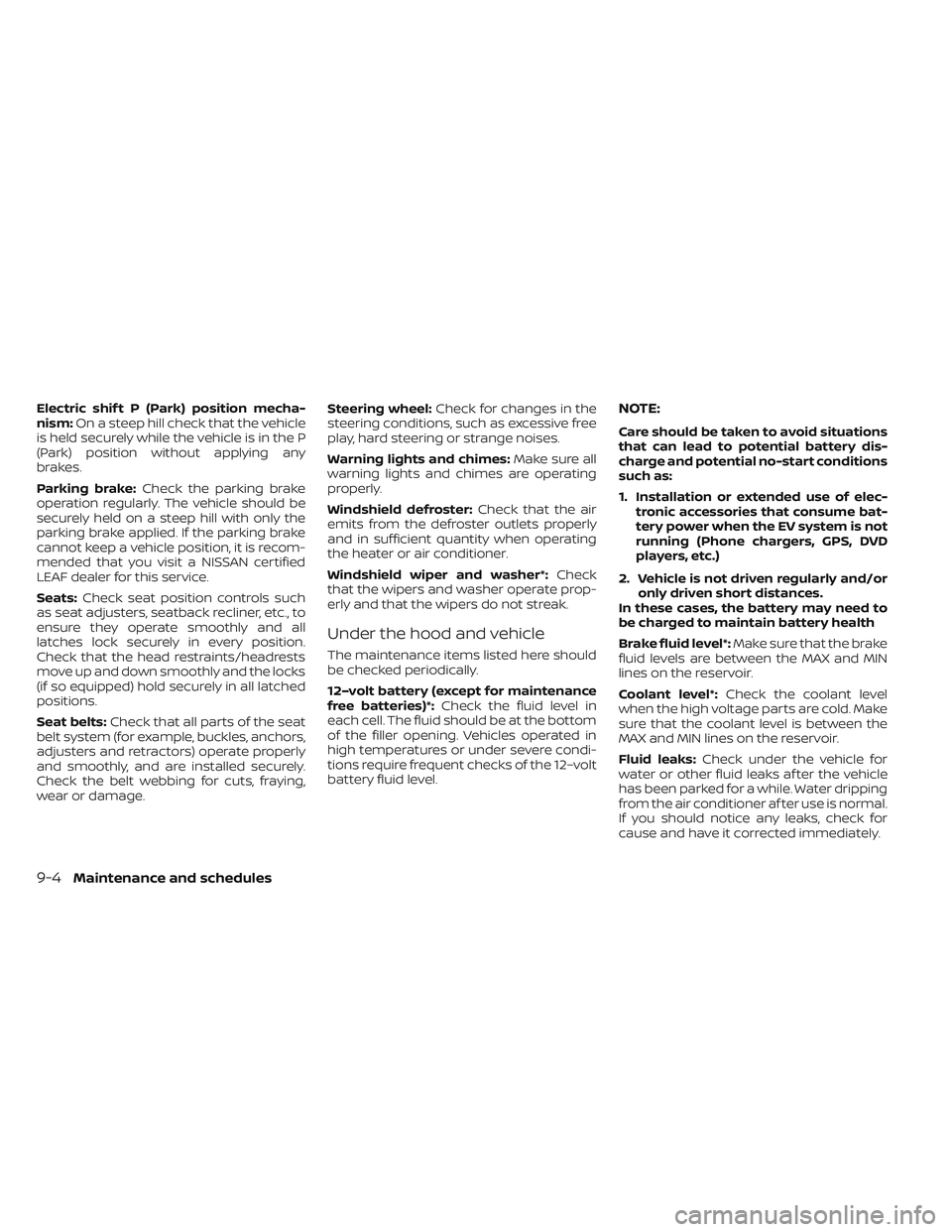
Electric shif t P (Park) position mecha-
nism:On a steep hill check that the vehicle
is held securely while the vehicle is in the P
(Park) position without applying any
brakes.
Parking brake: Check the parking brake
operation regularly. The vehicle should be
securely held on a steep hill with only the
parking brake applied. If the parking brake
cannot keep a vehicle position, it is recom-
mended that you visit a NISSAN certified
LEAF dealer for this service.
Seats: Check seat position controls such
as seat adjusters, seatback recliner, etc., to
ensure they operate smoothly and all
latches lock securely in every position.
Check that the head restraints/headrests
move up and down smoothly and the locks
(if so equipped) hold securely in all latched
positions.
Seat belts: Check that all parts of the seat
belt system (for example, buckles, anchors,
adjusters and retractors) operate properly
and smoothly, and are installed securely.
Check the belt webbing for cuts, fraying,
wear or damage. Steering wheel:
Check for changes in the
steering conditions, such as excessive free
play, hard steering or strange noises.
Warning lights and chimes: Make sure all
warning lights and chimes are operating
properly.
Windshield defroster: Check that the air
emits from the defroster outlets properly
and in sufficient quantity when operating
the heater or air conditioner.
Windshield wiper and washer*: Check
that the wipers and washer operate prop-
erly and that the wipers do not streak.
Under the hood and vehicle
The maintenance items listed here should
be checked periodically.
12–volt battery (except for maintenance
free batteries)*: Check the fluid level in
each cell. The fluid should be at the bottom
of the filler opening. Vehicles operated in
high temperatures or under severe condi-
tions require frequent checks of the 12–volt
battery fluid level.
NOTE:
Care should be taken to avoid situations
that can lead to potential battery dis-
charge and potential no-start conditions
such as:
1. Installation or extended use of elec- tronic accessories that consume bat-
tery power when the EV system is not
running (Phone chargers, GPS, DVD
players, etc.)
2. Vehicle is not driven regularly and/or only driven short distances.
In these cases, the battery may need to
be charged to maintain battery health
Brake fluid level*: Make sure that the brake
fluid levels are between the MAX and MIN
lines on the reservoir.
Coolant level*: Check the coolant level
when the high voltage parts are cold. Make
sure that the coolant level is between the
MAX and MIN lines on the reservoir.
Fluid leaks: Check under the vehicle for
water or other fluid leaks af ter the vehicle
has been parked for a while. Water dripping
from the air conditioner af ter use is normal.
If you should notice any leaks, check for
cause and have it corrected immediately.
9-4Maintenance and schedules
Page 592 of 612
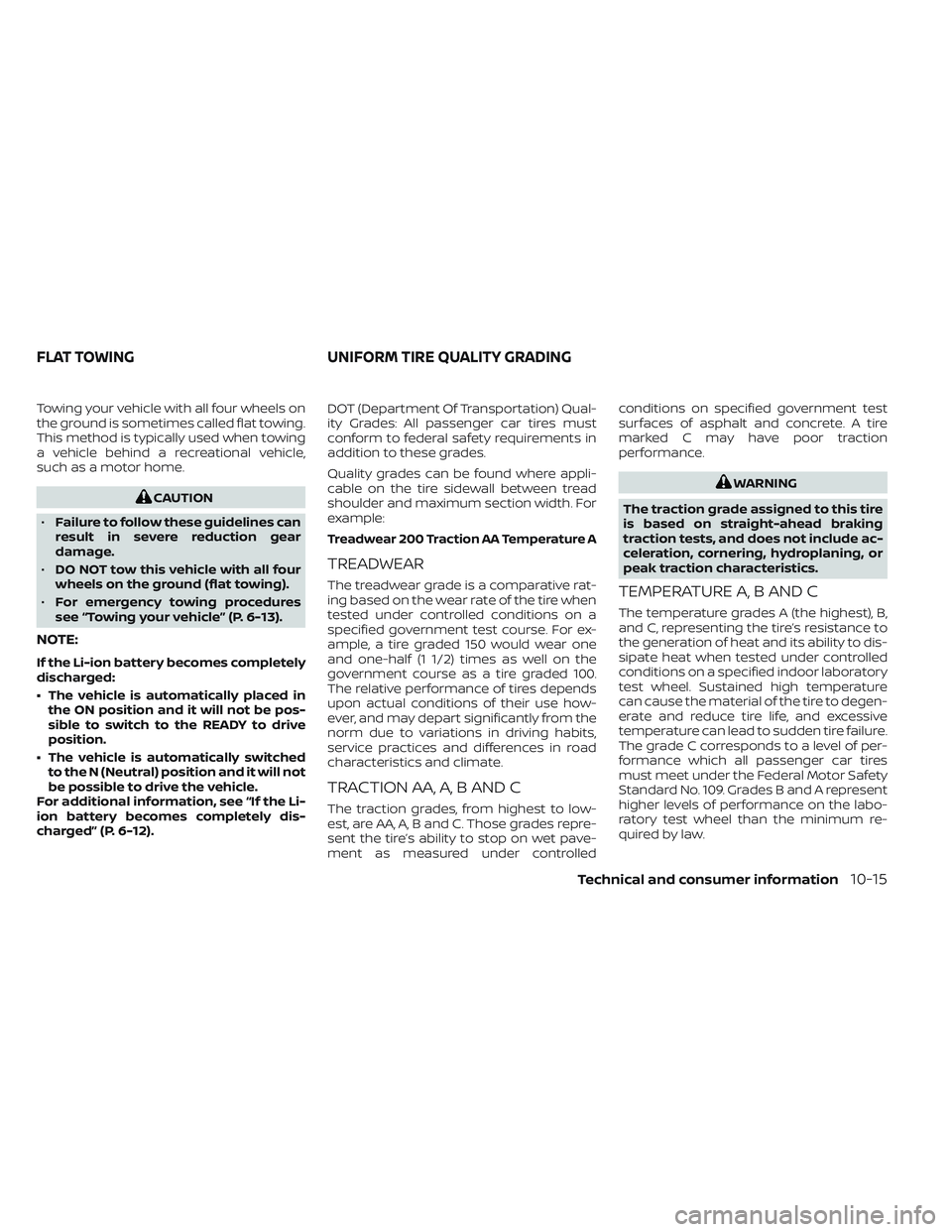
Towing your vehicle with all four wheels on
the ground is sometimes called flat towing.
This method is typically used when towing
a vehicle behind a recreational vehicle,
such as a motor home.
CAUTION
• Failure to follow these guidelines can
result in severe reduction gear
damage.
• DO NOT tow this vehicle with all four
wheels on the ground (flat towing).
• For emergency towing procedures
see “Towing your vehicle” (P. 6-13).
NOTE:
If the Li-ion battery becomes completely
discharged:
• The vehicle is automatically placed in the ON position and it will not be pos-
sible to switch to the READY to drive
position.
• The vehicle is automatically switched to the N (Neutral) position and it will not
be possible to drive the vehicle.
For additional information, see “If the Li-
ion battery becomes completely dis-
charged” (P. 6-12). DOT (Department Of Transportation) Qual-
ity Grades: All passenger car tires must
conform to federal safety requirements in
addition to these grades.
Quality grades can be found where appli-
cable on the tire sidewall between tread
shoulder and maximum section width. For
example:
Treadwear 200 Traction AA Temperature A
TREADWEAR
The treadwear grade is a comparative rat-
ing based on the wear rate of the tire when
tested under controlled conditions on a
specified government test course. For ex-
ample, a tire graded 150 would wear one
and one-half (1 1/2) times as well on the
government course as a tire graded 100.
The relative performance of tires depends
upon actual conditions of their use how-
ever, and may depart significantly from the
norm due to variations in driving habits,
service practices and differences in road
characteristics and climate.
TRACTION AA, A, B AND C
The traction grades, from highest to low-
est, are AA, A, B and C. Those grades repre-
sent the tire’s ability to stop on wet pave-
ment as measured under controlledconditions on specified government test
surfaces of asphalt and concrete. A tire
marked C may have poor traction
performance.
WARNING
The traction grade assigned to this tire
is based on straight-ahead braking
traction tests, and does not include ac-
celeration, cornering, hydroplaning, or
peak traction characteristics.
TEMPERATURE A, B AND C
The temperature grades A (the highest), B,
and C, representing the tire’s resistance to
the generation of heat and its ability to dis-
sipate heat when tested under controlled
conditions on a specified indoor laboratory
test wheel. Sustained high temperature
can cause the material of the tire to degen-
erate and reduce tire life, and excessive
temperature can lead to sudden tire failure.
The grade C corresponds to a level of per-
formance which all passenger car tires
must meet under the Federal Motor Safety
Standard No. 109. Grades B and A represent
higher levels of performance on the labo-
ratory test wheel than the minimum re-
quired by law.
FLAT TOWING UNIFORM TIRE QUALITY GRADING
Technical and consumer information10-15
Page 593 of 612
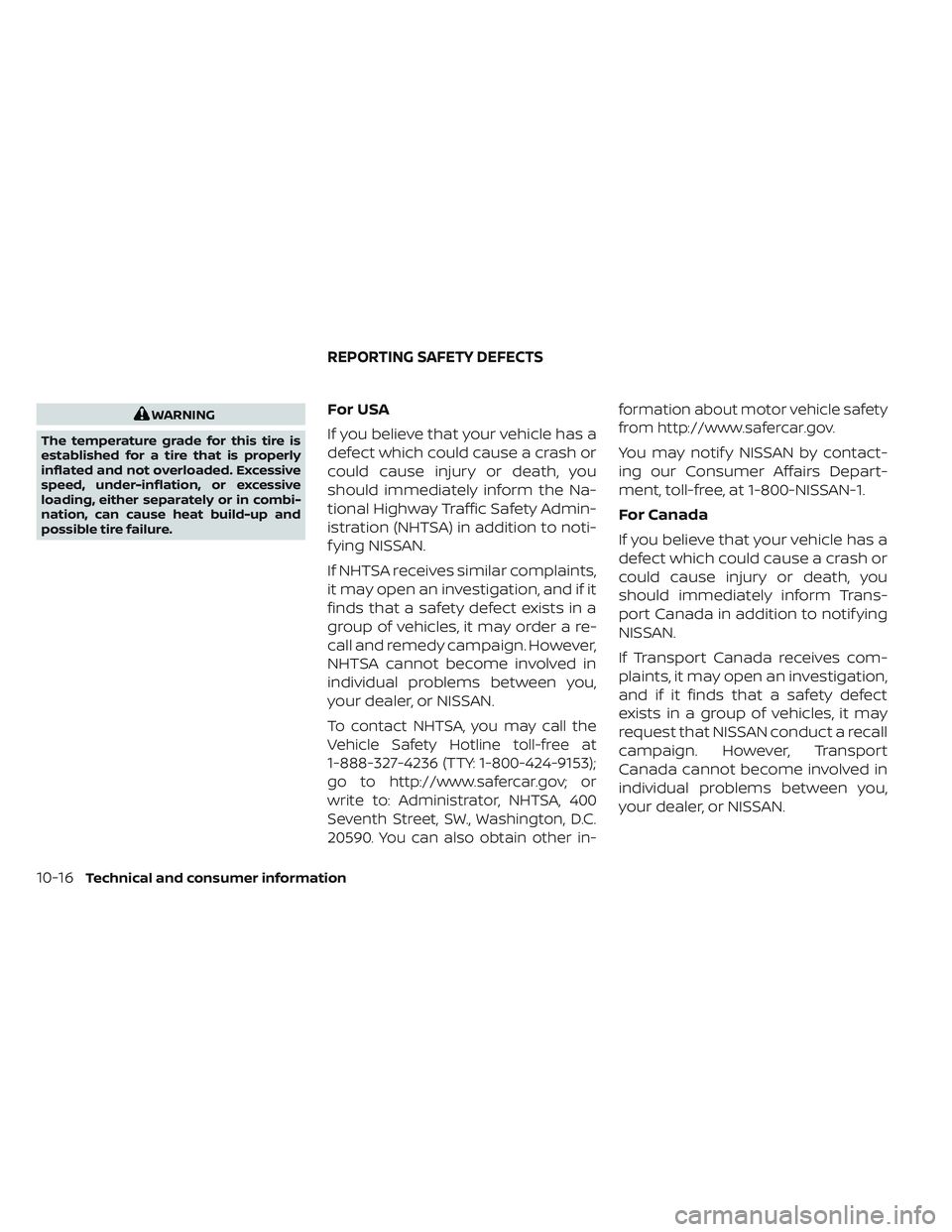
WARNING
The temperature grade for this tire is
established for a tire that is properly
inflated and not overloaded. Excessive
speed, under-inflation, or excessive
loading, either separately or in combi-
nation, can cause heat build-up and
possible tire failure.For USA
If you believe that your vehicle has a
defect which could cause a crash or
could cause injury or death, you
should immediately inform the Na-
tional Highway Traffic Safety Admin-
istration (NHTSA) in addition to noti-
f ying NISSAN.
If NHTSA receives similar complaints,
it may open an investigation, and if it
finds that a safety defect exists in a
group of vehicles, it may order a re-
call and remedy campaign. However,
NHTSA cannot become involved in
individual problems between you,
your dealer, or NISSAN.
To contact NHTSA, you may call the
Vehicle Safety Hotline toll-free at
1-888-327-4236 (TTY: 1-800-424-9153);
go to http://www.safercar.gov; or
write to: Administrator, NHTSA, 400
Seventh Street, SW., Washington, D.C.
20590. You can also obtain other in- formation about motor vehicle safety
from http://www.safercar.gov.
You may notif y NISSAN by contact-
ing our Consumer Affairs Depart-
ment, toll-free, at 1-800-NISSAN-1.
For Canada
If you believe that your vehicle has a
defect which could cause a crash or
could cause injury or death, you
should immediately inform Trans-
port Canada in addition to notif ying
NISSAN.
If Transport Canada receives com-
plaints, it may open an investigation,
and if it finds that a safety defect
exists in a group of vehicles, it may
request that NISSAN conduct a recall
campaign. However, Transport
Canada cannot become involved in
individual problems between you,
your dealer, or NISSAN.
REPORTING SAFETY DEFECTS
10-16Technical and consumer information
Page 605 of 612
Ceiling light...................2-73Center console................2-66Charge port lid.................3-20Charge port lid switch............2-61ChargingCharge port lid...............3-20Charging related indicator light. . .CH-49Normal charge..............CH-9Precautions on charging........CH-2Quick charge..........CH-35, CH-38Specifications................10-4Trickle charge...............CH-11Charging information............10-23Charging methods.............CH-43Charging related indicator light.....CH-49Charging related remote function. . .CH-48Charging status indicator light.....CH-49Charging the Li-ion battery........EV-12Charging troubleshooting guide. . . .CH-56CheckingChecking bulbs...............2-16Checking coolant level...........8-6Child restraint with top tether strap. . . .1-27Child restraints..............1-22,1-24Booster seats................1-40LATCH (Lower Anchors and Tethers for
CHildren) System..............1-24Precautions on child restraints.....1-22Top tether strap...............1-27Child safety...................1-19Child safety rear door lock..........3-6Chimes, audible reminders.........2-25Circuit breaker, fusible link..........8-17Cleaning exterior and interior......7-2,7-4
ClimateClimate control system refrigerant and
lubricant recommendations
......4-43Climate controlClimate control service..........4-43Climate control systemAir conditioner...............4-29Climate control operation........4-29Heater....................4-29Climate Ctrl. Timer..............4-38Clock.......................2-12Cold tire pressures..............10-25Cold weather driving............5-173ConsoleCenter console...............2-66CoolantCapacities and recommended
fuel/lubricants
...............10-2Changing coolant..............8-6Checking coolant level...........8-6Cooling system................ .8-5Corrosion protection..............7-7Cruise control.................5-65Cup holders................. .2-67
D
Defroster switch
Rear window and outside mirror defroster
switch
................... .2-49Dimensions and weights..........10-6Dimmer switch for instrument panel. . .2-56
Display
Information display............2-26Door locks................... .3-4Driving
Cold weather driving...........5-173Driving vehicle...............5-14Precautions when starting and
driving.................... .5-4Driving range..................2-8Driving the vehicle..............EV-18Driving vehicle.................5-14Dynamic driver assistance switch.....2-61e-Pedal......................2-13e-Pedal system................5-21
E
ECO
ECO switch................ .2-58Eco Drive Report...............5-157ECO mode...............2-13,5-157ECO switch.................. .2-58Efficient use of your vehicle........EV-23Electric shif t control system........5-14Electronic parking brake...........5-19Emblem light..................2-57Emergency call (SOS) button........2-60Emergency charge.............CH-11Emergency EV (Electric Vehicle)
shut off...................5-12,6-3Emergency shutoff system........EV-10Emission control information label. . . .10-8EV Characteristics..............EV-11
11-2
Page 606 of 612
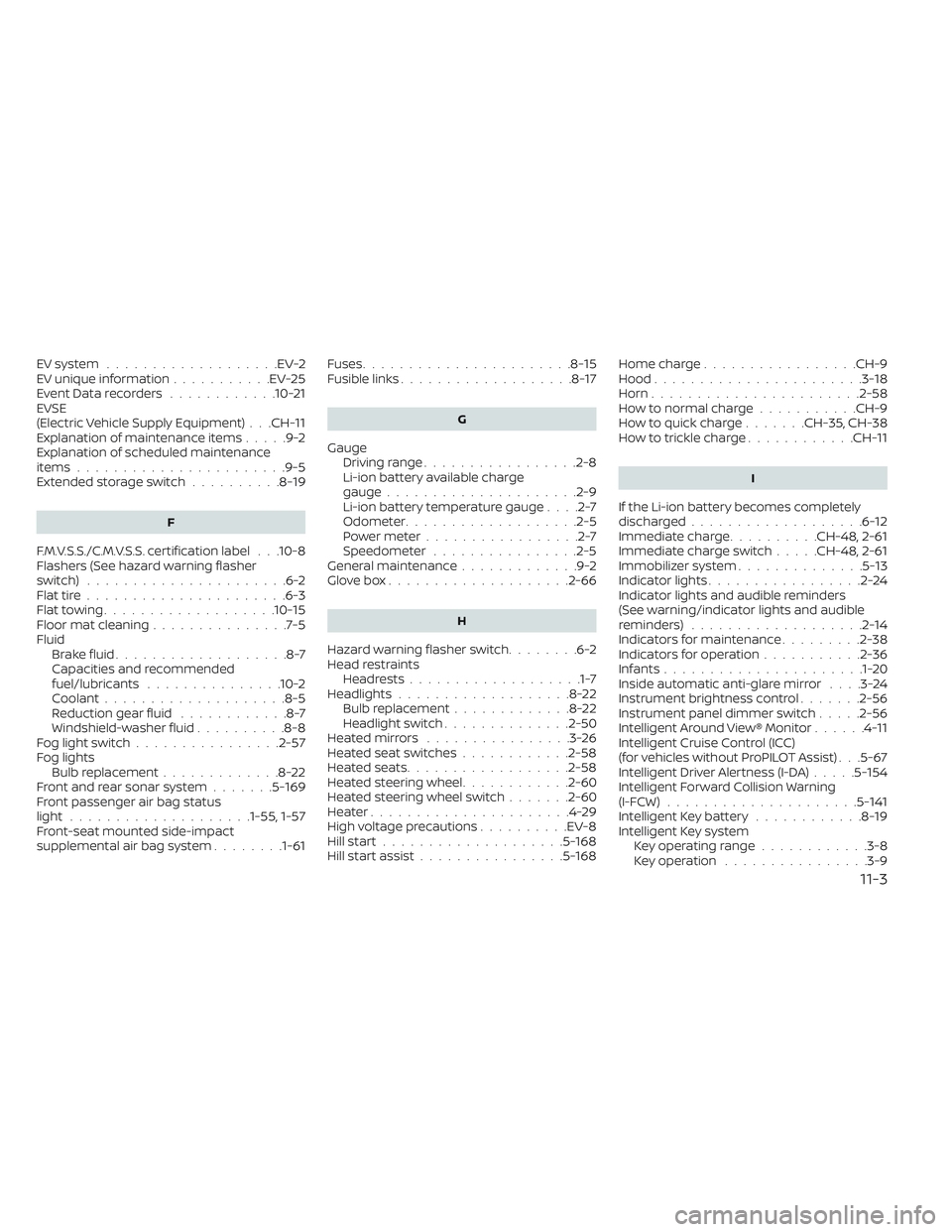
EV system...................EV-2EV unique information...........EV-25Event Data recorders............10-21EVSE
(Electric Vehicle Supply Equipment). . .CH-11Explanation of maintenance items.....9-2Explanation of scheduled maintenance
items...................... .9-5Extended storage switch..........8-19
F
F.M.V.S.S./C.M.V.S.S. certification label. . .10-8Flashers (See hazard warning flasher
switch)......................6-2Flat tire......................6-3Flat towing...................10-15Floor mat cleaning...............7-5Fluid
Brake fluid...................8-7Capacities and recommended
fuel/lubricants...............10-2Coolant................... .8-5Reduction gear fluid............8-7Windshield-washer fluid..........8-8Fog light switch................2-57Fog lights
Bulb replacement.............8-22Front and rear sonar system.......5-169Front passenger air bag status
light................... .1-55, 1-57Front-seat mounted side-impact
supplemental air bag system........1-61
Fuses.......................8-15Fusible links...................8-17
G
Gauge
Driving range................ .2-8Li-ion battery available charge
gauge.................... .2-9Li-ion battery temperature gauge. . . .2-7Odometer...................2-5Power meter.................2-7Speedometer................2-5General maintenance.............9-2Glove box................... .2-66
H
Hazard warning flasher switch........6-2Head restraints
Headrests...................1-7Headlights...................8-22Bulb replacement.............8-22Headlight switch..............2-50Heated mirrors................3-26Heated seat switches............2-58Heated seats................. .2-58Heated steering wheel............2-60Heated steering wheel switch.......2-60Heater......................4-29High voltage precautions..........EV-8Hill start....................5-168Hill start assist................5-168
Home charge.................CH-9Hood.......................3-18Horn...................... .2-58How to normal charge...........CH-9How to quick charge.......CH-35, CH-38How to trickle charge............CH-11
I
If the Li-ion battery becomes completely
discharged...................6-12Immediate charge..........CH-48, 2-61Immediate charge switch.....CH-48, 2-61Immobilizer system..............5-13Indicator lights.................2-24Indicator lights and audible reminders
(See warning/indicator lights and audible
reminders)
...................2-14Indicators for maintenance.........2-38Indicators for operation...........2-36Infants......................1-20Inside automatic anti-glare mirror. . . .3-24Instrument brightness control.......2-56Instrument panel dimmer switch.....2-56Intelligent Around View® Monitor......4-11Intelligent Cruise Control (ICC)
(for vehicles without ProPILOT Assist). . .5-67Intelligent Driver Alertness (I-DA).....5-154Intelligent Forward Collision Warning
(I-FCW).....................5-141Intelligent Key battery............8-19Intelligent Key system
Key operating range............3-8Key operation................3-9
11-3
Page 607 of 612
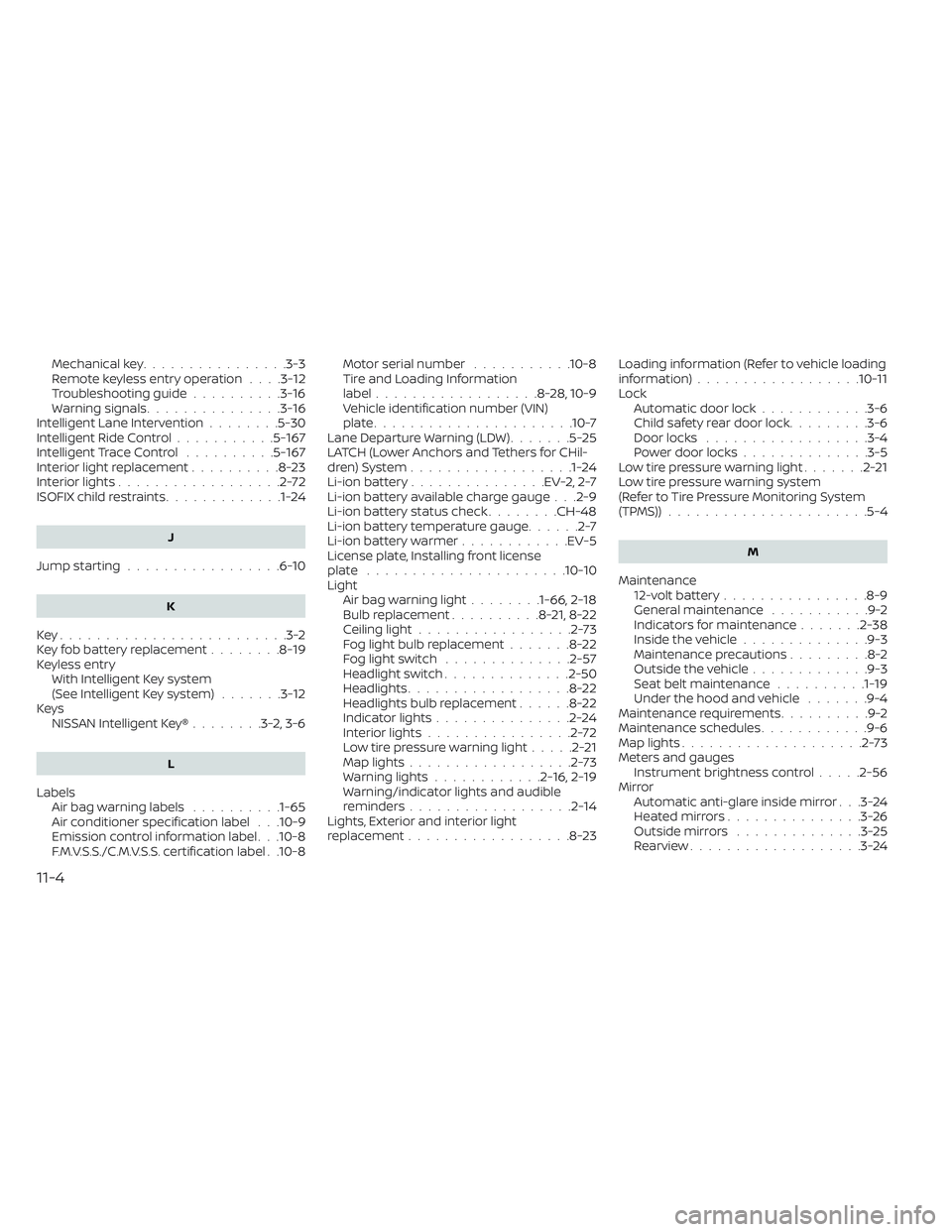
Mechanical key................3-3Remote keyless entry operation. . . .3-12Troubleshooting guide..........3-16Warning signals...............3-16Intelligent Lane Intervention........5-30Intelligent Ride Control...........5-167Intelligent Trace Control..........5-167Interior light replacement..........8-23Interior lights..................2-72ISOFIX child restraints.............1-24
J
Jump starting.................6-10
K
Key.........................3-2Key fob battery replacement........8-19Keyless entryWith Intelligent Key system
(See Intelligent Key system)
.......3-12KeysNISSAN Intelligent Key®........3-2,3-6
L
LabelsAir bag warning labels..........1-65Air conditioner specification label. . .10-9Emission control information label. . .10-8F.M.V.S.S./C.M.V.S.S. certification label. .10-8
Motor serial number...........10-8Tire and Loading Information
label..................8-28, 10-9Vehicle identification number (VIN)
plate..................... .10-7Lane Departure Warning (LDW).......5-25LATCH (Lower Anchors and Tethers for CHil-
dren) System..................1-24Li-ion battery...............EV-2, 2-7Li-ion battery available charge gauge. . .2-9Li-ion battery status check........CH-48Li-ion battery temperature gauge......2-7Li-ion battery warmer............EV-5License plate, Installing front license
plate......................10-10Light
Air bag warning light........1-66, 2-18Bulb replacement..........8-21,8-22Ceiling light.................2-73Fog light bulb replacement.......8-22Fog light switch..............2-57Headlight switch..............2-50Headlights..................8-22Headlights bulb replacement......8-22Indicator lights...............2-24Interior lights................2-72Low tire pressure warning light.....2-21Map lights..................2-73Warning lights............2-16,2-19Warning/indicator lights and audible
reminders..................2-14Lights, Exterior and interior light
replacement..................8-23
Loading information (Refer to vehicle loading
information)................. .10-11Lock
Automatic door lock............3-6Child safety rear door lock.........3-6Door locks................. .3-4Power door locks..............3-5Low tire pressure warning light.......2-21Low tire pressure warning system
(Refer to Tire Pressure Monitoring System
(TPMS))
..................... .5-4
M
Maintenance
12-volt battery................8-9General maintenance...........9-2Indicators for maintenance.......2-38Inside the vehicle..............9-3Maintenance precautions.........8-2Outside the vehicle.............9-3Seat belt maintenance..........1-19Under the hood and vehicle.......9-4Maintenance requirements..........9-2Maintenance schedules............9-6Map lights....................2-73Meters and gaugesInstrument brightness control.....2-56MirrorAutomatic anti-glare inside mirror. . .3-24Heated mirrors...............3-26Outside mirrors..............3-25Rearview...................3-24
11-4
Page 609 of 612
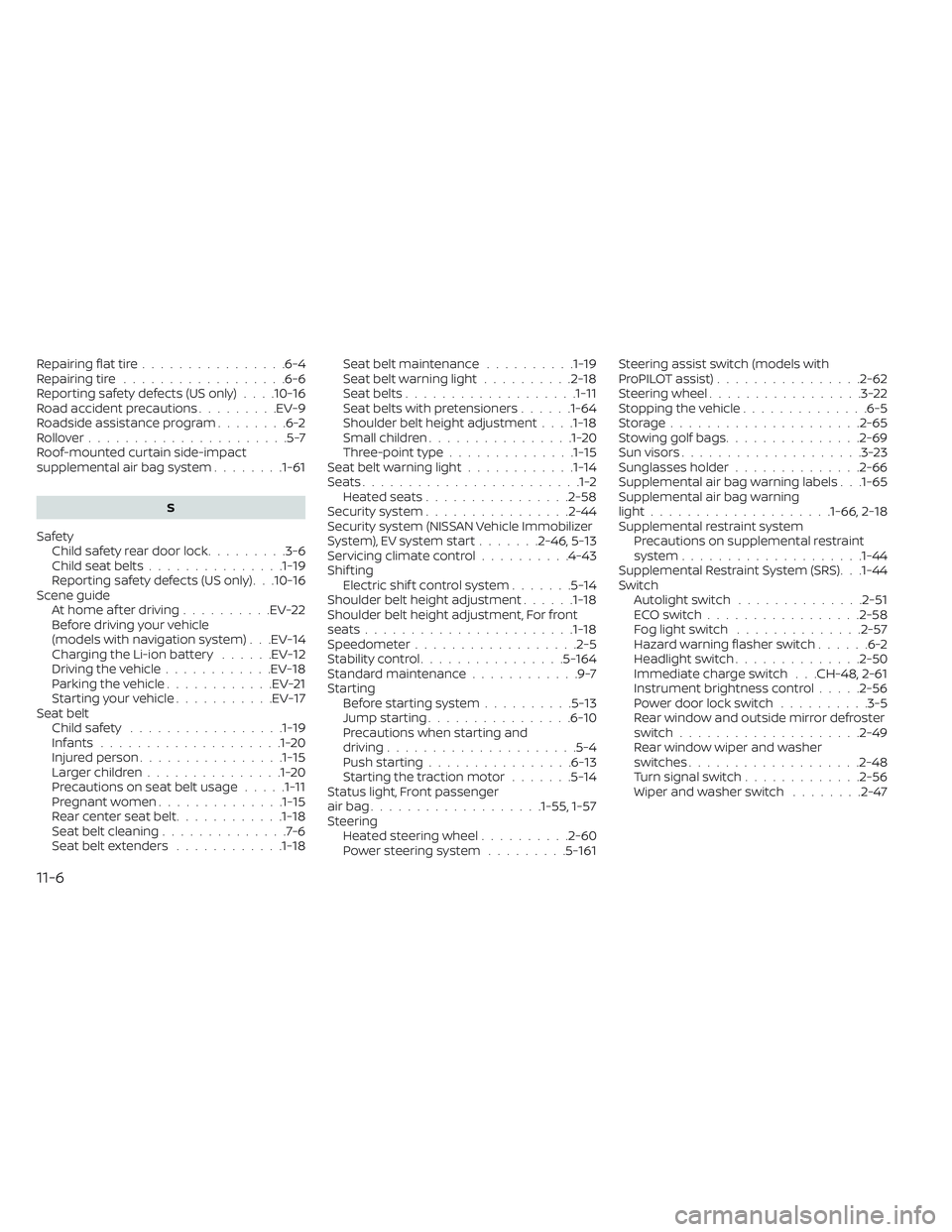
Repairing flat tire................6-4Repairing tire..................6-6Reporting safety defects (US only). . . .10-16Road accident precautions.........EV-9Roadside assistance program........6-2Rollover......................5-7Roof-mounted curtain side-impact
supplemental air bag system........1-61
S
Safety
Child safety rear door lock.........3-6Child seat belts...............1-19Reporting safety defects (US only). . .10-16Scene guideAt home af ter driving..........EV-22Before driving your vehicle
(models with navigation system). . .EV-14Charging the Li-ion battery......EV-12Driving the vehicle............EV-18Parking the vehicle............EV-21Starting your vehicle...........EV-17Seat beltChild safety.................1-19Infants....................1-20Injured person................1-15Larger children...............1-20Precautions on seat belt usage.....1-11Pregnant women..............1-15Rear center seat belt............1-18Seat belt cleaning..............7-6Seat belt extenders............1-18
Seat belt maintenance..........1-19Seat belt warning light..........2-18Seat belts...................1-11Seat belts with pretensioners......1-64Shoulder belt height adjustment. . . .1-18Small children................1-20Three-point type..............1-15Seat belt warning light............1-14Seats........................1-2Heated seats................2-58Security system................2-44Security system (NISSAN Vehicle Immobilizer
System), EV system start.......2-46, 5-13Servicing climate control..........4-43Shif tingElectric shif t control system.......5-14Shoulder belt height adjustment......1-18Shoulder belt height adjustment, For front
seats.......................1-18Speedometer................. .2-5Stability control................5-164Standard maintenance............9-7Starting
Before starting system..........5-13Jump starting................6-10Precautions when starting and
driving.................... .5-4Push starting................6-13Starting the traction motor.......5-14Status light, Front passenger
air bag...................1-55, 1-57Steering
Heated steering wheel..........2-60Power steering system.........5-161
Steering assist switch (models with
ProPILOT assist)................2-62Steering wheel.................3-22Stopping the vehicle..............6-5Storage.................... .2-65Stowing golf bags...............2-69Sun visors....................3-23Sunglasses holder..............2-66Supplemental air bag warning labels. . .1-65Supplemental air bag warning
light....................1-66, 2-18Supplemental restraint system
Precautions on supplemental restraint
system
................... .1-44Supplemental Restraint System (SRS). . .1-44Switch
Autolight switch..............2-51ECO switch................ .2-58Fog light switch..............2-57Hazard warning flasher switch......6-2Headlight switch..............2-50Immediate charge switch. . .CH-48, 2-61Instrument brightness control.....2-56Power door lock switch..........3-5Rear window and outside mirror defroster
switch................... .2-49Rear window wiper and washer
switches...................2-48Turn signal switch.............2-56Wiper and washer switch........2-47
11-6