2023 NISSAN LEAF service
[x] Cancel search: servicePage 562 of 612
9 Maintenance and schedules
Maintenance requirements.....................9-2
General maintenance ........................9-2
Scheduled maintenance .....................9-2
Where to go for service .......................9-2
General maintenance ...........................9-2
Explanation of general maintenance
items ........................................9-2
Explanation of scheduled maintenance items . . . 9-5 Explanation of scheduled maintenance
items
........................................9-5
Chassis and Body Maintenance: ..............9-6
Maintenance schedules .........................9-6
Additional Maintenance Items for
severe operating conditions ..................9-6
EV Maintenance schedules
(EM57 electric motor) .........................9-7
Page 563 of 612
Some day-to-day and regular mainte-
nance is essential to maintain your vehicle
good mechanical condition, and its Electric
Vehicle (EV) system performance.
It is the owner's responsibility to make sure
that the scheduled maintenance, and gen-
eral maintenance, is performed.
As the vehicle owner, you are the only one
who can ensure that your vehicle receives
proper maintenance. You are a vital link in
the maintenance chain.
GENERAL MAINTENANCE
General maintenance includes those items
which should be checked during normal
day-to-day operation. They are essential
for proper vehicle operation. It is your re-
sponsibility to perform these procedures
regularly as prescribed.
Performing general maintenance checks
requires minimal mechanical skill and only
a few general automotive tools.
These checks or inspections can be done
by yourself, a qualified technician or, if you
prefer, a NISSAN certified LEAF dealer.
SCHEDULED MAINTENANCE
The maintenance items listed in this sec-
tion are required to be serviced at regular
intervals. However under severe driving
conditions, additional or more frequent
maintenance will be required.
WHERE TO GO FOR SERVICE
If maintenance service is required or your
vehicle appears to malfunction, have the
systems checked and serviced. It is recom-
mended that you visit a NISSAN certified
LEAF dealer for this service.
NISSAN technicians are well-trained spe-
cialists and are kept up-to-date with the
latest service information through techni-
cal bulletins, service tips, and training pro-
grams. They are fully qualified to work on
NISSAN vehiclesbeforework begins.
If your vehicle is involved in a collision, it is
recommended that you ask your NISSAN
certified LEAF dealer where the nearest
NISSAN Certified Collision Center is located,
or go to http://collision.nissanusa.com.
You can be confident that a NISSAN certi-
fied LEAF dealer's service department per-
forms the best job to meet the mainte-
nance requirements on your vehicle. During the normal day-to-day operation of
the vehicle, general maintenance should
be performed regularly as prescribed in
this section. If you detect any unusual
sounds, vibrations or smells, be sure to
check for the cause or have a NISSAN cer-
tified LEAF dealer check it promptly. In ad-
dition, it is recommended that you visit a
NISSAN certified LEAF dealer if you think
that repairs are required.
When performing any checks or mainte-
nance work, closely observe the “Mainte-
nance precautions” (P. 8-2).
EXPLANATION OF GENERAL
MAINTENANCE ITEMS
WARNING
Failure to follow the procedures listed
within this section may result in per-
sonal injury.
Additional information on the following
items with“*”isf ound in the “Do-it-
yourself ” section of this manual.
MAINTENANCE REQUIREMENTS GENERAL MAINTENANCE
9-2Maintenance and schedules
Page 565 of 612
Electric shif t P (Park) position mecha-
nism:On a steep hill check that the vehicle
is held securely while the vehicle is in the P
(Park) position without applying any
brakes.
Parking brake: Check the parking brake
operation regularly. The vehicle should be
securely held on a steep hill with only the
parking brake applied. If the parking brake
cannot keep a vehicle position, it is recom-
mended that you visit a NISSAN certified
LEAF dealer for this service.
Seats: Check seat position controls such
as seat adjusters, seatback recliner, etc., to
ensure they operate smoothly and all
latches lock securely in every position.
Check that the head restraints/headrests
move up and down smoothly and the locks
(if so equipped) hold securely in all latched
positions.
Seat belts: Check that all parts of the seat
belt system (for example, buckles, anchors,
adjusters and retractors) operate properly
and smoothly, and are installed securely.
Check the belt webbing for cuts, fraying,
wear or damage. Steering wheel:
Check for changes in the
steering conditions, such as excessive free
play, hard steering or strange noises.
Warning lights and chimes: Make sure all
warning lights and chimes are operating
properly.
Windshield defroster: Check that the air
emits from the defroster outlets properly
and in sufficient quantity when operating
the heater or air conditioner.
Windshield wiper and washer*: Check
that the wipers and washer operate prop-
erly and that the wipers do not streak.
Under the hood and vehicle
The maintenance items listed here should
be checked periodically.
12–volt battery (except for maintenance
free batteries)*: Check the fluid level in
each cell. The fluid should be at the bottom
of the filler opening. Vehicles operated in
high temperatures or under severe condi-
tions require frequent checks of the 12–volt
battery fluid level.
NOTE:
Care should be taken to avoid situations
that can lead to potential battery dis-
charge and potential no-start conditions
such as:
1. Installation or extended use of elec- tronic accessories that consume bat-
tery power when the EV system is not
running (Phone chargers, GPS, DVD
players, etc.)
2. Vehicle is not driven regularly and/or only driven short distances.
In these cases, the battery may need to
be charged to maintain battery health
Brake fluid level*: Make sure that the brake
fluid levels are between the MAX and MIN
lines on the reservoir.
Coolant level*: Check the coolant level
when the high voltage parts are cold. Make
sure that the coolant level is between the
MAX and MIN lines on the reservoir.
Fluid leaks: Check under the vehicle for
water or other fluid leaks af ter the vehicle
has been parked for a while. Water dripping
from the air conditioner af ter use is normal.
If you should notice any leaks, check for
cause and have it corrected immediately.
9-4Maintenance and schedules
Page 566 of 612
Radiator and hoses:Check the front of the
radiator and clean off any dirt, insects,
leaves, etc., that may have accumulated.
Make sure the hoses have no cracks, defor-
mation, rot or loose connections.
Underbody: The underbody is frequently
exposed to corrosive substances such as
those used on icy roads or to control dust. It
is very important to remove these sub-
stances, otherwise rust will form on the
floor pan and frame. At the end of winter,
the underbody should be thoroughly
flushed with plain water, being careful to
clean those areas where mud and dirt may
accumulate. For additional information,
see “Cleaning exterior” (P. 7-2).
Windshield-washer fluid*: Check that
there is an adequate amount of fluid in the
reservoir. The following descriptions are provided to
give you a better understanding of the
scheduled maintenance items that should
be regularly checked or replaced. The
maintenance schedule indicates at which
mileage/time intervals each item requires
service.
In addition to scheduled maintenance,
your vehicle requires that some items be
checked during normal day-to-day opera-
tion. For additional information, see “Gen-
eral maintenance” (P. 9-2).
Items marked with
“*”are recommended
by NISSAN for reliable vehicle operation.
You are not required to perform mainte-
nance on these items in order to maintain
the warranties which come with your
NISSAN. Other maintenance items and in-
tervals are required.
When applicable, additional information
can be found in the “Do-it-yourself ” section
of this manual.
EXPLANATION OF SCHEDULED
MAINTENANCE ITEMS
EV System Charging Port*: Check the
charging port for any signs of contamina-
tion, dust, sand etc. Charging Port Sealing Cap*:
Use only
compressed air with proper eye protection
to clean any contamination from the seal-
ing cap.
Coolant: Replace coolant at the interval
specified below. When adding or replacing
coolant, be sure to use only Genuine
NISSAN Long Life Antifreeze/Coolant (Blue)
or equivalent with the proper mixture. (Re-
fer to the Owner’s Manual to determine the
proper mixture for your area.) The recom-
mended service interval of the factory fill
coolant is 125,000 miles (200,000 km) or 15
years, whichever comes first. Subsequent
replacement of Genuine NISSAN Long Life
Antifreeze/Coolant (Blue) should occur ev-
ery 75,000 miles (120,000 km) or 5 years,
whichever comes first.
NOTE:
Mixing any other type of coolant or the
use of nondistilled water will reduce the
recommended service interval of the
coolant.
EXPLANATION OF SCHEDULED
MAINTENANCE ITEMS
Maintenance and schedules9-5
Page 567 of 612
CHASSIS AND BODY
MAINTENANCE:
Brake lines and cables:Visually inspect for
proper installation. Check for chafing,
cracks, deterioration, and signs of leaking.
Replace any deteriorated or damaged
parts immediately.
Brake pads and rotors: Check for wear,
deterioration and fluid leaks. Replace any
deteriorated or damaged parts
immediately.
In-cabin microfilter: Replace at specified
intervals. When driving for prolonged peri-
ods in dusty conditions, replace the filter
more frequently.
Steering gear and linkage, axle and sus-
pension parts, drive shaf t boots: Check
for damage, looseness, and leakage of oil
or grease. Under severe driving conditions,
inspect more frequently.
Tire rotation: Rotate tires at the specified
interval shown in the maintenance sched-
ule. When rotating tires, check for damage
and uneven wear. Replace if necessary.
Reduction Gear Oil: Visually inspect for
signs of leakage at specified intervals. To help ensure smooth, safe and economi-
cal driving, NISSAN provides two mainte-
nance schedules that may be used, de-
pending upon the conditions in which you
usually drive. These schedules contain
both distance and time intervals, up to
120,000 miles (192,000 km)/96 months. For
most people, the odometer reading will in-
dicate when service is needed. However, if
you drive very little, your vehicle should be
serviced at the regular time intervals
shown in the schedule.
Af ter 120,000 miles (192,000 km)/96
months, continue maintenance at the
same mileage/time intervals.
ADDITIONAL MAINTENANCE ITEMS
FOR SEVERE OPERATING
CONDITIONS
Additional maintenance items for severe
operating conditions
should be per-
formed on vehicles that are driven under
especially demanding conditions. Addi-
tional maintenance items should be per-
formed if you primarily operate your vehicle
under the following conditions:
• Repeated short trips of less than 5 miles (8 km). • Repeated short trips of less than 10 miles
(16 km) with outside temperatures re-
maining below freezing.
• Operating in hot weather in stop-and-go “rush hour” traffic.
• Extensive idling and/or low speed driving for long distances, such as police, taxi or
door-to-door delivery use.
• Driving in dusty conditions.
• Driving on rough, muddy or salt spread roads.
• Using a car-top carrier.
If your vehicle is mainly operated under the
severe conditions, follow the severe use
maintenance intervals shown in the main-
tenance schedule.
MAINTENANCE SCHEDULES
9-6Maintenance and schedules
Page 578 of 612

10 Technical and consumer information
Recommended fluids/lubricants and
capacities...................................... 10-2
Air conditioning system refrigerant and
lubricant recommendations ................10-3
Specifications .................................. 10-4
Charging system ............................ 10-4
Motor ....................................... 10-5
Wheels and tires ............................ 10-5
Dimensions and weights ....................10-6
When traveling or registering in another
country ........................................ 10-7
Vehicle identification ........................... 10-7
Vehicle Identification Number (VIN)
plate ........................................ 10-7
Vehicle identification number
(chassis number) ............................ 10-7
Traction motor serial number ...............10-8
F.M.V.S.S./C.M.V.S.S Certification label .........10-8
Emission control information label ..........10-8
Tire and Loading Information label ..........10-9
Air conditioner specification label ...........10-9
Installing front license plate ...................10-10
Vehicle loading information ....................10-11Terms
....................................... 10-11
Vehicle load capacity ....................... 10-12
Loading tips ................................ 10-13
Measurement of weights ...................10-14
Towing a trailer ................................ 10-14
Flat towing .................................... 10-15
Uniform tire quality grading ...................10-15
Treadwear ................................. 10-15
Traction AA, A, B and C ......................10-15
Temperature A, B and C ....................10-15
Reporting safety defects ......................10-16
Telematics overview (models with Navigation
System) ....................................... 10-17
Telematic Control Unit Gen2K .................10-19
Event Data Recorders (EDR) ...................10-21
Additional data recording
(on vehicles equipped with optional
ProPILOT Assist) ............................ 10-21
Owner's Manual/Service Manual order
inf
ormation ................................... 10-22
Charging information ......................... 10-23
Cold tire pressures ............................ 10-25
Page 580 of 612
AIR CONDITIONING SYSTEM
REFRIGERANT AND LUBRICANT
RECOMMENDATIONS
The air conditioning system in your
NISSAN vehicle must be charged with the
refrigerant, HFO-1234yf (R-1234yf ), and
the compressor oil, ND-OIL11 or
equivalent.
CAUTION
The use of any other refrigerant or oil
will cause severe damage to the air
conditioning system and will require
the replacement of all air conditioner system components.
The refrigerant, HFO-1234yf (R-1234yf ), in
your NISSAN vehicle will not harm the
earth’s ozone layer. Although this refriger-
ant does not affect the earth’s atmo-
sphere, certain governmental regulations
require the recovery and recycling of any
refrigerant during automotive air condi-
tioning system service. Air conditioner sys-
tem should only be serviced by trained and
certified technicians to ensure proper and
safe operation (SAE J2845). A NISSAN certi-
fied LEAF dealer has the trained techni-
cians and equipment needed to recover
and recycle your air conditioning system
refrigerant. Only new and SAE J2842 certi-
fied evaporator(s) or inner condenser (if so
equipped) shall be used as replacement
parts. A damaged or leaking air conditioning
evaporator or inner condenser (if so
equipped) shall never be repaired or re-
placed with one removed from a used or
salvaged vehicle. To replace a damaged or
leaking evaporator or inner condenser (if
so equipped), use only new and SAE J2842
certified evaporator(s). It is recommended
that you visit a NISSAN certified LEAF dealer
when servicing your air conditioner
system.
Technical and consumer information10-3
Page 587 of 612
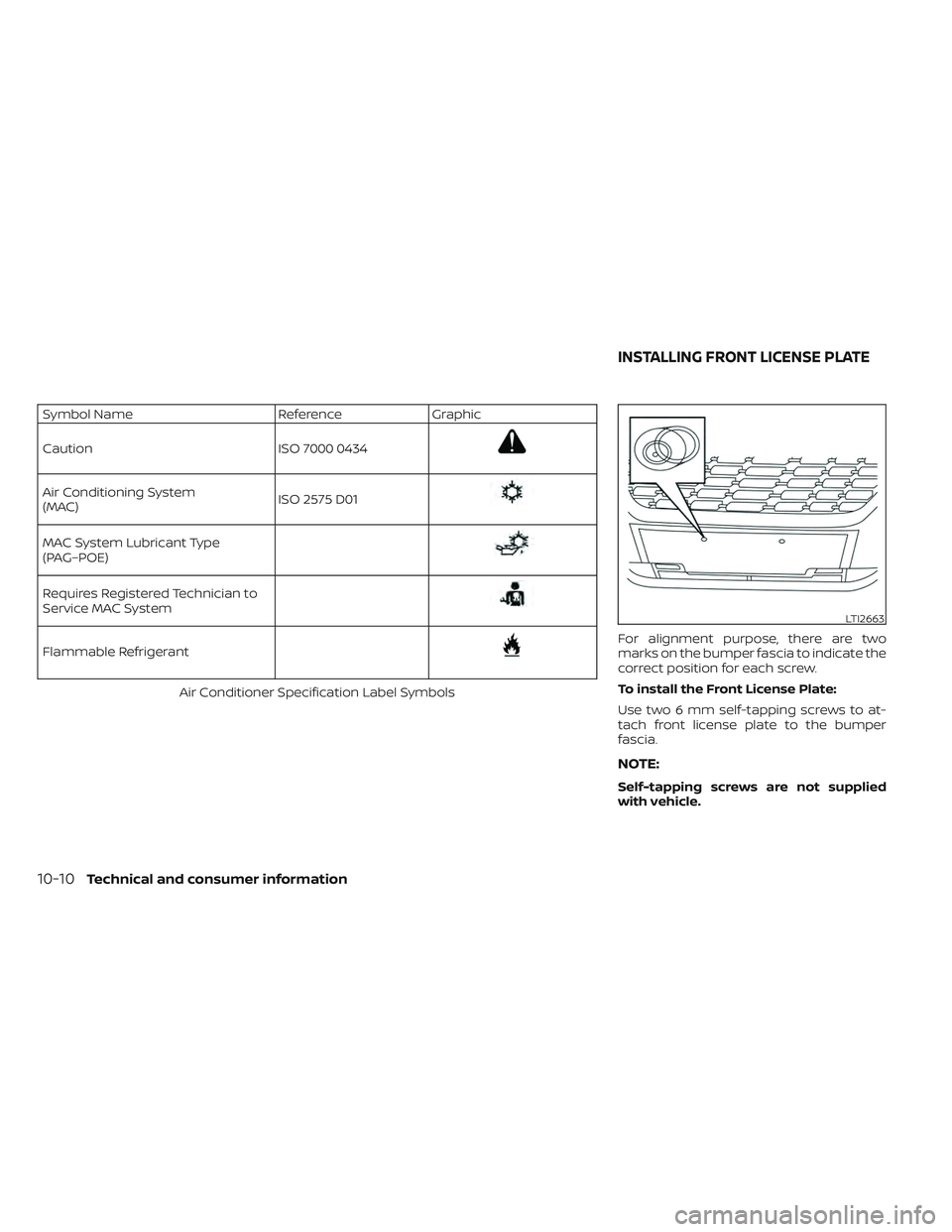
Symbol NameReferenceGraphic
Caution ISO 7000 0434
Air Conditioning System
(MAC)ISO 2575 D01
MAC System Lubricant Type
(PAG–POE)
Requires Registered Technician to
Service MAC System
Flammable Refrigerant
Air Conditioner Specification Label Symbols For alignment purpose, there are two
marks on the bumper fascia to indicate the
correct position for each screw.
To install the Front License Plate:
Use two 6 mm self-tapping screws to at-
tach front license plate to the bumper
fascia.
NOTE:
Self-tapping screws are not supplied
with vehicle.
LTI2663
INSTALLING FRONT LICENSE PLATE
10-10Technical and consumer information