Page 481 of 558
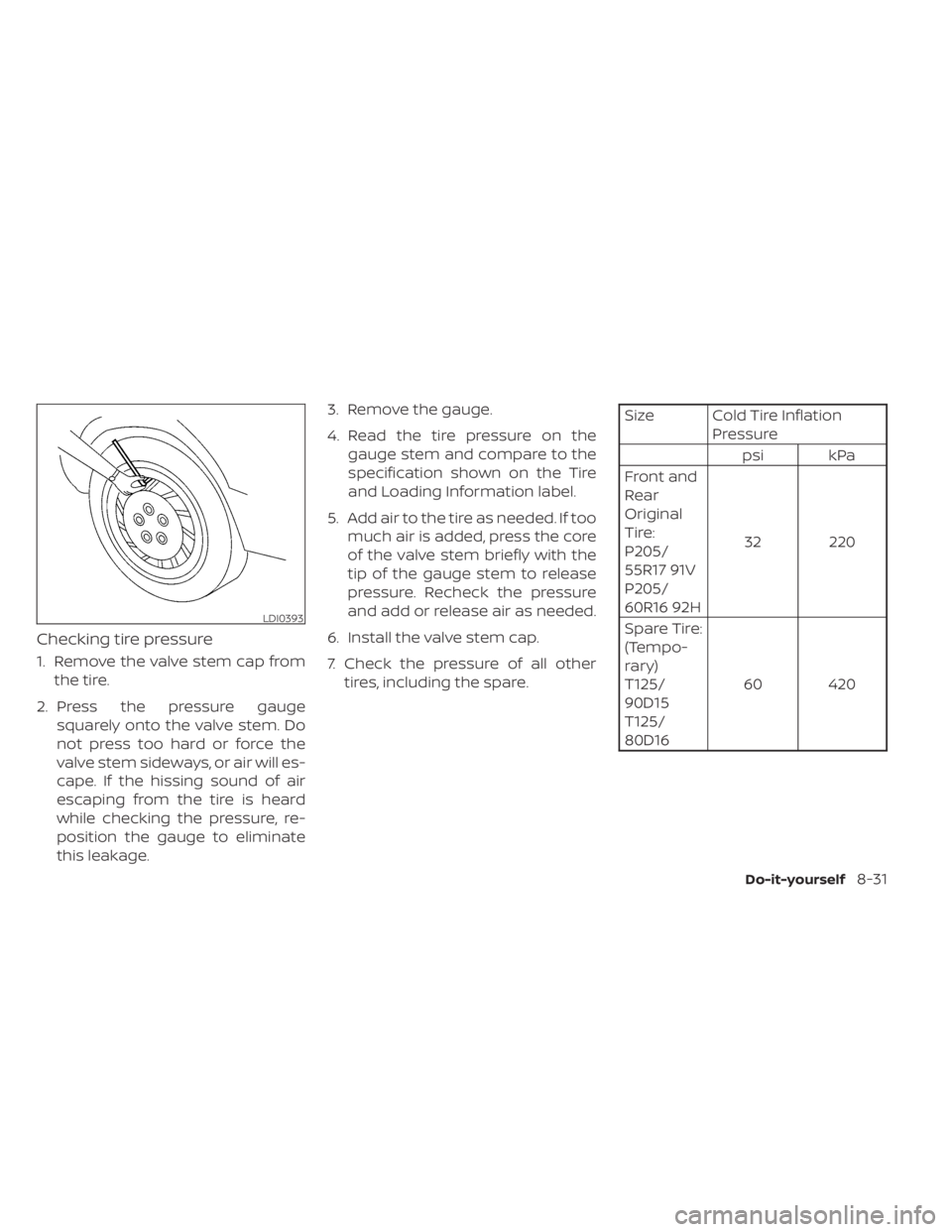
Checking tire pressure
1. Remove the valve stem cap fromthe tire.
2. Press the pressure gauge squarely onto the valve stem. Do
not press too hard or force the
valve stem sideways, or air will es-
cape. If the hissing sound of air
escaping from the tire is heard
while checking the pressure, re-
position the gauge to eliminate
this leakage. 3. Remove the gauge.
4. Read the tire pressure on the
gauge stem and compare to the
specification shown on the Tire
and Loading Information label.
5. Add air to the tire as needed. If too much air is added, press the core
of the valve stem briefly with the
tip of the gauge stem to release
pressure. Recheck the pressure
and add or release air as needed.
6. Install the valve stem cap.
7. Check the pressure of all other tires, including the spare.
Size Cold Tire Inflation Pressure
psi kPa
Front and
Rear
Original
Tire:
P205/
55R17 91V
P205/
60R16 92H 32 220
Spare Tire:
(Tempo-
rary)
T125/
90D15
T125/
80D16 60 420
LDI0393
Do-it-yourself8-31
Page 484 of 558
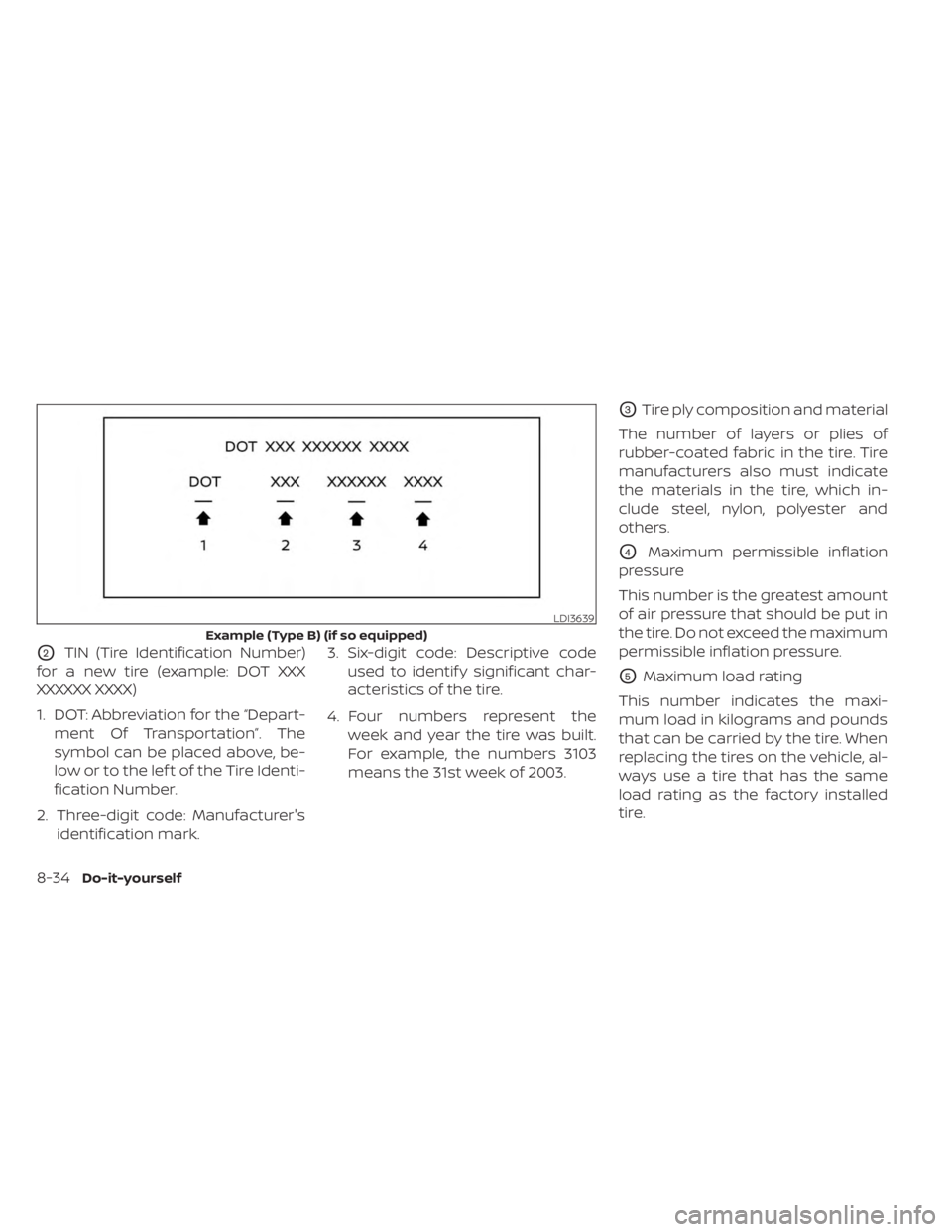
O2TIN (Tire Identification Number)
for a new tire (example: DOT XXX
XXXXXX XXXX)
1. DOT: Abbreviation for the “Depart- ment Of Transportation”. The
symbol can be placed above, be-
low or to the lef t of the Tire Identi-
fication Number.
2. Three-digit code: Manufacturer's identification mark. 3. Six-digit code: Descriptive code
used to identif y significant char-
acteristics of the tire.
4. Four numbers represent the week and year the tire was built.
For example, the numbers 3103
means the 31st week of 2003.
O3Tire ply composition and material
The number of layers or plies of
rubber-coated fabric in the tire. Tire
manufacturers also must indicate
the materials in the tire, which in-
clude steel, nylon, polyester and
others.
O4Maximum permissible inflation
pressure
This number is the greatest amount
of air pressure that should be put in
the tire. Do not exceed the maximum
permissible inflation pressure.
O5Maximum load rating
This number indicates the maxi-
mum load in kilograms and pounds
that can be carried by the tire. When
replacing the tires on the vehicle, al-
ways use a tire that has the same
load rating as the factory installed
tire.
LDI3639
Example (Type B) (if so equipped)
8-34Do-it-yourself
Page 490 of 558
Spare tire (TEMPORARY USE ONLY
spare tire)
When using a wheel without the TPMS such
as the spare tire, the TPMS will not function.
Observe the following precautions if the
TEMPORARY USE ONLY spare tire must be
used. Otherwise, your vehicle could be
damaged or involved in an accident:
WARNING
• The spare tire should be used for
emergency use only. It should be re-
placed with the standard tire at the
first opportunity to avoid possible
tire or differential damage.
• Drive carefully while the TEMPORARY
USE ONLY spare tire is installed. Avoid
sharp turns and abrupt braking while
driving.
• Periodically check spare tire inflation
pressure. Always keep the pressure
of the TEMPORARY USE ONLY spare
tire at 60 psi (420 kPa, 4.2 bar). •
With the TEMPORARY USE ONLY spare
tire installed do not drive the vehicle
at speeds faster than 50 mph (80
km/h).
• When driving on roads covered with
snow or ice, the TEMPORARY USE
ONLY spare tire should be used on the
rear wheels and the original tire used
on the front wheels (drive wheels).
• Tire tread of the TEMPORARY USE
ONLY spare tire will wear at a faster
rate than the standard tire. Replace
the spare tire as soon as the tread
wear indicators appear.
• Do not use the spare tire on other
vehicles.
• Do not use more than one spare tire
at the same time.
• Do not tow a trailer when the TEMPO-
RARY USE ONLY spare tire is installed.
CAUTION
• Do not use tire chains on a TEMPO-
RARY USE ONLY spare tire. Tire chains
will not fit properly and may cause
damage to the vehicle.
• Because the TEMPORARY USE ONLY
spare tire is smaller than the original
tire, ground clearance is reduced. To
avoid damage to the vehicle, do not
drive over obstacles. Also, do not
drive the vehicle through an auto-
matic car wash since it may get
caught.
8-40Do-it-yourself
Page 539 of 558
5. Determine the combined weightof luggage and cargo being
loaded on the vehicle. That weight
may not safely exceed the avail-
able cargo and luggage load ca-
pacity calculated in step 4.
6. If your vehicle will be towing a trailer, load from your trailer will be
transferred to your vehicle. Con-
sult this manual to determine
how this reduces the available
cargo and luggage load capacity
of your vehicle.
Towing a trailer with a vehicle that is
not intended for towing may result in
an accident involving injury or death.
WARNING
Do not tow a trailer with your vehicle.
Towing a trailer may result in an acci-
dent involving injury or death.
Before driving a loaded vehicle, con-
firm that you do not exceed the
(GVWR) or the (GAWR) for your ve-
hicle. For additional information, see
“Measurement of weights” (P. 10-19).
Also check tires for proper inflation
pressures. For additional informa-
tion, see “Tire and Loading Informa-
tion label” (P. 8-30).
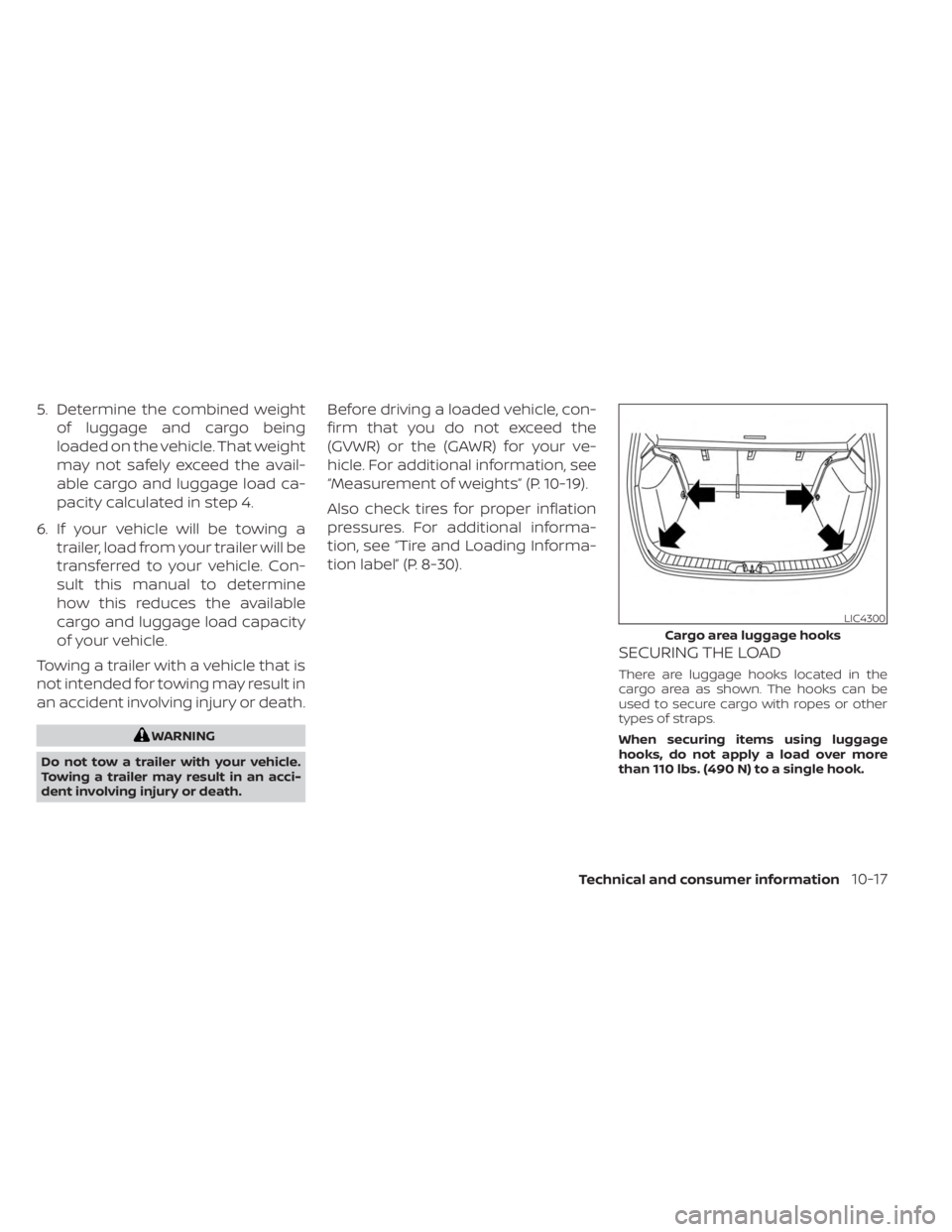
SECURING THE LOAD
There are luggage hooks located in the
cargo area as shown. The hooks can be
used to secure cargo with ropes or other
types of straps.
When securing items using luggage
hooks, do not apply a load over more
than 110 lbs. (490 N) to a single hook.
LIC4300
Cargo area luggage hooks
Technical and consumer information10-17