2023 LINCOLN AVIATOR park assist
[x] Cancel search: park assistPage 274 of 681

GENERAL INFORMATION
Note: Occasional brake noise is normal. If
a metal-to-metal, continuous grinding or
continuous squeal sound is present, the
brake linings may be worn. Have your
vehicle checked. If your vehicle has
continuous vibration or shudder in the
steering wheel when braking, have your
vehicle checked.
Note: Brake dust may accumulate on the
wheels, even under normal driving
conditions. Some dust is inevitable as the
brakes wear and does not contribute to
brake noise. Wet brakes result in reduced
braking efficiency. Gently press the brake
pedal a few times when driving from a car
wash or standing water to dry the brakes.
See Cleaning the Wheels (page 427).
Brake Over Accelerator
In the event the accelerator pedal becomes
stuck or entrapped, apply steady and firm
pressure to the brake pedal to slow the
vehicle and reduce engine power. If you
experience this condition, apply the brakes
and bring your vehicle to a safe stop. Move
the transmission to park (P), switch the
engine off and apply the parking brake.
Inspect the accelerator pedal for any
interference. If none are found and the
condition persists, have your vehicle
checked. If your vehicle has to be towed,
we recommend that you contact a
professional towing service.
Emergency Brake Assist
Emergency brake assist detects when you
brake heavily by measuring the rate at which
you press the brake pedal. It provides
maximum braking efficiency as long as you
press the pedal. Emergency brake assist
can reduce stopping distances in critical
situations.Note:Depending on applicable laws and
regulations in the country for which your
vehicle was originally built, your brake lamps
may flash during heavy braking. Following
this, your hazard lights may also flash when
your vehicle comes to a stop.
Anti-lock Brake System
This system helps you maintain steering
control during emergency stops by keeping
the brakes from locking.
This lamp illuminates momentarily
when you switch the ignition on to
confirm the lamp is functional.
If the warning lamp does not illuminate
during start up, remains on or flashes, the
system may be disabled. Have the system
checked. If the anti-lock brake system is
disabled, normal braking is still operational.
See Warning Lamps and Indicators (page
131).
Note:Indicators vary depending on region.
271
Brakes
Page 277 of 681

HILL START ASSIST
WARNING: The system does not
replace the parking brake. When you leave
your vehicle, always apply the parking
brake.
WARNING: You must remain in your
vehicle when the system turns on. At all
times, you are responsible for controlling
your vehicle, supervising the system and
intervening, if required. Failure to take care
may result in the loss of control of your
vehicle, serious personal injury or death.
WARNING: The system will turn off
if a malfunction is apparent or if you rev
the engine excessively. Failure to take care
may result in the loss of control of your
vehicle, serious personal injury or death.
The system makes it easier to pull away
when your vehicle is on a slope without the
need to use the parking brake.When the system is active, your vehicle
remains stationary on the slope for two to
three seconds after you release the brake
pedal. This allows time to move your foot
from the brake to the accelerator pedal. The
system releases the brakes automatically
once the engine has developed sufficient
torque to prevent your vehicle from rolling
down the slope. This is an advantage when
pulling away on a slope, for example from a
car park ramp, traffic lights or when reversing
uphill into a parking space.
The system activates on any slope that
causes your vehicle to roll.
Note:There is no warning light to indicate
the system is either on or off.
Using Hill Start Assist
1. Press the brake pedal to bring your
vehicle to a complete standstill. Keep the
brake pedal pressed and shift into first
gear when facing uphill or reverse (R)
when facing downhill.
2. If the sensors detect that your vehicle is
on a slope, the system activates
automatically.3. When you remove your foot from the
brake pedal, your vehicle remains on the
slope without rolling away for about two
to three seconds. This hold time
automatically extends if you are in the
process of driving off.
4. Drive off in the normal manner. The
system releases the brakes automatically.
Note:When you remove your foot from the
brake pedal and press the pedal again when
the system is active, you will experience
significantly reduced brake pedal travel. This
is normal.
Switching the System On and Off
Vehicles with Manual Transmission
You can switch this feature on or off in the
information display. The system remembers
the last setting when you start your vehicle.
Vehicles with Automatic Transmission
You cannot turn the system on or off. When
you switch the ignition on, the system
automatically turns on.
274
Brakes
Page 279 of 681

E197934
Illuminates when the system is
active. Your vehicle remains
stationary after you release the
brake pedal.
Illuminates when the system is on but
unavailable to hold your vehicle at a
standstill.
The system could be unavailable when any
of the following occur:
• During an active park assist maneuver.
• Your vehicle is in stay in neutral mode.
• The driver door is open.
• You shift into reverse (R) before the
system is active.
276
Brakes
Page 280 of 681

WHAT IS REVERSE BRAKING
ASSIST
E205199E205199
Reverse braking assist is designed to reduce
impact damage or assist in avoiding a
collision while in reverse (R). Using sensors
on the rear of the vehicle, it can detect a
possible collision and apply the brakes. If full
braking occurs, the system attempts to stop
the vehicle a safe distance from the obstacle.
HOW DOES REVERSE BRAKING
ASSIST WORK
Reverse braking assist functions when in
reverse (R) and traveling at a speed of
1–7 mph (2–12 km/h).If the system detects an obstacle behind your
vehicle, it provides a warning through the
rear parking aid or cross traffic alert system.
REVERSE BRAKING ASSIST
PRECAUTIONS
WARNING: You are responsible for
controlling your vehicle at all times. The
system is designed to be an aid and does
not relieve you of your responsibility to
drive with due care and attention. Failure
to follow this instruction could result in the
loss of control of your vehicle, personal
injury or death.
WARNING: To help avoid personal
injury, always use caution when in reverse
(R) and when using the sensing system.
WARNING: The system may not
operate properly during severe weather
conditions, for example snow, ice, heavy
rain and spray. Always drive with due care
and attention. Failure to take care may
result in a crash.
WARNING: Traffic control systems,
fluorescent lamps, inclement weather, air
brakes, external motors and fans may
affect the correct operation of the sensing
system. This may cause reduced
performance or false alerts.
WARNING: Some situations and
objects prevent hazard detection. For
example low or direct sunlight, inclement
weather, unconventional vehicle types, and
pedestrians. Apply the brakes when
necessary. Failure to follow this instruction
could result in the loss of control of your
vehicle, personal injury or death.
277
Reverse Braking Assist (If Equipped)
Page 281 of 681

WARNING: Do not use the system
with accessories that extend beyond the
front or rear of your vehicle, for example a
trailer hitch or bike rack. The system is not
able to make corrections for the additional
length of the accessories.
The system only applies the brakes for a
short period of time when an event occurs.
Act as soon as you notice the brakes apply
to remain in control of the vehicle. If you do
not intervene the vehicle may start to move
again.
Note:Certain add-on devices around the
bumper or fascia may create false alerts. For
example, large trailer hitches, bicycle or
surfboard racks, license plate brackets,
bumper covers or any other device that may
block the normal detection zone of the
system. Remove the add-on device to
prevent false alerts.
Note:The system does not react to small or
moving objects, particularly those close to
the ground.Note:The system does not operate during
hard acceleration or steering.
Note:If your vehicle sustains damage to the
bumper or fascia leaving it misaligned or
bent, it could alter the sensing zone causing
inaccurate measurement of obstacles or
false alerts.
Note:Vehicle loading and suspension
changes can impact the angle of the sensors
and may change the normal detection zone
of the system resulting in inaccurate
measurement of obstacles or false alerts.
Note:When you connect a trailer, the system
may detect the trailer and provide an alert,
or the system turns off. If the system does
not turn off, manually switch the system off
after you connect the trailer.
Note:You may experience reduced system
performance on road surfaces that limit
deceleration. For example, roads with ice,
loose gravel, mud or sand.
SWITCHING REVERSE BRAKING
ASSIST ON AND OFF
You can switch the system on or off through
the touchscreen. See Settings (page 555).
Note:The system is unavailable when rear
parking aid or cross traffic alert is off.
OVERRIDING REVERSE BRAKING
ASSIST
There could be instances when unexpected
or unwanted braking occurs. Firmly pressing
the accelerator pedal or switching the feature
off overrides the system.
REVERSE BRAKING ASSIST
INDICATORS
If the system determines that a collision with
an obstacle may occur, full braking may
apply.
E293490
A message and warning indicator
appear when the system applies
the brakes.
278
Reverse Braking Assist (If Equipped)
Page 282 of 681
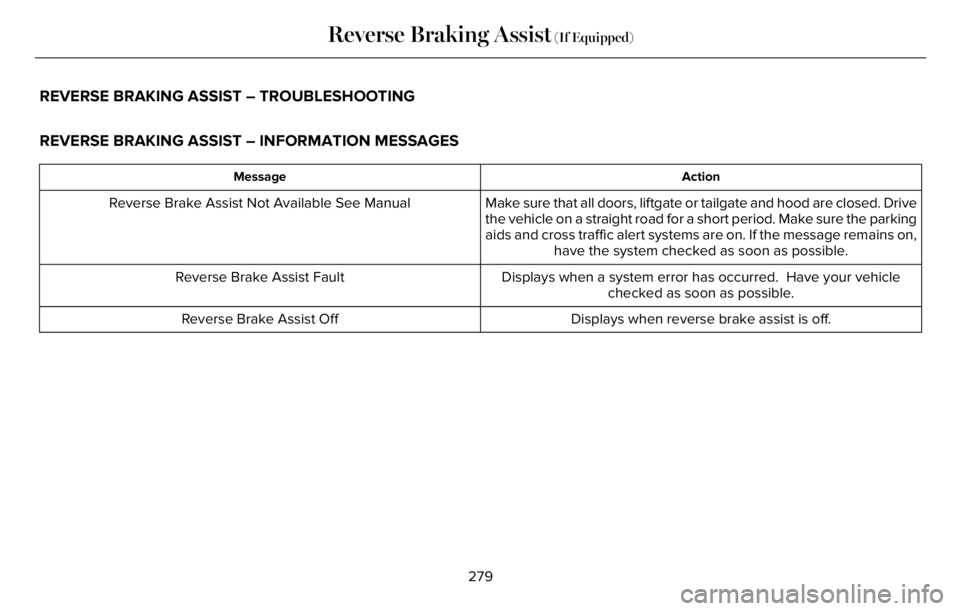
REVERSE BRAKING ASSIST – TROUBLESHOOTING
REVERSE BRAKING ASSIST – INFORMATION MESSAGES
Action Message
Make sure that all doors, liftgate or tailgate and hood are closed. Drive
the vehicle on a straight road for a short period. Make sure the parking
aids and cross traffic alert systems are on. If the message remains on,
have the system checked as soon as possible. Reverse Brake Assist Not Available See Manual
Displays when a system error has occurred. Have your vehicle
checked as soon as possible. Reverse Brake Assist Fault
Displays when reverse brake assist is off. Reverse Brake Assist Off
279
Reverse Braking Assist (If Equipped)
Page 283 of 681

REVERSE BRAKING ASSIST –
FREQUENTLY ASKED QUESTIONS
Why is reverse braking assist unavailable?
• Make sure you switch the system on.
See Switching Reverse Braking Assist
On and Off (page 278).
• Make sure that the liftgate, hood and all
doors are closed.
• Make sure the cross traffic alert system
is on. See Cross Traffic Alert (page 330).
• Make sure the rear parking aid system is
on. See Rear Parking Aid (page 286).
• Make sure traction control is on. See
Using Traction Control (page 281).
• The vehicle has sustained a rear end
impact. Have the sensors checked for
proper coverage and operation.
• An ABS, traction control or stability
control event may have occurred. The
system resumes operation when the
event is complete.• Make sure the rear view camera and 360
degree camera are not dirty or
obstructed. If it is dirty, clean the camera.
See Rear View Camera (page 297). See
360 Degree Camera (page 300). If the
message still appears after cleaning the
camera, wait a short time and the
message should clear. If the message
does not clear, have the system checked.
• Make sure the sensors are not blocked
or faulted. See Cross Traffic Alert (page
330). See Rear Parking Aid (page 286).
• You recently had your vehicle serviced,
or the battery disconnected. Drive your
vehicle a short distance to resume
system operation.
• The system does not function when you
connect a trailer. Operation resumes
when you disconnect the trailer.
Note:If the answers to why the system is
unavailable do not assist in returning reverse
braking assist to available, have the system
checked as soon as possible.
280
Reverse Braking Assist (If Equipped)
Page 287 of 681

WHAT IS HILL DESCENT CONTROL
WARNING: Hill descent control
cannot control descent in all surface
conditions and circumstances, such as ice
or extremely steep grades. Hill descent
control is a driver assist system and cannot
substitute for good judgment by the driver.
Failure to do so may result in loss of
vehicle control, crash or serious injury.
WARNING: The system does not
replace the parking brake. When you leave
your vehicle, always apply the parking
brake.
Note:The system does not function below
3 mph (5 km/h).
Hill descent control allows the driver to set
and maintain vehicle speed while
descending steep slopes in various surface
conditions.The system can maintain vehicle speeds on
downhill slopes between 3–20 mph
(5–32 km/h). Above 20 mph (32 km/h), the
system remains on but the descent speed
cannot be set or maintained.
The system requires a cool down interval
after a period of sustained use. The amount
of time that the system can remain active
before cooling varies with conditions. The
system provides a warning in the message
center and a tone sounds when the system
is about to disengage for cooling. At this
time, manually apply the brakes as needed
to maintain descent speed.
SWITCHING HILL DESCENT
CONTROL ON AND OFF
You can switch the hill descent control on
and off through the touchscreen.
SETTING THE HILL DESCENT
SPEED
WARNING: The system does not
replace the parking brake. When you leave
your vehicle, always apply the parking
brake.
WARNING: The system does not
control speed in low traction conditions or
extremely steep slopes. The system is
designed to be an aid and does not relieve
you of your responsibility to drive with due
care and attention. Failure to follow this
instruction could result in personal injury.
To increase the descent speed, press the
accelerator pedal until you reach the speed
you prefer.
To decrease the descent speed, press the
brake pedal until you reach the speed you
prefer.
284
Hill Descent Control (If Equipped)