2023 HYUNDAI IONIQ 5 drive mode
[x] Cancel search: drive modePage 12 of 680

01
1 -7
Electric Vehicle
An electric vehicle is driven using a
battery and an electric motor. While
general vehicles use an internal
combustion engine and gasoline as fuel,
electric vehicles use electrical energy
that is charged inside the high voltage
battery. As a result, electric vehicles are
eco-friendly in that they do not require
fuel and do not emit exhaust gases.
Characteristics of Electric
Vehicles
1. It is driven using the electrical energy that is charged inside the high voltage
battery. This method prevents air
pollution since fuel, like gasoline, is
not required, negating the emission of
exhaust gases.
2. A high performance motor is used in the vehicle as well. Compared to
standard, internal combustion engine
vehicles, engine noise and vibrations
are much more minimal when driving.
3. When decelerating or driving downhill, regenerative braking is
utilized to charge the high voltage
battery. This minimizes energy loss
and increases the distance to empty.
4. When the battery charge is not
sufficient, AC charge, DC charge and
trickle charge are available. (Refer to
“Charge Types for Electric Vehicle” for
details.)
Information
What does regenerative braking do?
It uses an electric motor when decelerating and braking and transforms kinetic
energy to electrical energy in order to
charge the high voltage battery. (Torque
is applied in the opposite direction when
decelerating to generate braking force and
electric energy.)
Battery Information
• The vehicle is composed of a high
voltage battery that drives the motor
and air-conditioner, and an auxiliary
battery (12 V) that drives the lamps,
wipers, and audio system.
• The auxiliary battery is automatically
charged when the vehicle is in the
ready (
) mode or the high
voltage battery is being charged.
eleCtriC VeHiCle
Page 13 of 680

Foreword / Electric Vehicle System Overview
1-8
main ComponentS oF eleCtriC VeHiCle
Main Components of Electric
Vehicle
• On-Board Charger (OBC) : A device
that charges the high voltage battery
by converting AC power of the power
grid to DC power.
• Inverter : Transforms direct current
into alternate current to supply power
to the motor, and transforms alternate
current into direct current to charge
the high voltage battery.
• LDC : Transforms power from the high
voltage battery to low voltage (12 V) to
supply power to the vehicle (DC-DC).
• VCU : Control the various controls on
the vehicle.
• Motor : Uses electrical energy stored
inside the high voltage battery to drive
the vehicle (functions like an engine in
a standard vehicle).
• Reduction gear : Delivers rotational
force of the motor to the tires at
appropriate speeds and torque.
• High voltage battery (lithium-ion
battery) : Stores and supplies power
necessary for the electric vehicle
to operate (12 V auxiliary battery
provides power to the vehicle features
such as lights and wipers).
à OBC : On-Board Charger
à LDC : Low Voltage DC-DC Converter
à VCU : Vehicle Control Unit
WARNING
• Do not intentionally remove
or disassemble high voltage
components and high voltage
battery connectors and wires. Also,
be careful not to damage high
voltage components and the high
voltage battery. It may cause serious
injury and significantly impact the
performance and durability of the
vehicle.
• When inspection and maintenance
is required for high voltage
components and the high voltage
battery, contact an authorized
HYUNDAI dealer.
High Voltage Battery
(lithium-ion battery)
• The charge amount of the high
voltage battery may gradually
decrease when the vehicle is not
being driven.
• The battery capacity of the high
voltage battery may decrease when
the vehicle is stored in high/low
temperatures.
• Distance to empty may vary depending on the driving conditions
(such as outside temperature), even
if the charge amount is the same.
The high voltage battery may expend
more energy when driving at high-
speed or uphill. These actions may
reduce the distance to empty.
• The high voltage battery is used when
using the air-conditioner / heater.
This may reduce the distance to
empty. Make sure to set moderate
temperatures when using the air-
conditioner/heater.
Page 27 of 680

Foreword / Electric Vehicle System Overview
1-22
Utility Mode
The high voltage battery is used instead
of the 12V auxiliary battery for operating
the convenient features of the vehicle.
When driving is not necessary such as
while camping or when stopping the
vehicle for a long time, it is possible to
use the electrical devices (audio, lights,
air conditioner, heater, etc.) for long
hours.
ONE1Q011032L
System Setting and Activation
System setting
The driver can activate the Utility mode
function when the following conditions
are satisfied. •
The vehicle is in the ready (
) mode and the gear is shifted
to P (Park).
• The EPB (Electronic Parking Brake) is
not a malfunction.
• ‘EV settings → Utility mode’ is selected on the infotainment system screen. System Activation
When the system is activated:•
The (
) indicator will turn off, and
the () indicator will illuminate on
the cluster and the EPB is applied.
• All electric devices are usable but the
vehicle cannot be driven.
• The EPB can be cancelled by pressing
the EPB switch.
Gear cannot be shifted out of P (Park).
If a shift attempt is made, a message
“Shifting conditions not met” will be
displayed on the infotainment system
screen.
System Deactivation
The Utility mode can be deactivated by
pressing the START/STOP button to the
OFF position. The function cannot be
deactivated from the EV settings.
Page 31 of 680

Foreword / Electric Vehicle System Overview
1-26
CHarging ConneCtor loCk
Locking Charging Cable
ONE1Q011092L
You may select when the charging
connector can be locked and unlocked in
the charging inlet.
Select ‘Settings → ECO Vehicle →
Charging Connector Locking Mode’ in
the infotainment. When the Charging Connector Is
Locked
Always
lock Lock
while
charging Do not
lock
Before
charging O X X
While
charging O O X
Finished
charging O X X
• ‘Always lock’ mode :
The connector locks when the
charging connector is plugged into
the charging inlet. The connector is
locked until all doors are unlocked by
the driver. This mode can be used to
prevent charging cable theft.
- If the charging connector is unlocked when all doors are
unlocked, but the charging cable
is not disconnected within 15 sec-
onds, the connector will be auto-
matically locked again.
- If the charging connector is unlocked when all doors are
unlocked, but all doors are locked
again, immediately, the connector
will be automatically locked again.
• ‘Lock while charging’ mode :
The connector locks when charg- ing
starts. The connector unlocks when
charging is complete. This mode can
be used when charging in a public
charging station.
• ‘Do not lock’ mode :
The connector unlocks regardless of
the state of charging.
Press the charging connector release
button, disconnect the connector.
Be careful to theft of the charging cable.
Page 56 of 680

01
1-51
Virtual Engine Sound System
The Virtual Engine Sound System
generates engine sound for pedestrians
to hear vehicle sound because there is
no sound while the Electric Vehicle (EV)
is operating. • If the vehicle is in the ready (
)
mode and the gear is not in P (Park),
the VESS will be operated.
• When the gear is shifted to R
(Reverse), an additional warning
sound will be heard.
CAUTION
• The vehicle is much quieter while
driving than a conventional gasoline-
powered vehicle. Be aware of your
surroundings and always drive safely.
• After you park the vehicle or while
you are waiting at a traffic light,
check whether there are children or
obstacles around the vehicle.
• Check if there is something behind
the vehicle when driving in reverse.
Pedestrians may not hear the sound
of the vehicle.
Distance to Empty
ONE1Q011049E
The distance to empty is displayed
differently according to the selected
drive mode in the Drive Mode Integrated
Control System.
For more information, refer to “Drive
Mode Integrated Control System” in
chapter 6.
When destination is not set • On average, a vehicle can drive about
199 miles (320 km) (Standard type) /
249 miles (400 km) (Extended type).
• Under certain circumstances where
the air conditioner/heater is ON,
the distance to empty is impacted,
resulting in a possible distance range
from 106 ~ 286 miles (170 ~ 460 km)
(Standard type) / 130 ~ 354 miles
(210 ~ 570 km) (Extended type).
When using the heater during cold
weather or driving at high speed, the
high voltage battery consumes a lot
more electricity. This may reduce the
distance to empty significantly.
• After ‘0 km’ has been displayed,
the vehicle can drive an additional
2~5 miles (3~8 km) depending on
driving speed, heater/air conditioner,
weather, driving style, and other
factors.
Page 57 of 680

Foreword / Electric Vehicle System Overview
1-52
•
Distance to empty that is displayed
on the instrument cluster after
completing a recharge may vary
significantly depending on previous
operating patterns.
When previous driving patterns
include high speed driving, resulting
in the high voltage battery using more
electricity than usual, the estimated
distance to empty is reduced. When
the high voltage battery uses little
electricity in ECO mode, the estimated
distance to empty increases.
• Distance to empty may depend on
many factors such as the charge
amount of the high voltage battery,
weather, temperature, durability of
the battery, geographical features,
and driving style.
• Natural degradation may occur with
the high voltage battery depending
on the number of years the vehicle is
used. This may reduce the distance to
empty.
When destination is set
When the destination is set, the distance
to empty may change. The distance
to empty is recalculated using the
information of the destination. However,
the distance to empty may vary
significantly based on traffic conditions,
driving habits, and condition of the
vehicle.
Tips for Improving Distance to
Empty
• If you operate the air conditioner /
heater too much, the driving battery
uses too much electricity. This
may reduce the distance to empty.
Therefore, it is recommended that
you set the cabin temperature to
22°C AUTO. This setting that has
been certified by various assessment
tests to maintain optimal energy
consumption rates while keeping the
temperature fresh.
Turn OFF the heater and air
conditioner if you do not need them.
• When the heater or air conditioning
system is on the energy consumption
is reduced if recirculation mode is
selected instead of selecting the fresh
mode. The fresh mode requires large
amount of energy consumption as
the outside air has to be re-heated or cooled.
• When using the heater or air
conditioning system use the DRIVER
ONLY or scheduled air conditioner/
heater function.
• Depress and hold the accelerator
pedal to maintain speed and drive
economically.
• Gradually depress and release the
accelerator pedal when accelerating
or decelerating.
• Always maintain specified tire
pressures.
• Do not use unnecessary electrical
components while driving.
• Do not load unnecessary items in the
vehicle.
• Do not mount parts that may increase
air resistance.
Page 60 of 680
01
1-55
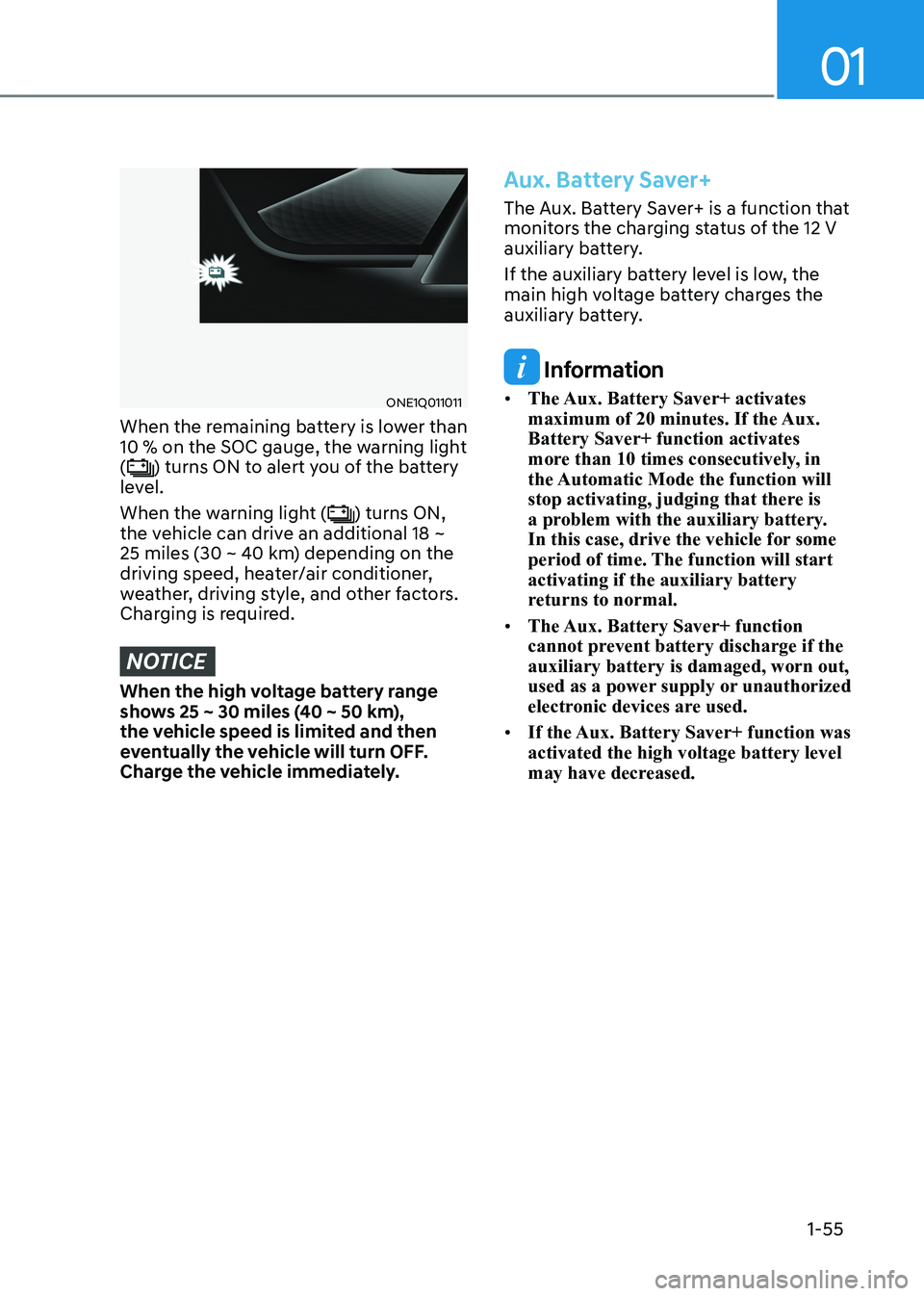
ONE1Q011011
When the remaining battery is lower than
10 % on the SOC gauge, the warning light (
) turns ON to alert you of the battery
level.
When the warning light (
) turns ON,
the vehicle can drive an additional 18 ~
25 miles (30 ~ 40 km) depending on the
driving speed, heater/air conditioner,
weather, driving style, and other factors.
Charging is required.
NOTICE
When the high voltage battery range
shows 25 ~ 30 miles (40 ~ 50 km),
the vehicle speed is limited and then
eventually the vehicle will turn OFF.
Charge the vehicle immediately.
Aux. Battery Saver+
The Aux. Battery Saver+ is a function that
monitors the charging status of the 12 V
auxiliary battery.
If the auxiliary battery level is low, the
main high voltage battery charges the
auxiliary battery.
Information
• The Aux. Battery Saver+ activates
maximum of 20 minutes. If the Aux. Battery Saver+ function activates
more than 10 times consecutively, in
the Automatic Mode the function will
stop activating, judging that there is
a problem with the auxiliary battery.
In this case, drive the vehicle for some
period of time. The function will start activating if the auxiliary battery
returns to normal.
• The Aux. Battery Saver+ function
cannot prevent battery discharge if the auxiliary battery is damaged, worn out,
used as a power supply or unauthorized
electronic devices are used.
• If the Aux. Battery Saver+ function was activated the high voltage battery level
may have decreased.
Page 76 of 680

2-6
Vehicle Information, Consumer Information and Reporting Safety DefectsinstrumEnt panEl ovErviEw (ii)
The actual shape may differ from the illustration.
ONE1011005
1. Lighting control lever ...........................5-88
2. Wiper and washer control lever........... 5-99
3. Rotary shifter(Rotary gear shift dial) .....6-9
4. Paddle shifter ......................................... 6-16
5. Voice recognition button ....................5-137
6. Steering wheel audio controls ............5-135 7.
Bluetooth wireless technology hands-free
button ................................................... 5-137
8. LCD display control ..............................4-29
9. Lane Driving Assist button ...........7-27, 7-97
10. Driving Assist button ..............................7-7 1
11. Vehicle Distance button .........................7-7 1
12. Drive mode button ...............................6-47