2023 HYUNDAI I30 trailer
[x] Cancel search: trailerPage 404 of 533
5-139
Driving your vehicle
5
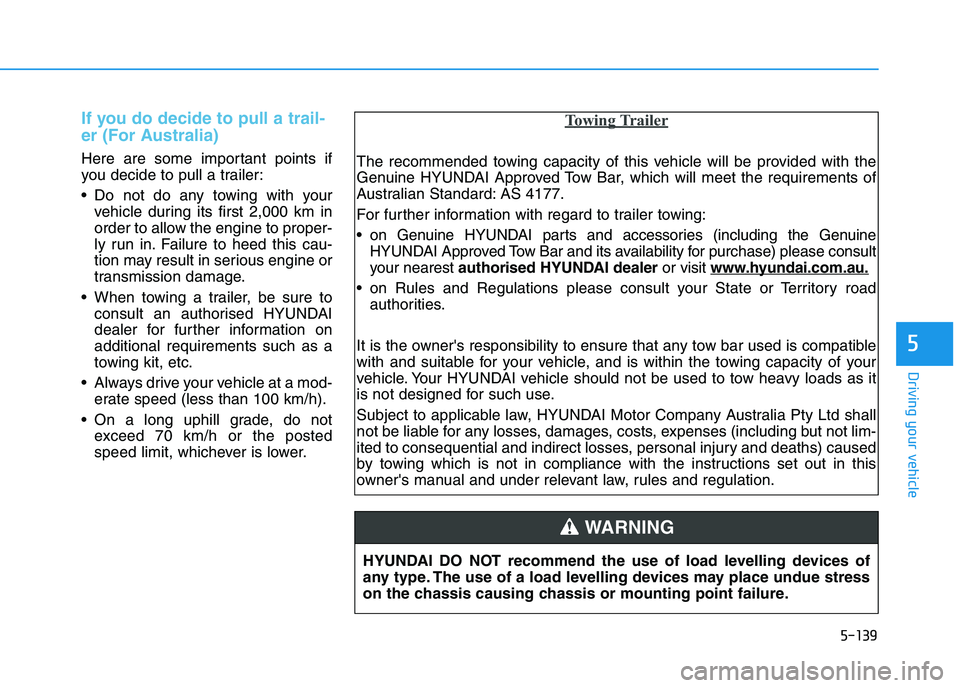
If you do decide to pull a trail-
er (For Australia)
Here are some important points if
you decide to pull a trailer:
Do not do any towing with your
vehicle during its first 2,000 km in
order to allow the engine to proper-
ly run in. Failure to heed this cau-
tion may result in serious engine or
transmission damage.
When towing a trailer, be sure to
consult an authorised HYUNDAI
dealer for further information on
additional requirements such as a
towing kit, etc.
Always drive your vehicle at a mod-
erate speed (less than 100 km/h).
On a long uphill grade, do not
exceed 70 km/h or the posted
speed limit, whichever is lower.
Towing Trailer
The recommended towing capacity of this vehicle will be provided with the
Genuine HYUNDAI Approved Tow Bar, which will meet the requirements of
Australian Standard: AS 4177.
For further information with regard to trailer towing:
on Genuine HYUNDAI parts and accessories (including the Genuine
HYUNDAI Approved Tow Bar and its availability for purchase) please consult
your nearest authorised HYUNDAI dealeror visit www
.hyundai.com.au.
on Rules and Regulations please consult your State or Territory road
authorities.
It is the owner's responsibility to ensure that any tow bar used is compatible
with and suitable for your vehicle, and is within the towing capacity of your
vehicle. Your HYUNDAI vehicle should not be used to tow heavy loads as it
is not designed for such use.
Subject to applicable law, HYUNDAI Motor Company Australia Pty Ltd shall
not be liable for any losses, damages, costs, expenses (including but not lim-
ited to consequential and indirect losses, personal injury and deaths) caused
by towing which is not in compliance with the instructions set out in this
owner's manual and under relevant law, rules and regulation.
HYUNDAI DO NOT recommend the use of load levelling devices of
any type. The use of a load levelling devices may place undue stress
on the chassis causing chassis or mounting point failure.
WARNING
Page 405 of 533
5-140
Driving your vehicle
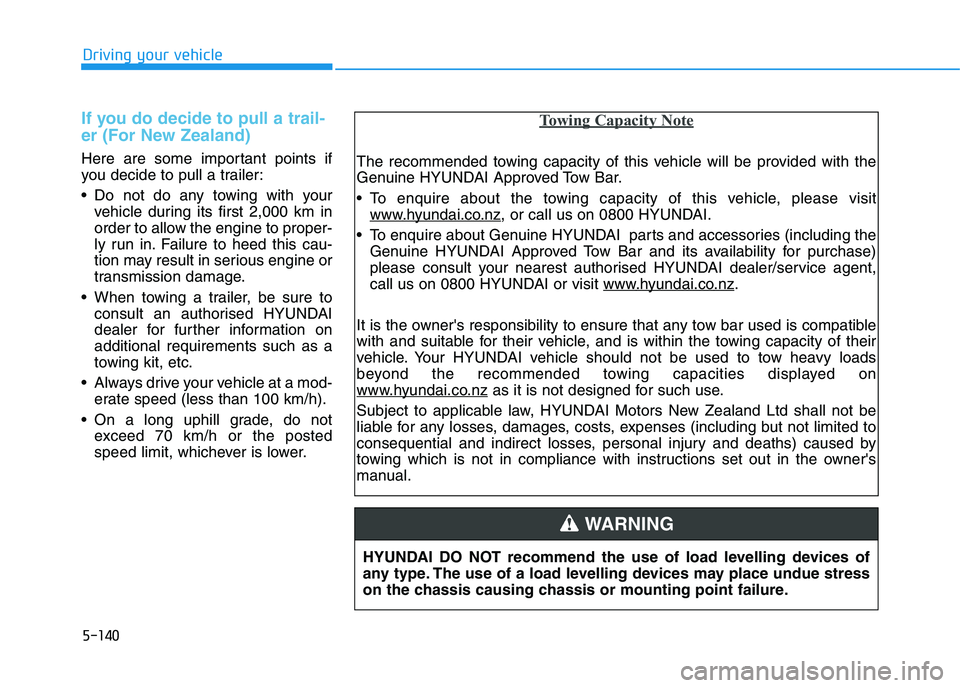
If you do decide to pull a trail-
er (For New Zealand)
Here are some important points if
you decide to pull a trailer:
Do not do any towing with your
vehicle during its first 2,000 km in
order to allow the engine to proper-
ly run in. Failure to heed this cau-
tion may result in serious engine or
transmission damage.
When towing a trailer, be sure to
consult an authorised HYUNDAI
dealer for further information on
additional requirements such as a
towing kit, etc.
Always drive your vehicle at a mod-
erate speed (less than 100 km/h).
On a long uphill grade, do not
exceed 70 km/h or the posted
speed limit, whichever is lower.
Towing Capacity Note
The recommended towing capacity of this vehicle will be provided with the
Genuine HYUNDAI Approved Tow Bar.
To enquire about the towing capacity of this vehicle, please visit
www
.hyundai.co.nz, or call us on 0800 HYUNDAI.
To enquire about Genuine HYUNDAI parts and accessories (including the
Genuine HYUNDAI Approved Tow Bar and its availability for purchase)
please consult your nearest authorised HYUNDAI dealer/service agent,
call us on 0800 HYUNDAI or visit www
.hyundai.co.nz.
It is the owner's responsibility to ensure that any tow bar used is compatible
with and suitable for their vehicle, and is within the towing capacity of their
vehicle. Your HYUNDAI vehicle should not be used to tow heavy loads
beyond the recommended towing capacities displayed on
www
.hyundai.co.nzas it is not designed for such use.
Subject to applicable law, HYUNDAI Motors New Zealand Ltd shall not be
liable for any losses, damages, costs, expenses (including but not limited to
consequential and indirect losses, personal injury and deaths) caused by
towing which is not in compliance with instructions set out in the owner's
manual.
HYUNDAI DO NOT recommend the use of load levelling devices of
any type. The use of a load levelling devices may place undue stress
on the chassis causing chassis or mounting point failure.
WARNING
Page 426 of 533
6-20
What to do in an emergency
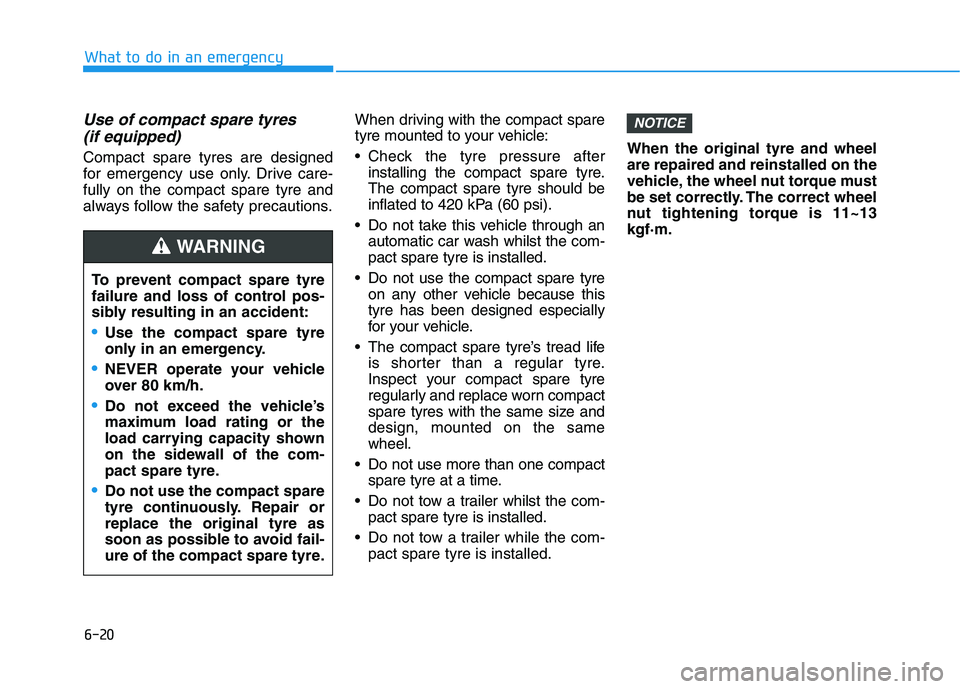
Use of compact spare tyres
(if equipped)
Compact spare tyres are designed
for emergency use only. Drive care-
fully on the compact spare tyre and
always follow the safety precautions.When driving with the compact spare
tyre mounted to your vehicle:
Check the tyre pressure after
installing the compact spare tyre.
The compact spare tyre should be
inflated to 420 kPa (60 psi).
Do not take this vehicle through an
automatic car wash whilst the com-
pact spare tyre is installed.
Do not use the compact spare tyre
on any other vehicle because this
tyre has been designed especially
for your vehicle.
The compact spare tyre’s tread life
is shorter than a regular tyre.
Inspect your compact spare tyre
regularly and replace worn compact
spare tyres with the same size and
design, mounted on the same
wheel.
Do not use more than one compact
spare tyre at a time.
Do not tow a trailer whilst the com-
pact spare tyre is installed.
Do not tow a trailer while the com-
pact spare tyre is installed.When the original tyre and wheel
are repaired and reinstalled on the
vehicle, the wheel nut torque must
be set correctly. The correct wheel
nut tightening torque is 11~13
kgf·m.
NOTICE
To prevent compact spare tyre
failure and loss of control pos-
sibly resulting in an accident:
Use the compact spare tyre
only in an emergency.
NEVER operate your vehicle
over 80 km/h.
Do not exceed the vehicle’s
maximum load rating or the
load carrying capacity shown
on the sidewall of the com-
pact spare tyre.
Do not use the compact spare
tyre continuously. Repair or
replace the original tyre as
soon as possible to avoid fail-
ure of the compact spare tyre.
WARNING
Page 440 of 533
7-9
7
Maintenance
S SC
CH
HE
ED
DU
UL
LE
ED
D
M
MA
AI
IN
NT
TE
EN
NA
AN
NC
CE
E
S
SE
ER
RV
VI
IC
CE
ES
S
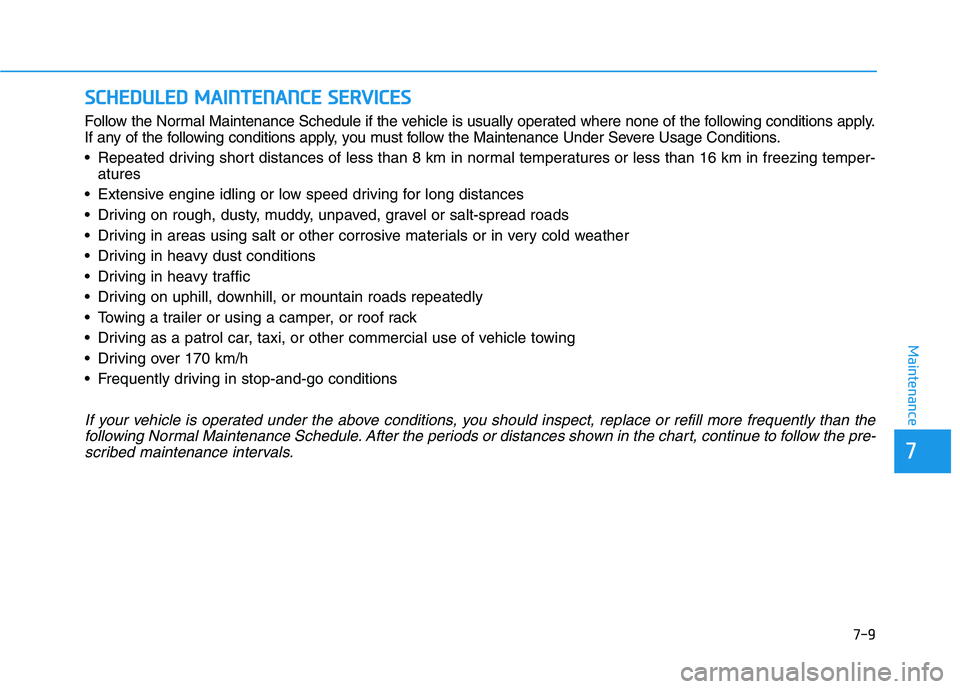
Follow the Normal Maintenance Schedule if the vehicle is usually operated where none of the following conditions apply.
If any of the following conditions apply, you must follow the Maintenance Under Severe Usage Conditions.
Repeated driving short distances of less than 8 km in normal temperatures or less than 16 km in freezing temper-
atures
Extensive engine idling or low speed driving for long distances
Driving on rough, dusty, muddy, unpaved, gravel or salt-spread roads
Driving in areas using salt or other corrosive materials or in very cold weather
Driving in heavy dust conditions
Driving in heavy traffic
Driving on uphill, downhill, or mountain roads repeatedly
Towing a trailer or using a camper, or roof rack
Driving as a patrol car, taxi, or other commercial use of vehicle towing
Driving over 170 km/h
Frequently driving in stop-and-go conditions
If your vehicle is operated under the above conditions, you should inspect, replace or refill more frequently than the
following Normal Maintenance Schedule. After the periods or distances shown in the chart, continue to follow the pre-
scribed maintenance intervals.
Page 445 of 533
Maintenance
7-14
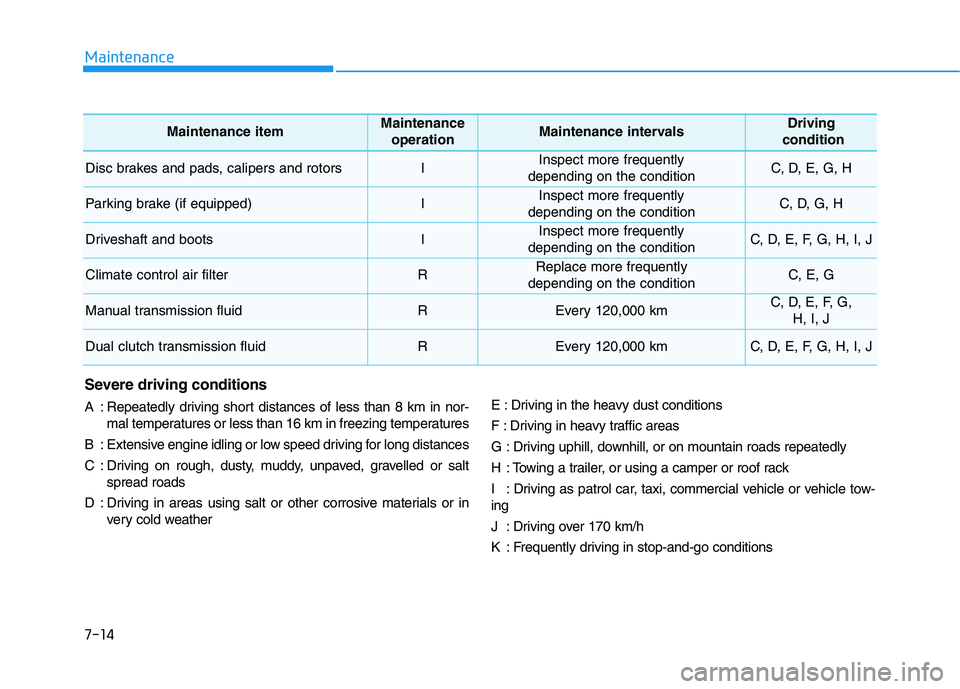
Maintenance itemMaintenance
operationMaintenance intervalsDriving
condition
Disc brakes and pads, calipers and rotorsIInspect more frequently
depending on the conditionC, D, E, G, H
Parking brake (if equipped)IInspect more frequently
depending on the conditionC, D, G, H
Driveshaft and bootsIInspect more frequently
depending on the conditionC, D, E, F, G, H, I, J
Climate control air filterRReplace more frequently
depending on the conditionC, E, G
Manual transmission fluidREvery 120,000 kmC, D, E, F, G,
H, I, J
Dual clutch transmission fluidREvery 120,000 kmC, D, E, F, G, H, I, J
Severe driving conditions
A : Repeatedly driving short distances of less than 8 km in nor-
mal temperatures or less than 16 km in freezing temperatures
B : Extensive engine idling or low speed driving for long distances
C : Driving on rough, dusty, muddy, unpaved, gravelled or salt
spread roads
D : Driving in areas using salt or other corrosive materials or in
very cold weatherE : Driving in the heavy dust conditions
F : Driving in heavy traffic areas
G : Driving uphill, downhill, or on mountain roads repeatedly
H : Towing a trailer, or using a camper or roof rack
I : Driving as patrol car, taxi, commercial vehicle or vehicle tow-
ing
J : Driving over 170 km/h
K : Frequently driving in stop-and-go conditions
Page 450 of 533
7-19
7
Maintenance
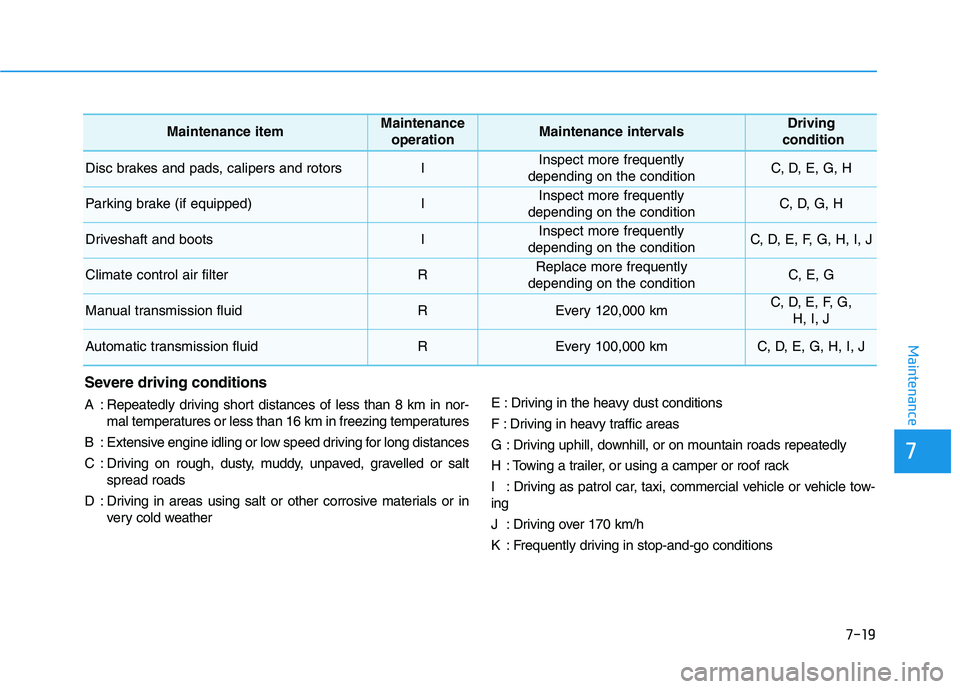
Maintenance itemMaintenance
operationMaintenance intervalsDriving
condition
Disc brakes and pads, calipers and rotorsIInspect more frequently
depending on the conditionC, D, E, G, H
Parking brake (if equipped)IInspect more frequently
depending on the conditionC, D, G, H
Driveshaft and bootsIInspect more frequently
depending on the conditionC, D, E, F, G, H, I, J
Climate control air filterRReplace more frequently
depending on the conditionC, E, G
Manual transmission fluidREvery 120,000 kmC, D, E, F, G,
H, I, J
Automatic transmission fluidREvery 100,000 kmC, D, E, G, H, I, J
Severe driving conditions
A : Repeatedly driving short distances of less than 8 km in nor-
mal temperatures or less than 16 km in freezing temperatures
B : Extensive engine idling or low speed driving for long distances
C : Driving on rough, dusty, muddy, unpaved, gravelled or salt
spread roads
D : Driving in areas using salt or other corrosive materials or in
very cold weatherE : Driving in the heavy dust conditions
F : Driving in heavy traffic areas
G : Driving uphill, downhill, or on mountain roads repeatedly
H : Towing a trailer, or using a camper or roof rack
I : Driving as patrol car, taxi, commercial vehicle or vehicle tow-
ing
J : Driving over 170 km/h
K : Frequently driving in stop-and-go conditions
Page 455 of 533
Maintenance
7-24
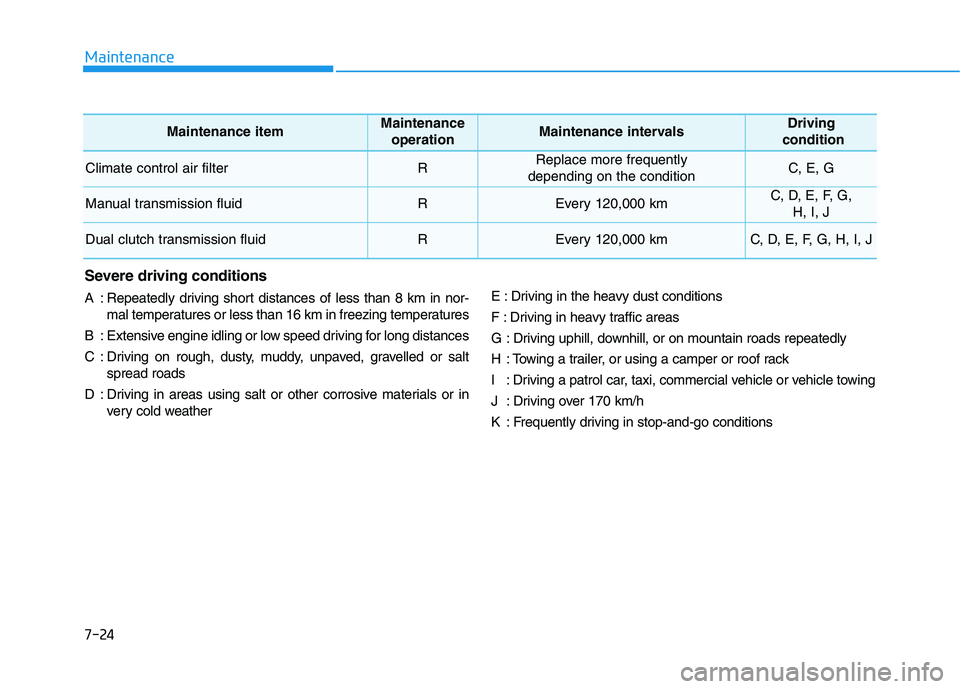
Maintenance itemMaintenance
operationMaintenance intervalsDriving
condition
Climate control air filter RReplace more frequently
depending on the conditionC, E, G
Manual transmission fluidREvery 120,000 kmC, D, E, F, G,
H, I, J
Dual clutch transmission fluidREvery 120,000 kmC, D, E, F, G, H, I, J
Severe driving conditions
A : Repeatedly driving short distances of less than 8 km in nor-
mal temperatures or less than 16 km in freezing temperatures
B : Extensive engine idling or low speed driving for long distances
C : Driving on rough, dusty, muddy, unpaved, gravelled or salt
spread roads
D : Driving in areas using salt or other corrosive materials or in
very cold weatherE : Driving in the heavy dust conditions
F : Driving in heavy traffic areas
G : Driving uphill, downhill, or on mountain roads repeatedly
H : Towing a trailer, or using a camper or roof rack
I : Driving a patrol car, taxi, commercial vehicle or vehicle towing
J : Driving over 170 km/h
K : Frequently driving in stop-and-go conditions