Page 228 of 533
4-3
Multimedia System
4
Antenna
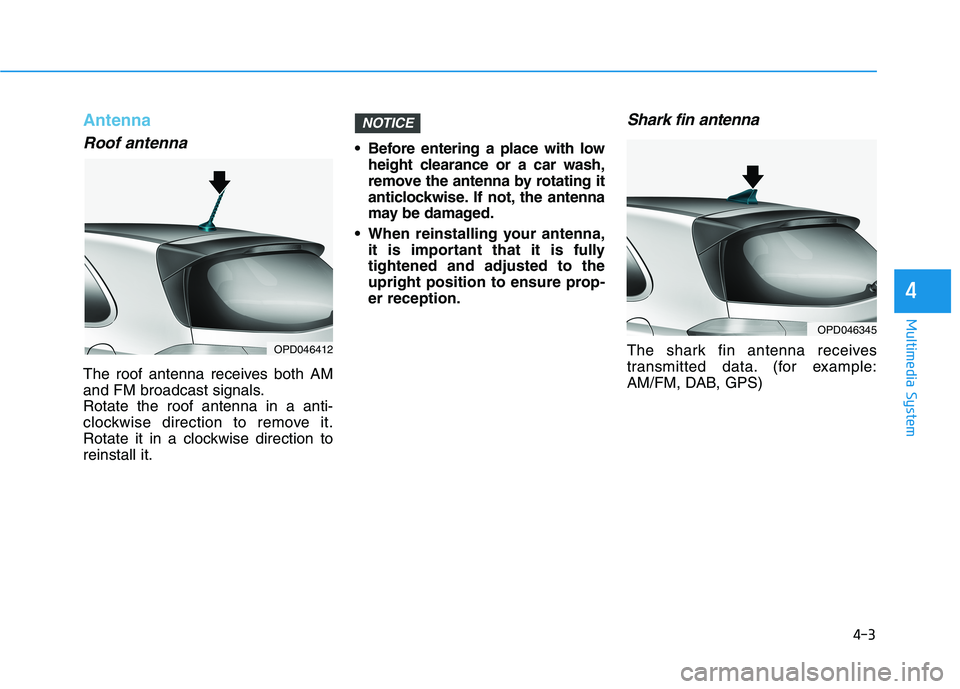
Roof antenna
The roof antenna receives both AM
and FM broadcast signals.
Rotate the roof antenna in a anti-
clockwise direction to remove it.
Rotate it in a clockwise direction to
reinstall it. Before entering a place with low
height clearance or a car wash,
remove the antenna by rotating it
anticlockwise. If not, the antenna
may be damaged.
When reinstalling your antenna,
it is important that it is fully
tightened and adjusted to the
upright position to ensure prop-
er reception.
Shark fin antenna
The shark fin antenna receives
transmitted data. (for example:
AM/FM, DAB, GPS)
NOTICE
OPD046412
OPD046345
Page 391 of 533
5-126
Driving your vehicle
Reducing the risk of a rollover
Your multi-purpose passenger vehi-
cle is defined as a Sports Utility
Vehicle (SUV). SUV’s have higher
ground clearance and a narrower
track to make them capable of per-
forming in a wide variety of off-road
applications. The specific design
characteristics give them a higher
centre of gravity than ordinary vehi-
cles making them more likely to roll
over if you make abrupt turns. Utility
vehicles have a significantly higher
rollover rate than other types of vehi-
cles. Due to this risk, driver and pas-
sengers are strongly recommended
to buckle their seat belts. In a rollover
crash, an unrestrained person is sig-
nificantly more likely to die than a
person wearing a seat belt.
There are steps that a driver can
make to reduce the risk of a rollover.
If at all possible, avoid sharp turns or
abrupt manoeuvres, do not load your
vehicle with heavy luggage on the
roof, and never modify your vehicle in
any way.Utility vehicles have a signifi-
cantly higher rollover rate than
other types of vehicles. To pre-
vent rollovers or loss of control:
Take corners at slower speeds
than you would with a passen-
ger vehicle.
Avoid sharp turns and abrupt
manoeuvres.
Do not modify your vehicle in
any way that you would raise
the centre of gravity.
Keep tyres properly inflated.
Do not carry heavy luggage
on the roof.
WARNING
In a rollover crash, an unre-
strained person is significantly
more likely to die than a person
wearing a seat belt. Make sure
all passengers are wearing their
seat belts.
WARNING
Page 440 of 533
7-9
7
Maintenance
S SC
CH
HE
ED
DU
UL
LE
ED
D
M
MA
AI
IN
NT
TE
EN
NA
AN
NC
CE
E
S
SE
ER
RV
VI
IC
CE
ES
S
Follow the Normal Maintenance Schedule if the vehicle is usually operated where none of the following conditions apply.
If any of the following conditions apply, you must follow the Maintenance Under Severe Usage Conditions.
Repeated driving short distances of less than 8 km in normal temperatures or less than 16 km in freezing temper-
atures
Extensive engine idling or low speed driving for long distances
Driving on rough, dusty, muddy, unpaved, gravel or salt-spread roads
Driving in areas using salt or other corrosive materials or in very cold weather
Driving in heavy dust conditions
Driving in heavy traffic
Driving on uphill, downhill, or mountain roads repeatedly
Towing a trailer or using a camper, or roof rack
Driving as a patrol car, taxi, or other commercial use of vehicle towing
Driving over 170 km/h
Frequently driving in stop-and-go conditions
If your vehicle is operated under the above conditions, you should inspect, replace or refill more frequently than the
following Normal Maintenance Schedule. After the periods or distances shown in the chart, continue to follow the pre-
scribed maintenance intervals.
Page 445 of 533
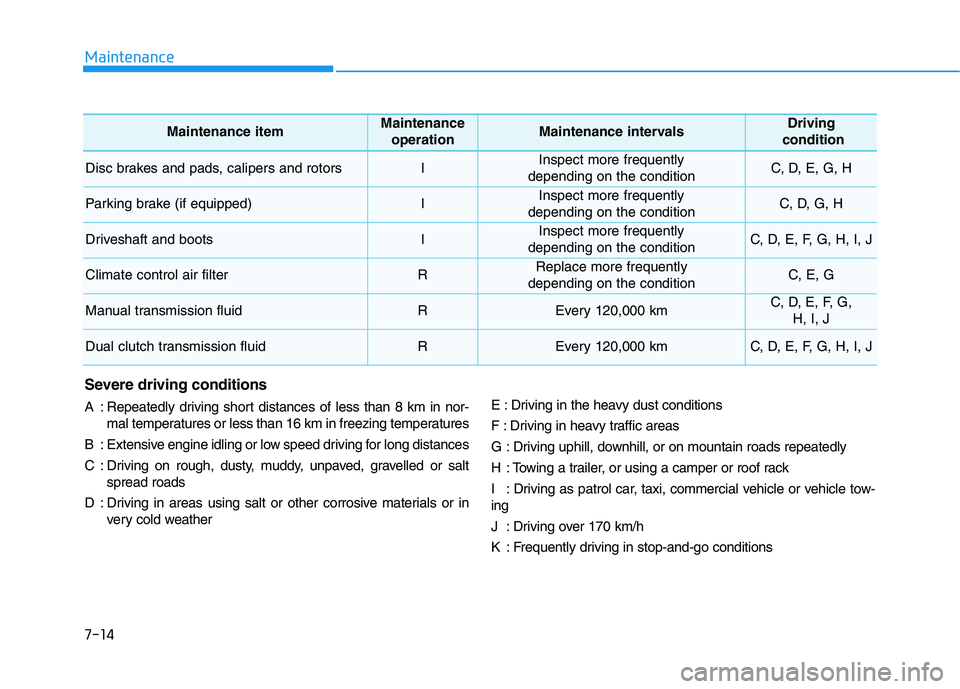
Maintenance
7-14
Maintenance itemMaintenance
operationMaintenance intervalsDriving
condition
Disc brakes and pads, calipers and rotorsIInspect more frequently
depending on the conditionC, D, E, G, H
Parking brake (if equipped)IInspect more frequently
depending on the conditionC, D, G, H
Driveshaft and bootsIInspect more frequently
depending on the conditionC, D, E, F, G, H, I, J
Climate control air filterRReplace more frequently
depending on the conditionC, E, G
Manual transmission fluidREvery 120,000 kmC, D, E, F, G,
H, I, J
Dual clutch transmission fluidREvery 120,000 kmC, D, E, F, G, H, I, J
Severe driving conditions
A : Repeatedly driving short distances of less than 8 km in nor-
mal temperatures or less than 16 km in freezing temperatures
B : Extensive engine idling or low speed driving for long distances
C : Driving on rough, dusty, muddy, unpaved, gravelled or salt
spread roads
D : Driving in areas using salt or other corrosive materials or in
very cold weatherE : Driving in the heavy dust conditions
F : Driving in heavy traffic areas
G : Driving uphill, downhill, or on mountain roads repeatedly
H : Towing a trailer, or using a camper or roof rack
I : Driving as patrol car, taxi, commercial vehicle or vehicle tow-
ing
J : Driving over 170 km/h
K : Frequently driving in stop-and-go conditions
Page 450 of 533
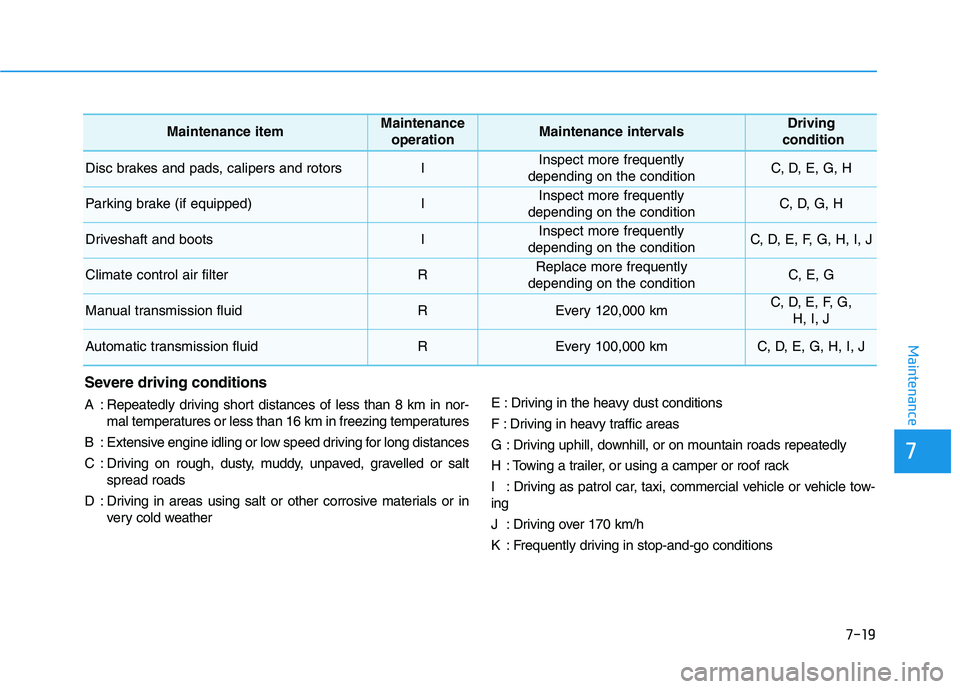
7-19
7
Maintenance
Maintenance itemMaintenance
operationMaintenance intervalsDriving
condition
Disc brakes and pads, calipers and rotorsIInspect more frequently
depending on the conditionC, D, E, G, H
Parking brake (if equipped)IInspect more frequently
depending on the conditionC, D, G, H
Driveshaft and bootsIInspect more frequently
depending on the conditionC, D, E, F, G, H, I, J
Climate control air filterRReplace more frequently
depending on the conditionC, E, G
Manual transmission fluidREvery 120,000 kmC, D, E, F, G,
H, I, J
Automatic transmission fluidREvery 100,000 kmC, D, E, G, H, I, J
Severe driving conditions
A : Repeatedly driving short distances of less than 8 km in nor-
mal temperatures or less than 16 km in freezing temperatures
B : Extensive engine idling or low speed driving for long distances
C : Driving on rough, dusty, muddy, unpaved, gravelled or salt
spread roads
D : Driving in areas using salt or other corrosive materials or in
very cold weatherE : Driving in the heavy dust conditions
F : Driving in heavy traffic areas
G : Driving uphill, downhill, or on mountain roads repeatedly
H : Towing a trailer, or using a camper or roof rack
I : Driving as patrol car, taxi, commercial vehicle or vehicle tow-
ing
J : Driving over 170 km/h
K : Frequently driving in stop-and-go conditions
Page 455 of 533
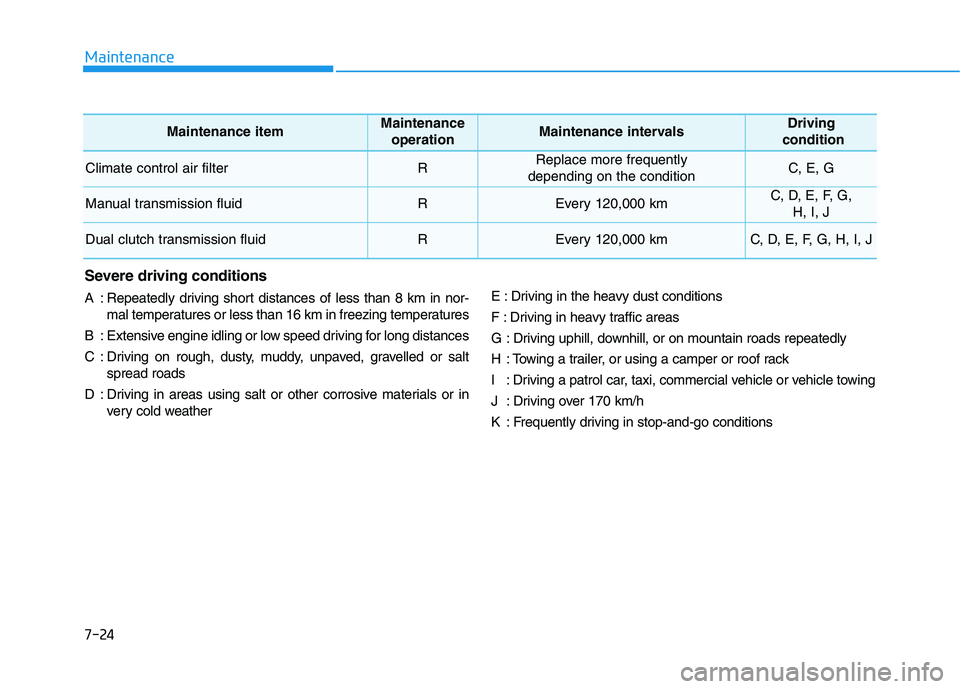
Maintenance
7-24
Maintenance itemMaintenance
operationMaintenance intervalsDriving
condition
Climate control air filter RReplace more frequently
depending on the conditionC, E, G
Manual transmission fluidREvery 120,000 kmC, D, E, F, G,
H, I, J
Dual clutch transmission fluidREvery 120,000 kmC, D, E, F, G, H, I, J
Severe driving conditions
A : Repeatedly driving short distances of less than 8 km in nor-
mal temperatures or less than 16 km in freezing temperatures
B : Extensive engine idling or low speed driving for long distances
C : Driving on rough, dusty, muddy, unpaved, gravelled or salt
spread roads
D : Driving in areas using salt or other corrosive materials or in
very cold weatherE : Driving in the heavy dust conditions
F : Driving in heavy traffic areas
G : Driving uphill, downhill, or on mountain roads repeatedly
H : Towing a trailer, or using a camper or roof rack
I : Driving a patrol car, taxi, commercial vehicle or vehicle towing
J : Driving over 170 km/h
K : Frequently driving in stop-and-go conditions
Page 477 of 533
7-46
Maintenance
By jump starting
After a jump start from a good bat-
tery, drive the vehicle for 20-30 min-
utes before it is shutoff. The vehicle
may not restart if you shut it off
before the battery had a chance to
adequately recharge. See “Jump
Starting” in chapter 6 for more infor-
mation on jump starting procedures.
Information
An inappropriately disposed
battery can be harmful to
the environment and human
health. Dispose of the bat-
tery according to your local
law(s) or regulation.
Reset items
The following items may need to be
reset after the battery has been dis-
charged or the battery has been dis-
connected.
Auto up/down window
Sunroof
Trip computer
Climate control system
Clock
Audio system
i
Page 506 of 533
7-75
7
Maintenance
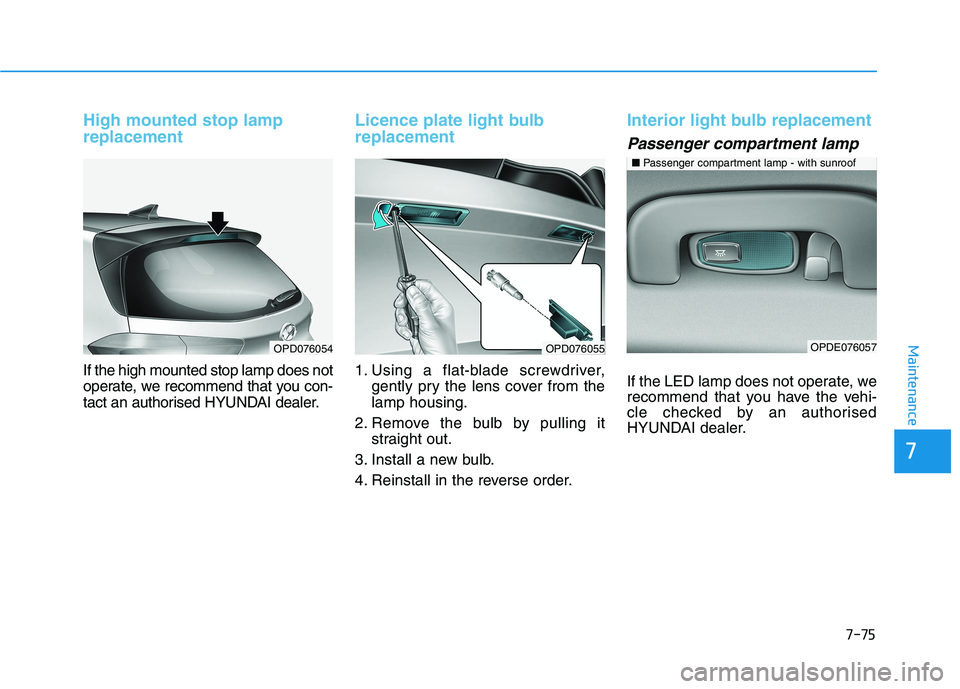
High mounted stop lamp
replacement
If the high mounted stop lamp does not
operate, we recommend that you con-
tact an authorised HYUNDAI dealer.
Licence plate light bulb
replacement
1. Using a flat-blade screwdriver,
gently pry the lens cover from the
lamp housing.
2. Remove the bulb by pulling it
straight out.
3. Install a new bulb.
4. Reinstall in the reverse order.
Interior light bulb replacement
Passenger compartment lamp
If the LED lamp does not operate, we
recommend that you have the vehi-
cle checked by an authorised
HYUNDAI dealer.
OPD076054OPD076055OPDE076057
■Passenger compartment lamp - with sunroof