2023 FORD SUPER DUTY engine coolant
[x] Cancel search: engine coolantPage 220 of 738
Using low-sulfur diesel fuel(16-500 ppm) or high-sulfurdiesel fuel (greater than 500ppm) in your diesel engine will causecertain emission components tomalfunction which could also cause theservice engine soon light to illuminateindicating an emissions-related concern.
Diesel fuel is adjusted seasonally for coldtemperature. For best results attemperatures below 19°F (-7°C), werecommend using a diesel fuel which hasbeen seasonally adjusted for the ambientconditions.
Choosing the Right Fuel: VehiclesOperated Where Ultra Low SulfurDiesel Fuel Is Not Required
For the engine to operate reliably onlow-sulfur or high-sulfur diesel fuel, theengine must be a factory-built high-sulfurengine (available as a dealer order optionfor select markets) or an ultra-low sulfurdiesel fuel configured engine that has beenretrofitted for high-sulfur diesel fuel usingauthorized dealer service parts. Failure touse retrofit components other than thoseavailable through your authorized dealerresults in coolant system damage, engineoverheating, selective catalyst reductionsystem or diesel particulate filter damageand possible base engine damage.
Use only a diesel engine configured for usewith high-sulfur diesel fuel in markets withdiesel fuel that has sulfur content greaterthan 15 ppm. Using low-sulfur diesel fuel(16–500 ppm) or high-sulfur diesel fuel(greater than 500 ppm) in a diesel enginedesigned to use only ultra-low sulfur dieselfuel could result in damage to engineemission control devices and the aftertreatment system, potentially renderingthe vehicle inoperable.
Vehicles with engines configured for usewith high-sulfur diesel fuel are onlyavailable for sale in countries whereultra-low sulfur diesel fuel is generally notavailable or mandated by the government.Vehicles originally sold in an ultra-lowsulfur diesel fuel market that aresubsequently exported to non-ultra lowsulfur diesel fuel markets will need to beretrofitted at the customer’s expense usingFord authorized dealer service parts inorder to be reliably operated on non-ultralow sulfur diesel fuel.
Biodiesel
WARNING: Do not mix diesel withgasoline, gasohol or alcohol. This couldcause an explosion.
Note:Do not use home heating oil,agricultural fuel, raw fats and oils, wastecooking greases, biodiesel greater than 20%or any diesel not intended for highway use.Damage to the fuel injection system, engineand exhaust catalyst, and diesel particulatefilter can occur if you use an improper fuel.Red dye is used to identify fuels intendedfor agricultural and non-highway use.
You can operate your vehicle on dieselfuels containing up to 20% biodiesel, alsoknown as B20.
Biodiesel fuel is a chemically convertedproduct from renewable fuel sources, suchas vegetable oils, animal fats and wastecooking greases.
To help achieve acceptable engineperformance and durability when usingbiodiesel in your vehicle:
•Confirm the biodiesel content of thefuel to be B20 (20% biodiesel) or less.
•Only use biodiesel fuel of good qualitythat complies with industry standards.
216
2023 Super Duty (TFH) Canada/United States of America, enUSA, Edition date: 202211, DOMFuel and RefuelingE67028
Page 429 of 738
We recommend the use of a wheel lift anddollies or flatbed equipment to tow yourvehicle. Vehicle damage could occur iftowed incorrectly, or by any other means.
Front-wheel and rear-wheel drive vehiclesmust have their designated drive wheelsoff the ground regardless of towingdirection. Use tow dollies to preventdamage to the transmission.
All-wheel or four-wheel drive vehiclesrequire that all wheels be off the groundusing a wheel lift and dollies or flatbedequipment. This prevents damage to thetransmission and drive system.
Note:You need to switch on the ignition tounlock the steering.
Note:Make sure you check the steeringcolumn before towing. It could lock if thebattery is dead.
FAIL-SAFE COOLING
WHAT IS FAIL-SAFE COOLING
Fail-safe cooling allows you to temporarilydrive your vehicle before any incrementalcomponent damage occurs due tooverheating.
The fail-safe distance depends on outsidetemperature, vehicle load and terrain.
HOW DOES FAIL-SAFE COOLINGWORK
If the engine reaches a presetover-temperature condition, the engineautomatically switches to alternatingcylinder operation. Each disabled cylinderacts as an air pump and cools the engine.
When this occurs, your vehicle stilloperates, however:
•Engine power is limited.
•The air conditioning system turns off.
Continued operation increases the enginetemperature, causing the engine tocompletely shut down. Your steering andbraking effort increases in this situation.
When the engine temperature cools, youcan re-start the engine.
Note:Have your vehicle checked as soonas possible to minimize engine damage.
DRIVING WHEN FAIL-SAFE MODEIS ACTIVATED
WARNING: Fail-safe mode is foruse during emergencies only. Operateyour vehicle in fail-safe mode only aslong as necessary to bring your vehicleto rest in a safe location and seekimmediate repairs. When in fail-safemode, your vehicle will have limitedpower, will not be able to maintainhigh-speed operation, and maycompletely shut down without warning,potentially losing engine power, powersteering assist, and power brake assist,which may increase the possibility of acrash resulting in serious injury.
WARNING: Do not remove thecoolant reservoir cap when the engine ison or the cooling system is hot. Wait 10minutes for the cooling system to cooldown. Cover the coolant reservoir capwith a thick cloth to prevent thepossibility of scalding and slowly removethe cap. Failure to follow this instructioncould result in personal injury.
Continued operation increases the enginetemperature, causing the engine tocompletely shut down. Your steering andbraking effort increases in this situation.
When the engine temperature cools, youcan re-start the engine. Have your vehiclechecked as soon as possible to minimizeengine damage.
425
2023 Super Duty (TFH) Canada/United States of America, enUSA, Edition date: 202211, DOMCrash and Breakdown Information
Page 430 of 738
Your vehicle has limited engine powerwhen in the fail-safe mode, drive yourvehicle with caution. Your vehicle does notmaintain high-speed operation and theengine may operate poorly.
Remember that the engine is capable ofautomatically shutting down to preventengine damage. In this situation:
1.Pull off the road as soon as safelypossible and switch the engine off.
2.If you are a member of a roadsideassistance program, we recommendthat you contact your roadsideassistance service provider.
3.If this is not possible, wait for a shortperiod of time for the engine to cool.
4.Check the coolant level. If the coolantlevel is at or below the minimum mark,add prediluted coolant immediately.
5.When the engine temperature cools,you can re-start the engine. Have yourvehicle checked as soon as possible tominimize engine damage.
Note:Driving your vehicle without repairincreases the chance of engine damage.
FAIL-SAFE COOLING INDICATORS
If the engine begins to overheat,the coolant temperature gaugemoves toward the red zone.
A warning lamp illuminates anda message may appear in theinstrument cluster display.
426
2023 Super Duty (TFH) Canada/United States of America, enUSA, Edition date: 202211, DOMCrash and Breakdown InformationE103308 E67028
Page 445 of 738

UNDER HOOD OVERVIEW - 6.7L DIESEL
Battery. See Changing the 12V Battery (page 457).A
Under hood fuse box. See Accessing the Under Hood Fuse Box (page 430).B
Engine oil dipstick. See Engine Oil Dipstick Overview (page 444).C
Secondary fuel filter. See Changing the Fuel Filter (page 453).D
Engine oil filler cap. See Checking the Engine Oil Level (page 444).E
Engine cooling system coolant reservoir - primary high-temperature coolingsystem. See Checking the Coolant Level (page 450).F
Brake fluid reservoir. See Checking the Brake Fluid (page 249).G
Battery. See Changing the 12V Battery (page 457).H
Windshield washer fluid reservoir. See Adding Washer Fluid (page 115).I
Power steering fluid reservoir. See Checking the Hydraulic Power SteeringFluid (page 280).J
Secondary cooling system coolant reservoir. See Checking the Coolant Level(page 450).K
Air filter assembly. See Changing the Engine Air Filter (page 445).L
441
2023 Super Duty (TFH) Canada/United States of America, enUSA, Edition date: 202211, DOMMaintenanceE350655
Page 446 of 738

UNDER HOOD OVERVIEW - 6.8L, GASOLINE
Engine compartment fuse box. See Locating the Under Hood Fuse Box (page430).A
Battery. See Changing the 12V Battery (page 457).B
Engine oil dipstick. See Engine Oil Dipstick Overview (page 444).C
Engine oil filler cap. See Checking the Engine Oil Level (page 444).D
Brake fluid reservoir. See Checking the Brake Fluid (page 249).E
Windshield washer fluid reservoir. See Adding Washer Fluid (page 115).F
Engine coolant reservoir. See Checking the Coolant Level (page 450).G
Power steering fluid reservoir. See Checking the Hydraulic Power SteeringFluid (page 280).H
Air cleaner assembly. See Changing the Engine Air Filter (page 445).I
442
2023 Super Duty (TFH) Canada/United States of America, enUSA, Edition date: 202211, DOMMaintenanceE398419
Page 447 of 738
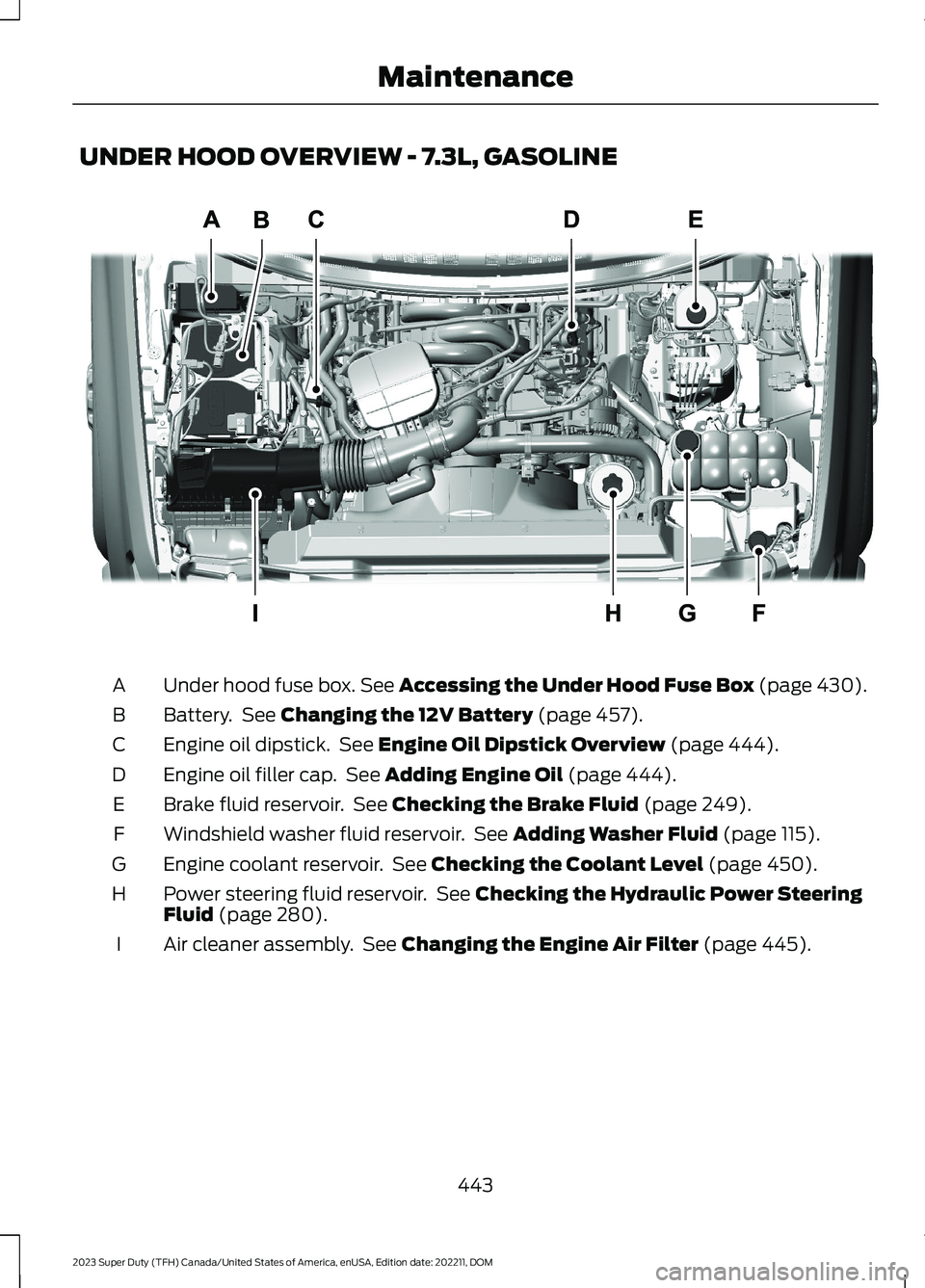
UNDER HOOD OVERVIEW - 7.3L, GASOLINE
Under hood fuse box. See Accessing the Under Hood Fuse Box (page 430).A
Battery. See Changing the 12V Battery (page 457).B
Engine oil dipstick. See Engine Oil Dipstick Overview (page 444).C
Engine oil filler cap. See Adding Engine Oil (page 444).D
Brake fluid reservoir. See Checking the Brake Fluid (page 249).E
Windshield washer fluid reservoir. See Adding Washer Fluid (page 115).F
Engine coolant reservoir. See Checking the Coolant Level (page 450).G
Power steering fluid reservoir. See Checking the Hydraulic Power SteeringFluid (page 280).H
Air cleaner assembly. See Changing the Engine Air Filter (page 445).I
443
2023 Super Duty (TFH) Canada/United States of America, enUSA, Edition date: 202211, DOMMaintenanceE351057
Page 454 of 738
COOLANT
CHECKING THE COOLANT LEVEL
WARNING: Do not remove thecoolant reservoir cap when the engine ison or the cooling system is hot. Wait 10minutes for the cooling system to cooldown. Cover the coolant reservoir capwith a thick cloth to prevent thepossibility of scalding and slowly removethe cap. Failure to follow this instructioncould result in personal injury.
WARNING: To reduce the risk ofpersonal injury, make sure the engine iscool before unscrewing the coolantpressure relief cap. The cooling systemis under pressure. Steam and hot liquidcan come out forcefully when you loosenthe cap slightly.
When the engine is cold, check theconcentration and level of the coolant atthe intervals listed in the scheduledmaintenance information. See ScheduledMaintenance (page 591).
Note:Make sure that the coolant level isbetween the MIN and the MAX marks onthe coolant reservoir.
Note: Coolant expands when it is hot. Thelevel may extend beyond the MAX mark.This is normal.
Maintain coolant concentration within48% to 50%, which equates to a freezepoint between -29°F (-34°C) and -35°F(-37°C). Coolant concentration should bechecked using a refractometer. We do notrecommend the use of hydrometers orcoolant test strips for measuring coolantconcentration.
ADDING COOLANT
WARNING: Do not add coolantwhen the vehicle is on or the coolingsystem is hot. Failure to follow thisinstruction could result in personal injury.
WARNING: Do not remove thecoolant reservoir cap when the engine ison or the cooling system is hot. Wait 10minutes for the cooling system to cooldown. Cover the coolant reservoir capwith a thick cloth to prevent thepossibility of scalding and slowly removethe cap. Failure to follow this instructioncould result in personal injury.
WARNING: Do not allow the fluidto touch your skin or eyes. If thishappens, rinse the affected areasimmediately with plenty of water andcontact your physician.
WARNING: Do not put coolant inthe windshield washer reservoir. Ifsprayed on the windshield, coolant couldmake it difficult to see through thewindshield.
WARNING: Do not add coolantfurther than the MAX mark.
Note: Do not use stop leak pellets, coolingsystem sealants, or non-specified additivesas they can cause damage to the enginecooling or heating systems. Resultingcomponent damage may not be covered bythe vehicle Warranty.
Note:Automotive fluids are notinterchangeable.
450
2023 Super Duty (TFH) Canada/United States of America, enUSA, Edition date: 202211, DOMMaintenance
Page 455 of 738
It is very important to use predilutedcoolant approved to the correctspecification in order to avoid plugging thesmall passageways in the engine coolingsystem. See Capacities andSpecifications (page 520). Do not mixdifferent colors or types of coolant in yourvehicle. Mixing of engine coolants or usingan incorrect coolant may harm the engineor cooling system components and maynot be covered by the vehicle Warranty.
Note:If prediluted coolant is not available,use the approved concentrated coolantdiluting it to 50/50 with deionised ordistilled water. See Capacities andSpecifications (page 520). Using water thathas not been deionised may contribute todeposit formation, corrosion and pluggingof the small cooling system passageways.
Note: Coolants marketed for all makes andmodels may not be approved to ourspecifications and may cause damage tothe cooling system. Resulting componentdamage may not be covered by the vehicleWarranty.
If the coolant level is at or below theminimum mark, add prediluted coolantimmediately.
To top up the coolant level do thefollowing:
1.Unscrew the cap slowly. Any pressureescapes as you unscrew the cap.
2.Add prediluted coolant approved tothe correct specification. SeeCapacities and Specifications (page520).
3.Add enough prediluted coolant toreach the correct level.
4.Replace the coolant reservoir cap. Turnthe cap clockwise until it contacts thehard stop.
5.Check the coolant level in the coolantreservoir the next few times you driveyour vehicle. If necessary, add enoughprediluted engine coolant to bring thecoolant level to the correct level.
If you have to add more than 1.1 qt (1 L) ofengine coolant per month, have yourvehicle checked as soon as possible.Operating an engine with a low level ofcoolant can result in engine overheatingand possible engine damage.
In case of emergency, you can add a largeamount of water without engine coolantin order to reach a vehicle service location.
Water alone, without engine coolant, cancause engine damage from corrosion,overheating or freezing.
Do not use the following as a coolantsubstitute:
•Alcohol.
•Methanol.
•Brine.
•Any coolant mixed with alcohol ormethanol antifreeze.
Alcohol and other liquids can cause enginedamage from overheating or freezing.
Do not add extra inhibitors or additives tothe coolant. These can be harmful andcompromise the corrosion protection ofthe coolant.
CHANGING THE COOLANT
For coolant change, see your authorizeddealer.
Changing the coolant is necessary atspecific mileage intervals listed in thescheduled maintenance information. SeeScheduled Maintenance (page 591).
451
2023 Super Duty (TFH) Canada/United States of America, enUSA, Edition date: 202211, DOMMaintenance