2023 FORD RANGER steering
[x] Cancel search: steeringPage 150 of 470

Stopping the Engine When YourVehicle is Moving
WARNING: Switching off theengine when your vehicle is still movingresults in a significant decrease inbraking assistance. Higher effort isrequired to apply the brakes and to stopyour vehicle. A significant decrease insteering assistance could also occur. Thesteering does not lock, but higher effortcould be required to steer your vehicle.When you switch the ignition off, someelectrical circuits, for example airbags,also turn off. If you unintentionally switchthe ignition off, shift into neutral (N) andrestart the engine.
Vehicles with an Ignition Key
1.Shift into neutral and use the brakes tobring your vehicle to a safe stop.
2.When your vehicle has stopped, shiftinto park (P) and switch the ignitionoff.
3.Apply the parking brake.
Vehicles with Keyless Start
1.Shift into neutral and use the brakes tobring your vehicle to a safe stop.
2.When your vehicle has stopped, shiftinto park (P).
3.Press and hold the push button ignitionswitch, or press it three times withintwo seconds.
4.Apply the parking brake.
Guarding Against Exhaust Fumes
WARNING: Exhaust leaks mayresult in entry of harmful and potentiallylethal fumes into the passengercompartment. If you smell exhaustfumes inside your vehicle, have yourvehicle inspected immediately. Do notdrive if you smell exhaust fumes.
Important Ventilating Information
If you stop your vehicle and then leave theengine idling for long periods, werecommend that you do one of thefollowing:
•Open the windows at least 1 in (3 cm).
•Set your climate control to outside air.
ENGINE BLOCK HEATER (IF
EQUIPPED)
WARNING: Failure to follow engineblock heater instructions could result inproperty damage or serious personalinjury.
WARNING: Do not use your heaterwith ungrounded electrical systems ortwo-pronged adapters. There is a risk ofelectrical shock.
WARNING: Do not fully close thehood, or allow it to drop under its ownweight when using the engine blockheater. This could damage the powercable and may cause an electrical shortresulting in fire, injury and propertydamage.
Note:The heater is most effective whenoutdoor temperatures are below 0°F(-18°C).
146
2023 Ranger (TFG) Canada/United States of America, Vehicles Built From: 10-10-2022, enUSA, Edition date: 202208, First-PrintingStarting and Stopping the Engine
Page 152 of 470

AUTO-START-STOP (IF EQUIPPED)
The system helps reduce fuel consumptionby automatically shutting off and restartingthe engine while your vehicle is stopped.The engine will restart automatically whenyou release the brake pedal. In somesituations, your vehicle may restartautomatically, for example:
•To maintain interior comfort
•To recharge the battery
Note:Power assist steering is turned offwhen the engine is off.
WARNING: Apply the parkingbrake, shift into park (P), switch theignition off and remove the key beforeyou leave your vehicle. Failure to followthis instruction could result in personalinjury or death.
WARNING: Apply the parkingbrake, shift into park (P), switch theignition off and remove the key beforeyou open the hood or have any serviceor repair work completed. If you do notswitch the ignition off, the engine couldrestart at any time. Failure to follow thisinstruction could result in personal injuryor death.
WARNING: The system mayrequire the engine to automaticallyrestart when the auto-start-stopindicator illuminates green or flashesamber. Failure to follow this instructioncould result in personal injury.
The Auto-Start-Stop system status isavailable at a glance within the informationdisplay. See Information Displays (page96).
Enabling Auto-Start-Stop
The system is automatically enabled everytime you start your vehicle if the followingconditions are met:
•The Auto-Start-Stop button is notpressed (not illuminated).
•Your vehicle exceeds an initial speedof 3 mph (5 km/h) after you haveinitially started the vehicle.
•Your vehicle is stopped.
•Your foot is on the brake pedal.
•The transmission is in drive (D).
•The driver's door is closed.
•There is adequate brake vacuum.
•The interior compartment has beencooled or warmed to an acceptablelevel.
•The front windshield defroster is off.
•The steering wheel is not turned rapidlyor is not at a sharp angle.
•The vehicle is not on a steep roadgrade.
•The battery is within optimal operatingconditions (battery state of charge andtemperature in range).
•The engine coolant is at operatingtemperature.
•Elevation is below approximately12,000 ft (3,650 m).
•Ambient temperature is moderate.
The green Auto-Start-Stopindicator light on the instrumentcluster will illuminate to indicatewhen the automatic engine stop occurs.
If the instrument cluster isequipped with a greyAuto-Start-Stop indicator light,it is illuminated when automatic enginestop is not available due to one of theabove noted conditions not being met.
148
2023 Ranger (TFG) Canada/United States of America, Vehicles Built From: 10-10-2022, enUSA, Edition date: 202208, First-PrintingUnique Driving CharacteristicsE121377 E146361
Page 170 of 470

Note:2H may engage or disengage basedon terrain mode selection. See Principle ofOperation (page 165).
4H (4X4 HIGH)
Provides mechanically locked four-wheeldrive power to both the front and rearwheels for use in off-road or winterconditions such as deep snow, sand ormud. This mode is not for use on drypavement.
Note:4H may engage or disengage basedon terrain mode selection. See Principle ofOperation (page 165).
4L (4X4 LOW)
Provides mechanically locked four-wheeldrive power to both the front and rearwheels with additional gearing forincreased torque multiplication. Intendedonly for off-road applications such as deepsand, steep slopes, or pulling heavyobjects.
Note:4L may engage or disengage basedon terrain mode selection. See Principle ofOperation (page 165).
Shifting Between 4WD System Modes
Note:Momentarily releasing the acceleratorpedal when performing a shift aids theperformance of engagement ordisengagement.
Note:Do not perform this operation if therear wheels are slipping, or when applyingthe accelerator pedal.
Note:It is normal to hear some noise as thesystem shifts or engages.
You can move the control between 2H to4H at a stop or when driving up to 68 mph(110 km/h). The information display maydisplay a message indicating a 4X4 shiftand the LED for the selected mode flashes.Once the shift is complete, the LED lightfor the selected mode remains illuminated.
Shifting To or From 4L (4X4 Low)
Note:It is normal to hear some noise as thesystem shifts or engages.
1.Stop your vehicle when it is safe to doso.
2.Place the transmission in neutral (N).
3.Move the transfer shift switch to thedesired position.
The information display displays amessage indicating a 4X4 shift is inprogress followed by the system modeselected. If any of the above shiftconditions are not present, the shift doesnot occur and the information displayshows information guiding you through theproper shifting procedures.
How Your Vehicle Differs FromOther Vehicles
WARNING: Vehicles with a highercenter of gravity (utility and four-wheeldrive vehicles) handle differently thanvehicles with a lower center of gravity(passenger cars). Avoid sharp turns,excessive speed and abrupt steering inthese vehicles. Failure to drive cautiouslyincreases the risk of losing control of yourvehicle, vehicle rollover, personal injuryand death.
Truck and utility vehicles can differ fromsome other vehicles. Your vehicle may behigher to allow it to travel over roughterrain without getting hung up ordamaging underbody components.
The differences that make your vehicle soversatile also make it handle differentlythan an ordinary passenger car.
166
2023 Ranger (TFG) Canada/United States of America, Vehicles Built From: 10-10-2022, enUSA, Edition date: 202208, First-PrintingFour-Wheel Drive (If Equipped)
Page 171 of 470

Maintain steering wheel control at alltimes, especially in rough terrain. Sincesudden changes in terrain can result inabrupt steering wheel motion, make sureyou grip the steering wheel from theoutside. Do not grip the spokes of thesteering wheel.
Drive cautiously to avoid vehicle damagefrom concealed objects such as rocks andstumps.
Either know the terrain or examine mapsof the area before driving. Map out yourroute before driving in the area. Tomaintain steering and braking control ofyour vehicle, have all four wheels on theground and they need to be rolling, notsliding or spinning.
Driving Off-Road With Truck andUtility Vehicles
Note:Your vehicle may have a front airdam. Due to low ground clearance, you candamage it when taking your vehicle off-road.You can take the air dam off by removingthe bolts that secure it.
We design four-wheel drive vehicles fordriving on sand, snow, mud and roughterrain and they have operatingcharacteristics that are somewhatdifferent from conventional vehicles, bothon and off the road.
The transfer case supplies power to all fourwheels. On four-wheel drive vehicles, thetransfer case allows you to select different4WD modes when necessary. Becomethoroughly familiar with this informationbefore you operate your vehicle.
Four-wheel drive uses all four wheels topower your vehicle. This increases traction,enabling you to drive over terrain and roadconditions that a conventional two-wheeldrive vehicle cannot.
Basic Operating Principles
•Drive slower in strong crosswinds whichcan affect the normal steeringcharacteristics of your vehicle.
•When driving your vehicle on surfacesmade slippery by loose sand, water,gravel, snow or ice, proceed with care.
•Do not use 4H or 4L on dry, hardsurfaced roads. Doing so can produceexcessive noise, increase tire wear andcould damage drive components. Use4H or 4L modes for consistentlyslippery or loose surfaces.
If Your Vehicle Leaves the Road
If your vehicle leaves the road, reduce yourvehicle speed and avoid severe braking.When your vehicle speed decreases, easeyour vehicle back onto the road. Do notsharply turn the steering wheel whenreturning your vehicle to the road.
It may be safer to stay on the shoulder ofthe road and gradually slow down beforereturning to the road. You may lose controlif you do not slow down or if you toosharply or abruptly turn the steering wheel.
It may be less risky to strike small objects,such as freeway reflectors, with minordamage to your vehicle rather thanattempt a sudden return to the road whichcould cause your vehicle to slide sidewaysout of control or roll over. Remember, yoursafety and the safety of others should beyour primary concern.
Emergency Maneuvers
In an unavoidable emergency situationwhere you must make a sudden sharp turn,remember to avoid over-driving yourvehicle and turn the steering wheel only asrapidly and as far as required to avoid theemergency. Excessive steering can resultin loss of vehicle control. Apply smoothpressure to the accelerator pedal or brakepedal when you require changes in vehicle
167
2023 Ranger (TFG) Canada/United States of America, Vehicles Built From: 10-10-2022, enUSA, Edition date: 202208, First-PrintingFour-Wheel Drive (If Equipped)
Page 172 of 470

speed. Avoid abrupt steering, accelerationand braking. This could result in anincreased risk of vehicle roll over, loss ofvehicle control and personal injury. Use theavailable road surface to bring your vehicleto a safe direction of travel.
In the event of an emergency stop, avoidskidding the tires and do not attempt anysharp steering wheel movements.
If your vehicle goes from one type ofsurface to another, such as concrete togravel, there can be a change in the wayyour vehicle responds to a maneuver usingsteering, acceleration or braking.
Operating Four-Wheel Drive with aSpare or Mismatched Tires
On four-wheel drive vehicles, the size ofthe spare tire can affect the four-wheeldrive system. If there is a significantdifference between the size of the sparetire and the remaining tires, you could havelimited four-wheel drive functionality,added noise, discomfort and drivelinedamage. Due to normal tire wear, yourspare tire is not necessarily the same sizeas your on-road tires, which makes yourspare tire a dissimilar size. Use the sparetire on a limited basis only. When drivingwith a dissimilar wheel and tire assemblydo not:
•Exceed 50 mph (80 km/h) with afour-wheel drive mode turned on.
•Turn on a four-wheel drive modeunless the vehicle is stationary.
•Use a four-wheel drive mode on drypavement.
Driving with the full-size dissimilar sparewheel and tire assembly can limitfour-wheel drive functionality, especiallywhen driving in a mechanically lockedfour-wheel drive mode. You can experiencethe following:
•Additional noise from the transfer caseor other drive components.
•Difficulty shifting out of a mechanicallylocked four-wheel drive mode.
•Driveline component damage.
Mechanical Shift Blocking
On vehicles with an electronicshift-on-the-fly transfer case, the transfercase distributes torque to the front wheelsby mechanically interlocking the front andrear driveshafts together. Various externalfactors can affect shifting performance ofthis type of system including, but notlimited to:
•Vehicle acceleration.
•Dissimilar tire sizes.
•High steering input.
For vehicles with an electronicshift-on-the-fly transfer case, whenshifting into two-wheel drive high on dry,hard surfaced roads, we recommend thatthe following procedure is followed toreduce the likelihood of a mechanical shiftblock:
•While driving straight, come to a stopon a flat, horizontal surface.
•Shift into park (P).
•Select 2H and wait for the 2H LED tobecome solid.
•Shift into reverse (R) and let the vehicleroll backward up to 5 ft (1 m).
•Shift into drive (D) and let the vehicleroll forward up to 5 ft (1 m).
•Driving the vehicle around a tight turnat a slow speed.
If the system is mechanically blocked, oneor more of the following actions can relievethe mechanical shift block:
•Momentary acceleration.
•Momentary braking.
•Bringing the vehicle to a stop.
168
2023 Ranger (TFG) Canada/United States of America, Vehicles Built From: 10-10-2022, enUSA, Edition date: 202208, First-PrintingFour-Wheel Drive (If Equipped)
Page 174 of 470
“Tread Lightly” is an educational programdesigned to increase public awareness ofland-use regulations and responsibilitiesin our nation's wilderness areas. We jointhe U.S. Forest Service and the Bureau ofLand Management in encouraging you tohelp preserve our national forest and otherpublic and private lands by “treadinglightly.”
Driving on Hilly or Sloping Terrain
Although natural obstacles may make itnecessary to travel diagonally up or downa hill or steep incline, you should drivestraight up or straight down.
Note: Avoid turning on steep slopes or hills.A danger lies in losing traction, slippingsideways and possible vehicle roll over. Donot drive over the crest of a hill withoutseeing what conditions are on the other side.Do not drive in reverse over a hill without theaid of an observer. Whenever driving on ahill, determine beforehand the route youintend to use.
When climbing a steep slope or hill, startin a lower gear rather than downshifting toa lower gear from a higher gear once theascent has started. This reduces strain onthe engine and the possibility of stalling.
If your vehicle stalls, do not try to turnaround because this could cause vehicleroll over. It is better to reverse back to asafe location.
Apply just enough power to the wheels toclimb the hill. Too much power could causethe tires to slip, spin or lose traction,resulting in loss of vehicle control.
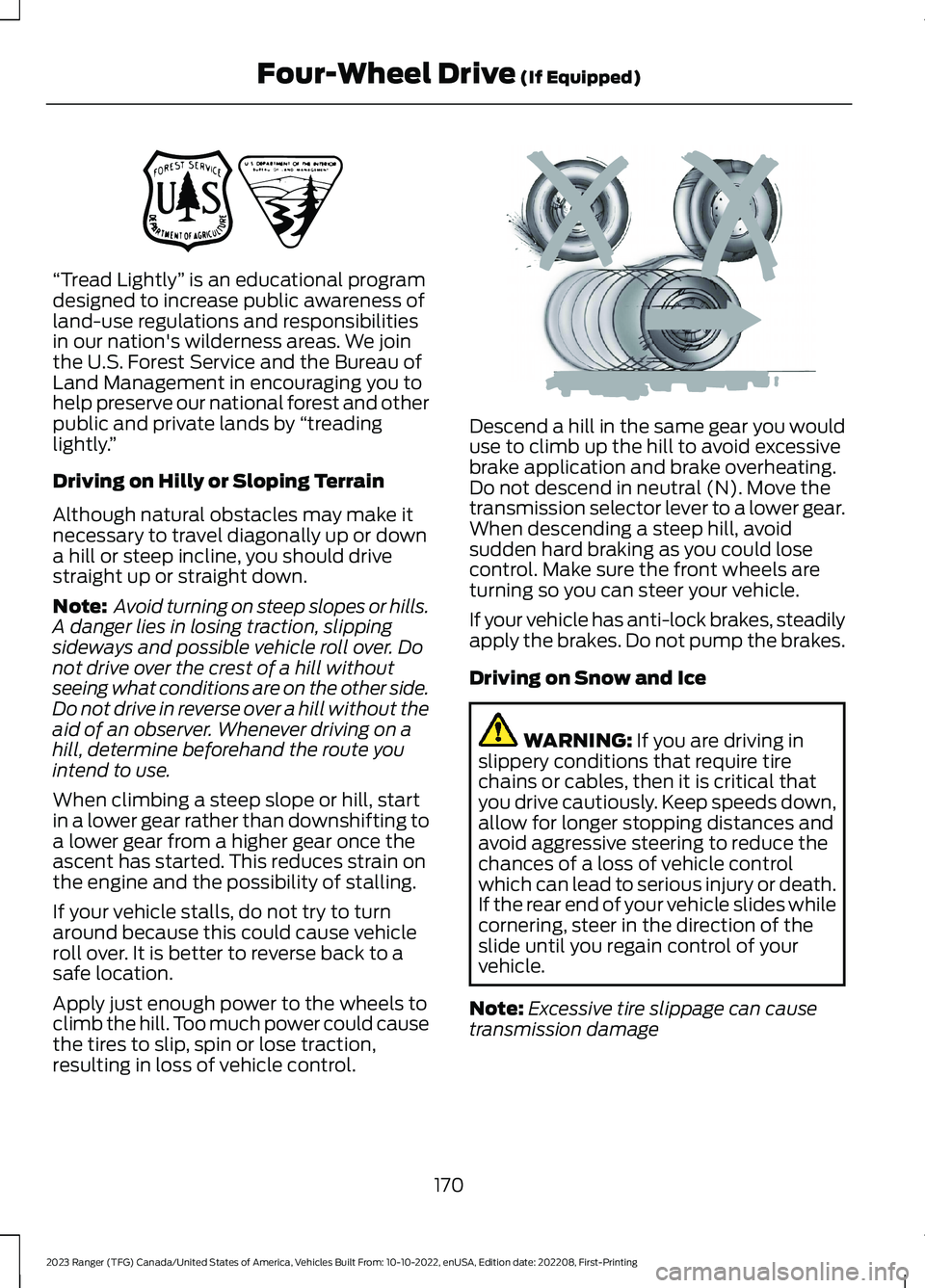
Descend a hill in the same gear you woulduse to climb up the hill to avoid excessivebrake application and brake overheating.Do not descend in neutral (N). Move thetransmission selector lever to a lower gear.When descending a steep hill, avoidsudden hard braking as you could losecontrol. Make sure the front wheels areturning so you can steer your vehicle.
If your vehicle has anti-lock brakes, steadilyapply the brakes. Do not pump the brakes.
Driving on Snow and Ice
WARNING: If you are driving inslippery conditions that require tirechains or cables, then it is critical thatyou drive cautiously. Keep speeds down,allow for longer stopping distances andavoid aggressive steering to reduce thechances of a loss of vehicle controlwhich can lead to serious injury or death.If the rear end of your vehicle slides whilecornering, steer in the direction of theslide until you regain control of yourvehicle.
Note:Excessive tire slippage can causetransmission damage
170
2023 Ranger (TFG) Canada/United States of America, Vehicles Built From: 10-10-2022, enUSA, Edition date: 202208, First-PrintingFour-Wheel Drive (If Equipped)E143950 E143949
Page 175 of 470

Four-wheel drive vehicles have advantagesover two-wheel drive vehicles in snow andice but can skid like any other vehicle.Should you start to slide when driving onsnowy or icy roads, turn the steering wheelin the direction of the slide until you regaincontrol.
Avoid sudden applications of power andquick changes of direction on snow andice. Apply the accelerator slowly andsteadily when starting from a full stop.
Avoid sudden braking. Although afour-wheel drive vehicle may acceleratebetter than a two-wheel drive vehicle insnow and ice, it cannot stop any faster asbraking occurs at all four wheels. Do notbecome overconfident of road conditions.
Make sure you allow sufficient distancebetween you and other vehicles forstopping. Drive slower than usual andconsider using one of the lower gears. Inemergency stopping situations, apply thebrake steadily. Do not pump the brakepedal. See Hints on Driving WithAnti-Lock Brakes (page 175).
If Your Vehicle Gets Stuck In Mud orSnow
WARNING: Do not spin the wheelsat over 34 mph (55 km/h). The tires mayfail and injure a passenger or bystander.
If your vehicle gets stuck in mud or snow,you may rock it out by shifting betweenforward and reverse gears, stoppingbetween shifts in a steady pattern. Presslightly on the accelerator in each gear.
Note:Do not rock your vehicle if the engineis not at normal operating temperature,damage to the transmission could occur.
Note:Do not rock your vehicle for morethan a minute, damage to the transmissionand tires could occur or the engine couldoverheat.
Parking
WARNING: If the parking brake isfully released, but the brake warninglamp remains illuminated, the brakesmay not be working properly. Have yourvehicle checked as soon as possible.
WARNING: Apply the parkingbrake, shift into park (P), switch theignition off and remove the key beforeyou leave your vehicle. Failure to followthis instruction could result in personalinjury or death.
On four-wheel drive vehicles, when thetransfer case is in the neutral (N) position,the engine and transmission disconnectfrom the rest of the driveline. Therefore,your vehicle is free to roll even if theautomatic transmission is in park (P) orthe manual transmission is in gear. Do notleave your vehicle unattended with thetransfer case in the neutral (N) position.Fully set the parking brake and turn off theignition when leaving your vehicle.
Maintenance and Modifications
We designed and tested the suspensionand steering systems on your vehicle toprovide predictable performance whetherloaded or empty. For this reason, westrongly recommend that you do not makemodifications such as adding or removingparts that include lift kits or stabilizer bars,or by using replacement parts notequivalent to the original factoryequipment.
We recommend that you use caution whenyour vehicle has either a high load or devicesuch as ladders or luggage racks. Anymodifications to your vehicle that raise thecenter of gravity could cause your vehicleto roll over when there is a loss of vehiclecontrol.
171
2023 Ranger (TFG) Canada/United States of America, Vehicles Built From: 10-10-2022, enUSA, Edition date: 202208, First-PrintingFour-Wheel Drive (If Equipped)
Page 177 of 470

ELECTRONIC LOCKING
DIFFERENTIAL (IF EQUIPPED)
Note:Do not operate the system on dryhard surface roads. Doing so could lead toexcessive tire noise and wear. Use thesystem only on consistently slippery or loosesurfaces.
The system locks the left and right portionsof the rear axle together to form a soliddriving axle, resulting in increased rearwheel traction in certain conditions.
Press and hold the electronic differentiallock button for 2 seconds to activate thesystem.
Note:The lock button is on the centerconsole.
Note:Do not perform this operation whencruise control or trail control are selectedand active. The system may not engage asexpected.
The electronic differential lock can lockand unlock when the internal gears arealigned and no torque load is placed onthe differential. To aid alignment, drive thevehicle in a straight line with theaccelerator pedal released. Alternatively,drive slowly forward and backward whilemoving the steering wheel from side to sideto allow the electronic differential lock tolock.
High vehicle speed and high acceleratorpedal application inhibit the electroniclocking differential system engagement.Follow the instruction on the instrumentcluster for engagement anddisengagement.
Note:You can use the system in any drivemode 2H, 4H or 4L.
Note:When you engage the system, theElectronic Stability Program (ESP) functionssuch as Stability Control, Traction Control,Hill Descent Control, Emergency stop signal,Hill Start Assist and Trailer Sway Controlare deactivated, the ESP Off indicatorilluminates, and the HDC on indicator turnsoff.
Note:When the anti-lock braking systemis operating, the system disengages.
The electronic locking differential systemcan affect various terrain modes. SeePrinciple of Operation (page 182).
Operating Electronic LockingDifferential with Spare orMismatched Tires
The size of the spare tire can affect theperformance of the electronic lockingdifferential system. When there is asignificant size difference between the tworear tires, you could have limited electroniclocking differential functionality. If yourelectronic locking differential has difficultydisengaging, release your accelerator pedaland turn the steering wheel in the oppositedirection while rolling forward.
Note:We recommend that you engage anddisengage the electronic locking differentialwhen stopped, and a spare tire is mountedon the rear axle.
173
2023 Ranger (TFG) Canada/United States of America, Vehicles Built From: 10-10-2022, enUSA, Edition date: 202208, First-PrintingRear AxleE277073