2023 FORD MUSTANG light
[x] Cancel search: lightPage 235 of 535

•Follow the recommended maintenanceschedule and carry out therecommended checks.
•Plan your journey and check the trafficbefore you set off. It is more efficientto combine errands into a single tripwhenever possible.
•Avoid idling the engine in cold weatheror for extended periods. Start theengine only when you are ready to setoff.
•Do not carry unnecessary weight in yourvehicle as extra weight wastes fuel.
•Do not add unnecessary accessoriesto the exterior of your vehicle, forexample running boards. If you use aroof rack, remember to fold it down orremove it when not in use.
•Do not shift into neutral when you arebraking or when your vehicle is slowingdown.
•Shut all windows when driving at highspeeds.
•Switch off all electric systems whennot in use, for example air conditioning.Make sure that you unplug anyaccessories from the auxiliary powerpoints when not in use.
DRIVING THROUGH SHALLOW
WATER
WARNING: Do not attempt tocross a deep or flowing body of water.Failure to follow this instruction couldresult in the loss of control of yourvehicle, personal injury or death.
Note:Driving through standing water cancause vehicle damage.
Note:Engine damage can occur if waterenters the air filter.
Before driving through standing water,check the depth. Never drive through waterthat is higher than the bottom of the frontrocker area of your vehicle.
When driving through standing water, drivevery slowly and do not stop your vehicle.Your brake performance and traction couldbe limited. After driving through water andas soon as it is safe to do so:
•Lightly press the brake pedal to dry thebrakes and to check that they work.
•Turn the steering wheel to check thatthe steering power assist works.
Check the function of the following:
•Horn
•Exterior lights
FLOOR MATS
WARNING: Use a floor matdesigned to fit the footwell of yourvehicle that does not obstruct the pedalarea. Failure to follow this instructioncould result in the loss of control of yourvehicle, personal injury or death.
WARNING: Pedals that cannotmove freely can cause loss of vehiclecontrol and increase the risk of seriouspersonal injury.
231
2023 Mustang (CZG) Canada/United States of America, Vehicles Built From: 14-11-2022, enUSA, Edition date: 202209, First-PrintingDriving Hints E266447
Page 239 of 535
JUMP STARTING THE VEHICLE
WARNING: Batteries normallyproduce explosive gases which cancause personal injury. Therefore, do notallow flames, sparks or lightedsubstances to come near the battery.When working near the battery, alwaysshield your face and protect your eyes.Always provide correct ventilation.
WARNING: Keep batteries out ofreach of children. Batteries containsulfuric acid. Avoid contact with skin,eyes or clothing. Shield your eyes whenworking near the battery to protectagainst possible splashing of acidsolution. In case of acid contact with skinor eyes, flush immediately with water fora minimum of 15 minutes and get promptmedical attention. If acid is swallowed,call a physician immediately.
WARNING: Use only adequatelysized cables with insulated clamps.
Note:Do not attempt to push-start yourautomatic transmission vehicle. Attemptingto push-start a vehicle with an automatictransmission may cause transmissiondamage.
Note:Do not disconnect the battery of thedisabled vehicle as this could damage thevehicle electrical system.
Preparing Your Vehicle
Note:Use only a 12-volt supply to start yourvehicle.
Park the booster vehicle close to the hoodof the disabled vehicle, making sure thetwo vehicles do not touch.
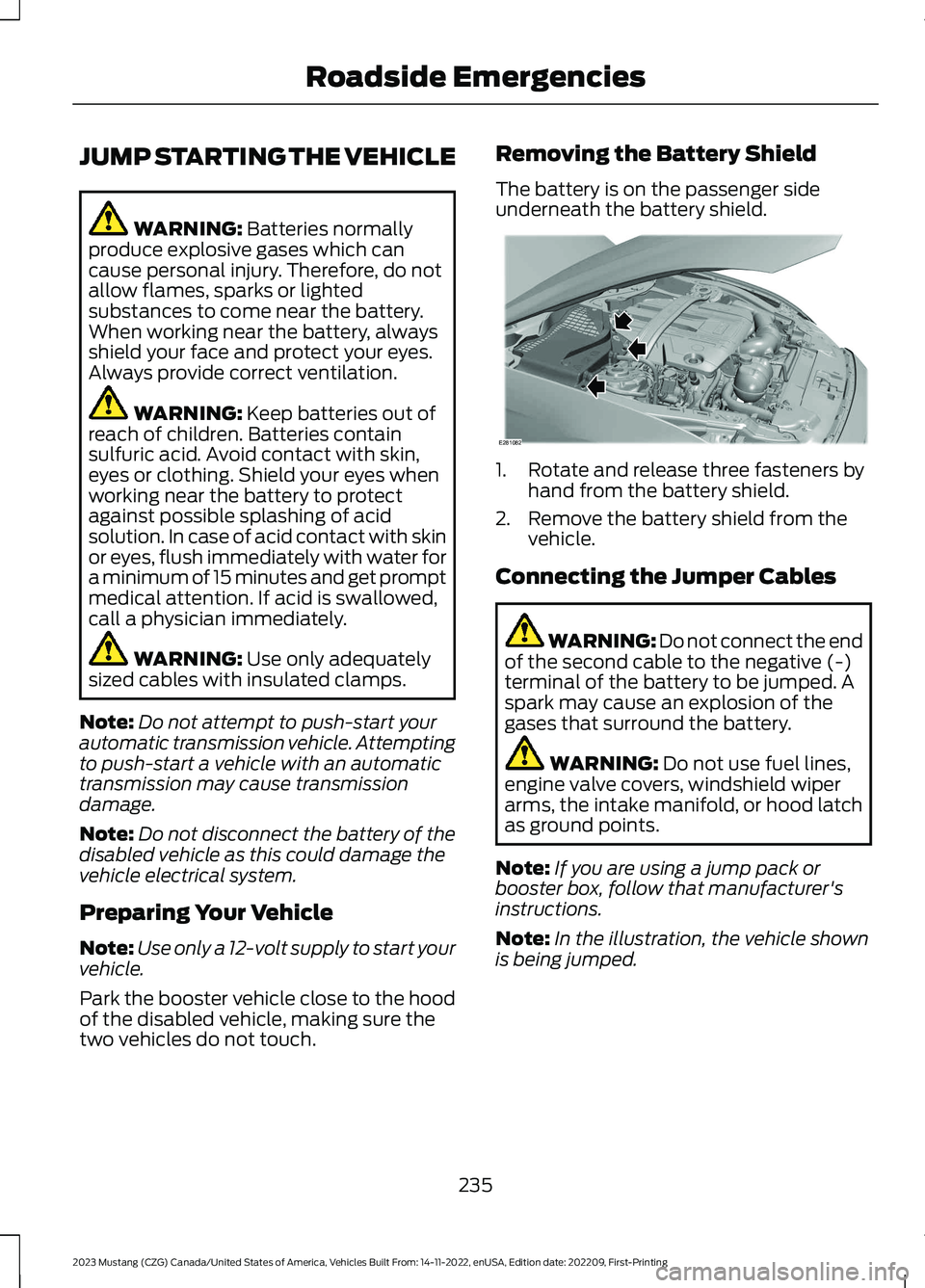
Removing the Battery Shield
The battery is on the passenger sideunderneath the battery shield.
1.Rotate and release three fasteners byhand from the battery shield.
2.Remove the battery shield from thevehicle.
Connecting the Jumper Cables
WARNING: Do not connect the endof the second cable to the negative (-)terminal of the battery to be jumped. Aspark may cause an explosion of thegases that surround the battery.
WARNING: Do not use fuel lines,engine valve covers, windshield wiperarms, the intake manifold, or hood latchas ground points.
Note:If you are using a jump pack orbooster box, follow that manufacturer'sinstructions.
Note:In the illustration, the vehicle shownis being jumped.
235
2023 Mustang (CZG) Canada/United States of America, Vehicles Built From: 14-11-2022, enUSA, Edition date: 202209, First-PrintingRoadside EmergenciesE281082
Page 253 of 535

Protected ComponentFuse RatingFuse or RelayNumber
Right-hand high-intensity discharge head-lamps (GT500).20A335
Not used (base).—
Alternator sense.10A336
Not used.—37
Vehicle power 1.20A338
Not used.—39
Vehicle power 2.20A340
Fuel injectors.15A341
Vehicle power 3.15A342
Not used.—43
Vehicle power 4 (base).15A3
44Vehicle power 4 (GT500).30A3
Not used.—45
Differential pump (Mach 1, GT500).20A246
Not used (base).—
Not used.—47
Fuel pump #2 (GT500).30A248
Not used (base).—
Fuel pump.30A249
Steering column lock relay.—50
Not used.—51
Horn relay.—52
Cigar lighter.20A253
249
2023 Mustang (CZG) Canada/United States of America, Vehicles Built From: 14-11-2022, enUSA, Edition date: 202209, First-PrintingFuses
Page 254 of 535

Protected ComponentFuse RatingFuse or RelayNumber
Auxiliary power point.20A254
Electronic fan 2 (base).25A255
Not used (GT500).—
Not used.—56
Air conditioning clutch relay.—57
Not used.—58
Exhaust valves relay.—59
Powertrain control module.5A360
Not used.—61
Anti-lock brakes run/start switch.5A362
Not used.—63
Electronic power assist steering.5A364
Not used.—65
Blind spot information system.
5A366Rear view camera.Rear window defroster relay coils.Vehicle dynamics module.
Not used.—67
Headlamp leveling switch (base).10A368
Signature lighting (GT500).10A3
Cigar lighter relay.—69Auxiliary power point relay.
Mass air flow sensor (base).5A374
Not used (GT500).—
Rain sensor module (base).5A375
250
2023 Mustang (CZG) Canada/United States of America, Vehicles Built From: 14-11-2022, enUSA, Edition date: 202209, First-PrintingFuses
Page 258 of 535

Protected ComponentFuse RatingFuse or RelayNumber
In-vehicle temperature and humiditysensor.5A21
Auxiliary body module.5A22
Amplifier.30A23
Vehicle dynamics module.30A24
Ambient lighting module (base).20A25Auxiliary body module.
Right-hand front-window motor (powerdistribution module).30A26
Passenger door control unit.
Left-hand rear-window power (base).30A27
Not used (GT500).—
Right-hand rear-window power (base).30A28
Not used (GT500).—
Gateway module (base).15A29Not used (spare) (GT500).
Not used (spare)5A30
Remote keyless entry.10A31
Audio unit.20A32
Not used.—33
Run/start bus.30A34
Power distribution box run/start relay(base).5A35
Not used (GT500).—
Front camera (base).15A36
Not used (GT500).—
Heated steering wheel module (base).20A37
Not used (GT500).—
Note:Spare fuse amperage may vary.
254
2023 Mustang (CZG) Canada/United States of America, Vehicles Built From: 14-11-2022, enUSA, Edition date: 202209, First-PrintingFuses
Page 261 of 535

GENERAL INFORMATION
Have your vehicle serviced regularly to helpmaintain its roadworthiness and resalevalue. There is a large network ofauthorized dealers that are there to helpyou with their professional servicingexpertise. We believe that their speciallytrained technicians are best qualified toservice your vehicle properly and expertly.They are supported by a wide range ofhighly specialized tools developedspecifically for servicing your vehicle.
If your vehicle requires professional service,an authorized dealer can provide thenecessary parts and service. Check yourwarranty information to find out whichparts and services are covered.
Use only recommended fuels, lubricants,fluids and service parts conforming tospecifications. Motorcraft® parts aredesigned and built to provide the bestperformance in your vehicle.
Precautions
•Do not work on a hot engine.
•Make sure that nothing gets caught inmoving parts.
•Do not work on a vehicle with theengine running in an enclosed space,unless you are sure you have enoughventilation.
•Keep all open flames and other burningmaterial, such as cigarettes, away fromthe battery and all fuel related parts.
Working with the Engine Off
1.Set the parking brake and shift thetransmission to park (P), for automatictransmission, or neutral (N), for manualtransmission.
2.Switch off the engine.
3.Block the wheels.
Working with the Engine On
WARNING: To reduce the risk ofvehicle damage and personal burninjuries, do not start your engine with theair cleaner removed and do not removeit while the engine is running.
1.Set the parking brake and shift thetransmission to park (P), for automatictransmission, or neutral (N), for manualtransmission.
2.Block the wheels.
OPENING AND CLOSING THE
HOOD
Opening the Hood
1.Inside the vehicle, pull the hood releasehandle located under the left-handside of the instrument panel.
2.Slightly lift the hood.
257
2023 Mustang (CZG) Canada/United States of America, Vehicles Built From: 14-11-2022, enUSA, Edition date: 202209, First-PrintingMaintenanceE142457
Page 269 of 535

1.Remove the two sensor wire harnessretainers from the air box studs locatedon the front side of the air box.
2.Remove the four studs that fasten theupper air box housing to the lower airbox housing.
3.Separate the upper air box housingfrom the lower air box housing.
4.Loosen the air filter clamp enough toallow the filter to slip off the housingeasily.
5.Remove the air filter from the air filterhousing.
6.Wipe the newly-exposed air filter outlettube clamping area clean to removeany dirt or debris.
7.Install a new air filter, taking care notto damage the air filter element. Alignthe tab on the closed end of the filterwith the notch in the air filter housing.
8.Tighten the air filter clamp down.
Note:Do not overtighten the clamp or studswhen reinstalling.
9.Reinstall the upper air box piece to thelower air box piece. Tighten the 4 studsdown.
10.Reinstall the two sensor wire harnessretainers to the mating air box studs.
ENGINE COOLANT CHECK
WARNING: Do not remove thecoolant reservoir cap when the engine ison or the cooling system is hot. Wait 10minutes for the cooling system to cooldown. Cover the coolant reservoir capwith a thick cloth to prevent thepossibility of scalding and slowly removethe cap. Failure to follow this instructioncould result in personal injury.
WARNING: Do not put coolant inthe windshield washer reservoir. Ifsprayed on the windshield, coolant couldmake it difficult to see through thewindshield.
WARNING: To reduce the risk ofpersonal injury, make sure the engine iscool before unscrewing the coolantpressure relief cap. The cooling systemis under pressure. Steam and hot liquidcan come out forcefully when you loosenthe cap slightly.
When the engine is cold, check theconcentration and level of the coolant atthe intervals listed in the scheduledmaintenance information. See ScheduledMaintenance (page 449).
Note:Make sure that the coolant level isbetween the MIN and the MAX marks onthe coolant reservoir.
Note: Coolant expands when it is hot. Thelevel may extend beyond the MAX mark.
Maintain coolant concentration within48% to 50%, which equates to a freezepoint between -29°F (-34°C) and -35°F(-37°C). Coolant concentration should bechecked using a refractometer. We do notrecommend the use of hydrometers orcoolant test strips for measuring coolantconcentration.
Adding Coolant
WARNING: Do not add coolantfurther than the MAX mark.
WARNING: Do not add coolantwhen the vehicle is on or the coolingsystem is hot. Failure to follow thisinstruction could result in personal injury.
265
2023 Mustang (CZG) Canada/United States of America, Vehicles Built From: 14-11-2022, enUSA, Edition date: 202209, First-PrintingMaintenance
Page 275 of 535

1.Park your vehicle on a level surface.
2.Look at the brake fluid reservoir to seewhere the brake fluid level is relativeto the MIN and the MAX marks on thereservoir.
Note:If the brake fluid level is between theMIN and the MAX marks on the reservoir, itis acceptable.
Note:If the brake fluid level is below theMIN mark or above the MAX mark, haveyour vehicle checked as soon as possible.
Note:To avoid fluid contamination, thereservoir cap must remain in place and fullytight, unless you are adding fluid.
Only use fluid that meets ourspecifications. See Capacities andSpecifications (page 337).
Brake Fluid Service Interval
Brake fluid absorbs water over time whichdegrades the effectiveness of the brakefluid. Change the brake fluid at thespecified intervals to prevent degradedbraking performance.
For detailed interval information, seeScheduled Maintenance in your Owner'sManual or your local maintenance guide.
CLUTCH FLUID CHECK -
MANUAL TRANSMISSION
The clutch and brake systems share thesame fluid reservoir. See Brake FluidCheck (page 270).
POWER STEERING FLUID
CHECK
Your vehicle is equipped with an electricpower steering (EPS) system. There is nofluid reservoir to check or fill.
CHANGING THE 12V BATTERY
WARNING: Batteries normallyproduce explosive gases which cancause personal injury. Therefore, do notallow flames, sparks or lightedsubstances to come near the battery.When working near the battery, alwaysshield your face and protect your eyes.Always provide correct ventilation.
WARNING: When lifting aplastic-cased battery, excessive pressureon the end walls could cause acid to flowthrough the vent caps, resulting inpersonal injury and damage to thevehicle or battery. Lift the battery with abattery carrier or with your hands onopposite corners.
271
2023 Mustang (CZG) Canada/United States of America, Vehicles Built From: 14-11-2022, enUSA, Edition date: 202209, First-PrintingMaintenanceE170684