2023 FORD BRONCO instrument cluster
[x] Cancel search: instrument clusterPage 202 of 642

•2H - Two-wheel drive high.
•4H - Four-wheel drive high. SeeFour-Wheel Drive High (page 199).
•4L - Four-wheel drive low. SeeFour-Wheel Drive Low (page 200).
Note:Do not perform this operation whenyou have cruise control or trail controlselected and active. The system may notshift as expected.
Note:Do not perform this operation if therear wheels are slipping or when applyingthe accelerator pedal or when driving in atight turn.
Note:Momentarily releasing the acceleratorpedal when a shift in progress messagedisplays can improve engagement ordisengagement performance.
Note:When the light is solid, the systemhas achieved the desired four-wheel drivemode. When a selected four-wheel drivemode light is blinking, the system isattempting to shift to that specificfour-wheel drive mode.
Note:When you achieve recreationaltowing, all lights are off and Neutral TowEnabled Leave Transmission in Neutralappears in the instrument cluster display.
Shifting to or from Four-WheelDrive Low
1.Bring your vehicle to a stop.
2.For vehicles with an automatictransmission, place in neutral (N). Forvehicles with a manual transmission,fully press the clutch pedal.
3.Push 4L on the four-wheel drive modeselector.
Note: A 4x4 Shift in Progress messageappears in the instrument cluster displayindicating the shift is in progress. If any ofthe previous shift conditions are not met,the shift should not occur and theinstrument cluster display can guide youthrough the proper shifting procedures.
Note: If Shift Delayed Drive Forwarddisplays in the instrument cluster display,place the transmission in a forward gear,move your vehicle forward approximately5 ft (1.5 m), and shift the transmission backto neutral (N) to allow the transfer case tocomplete the range shift.
SELECTING A FOUR-WHEEL
DRIVE MODE - ADVANCED 4X4
WITH 4A MODE
To select a four-wheel drive mode, pushthe button.
•2H - Two-wheel drive high.
•4A - Four-wheel drive Auto. SeeFour-Wheel Drive Auto (page 199).
198
2023 Bronco (TG1) Canada/United States of America, enUSA, Edition date: 202208, DOMFour-Wheel DriveE324543
Page 203 of 642

•4H - Four-wheel drive high. SeeFour-Wheel Drive High (page 199).
•4L - Four-wheel drive low. SeeFour-Wheel Drive Low (page 200).
Note:Do not perform this operation whenyou have cruise control or trail controlselected and active. The system may notshift as expected.
Note: Do not perform this operation if therear wheels are slipping or when applyingthe accelerator pedal.
Note:When the light is solid, the systemhas achieved the desired four-wheel drivemode. When a selected four-wheel drivemode LED is blinking, the system isattempting to shift to that specificfour-wheel drive mode.
Note:When all lights are blinking, have yourvehicle serviced as soon as possible.
Note:When you achieve recreationaltowing, all lights are off and Neutral TowEnabled Leave Transmission in Neutralappears in the instrument cluster display.
Shifting to or from Four-WheelDrive Low
1.Bring your vehicle to a stop.
2.For vehicles with an automatictransmission, place in neutral (N). Forvehicles with a manual transmission,fully press the clutch pedal.
3.Push 4L on the four-wheel drive modeselector.
Note: A 4x4 Shift in Progress messageappears in the instrument cluster displayindicating the shift is in progress. If any ofthe previous shift conditions are not met,the shift should not occur and theinstrument cluster display can guide youthrough the proper shifting procedures.
Note: If Shift Delayed Drive Forwarddisplays in the instrument cluster display,place the transmission in a forward gear,move your vehicle forward approximately5 ft (1.5 m), and shift the transmission backto neutral (N) to allow the transfer case tocomplete the range shift.
FOUR-WHEEL DRIVE MODES
TWO-WHEEL DRIVE HIGH
Two-wheel drive high is for generalon-road driving. Power is sent to the rearwheels only.
Note:Two-wheel drive high can turn on oroff based on Drive Mode selection SeeG.O.A.T. Mode Control (page 260).
FOUR-WHEEL DRIVE AUTO (If
Equipped)
Four-wheel drive auto provideselectronically controlled four-wheel drivepower to both the front and rear wheels,as required, for increased traction in varyingon-road conditions. The four-wheel driveauto tuning varies based on selected DriveMode. See Selecting a Four-Wheel DriveMode (page 197).
Note:Four-wheel drive auto can turn on oroff automatically based on Drive Modeselection. See Selecting a Four-WheelDrive Mode (page 197).
FOUR-WHEEL DRIVE HIGH
Four-wheel drive high provideselectronically or mechanically lockedfour-wheel drive power to both the frontand rear wheels for use in off-road orwinter conditions such as deep snow, sandor mud. This mode is not for use on drypavement.
199
2023 Bronco (TG1) Canada/United States of America, enUSA, Edition date: 202208, DOMFour-Wheel Drive
Page 210 of 642

Automatic Re-Engagement SpeedAutomatic Disen-gagement SpeedMaximum Engage-ment SpeedG.O.A.T Modes(Four-Wheel DriveModes)
No speed limitNo speed limitNo speed limitRock Crawl (4L)1
No speed limitNo speed limitNo speed limitOff-Road(4H, 4L)
1 Automatically engages when you select these G.O.A.T modes. You have the ability tomanually override the automatic engagement by pressing the electronic locking differentialswitch.
Automatic Re-Engagement SpeedAutomatic Disen-gagement SpeedMaximum Engage-ment SpeedG.O.A.T Modes(Four-Wheel DriveModes)
No speed limitNo speed limitNo speed limit4L
ELECTRONIC LOCKING
DIFFERENTIAL INDICATORS
Rear locking differentialIndicator.
Front locking differentialIndicator.
If the front or rear indicator in the clusteris amber, both wheels of the indicated axleare locked together providing additionaltraction.
If the electronic locking differential isselected and the indicator in the cluster isgray or turns from amber to gray whiledriving, one of the following has occurred:
•Your vehicle speed is too high.
•The accelerator pedal is too high duringan engagement attempt.
•Your vehicle is experiencing ananti-lock brake activation.
•The left and right wheel speeddifference is too high during anengagement attempt.
If the electronic locking differential isselected and the indicator in the clusterdoes not illuminate, one of the followinghas occurred:
•The electronic locking differential is notallowed in the current G.O.A.T modeand is accompanied by SELECTEDLOCKING DIFFERENTIAL NOTAVAILABLE IN CURRENT Drive Modein the instrument cluster display.
•The electronic locking differential is notallowed in the current 4x4 mode andis accompanied by SELECTEDLOCKING DIFFERENTIAL NOTAVAILABLE IN CURRENT 4x4 MODE inthe instrument cluster display.
•The system has malfunctioned and isaccompanied by CHECK LOCKINGDIFFERENTIAL in the instrumentcluster display. See your authorizeddealer for assistance.
206
2023 Bronco (TG1) Canada/United States of America, enUSA, Edition date: 202208, DOMElectronic Locking Differential (If Equipped)E325779 E328595
Page 221 of 642

WHAT IS TRACTION CONTROL
The traction control system helps to avoiddrive wheel spin and loss of traction.
HOW DOES TRACTION
CONTROL WORK
If your wheels begin to spin, the loss oftraction can compromise steering controland stability of the vehicle. The tractioncontrol system applies the brakes toindividual wheels and when needed,reduces engine power at the same time toincrease traction.
SWITCHING TRACTION
CONTROL ON AND OFF
WARNING: Operating your vehiclewith the traction control disabled couldlead to an increased risk of loss of vehiclecontrol, vehicle rollover, personal injuryand death.
The system turns on each time you switchthe ignition on.
If your vehicle is stuck in mud or snow,switching traction control off may bebeneficial as this allows the wheels to spin.
Switching the System Off
The switch for the stability andtraction control system is on theinstrument panel.
When you switch the system off, amessage and an illuminated icon appearon the instrument cluster.
Use the switch again to return the tractioncontrol system to normal operation.
Note:When you switch traction control off,stability control remains fully active.
Note:When you place your vehicle intofour-wheel drive low (4L), the tractioncontrol disables. Traction control resumeswhen you put your vehicle back intotwo-wheel drive or four-wheel drive high(4H).
Note:For additional information on thetraction and stability control systems. SeeStability Control (page 219).
TRACTION CONTROL
INDICATOR
Stability and Traction ControlIndicator
If the indicator does notilluminate when you switch theignition on, or remains on whenthe engine is running, this indicates amalfunction. Have your vehicle checkedby an authorized dealer as soon aspossible.
The traction control off indicatorilluminates when you switch thetraction control system off, orwhen an alternative stability control modeis selected that requires the tractioncontrol off depending on the drive modeselected.
217
2023 Bronco (TG1) Canada/United States of America, enUSA, Edition date: 202208, DOMTraction ControlE348750 E138639 E130458
Page 228 of 642

TRAIL ONE PEDAL DRIVELIMITATIONS
Trail one pedal drive is unavailable whenany of the following occur:
•Your vehicle is not in four-wheel drivehigh (4H) or four-wheel drive low (4L)modes.
•Using cruise control.
•Using trail control.
•You exceed 30 mph (48 km/h).
Releasing the accelerator pedal may allowyour vehicle to come to a complete stop,some situations may require you to pressthe brake pedal to come to a completestop.
SWITCHING TRAIL ONE PEDALDRIVE ON AND OFF
Bronco Off-Road Features
Switching Trail One Pedal Drive On
Press the trail features button when infour-wheel drive high (4H) or four-wheeldrive low (4L) to activate trail one pedaldrive.
Switching Trail One Pedal DriveOff
Press the trail features button again toswitch trail one pedal drive off.
Selecting a driveline mode other thanfour-wheel drive high (4H) or four-wheeldrive low (4L) switches trail one pedaldrive off.
If you exceed 42 mph (68 km/h) trail onepedal drive switches off.
Pressing either button when trailone pedal drive is active turnstrail control on and places trailone pedal drive into standbymode.
Switching from Trail Control toTrail One Pedal Drive
When using trail control infour-wheel drive high (4H) orfour-wheel drive low (4L)modes, you can switch to trail one pedaldrive by pressing the button on the steeringwheel.
TRAIL ONE PEDAL DRIVEINDICATORS
When trail one pedal drive isactive, the indicator displaysgreen in the instrument cluster.When the system is switched on but isunavailable or in standby mode, it displaysgrey.
224
2023 Bronco (TG1) Canada/United States of America, enUSA, Edition date: 202208, DOMTrail Control (If Equipped)E343599 E246884 E246885 1E328584
Page 233 of 642
WHAT IS THE STABILIZER BAR
DISCONNECT
Stabilizer bar disconnect is a feature thatallows the front stabilizer bar to bedisconnected for off-road use. This allowsfor increased front wheel articulation toimprove capability and comfort on off-roadterrain.
STABILIZER BAR DISCONNECT
PRECAUTIONS
WARNING: If the stabilizer bardisconnect warning lamp illuminates red,a fault could be detected and thestabilizer bar could not be connected.Do not drive your vehicle above 20 mph(32 km/h) and have the system checkedas soon as possible. Driving your vehicleabove 20 mph (32 km/h) could reducevehicle stability.
WARNING: Do not get under avehicle that is switched on as thestabilizer bar disconnect could activateand the vehicle could unexpectedly drop.Failure to follow this instruction couldresult in personal injury or death.
If an amber warning message appears inthe cluster indicating that the systemrequires service, the stabilizer bardisconnect will not be available. Have yourvehicle checked by an authorized dealeras soon as possible.
SWITCHING THE STABILIZER
BAR DISCONNECT ON AND
OFF - EXCLUDING: RAPTOR
Bronco 4x4 Systems
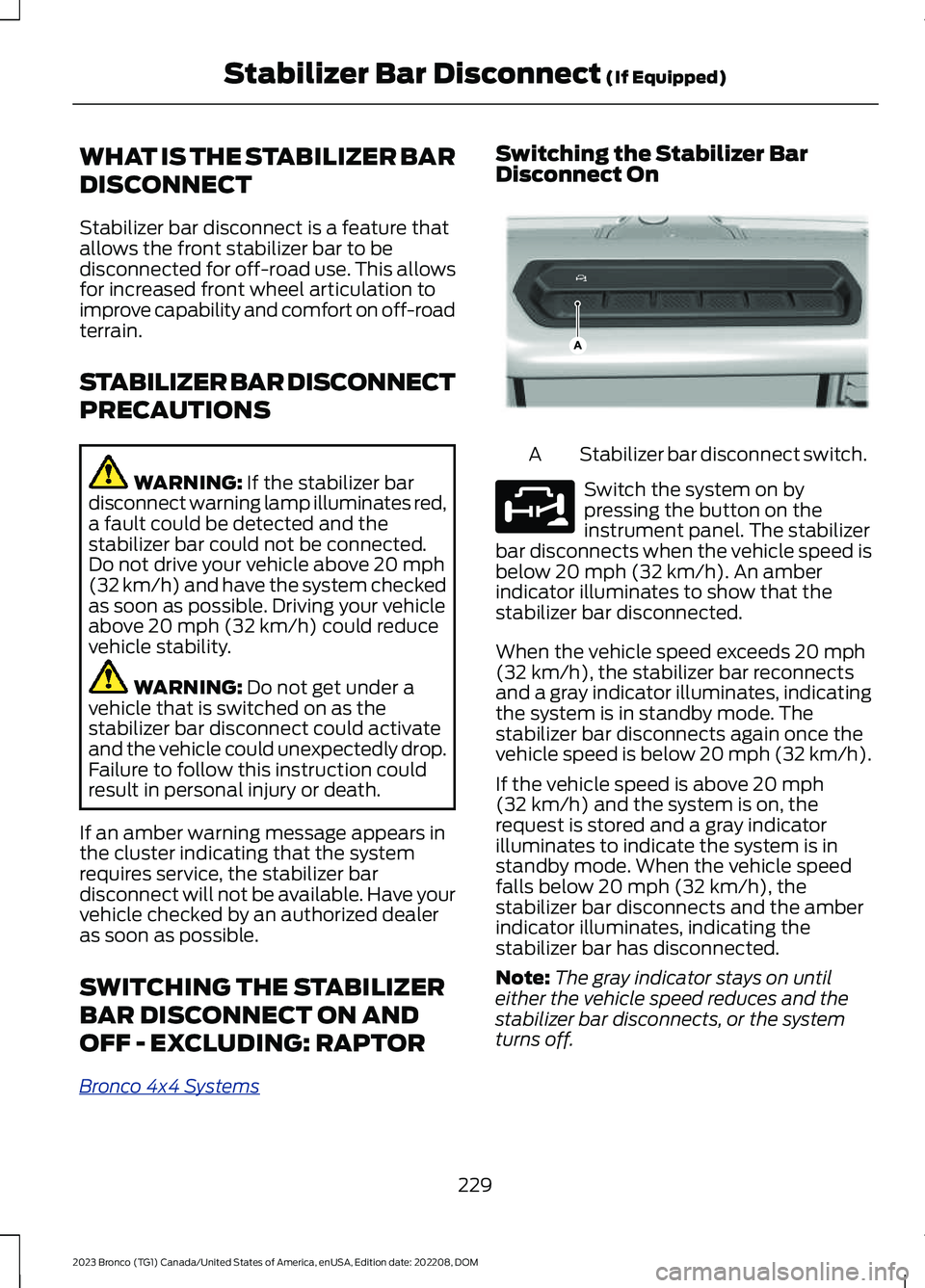
Switching the Stabilizer BarDisconnect On
Stabilizer bar disconnect switch.A
Switch the system on bypressing the button on theinstrument panel. The stabilizerbar disconnects when the vehicle speed isbelow 20 mph (32 km/h). An amberindicator illuminates to show that thestabilizer bar disconnected.
When the vehicle speed exceeds 20 mph(32 km/h), the stabilizer bar reconnectsand a gray indicator illuminates, indicatingthe system is in standby mode. Thestabilizer bar disconnects again once thevehicle speed is below 20 mph (32 km/h).
If the vehicle speed is above 20 mph(32 km/h) and the system is on, therequest is stored and a gray indicatorilluminates to indicate the system is instandby mode. When the vehicle speedfalls below 20 mph (32 km/h), thestabilizer bar disconnects and the amberindicator illuminates, indicating thestabilizer bar has disconnected.
Note:The gray indicator stays on untileither the vehicle speed reduces and thestabilizer bar disconnects, or the systemturns off.
229
2023 Bronco (TG1) Canada/United States of America, enUSA, Edition date: 202208, DOMStabilizer Bar Disconnect (If Equipped)E358560 E329476
Page 239 of 642

WHAT IS HILL DESCENT
CONTROL
Hill descent control allows the driver to setand maintain vehicle speed whiledescending steep slopes in various surfaceconditions.
HOW DOES HILL DESCENT
CONTROL WORK
Hill descent control can maintain vehiclespeeds on downhill slopes between2–20 mph (3–32 km/h). Above 20 mph(32 km/h), the system remains on but thedescent speed cannot be set ormaintained.
Note:The system does not function below2 mph (3 km/h).
The system requires a cool down intervalafter a period of sustained use. Hill descentcontrol provides a warning in the messagecenter and a tone sounds when the systemis about to disengage for cooling. At thistime, manually apply the brakes as neededto maintain descent speed.
Note:The amount of time that the systemcan remain active before cooling varies withconditions.
HILL DESCENT CONTROL
PRECAUTIONS
WARNING: The system does notcontrol speed in low traction conditionsor extremely steep slopes. The systemis designed to be an aid and does notrelieve you of your responsibility to drivewith due care and attention. Failure tofollow this instruction could result inpersonal injury.
WARNING: The system does notreplace the parking brake. When youleave your vehicle, always apply theparking brake.
SWITCHING HILL DESCENT
CONTROL ON AND OFF
Bronco Off-Road Features
Press the button on the centerconsole. A light in the instrumentcluster illuminates when thesystem is active.
SETTING THE HILL DESCENT
SPEED
To increase or decrease the descent speed,press the accelerator or brake pedal, or usethe SET + and SET - buttons on thesteering wheel. Once you reach thepreferred speed remove your feet from thepedals.
HILL DESCENT CONTROL
INDICATOR
Illuminates when you switch hilldescent control on.
235
2023 Bronco (TG1) Canada/United States of America, enUSA, Edition date: 202208, DOMHill Descent Control - Manual TransmissionE328593 E328593
Page 247 of 642

PARKING AID INDICATORS
The system provides object distanceindication through the information display.
•As the distance to the objectdecreases, the indicator blocksilluminate and move toward the vehicleicon.
•If there is no object detected, thedistance indicator blocks are gray.
Visual indication remains on when thetransmission is in reverse (R). When youstop your vehicle, visual indication turnsoff after four seconds.
If the system is not available, the sidedistance indicator blocks do not display.
PARKING AIDS –
TROUBLESHOOTING
PARKING AIDS – INFORMATIONMESSAGES
If a fault is present in the parking aids, awarning message appears in theinstrument cluster or the touchscreen.
Note:When the front or rear park aidpresents a fault message, the side parkingaid also disables.
ActionMessage
The system detects a condition thatrequires service. Have your vehicle checkedas soon as possible.
Check Front Park Aid
The system detects a condition thatrequires service. Have your vehicle checkedas soon as possible.
Check Rear Park Aid
Displays the park aid status.Front Park Aid On Off
Displays the park aid status.Rear Park Aid On Off
243
2023 Bronco (TG1) Canada/United States of America, enUSA, Edition date: 202208, DOMParking AidsE190459