2023 CITROEN C3 fuel
[x] Cancel search: fuelPage 42 of 104

40
Practical information
The battery electrolyte must be filled. If the level
is found to be below the “MIN” level line, add
distilled water to the “MAX” level line.
For more information on the precautions
to take before any work on the 12 V
battery, refer to the corresponding section.
Passenger compartment
filter
Depending on the environment and the
use of the vehicle (e.g. dusty atmosphere,
city driving), change it twice as often, if
necessary .
A clogged passenger compartment filter
can adversely affect air conditioning
system performance and generate
undesirable odours.
Air filter
Depending on the environment and the
use of the vehicle (e.g. dusty atmosphere,
city driving), change it twice as often, if
necessary .
Oil filter
Change the oil filter each time the engine
oil is changed.
Manual gearbox
The gearbox does not require any
maintenance (no oil change).
Brake pads
Brake wear depends on the style of
driving, particularly in the case of vehicles
used in town, over short distances. It may be
necessary to have the condition of the brakes
checked, even between vehicle services.
Unless there is a leak in the circuit, a drop in the
brake fluid level indicates that the brake pads
are worn.
After washing the vehicle, moisture, or in wintry conditions, ice can form on the
brake discs and pads: braking efficiency may
be reduced. Gently dab the brakes to dry and
defrost them.
Brake disc and drum wear
For information on checking brake disc
and drum wear, contact a CITROËN
dealer.
Wheels and tyres
The inflation pressure of all tyres, including the spare wheel, must be
checked on "cold” tyres.
The pressures indicated on the tyre pressure
label are valid for "cold" tyres. If you have driven
for more than 10 minutes or more than 10
kilometres at over 50 km/h, add 0.3 bar (30 kPa)
to the values indicated on the label.
Under-inflation increases fuel
consumption. Non-compliant tyre
pressure causes premature wear on tyres and
has an adverse effect on the vehicle's road
holding - risk of an accident!
Driving with worn or damaged tyres reduces the
braking and road holding performance of the
vehicle. It is recommended to regularly check the
condition of the tyres (tread and sidewalls) and
wheel rims as well as the presence of the valves.
When the wear indicators no longer appear set
back from the tread, the depth of the grooves is
less than 1.6 mm; it is imperative to replace the
tyres.
Using different size wheels and tyres from those
specified can affect the lifetime of tyres, wheel
rotation, ground clearance, the speedometer
reading and have an adverse effect on road
holding.
Fitting different tyres on the front and rear axles
can cause ABS and EBFD systems to mistime.
Shock absorbers
It is not easy for drivers to detect when
shock absorbers are worn. Nevertheless,
the shock absorbers have a major impact on
road-holding and braking performance.
For your safety and driving comfort, it is
important to have them regularly checked by a
CITROËN dealer.
Page 53 of 104

51
In the event of a breakdown
8Relays
RelayColourRating (A) Functions
MICRO Brown 20Ignition Loads
Engine compartment fuses
The fusebox is placed in the engine
compartment near the battery.
Access to the fuses
► Remove the cover.
► Change the fuse.
►
When you have finished, close the cover
carefully then engage the two latches, to ensure
correct sealing of the fusebox.
Version 1
Engine fuse cum relay box
Fuse No. ColourRating (A) Functions
FF01 Green 30ABS ECU
FF02 Red 10HVAC Compressor
FF03 Red 10Horn
FF04 Green 30ECM Loads (Ignition Coil / Injectors / Fuel Pump)
FF05 Blue 15ECM Loads (Canister Valve / O2 Sensors)
FF06 Ta n 5ECM Loads (VVT Valve)
Page 55 of 104
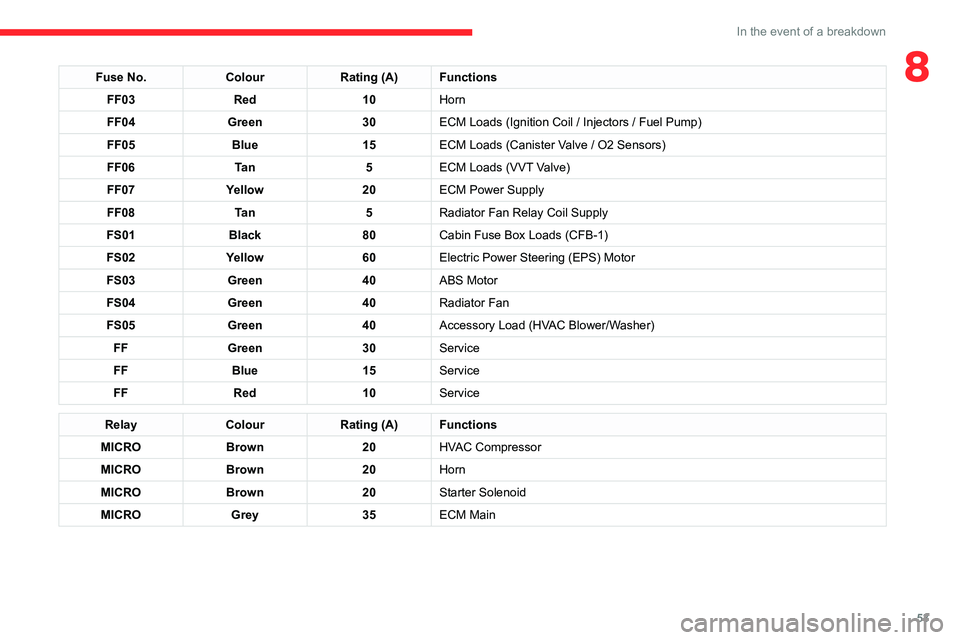
53
In the event of a breakdown
8Fuse No.ColourRating (A) Functions
FF03 Red 10Horn
FF04 Green 30ECM Loads (Ignition Coil
/ Injectors / Fuel Pump)
FF05 Blue 15ECM Loads (Canister Valve
/ O2 Sensors)
FF06 Ta n 5ECM Loads (VVT Valve)
FF07 Yellow 20ECM Power Supply
FF08 Ta n 5Radiator Fan Relay Coil Supply
FS01 Black 80Cabin Fuse Box Loads (CFB-1)
FS02 Yellow 60Electric Power Steering (EPS) Motor
FS03 Green 40ABS Motor
FS04 Green 40Radiator Fan
FS05 Green 40Accessory Load (HVAC Blower/Washer)
FF Green 30Service
FF Blue 15Service
FF Red 10Service
Relay ColourRating (A) Functions
MICRO Brown 20HVAC Compressor
MICRO Brown 20Horn
MICRO Brown 20Starter Solenoid
MICRO Grey 35ECM Main
Page 56 of 104

54
In the event of a breakdown
Engine fuse cum relay box turbo
Fuse No.ColourRating (A) Functions
FF01 Green 30ABS ECU
FF02 Red 10HVAC Compressor
FF03 Red 10Horn
FF04 Green 30ECM Loads (Ignition Coil
/ Fuel Pump)
FF05 Blue 15ECM Loads (Canister Valve
/ O2 Sensors)
FF06 Blue 15ECM Loads (VVT
/ Thermostat / Oil Pump Valve)
FF07 Yellow 20ECM Power Supply & Injectors
FF08 Ta n 5Radiator Fan Relay Coil Supply
FS01 Black 80Cabin Fuse Box Loads (CFB-1)
FS02 Yellow 60Electric Power Steering (EPS) Motor
FS03 Green 40ABS Motor
FS04 Yellow 60Radiator Fan
FS05 Green 40Accessory Load (HVAC Blower/Washer)
FF Green 30Service
FF Blue 15Service
FF Red 10Service
Relay ColourRating (A) Functions
MICRO Brown 20HVAC Compressor
MICRO Brown 20Horn
MICRO Brown 20Starter Solenoid
MICRO Grey 35ECM Main
Page 59 of 104

57
In the event of a breakdown
8at least equal to that of the discharged
battery.
The two vehicles must not be in contact with
each other.
Switch off all electricity-consuming equipment
on both vehicles (audio system, wipers,
lighting, etc.).
Make sure that the jump leads are well away
from the engine’s moving parts (fan, belt,
etc.).
Do not disconnect the (+) terminal while the
engine is running.
During jump start, extra care should be taken
to ensure right terminals are connected. If
terminal connections are reversed, it will
lead to failure of alternator & other electrical,
electronic components.
Never power electrical or electronic
components directly from battery terminals
as it will lead to poor battery charging, poor
performance of components and battery
sensor malfunction, which will impact fuel
economy. For Naturally Aspirated engine version
► Lift the cover on the (+) terminal, if the vehicle
has one.
►
Connect the red cable to the (+) terminal
of flat battery
A, then to the (+) terminal of the
backup battery
B or of the booster.
►
Connect one end of the green or black cable
to the (-) terminal of the backup battery
B or of
the booster (or to an earth point on the assisting
vehicle).
►
Connect the other end of the green or black
cable to the (-) terminal of flat battery
A.
►
Start the engine on the assisting vehicle and
leave it running for a few minutes.
►
Operate the starter on the broken down
vehicle and let the engine run.
If the engine does not start immediately
, switch
off the ignition and wait a few moments before
trying again.
►
W
ait for it to return to idle.
►
Disconnect the jump leads in reverse order:
first remove (-) terminal then (+) terminal.
► Refit the cover to the (+) terminal, if the
vehicle has one.
►
Allow the engine to run for at least
30
minutes, with the vehicle stationary, so that
the battery reaches an adequate state of charge.
For Turbo engine version
The negative cable must be connected to the car ground (not to the battery
negative terminal) so that the battery sensor
can detect all charging and discharging
currents.
►
Lift
the cover on the (+) terminal, if the vehicle
has one.
►
Connect the red cable to the (+) terminal of
flat battery
A (at the metal elbow), then to the
(+) terminal of the backup battery
B or of the
booster.
►
Connect one end of the green or black cable
to the (-) terminal of the backup battery
B or of
Page 60 of 104

58
In the event of a breakdown
the booster (or to an earth point on the assisting
vehicle).
►
Connect the other end of the green or black
cable to the earth point
C
on the broken down
vehicle.
►
Start the engine on the assisting vehicle and
leave it running for a few minutes.
►
Operate the starter on the broken down
vehicle and let the engine run.
If the engine does not start immediately
, switch
off the ignition and wait a few moments before
trying again.
►
W
ait for it to return to idle.
►
Disconnect the jump leads in reverse order:
first remove (-) terminal then (+) terminal..
►
Refit the cover to the (+) terminal, if the
vehicle has one.
►
Allow the engine to run for at least
30
minutes, with the vehicle stationary, so that
the battery reaches an adequate state of charge.
Driving immediately without having
reached a sufficient level of charge may
affect some of the vehicle's functionalities.
Disconnecting/removing the
battery
In order to maintain an adequate state of charge
for starting the engine, it is recommended that
the battery be disconnected if the vehicle is
taken out of service for a long period.
Before disconnecting the battery: ►
Close all openings (doors, boot, windows).
►
Switch off all electrical consumers (audio
system, wipers, lighting, etc.).
►
Switch off the ignition and wait for 4
minutes.
Naturally Aspirated engine version
Turbo engine version
►
Disconnect the negative cable.
►
Disconnect the positive cable.
► Remove the mounting bracket if you need to
remove the battery .
Be careful not to cause accidental short
circuits between the positive and
negative battery terminals.
Do not allow smoking, sparks or flames
around fuel or the battery.
After reconnection
After reconnecting the battery, turn on the
ignition and wait 1 minute before starting the
engine, to enable the electronic systems to
initialise.
If minor problems nevertheless persist following
this operation, contact a CITROËN dealer.
Referring to the relevant section, initialise or
reset certain equipment:
–
Date and time.
–
Preset radio stations.
Towing the vehicle
General recommendations
Observe the legislation in force in the
country where you are driving.
Ensure that the weight of the towing vehicle is
higher than that of the towed vehicle.
The driver must remain at the wheel of the
towed vehicle and must have a valid driving
licence.
Page 62 of 104

60
Technical data
Engines technical data
The engine characteristics are given in the
vehicle's registration document, as well as in
sales brochures.
The maximum power corresponds to the value type-approved on a test bed, under
conditions defined as per AIS 137 (Part 5).
For more information, contact a CITROËN
dealer.
Engine EB2NA
engine EB2ADTM
engine
Gearbox MA5
(Manual
5-speed) MB6
(Manual
6-speed)
Cubic capacity 1 199 cc 1 199 cc
Max. power 60 kW at 5750 rpm81 kW at
5500 rpm
Fuel BSVI
Commercial Gasoline Fuel BSVI
Commercial Gasoline Fuel
Curb weight L1-939 kg L2-964 kgL2-1035 Kg
Dimensions (mm)
These dimensions have been measured on an
unladen vehicle.
Identification markings
Various visible markings for the identification and
research of your vehicle.
A. Vehicle identification number (VIN), BSO
(Body Side Outer) Front Panel RH
Stamped on BIW.
Bears the following information:
–
Manufacturer's name.
–
VIN number
.
–
Model.
–
Engine number
.
B. Chassis number, Seat Cross Member
Panel RH
Below driver seat.
Page 72 of 104

70
Alphabetical index
A
ABS 23
Adjusting headlamps
20
Adjusting seat
14
Adjusting the air distribution
17
Adjusting the air flow
17
Adjusting the headlamp beam height
20
Adjusting the height and reach of
the steering wheel
15
Adjusting the temperature
17
Advice on care and maintenance
41
Advice on driving
4, 31
Airbags
26–27
Airbags, front
26–27
Air conditioning
16–17
Air conditioning, manual
17
Air intake
18
Air vents
16
Anti-lock braking system (ABS)
23
Antitheft / Immobiliser
10
B
Battery, 12 V 39, 56, 58
Battery, remote control
10
Bodywork
41
Bonnet
35–36
Boot
11
Brake discs
40
Brake lamps
47
Brakes 40
Bulbs
45
Bulbs (changing)
45–47
C
Capacity, fuel tank 35
Cap, fuel filler
35
Care of the bodywork
41
Central locking
9–10
Changing a bulb
45–47
Changing a fuse
48, 51
Changing a wheel
42
Changing the remote control battery
10
Checking the levels
37–38
Checks
37, 39–41
Checks, routine
39–40
Child lock
30
Children
25
Children (safety)
30
Child seats
25, 28–29
Child seats, conventional
29
Cleaning (advice)
41
Closing the boot
11
Control, emergency boot release
11
Control, emergency door
10
Control stalk, lighting
20
Control stalk, wipers
21
Courtesy lamp
47
Courtesy lamps
19
D
Dimensions 60
Dipstick
37
Direction indicators (turn signals)
20, 46–47
Doors
11
Driving
31
Driving economically
4
E
EBFD 23
Eco-driving (advice)
4
Electric windows
12
Electronic brake force distribution (EBFD)
23
Emergency warning lamps
23
Engine
35–36, 41
Engine compartment
37
Engine, petrol
60
Engines
60
Environment
10
F
Filling the fuel tank 35
Filter, air
40
Filter, oil
40
Filter, passenger compartment
16, 40
Fitting a wheel
43–44
Fittings, boot
19