2023 CADILLAC XT5 service
[x] Cancel search: servicePage 382 of 482
Cadillac XT5 Owner Manual (GMNA-Localizing-U.S./Canada/Mexico-
16406251) - 2023 - CRC - 3/28/22
Vehicle Care 381
letter“T”as the first
character in the tire size
means the tire is for
temporary use only.
(7) TPC Spec (Tire
Performance Criteria
Specification)
:Original
equipment tires designed
to GM's specific tire
performance criteria have a
TPC specification code
molded onto the sidewall.
GM's TPC specifications
meet or exceed all federal
safety guidelines.
Tire Designations
Tire Size
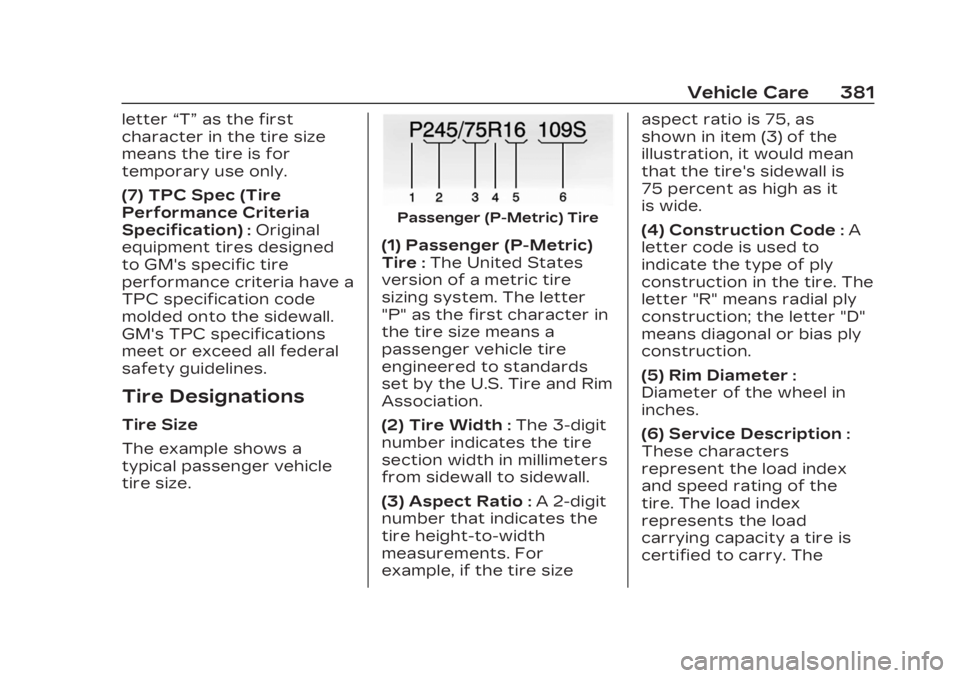
The example shows a
typical passenger vehicle
tire size.
Passenger (P-Metric) Tire
(1) Passenger (P-Metric)
Tire
:The United States
version of a metric tire
sizing system. The letter
"P" as the first character in
the tire size means a
passenger vehicle tire
engineered to standards
set by the U.S. Tire and Rim
Association.
(2) Tire Width
:The 3-digit
number indicates the tire
section width in millimeters
from sidewall to sidewall.
(3) Aspect Ratio
:A 2-digit
number that indicates the
tire height-to-width
measurements. For
example, if the tire size aspect ratio is 75, as
shown in item (3) of the
illustration, it would mean
that the tire's sidewall is
75 percent as high as it
is wide.
(4) Construction Code
:A
letter code is used to
indicate the type of ply
construction in the tire. The
letter "R" means radial ply
construction; the letter "D"
means diagonal or bias ply
construction.
(5) Rim Diameter
:
Diameter of the wheel in
inches.
(6) Service Description
:
These characters
represent the load index
and speed rating of the
tire. The load index
represents the load
carrying capacity a tire is
certified to carry. The
Page 391 of 482

Cadillac XT5 Owner Manual (GMNA-Localizing-U.S./Canada/Mexico-
16406251) - 2023 - CRC - 3/28/22
390 Vehicle Care
successfully completing the
sensor matching process.
See "TPMS Sensor Matching
Process" later in this section.
.One or more TPMS sensors
are missing or damaged. The
malfunction light and the DIC
message should go off when
the TPMS sensors are
installed and the sensor
matching process is
performed successfully. See
your dealer for service.
.Replacement tires or wheels
do not match the original
equipment tires or wheels.
Tires and wheels other than
those recommended could
prevent the TPMS from
functioning properly. See
Buying New Tires0395.
.Operating electronic devices
or being near facilities using
radio wave frequencies
similar to the TPMS could
cause the TPMS sensors to
malfunction. If the TPMS is not functioning
properly it cannot detect or
signal a low tire pressure
condition. See your dealer for
service if the TPMS
malfunction light and DIC
message come on and stay on.
Tire Fill Alert (If Equipped)
This feature provides visual
and audible alerts outside the
vehicle to help when inflating
an underinflated tire to the
recommended cold tire
pressure.
When the low tire pressure
warning light comes on:
1. Park the vehicle in a safe, level place.
2. Set the parking brake firmly.
3. Place the vehicle in P (Park).
4. Add air to the tire that is underinflated. The turn
signal lamp will flash. When the recommended
pressure is reached, the
horn sounds once and the
turn signal lamp will stop
flashing and briefly turn
solid.
Repeat these steps for all
underinflated tires that have
illuminated the low tire
pressure warning light.
{Warning
Overinflating a tire could
cause the tire to rupture
and you or others could be
injured. Do not exceed the
maximum pressure listed on
the tire sidewall. See Tire
Sidewall Labeling 0378 and
Vehicle Load Limits 0247.
If the tire is overinflated by
more than 35 kPa (5 psi), the
horn will sound multiple times
and the turn signal lamp will
continue to flash for several
seconds after filling stops. To
release and correct the
pressure, while the turn signal
Page 392 of 482

Cadillac XT5 Owner Manual (GMNA-Localizing-U.S./Canada/Mexico-
16406251) - 2023 - CRC - 3/28/22
Vehicle Care 391
lamp is still flashing, briefly
press the center of the valve
stem. When the recommended
pressure is reached, the horn
sounds once.
If the turn signal lamp does
not flash within 15 seconds
after starting to inflate the
tire, the tire fill alert has not
been activated or is not
working.
If the hazard warning flashers
are on, the tire fill alert visual
feedback will not work
properly.
The TPMS will not activate the
tire fill alert properly under the
following conditions:
.There is interference from
an external device or
transmitter.
.The air pressure from the
inflation device is not
sufficient to inflate the tire.
.There is a malfunction in
the TPMS.
.There is a malfunction in the
horn or turn signal lamps.
.The identification code of
the TPMS sensor is not
registered to the system.
.The battery of the TPMS
sensor is low.
If the tire fill alert does not
operate due to TPMS
interference, move the vehicle
about 1 m (3 ft) back or
forward and try again. If the
tire fill alert feature is not
working, use a tire pressure
gauge.
TPMS Sensor Matching
Process
Each TPMS sensor has a
unique identification code. The
identification code needs to be
matched to a new tire/wheel
position after rotating the
vehicle’s tires or replacing one
or more of the TPMS sensors.
The TPMS sensor matching
process should also be
performed after replacing a
spare tire with a road tire
containing the TPMS sensor.
The malfunction light and the DIC message should go off at
the next ignition cycle. The
sensors are matched to the
tire/wheel positions, using a
TPMS relearn tool, in the
following order: driver side
front tire, passenger side front
tire, passenger side rear tire,
and driver side rear. See your
dealer for service or to
purchase a relearn tool.
A TPMS relearn tool can also
be purchased. See Tire
Pressure Monitor Sensor
Activation Tool at www.
gmtoolsandequipment.com or
call 1-800-GM TOOLS
(1-800-468-6657).
There are two minutes to
match the first tire/wheel
position, and five minutes
overall to match all four tire/
wheel positions. If it takes
longer, the matching process
stops and must be restarted.
The TPMS sensor matching
process is:
1. Set the parking brake.
Page 393 of 482

Cadillac XT5 Owner Manual (GMNA-Localizing-U.S./Canada/Mexico-
16406251) - 2023 - CRC - 3/28/22
392 Vehicle Care
2. Place the vehicle in ServiceMode. See Ignition
Positions 0252.
3. Make sure the Tire Pressure info display
option is turned on. The
info displays on the DIC
can be turned on and off
through the Options menu.
See Driver Information
Center (DIC) 0139.
4. Use the five-way DIC control on the right side of
the steering wheel to scroll
to the Tire Pressure
screen under the DIC info
page. See Driver
Information Center (DIC)
0139.
5. Press and hold SEL in the center of the five-way DIC
control.
The horn sounds twice to
signal the receiver is in
relearn mode and the TIRE
LEARNING ACTIVE
message displays on the
DIC screen. 6. Start with the driver side
front tire.
7. Place the relearn tool against the tire sidewall,
near the valve stem. Then
press the button to
activate the TPMS sensor.
A horn chirp confirms that
the sensor identification
code has been matched to
this tire and wheel
position.
8. Proceed to the passenger side front tire, and repeat
Step 7.
9. Proceed to the passenger side rear tire, and repeat
Step 7.
10. Proceed to the driver side rear tire, and repeat
Step 7. The horn sounds
two times to indicate the
sensor identification code
has been matched to the
driver side rear tire, and
the TPMS sensor matching
process is no longer active.
The TIRE LEARNING ACTIVE message on the
DIC display screen
goes off.
11. Turn the vehicle off.
12. Set all four tires to the recommended air pressure
level as indicated on the
Tire and Loading
Information label.
Tire Inspection
We recommend that the
tires, including the spare
tire, if the vehicle has one,
be inspected for signs of
wear or damage at least
once a month.
Replace the tire if:
.The indicators at three or
more places around the
tire can be seen.
.There is cord or fabric
showing through the
tire's rubber.
Page 397 of 482

Cadillac XT5 Owner Manual (GMNA-Localizing-U.S./Canada/Mexico-
16406251) - 2023 - CRC - 3/28/22
396 Vehicle Care
performance may be
adversely affected if all the
tires are not replaced at
the same time. If proper
rotation and maintenance
have been done, all four
tires should wear out at
about the same time.
However, if it is necessary
to replace only one axle set
of worn tires, place the
new tires on the rear axle.
See Tire Rotation0393.
{Warning
Tires could explode
during improper service.
Attempting to mount or
dismount a tire could
cause injury or death.
Only your dealer or
authorized tire service
center should mount or
dismount the tires.
{Warning
Mixing tires of different
sizes (other than those
originally installed on the
vehicle), brands, tread
patterns, or types may
cause loss of vehicle
control, resulting in a
crash or other vehicle
damage. Use the correct
size, brand, and type of
tire on all wheels.
{Warning
Using bias-ply tires on
the vehicle may cause the
wheel rim flanges to
develop cracks after
many miles of driving.
A tire and/or wheel could
fail suddenly and cause a
crash. Use only radial-ply
tires with the wheels on
the vehicle. Winter tires with the same
speed rating as the original
equipment tires may not be
available for H, V, W, Y and
ZR speed rated tires. Never
exceed the winter tires’
maximum speed capability
when using winter tires
with a lower speed rating.
If the vehicle tires must be
replaced with a tire that
does not have a TPC Spec
number, make sure they
are the same size, load
range, speed rating, and
construction (radial) as the
original tires.
The Tire and Loading
Information label indicates
the original equipment tires
on the vehicle. See Vehicle
Load Limits
0247.
Page 399 of 482

Cadillac XT5 Owner Manual (GMNA-Localizing-U.S./Canada/Mexico-
16406251) - 2023 - CRC - 3/28/22
398 Vehicle Care
Treadwear 200 Traction AA
Temperature A
All Passenger Car Tires
Must Conform to Federal
Safety Requirements In
Addition To These Grades.
Treadwear
The treadwear grade is a
comparative rating based
on the wear rate of the tire
when tested under
controlled conditions on a
specified government test
course. For example, a tire
graded 150 would wear one
and one-half (1½) times as
well on the government
course as a tire graded
100. The relative
performance of tires
depends upon the actual
conditions of their use,
however, and may depart
significantly from the norm
due to variations in drivinghabits, service practices
and differences in road
characteristics and climate.
Traction
The traction grades, from
highest to lowest, are AA,
A, B, and C. Those grades
represent the tire's ability
to stop on wet pavement
as measured under
controlled conditions on
specified government test
surfaces of asphalt and
concrete. A tire marked C
may have poor traction
performance. Warning: The
traction grade assigned to
this tire is based on
straight-ahead braking
traction tests, and does not
include acceleration,
cornering, hydroplaning,
or peak traction
characteristics.
Temperature
The temperature grades
are A (the highest), B, and
C, representing the tire's
resistance to the
generation of heat and its
ability to dissipate heat
when tested under
controlled conditions on a
specified indoor laboratory
test wheel. Sustained high
temperature can cause the
material of the tire to
degenerate and reduce tire
life, and excessive
temperature can lead to
sudden tire failure. The
grade C corresponds to a
level of performance which
all passenger car tires must
meet under the Federal
Motor Safety Standard
No. 109. Grades B and A
represent higher levels of
performance on the
laboratory test wheel than
the minimum required by
Page 402 of 482

Cadillac XT5 Owner Manual (GMNA-Localizing-U.S./Canada/Mexico-
16406251) - 2023 - CRC - 3/28/22
Vehicle Care 401
If a Tire Goes Flat
It is unusual for a tire to blow
out while driving, especially if
the tires are maintained
properly. See Tires0376. If air
goes out of a tire, it is much
more likely to leak out slowly.
But if there is ever a blowout,
here are a few tips about what
to expect and what to do:
If a front tire fails, the flat tire
creates a drag that pulls the
vehicle toward that side. Take
your foot off the accelerator
pedal and grip the steering
wheel firmly. Steer to maintain
lane position, and then gently
brake to a stop, well off the
road, if possible.
A rear blowout, particularly on
a curve, acts much like a skid
and may require the same
correction as used in a skid.
Stop pressing the accelerator
pedal and steer to straighten
the vehicle. It may be very
bumpy and noisy. Gently brake
to a stop, well off the road,
if possible.{Warning
Driving on a flat tire will
cause permanent damage to
the tire. Re-inflating a tire
after it has been driven on
while severely underinflated
or flat may cause a blowout
and a serious crash. Never
attempt to re-inflate a tire
that has been driven on
while severely underinflated
or flat. Have your dealer or
an authorized tire service
center repair or replace the
flat tire as soon as possible.
{Warning
Lifting a vehicle and getting
under it to do maintenance
or repairs is dangerous
without the appropriate
safety equipment and
training. If a jack is provided
with the vehicle, it is
designed only for changing a
(Continued)
Warning (Continued)
flat tire. If it is used for
anything else, you or others
could be badly injured or
killed if the vehicle slips off
the jack. If a jack is provided
with the vehicle, only use it
for changing a flat tire.
If a tire goes flat, avoid further
tire and wheel damage by
driving slowly to a level place,
well off the road, if possible.
Turn on the hazard warning
flashers. See Hazard Warning
Flashers 0155.
If your vehicle is loaded at or
near maximum cargo capacity,
it may be difficult to fit the jack
under the vehicle due to the
environment (shoulder slope,
road debris, etc.). Removal of
some weight may improve the
ability to fit the jack under the
vehicle at the correct jacking
location.
Page 413 of 482

Cadillac XT5 Owner Manual (GMNA-Localizing-U.S./Canada/Mexico-
16406251) - 2023 - CRC - 3/28/22
412 Vehicle Care
6. Connect the other end ofthe red positive (+) cable to
the good battery
positive (+) terminal.
7. Connect one end of the black negative (–) cable to
the good battery negative
(–) terminal.
8. Connect the other end of the black negative (–) cable
to the discharged battery
negative (–) grounding
point.
9. Start the engine in the vehicle with the good
battery and run the engine
at idle speed for at least
four minutes.
10. Try to start the vehicle that had the dead battery.
If it will not start after a
few tries, it probably needs
service.
Jumper Cable Removal
Reverse the sequence exactly
when removing the jumper
cables. After starting the disabled
vehicle and removing the
jumper cables, allow it to idle
for several minutes.
Towing the
Vehicle
Transporting a
Disabled Vehicle
Caution
Incorrectly transporting a
disabled vehicle may cause
damage to the vehicle. Use
proper tire straps to secure
the vehicle to the flatbed
tow truck. Do not strap or
hook to any frame,
underbody, or suspension
component not specified
below. Do not move vehicles
with drive axle tires on the
ground. Damage is not
covered by the vehicle
warranty.
Caution
The vehicle may be equipped
with an electric parking
brake and/or an electronic
shifter. In the event of a loss
of 12-volt battery power, the
electric parking brake
cannot be released, and the
vehicle cannot be shifted to
N (Neutral). Tire skates or
dollies must be used under
the non-rolling tires to
prevent damage while
loading/unloading the
vehicle. Dragging the vehicle
will cause damage not
covered by the vehicle
warranty.
Caution
The vehicle may be equipped
with a tow eye. Improper use
of the tow eye may cause
damage to the vehicle and is
not covered by the vehicle
warranty. If equipped, use
(Continued)