2023 CADILLAC LYRIC air condition
[x] Cancel search: air conditionPage 314 of 424
Cadillac Lyriq Owner Manual (GMNA-Localizing-U.S./Canada-15644413) -
2023 - CRC - 2/23/22
Vehicle Care 313
1. Windshield Washer FluidReservoir. See Washer Fluid
0314.
2. Hood Latch.
3. Brake Fluid Reservoir. See Brake Fluid 0316.
Cooling System
It is not necessary to regularly
check coolant unless a leak is
suspected or an unusual noise
is heard. A coolant loss could
indicate a problem. Have it
inspected and repaired by
your dealer.
During vehicle operation and
also during charging, the high
voltage battery cells in the
vehicle are kept within a
normal operating temperature
range. If the temperature rises
above this temperature, the
battery cooling system turns
on the air conditioning
compressor and cools the
coolant until the correct
temperature is reached. If the
temperature falls below this
temperature, a high voltage heater, located outside the
battery on a cradle, heats the
coolant until the correct
temperature is reached.
The cooling system allows the
vehicle to maintain the correct
working temperature.Checking Coolant
The coolant needs to be
replaced at the appropriate
interval. See Maintenance
Schedule
0376.
The coolant reservoir is in the
underhood compartment. See
Underhood Compartment
Overview 0312.
To access the coolant
reservoir under the hood, the
right side access cover needs
to be removed. 1. Park on a level surface and turn the vehicle off.
2. Open the hood. See Hood 0310.
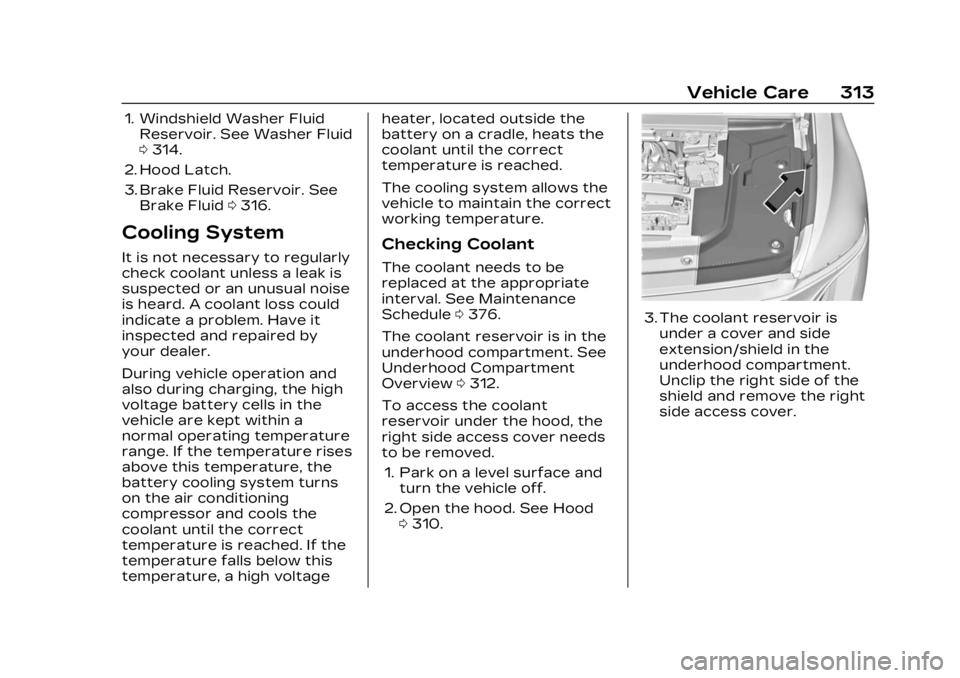
3. The coolant reservoir is
under a cover and side
extension/shield in the
underhood compartment.
Unclip the right side of the
shield and remove the right
side access cover.
Page 316 of 424
Cadillac Lyriq Owner Manual (GMNA-Localizing-U.S./Canada-15644413) -
2023 - CRC - 2/23/22
Vehicle Care 315
Caution (Continued)
damage the washer fluid
tank and other parts of
the washer system.
.When using concentrated
washer fluid, follow the
manufacturer instructions
for adding water.
.Fill the washer fluid tank
only three-quarters full
when it is very cold. This
allows for fluid expansion
if freezing occurs, which
could damage the tank if it
is completely full.
Brakes
Disc brake linings have built-in
wear indicators that make a
high-pitched warning sound
when the brake linings are
worn and new linings are
needed. The sound can come
and go or can be heard all the
time when the vehicle is
moving, except when applying
the brake pedal firmly.
{Warning
The brake wear warning
sound means that soon the
brakes will not work well.
That could lead to a crash.
When the brake wear
warning sound is heard,
have the vehicle serviced.
Caution
Continuing to drive with
worn-out brake linings could
result in costly brake repairs.
Some driving conditions or
climates can cause a brake
squeal when the brakes are
first applied, clearing up
following several applications.
This does not mean something
is wrong with the brakes.
Properly torqued wheel nuts
are necessary to help prevent
brake pulsation. When tires
are rotated, inspect brake
linings for wear and evenly
tighten wheel nuts in the proper sequence to torque
specifications. See Capacities
and Specifications
0383.
Brake pads should be replaced
as complete axle sets.
Brake Pedal Travel
See your dealer if the brake
pedal does not return to
normal height, or if there is a
rapid increase in pedal travel.
This could be a sign that brake
service may be required.
Replacing Brake System
Parts
Always replace brake system
parts with new, approved
replacement parts. If this is
not done, the brakes may not
work properly. The braking
performance can change in
many ways if the wrong brake
parts are installed or if parts
are improperly installed.
Page 329 of 424

Cadillac Lyriq Owner Manual (GMNA-Localizing-U.S./Canada-15644413) -
2023 - CRC - 2/23/22
328 Vehicle Care
Fuses Usage8 MTR MAIN COOL
VLV & ACEC
–
Motor Main
Coolant Valve and
Air Condition
Electric
Compressor
9 Motor: PECP &
Motor: ESSCP
–
Power Electronics
Coolant Pump and
Energy Storage
System
Coolant Pump
10 –
11 –
12 ECP_S & OBCM 2
–
Electrification
Control Processor
(Traction Power
Inverter Module 2)
& On Board
Charging Module 2
13 –
14 – Fuses Usage
15 TRLR PRK LAMPS
–
Trailer Park
Lamps
–
16 TRLR REV LAMP
–
Trailer
Reverse Lamp
–
17 –
18 GLBX DR RELSE
–
Glove Box Release
19 –
20 –
21 CHARGE PORT
DR MTR
–Charge
Port Door Motor
22 AC/DC INV MDL
–
Alternate Current/
Direct Current
Inverter Module
23 –
24 –
25 – Fuses Usage
26 Spare27 –
28 ETC MDL
–
Electronic Toll
Control Module
29 –
30 Rear Cargo APO
–
Rear Cargo
Auxiliary Power
Outlet
31 TRLR INTERFACE
MDL BATT
SOURCE 1
–
Trailer Interface
Module Battery
Source 1
32 Spare
33 Spare
34 ELM 5
–Exterior
Lighting Module 5
35 ELM 4
–Exterior
Lighting Module 4
36 –
Page 335 of 424
Cadillac Lyriq Owner Manual (GMNA-Localizing-U.S./Canada-15644413) -
2023 - CRC - 2/23/22
334 Vehicle Care
Fuses UsageF26 ECP_E_BATT 2/ ACEC & HUD/
HVAC DISPLAY –
Electrification
Control Processor
Battery 2/Air
Condition Electric
Compressor and
Heads-Up Display/
Heating,
Ventilation and Air
Conditioning
Display
F27 BCM 3 –Body
Control Module 3
F28 BCM 2 –Body
Control Module 2
F29 AMP-UPLEVEL –
Amplifier-Uplevel
F30 BCM 4 –Body
Control Module 4 Fuses Usage
F31 VPM/SD CARD/ ILSS/OHC –Video
Processing
Module/SD Card/
Indicator Light and
Solar Sensor/Over
Head Console
F32 HSWM –Heated
Steering Wheel
Module
F33 LRR FR/LIDAR –
Long Range Radar
Front/Light
Detection and
Ranging
F34 ELM 2 –Exterior
Lighting Module 2
F35 HDLP LT –
Headlamp Left
F36 VCU BATT 1 –
Virtual Cockpit
Unit Battery 1
F37 TCP (OnStar) –
Telematics
Communication
Platform Fuses Usage
F38 WCM –Wireless
Charger Module
F39 HI VOLTAGE SYS LCKOUT –High
Voltage System
Lockout
F40 VCU Batt 2 –
Virtual Cockpit
Unit Battery 2
F41 ELM 6 –Exterior
Lighting Module 6
F42 –
Wheels and Tires
Tires
Every new GM vehicle has
high-quality tires made by a
leading tire manufacturer.
See the warranty manual
for information regarding
the tire warranty and
where to get service. For
additional information refer
to the tire manufacturer.
Page 336 of 424
Cadillac Lyriq Owner Manual (GMNA-Localizing-U.S./Canada-15644413) -
2023 - CRC - 2/23/22
Vehicle Care 335
{Warning
.Poorly maintained and
improperly used tires
are dangerous.
.Overloading the tires
can cause overheating
as a result of too much
flexing. There could be
a blowout and a serious
crash. See Vehicle Load
Limits0202.
.Underinflated tires
pose the same danger
as overloaded tires. The
resulting crash could
cause serious injury.
Check all tires
frequently to maintain
the recommended
pressure. Tire pressure
should be checked
when the tires are cold.
(Continued)
Warning (Continued)
.Overinflated tires are
more likely to be cut,
punctured, or broken by
a sudden impact —such
as when hitting a
pothole. Keep tires at
the recommended
pressure.
.Worn or old tires can
cause a crash. If the
tread is badly worn,
replace them.
.Replace any tires that
have been damaged by
impacts with potholes,
curbs, etc.
.Improperly repaired
tires can cause a crash.
Only your dealer or an
authorized tire service
center should repair,
replace, dismount, and
mount the tires.
(Continued)
Warning (Continued)
.Do not spin the tires in
excess of 56 km/h
(35 mph) on slippery
surfaces such as snow,
mud, ice, etc. Excessive
spinning may cause the
tires to explode.
All-Season Tires
This vehicle may come with
all-season tires. These tires
are designed to provide good
overall performance on most
road surfaces and weather
conditions. Original equipment
tires designed to GM's specific
tire performance criteria have
a TPC specification code
molded onto the sidewall.
Original equipment all-season
tires can be identified by the
last two characters of this
TPC code, which will be “MS.”
Consider installing winter tires
on the vehicle if frequent
driving on snow or ice-covered
Page 337 of 424
Cadillac Lyriq Owner Manual (GMNA-Localizing-U.S./Canada-15644413) -
2023 - CRC - 2/23/22
336 Vehicle Care
roads is expected. All-season
tires provide adequate
performance for most winter
driving conditions, but they
may not offer the same level
of traction or performance as
winter tires on snow or
ice-covered roads. See Winter
Tires0336.
Winter Tires
This vehicle was not originally
equipped with winter tires.
Winter tires are designed for
increased traction on snow
and ice-covered roads.
Consider installing winter tires
on the vehicle if frequent
driving on ice or snow covered
roads is expected. See your
dealer for details regarding
winter tire availability and
proper tire selection. Also, see
Buying New Tires 0350.
With winter tires, there may
be decreased dry road
traction, increased road noise,
and shorter tread life. After changing to winter tires, be
alert for changes in vehicle
handling and braking.
If using winter tires:
.Use tires of the same brand
and tread type on all four
wheel positions.
.Use only radial ply tires of
the same size, load range,
and speed rating as the
original equipment tires.
Winter tires with the same
speed rating as the original
equipment tires may not be
available for H, V, W, Y, and ZR
speed rated tires. If winter
tires with a lower speed rating
are chosen, never exceed the
tire's maximum speed
capability.
Self-Sealing Tires
This vehicle may have
self-sealing tires. These tires
have a material inside that can
seal punctures from common
road hazards, such as nails
and screws, in the tread area.
The tire may lose air pressure if the sidewall is damaged or
the tread puncture is too
large. If the Tire Pressure
Monitor System indicates the
tire pressure is low, inspect
the tire for damage and inflate
it to the recommended
pressure. If the tire is unable
to maintain the recommended
pressure, contact the nearest
authorized GM servicing
facility immediately for
inspection and repair or
replacement. To locate the
nearest GM servicing facility,
call GM Customer Assistance.
Caution
Do not drive on a deflated
self-sealing tire as this could
damage the tire. Make sure
the tire is inflated to the
recommended pressure or
have it immediately repaired
or replaced.
When tire replacement is
needed replace with a
self-sealing tire, because the
Page 345 of 424

Cadillac Lyriq Owner Manual (GMNA-Localizing-U.S./Canada-15644413) -
2023 - CRC - 2/23/22
344 Vehicle Care
maintain correct tire pressure,
even if under-inflation has not
reached the level to trigger
illumination of the TPMS low
tire pressure telltale.
Your vehicle has also been
equipped with a TPMS
malfunction indicator to
indicate when the system is
not operating properly. The
TPMS malfunction indicator is
combined with the low tire
pressure telltale. When the
system detects a malfunction,
the telltale will flash for
approximately one minute and
then remain continuously
illuminated. This sequence will
continue upon subsequent
vehicle start-ups as long as
the malfunction exists.
When the malfunction
indicator is illuminated, the
system may not be able to
detect or signal low tire
pressure as intended. TPMS
malfunctions may occur for a
variety of reasons, including
the installation of replacementor alternate tires or wheels on
the vehicle that prevent the
TPMS from functioning
properly. Always check the
TPMS malfunction telltale
after replacing one or more
tires or wheels on your vehicle
to ensure that the
replacement or alternate tires
and wheels allow the TPMS to
continue to function properly.
See Tire Pressure Monitor
Operation
0344.
See Radio Frequency
Statement 0395.
Tire Pressure Monitor
Operation
This vehicle may have a Tire
Pressure Monitor System
(TPMS). The TPMS is designed
to warn the driver when a low
tire pressure condition exists.
TPMS sensors are mounted
onto each tire and wheel
assembly, excluding the spare
tire and wheel assembly. The
TPMS sensors monitor the air
pressure in the tires and transmit the tire pressure
readings to a receiver located
in the vehicle.
When a low tire pressure
condition is detected, the
TPMS illuminates the low tire
pressure warning light located
on the instrument cluster.
If the warning light comes on,
stop as soon as possible and
inflate the tires to the
recommended pressure
shown on the Tire and
Loading Information label. See
Vehicle Load Limits
0202.
A message to check the
pressure in a specific tire
displays in the Driver
Information Center (DIC). The
low tire pressure warning light
and the DIC warning message
come on each time the vehicle
is turned on until the tires are
Page 346 of 424

Cadillac Lyriq Owner Manual (GMNA-Localizing-U.S./Canada-15644413) -
2023 - CRC - 2/23/22
Vehicle Care 345
inflated to the correct inflation
pressure. If the vehicle has
DIC buttons, tire pressure
levels can be viewed. For
additional information and
details about the DIC
operation and displays, see
Driver Information Center
(DIC)0132.
The low tire pressure warning
light may come on in cool
weather when the vehicle is
first started, and then turn off
as the vehicle is driven. This
could be an early indicator
that the air pressure is getting
low and needs to be inflated to
the proper pressure.
A Tire and Loading
Information label shows the
size of the original equipment
tires and the correct inflation
pressure for the tires when
they are cold. See Vehicle
Load Limits 0202, for an
example of the Tire and
Loading Information label and
its location. Also see Tire
Pressure 0342. The TPMS can warn about a
low tire pressure condition but
it does not replace normal tire
maintenance. See Tire
Inspection
0347, Tire Rotation
0 348, and Tires 0334.
Caution
Tire sealant materials are
not all the same.
A non-approved tire sealant
could damage the TPMS
sensors. TPMS sensor
damage caused by using an
incorrect tire sealant is not
covered by the vehicle
warranty. Always use only
the GM approved tire
sealant available through
your dealer or included in
the vehicle.
TPMS Malfunction Light
and Message
The TPMS will not function
properly if one or more of the
TPMS sensors are missing or
inoperable. When the system
detects a malfunction, the low tire pressure warning light
flashes for about one minute
and then stays on for the
remainder of the time the
vehicle is on. A DIC warning
message also displays. The
malfunction light and DIC
warning message will come on
each time the vehicle is turned
on until the problem is
corrected. Some of the
conditions that can cause
these to come on are:
.One of the road tires has
been replaced with the
spare tire. The spare tire
does not have a TPMS
sensor. The malfunction light
and the DIC message should
go off after the road tire is
replaced and the sensor
matching process is
performed successfully. See
"TPMS Sensor Matching
Process" later in this section.
.The TPMS sensor matching
process was not done or not
completed successfully after
rotating the tires. The
malfunction light and the DIC