2023 CADILLAC LYRIC light
[x] Cancel search: lightPage 291 of 424
Cadillac Lyriq Owner Manual (GMNA-Localizing-U.S./Canada-15644413) -
2023 - CRC - 2/23/22
290 Driving and Operating
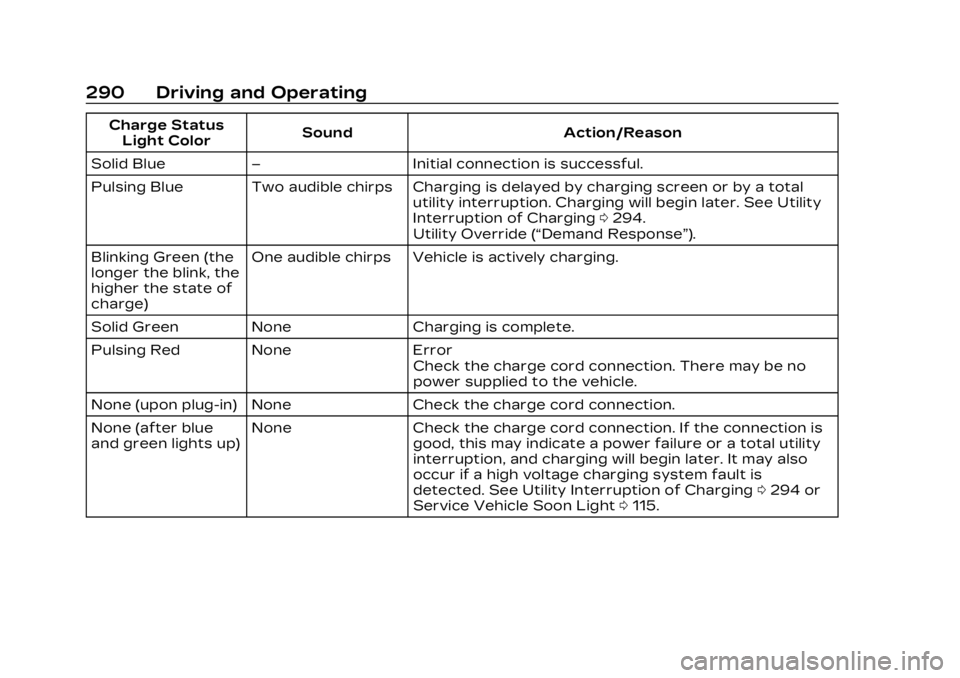
Charge StatusLight Color Sound Action/Reason
Solid Blue – Initial connection is successful.
Pulsing Blue Two audible chirps Charging is delayed by charging screen or by a total utility interruption. Charging will begin later. See Utility
Interruption of Charging0294.
Utility Override (“Demand Response”).
Blinking Green (the
longer the blink, the
higher the state of
charge) One audible chirps Vehicle is actively charging.
Solid Green None Charging is complete.
Pulsing Red None Error Check the charge cord connection. There may be no
power supplied to the vehicle.
None (upon plug-in) None Check the charge cord connection.
None (after blue
and green lights up) None Check the charge cord connection. If the connection is
good, this may indicate a power failure or a total utility
interruption, and charging will begin later. It may also
occur if a high voltage charging system fault is
detected. See Utility Interruption of Charging 0294 or
Service Vehicle Soon Light 0115.
Page 292 of 424
Cadillac Lyriq Owner Manual (GMNA-Localizing-U.S./Canada-15644413) -
2023 - CRC - 2/23/22
Driving and Operating 291
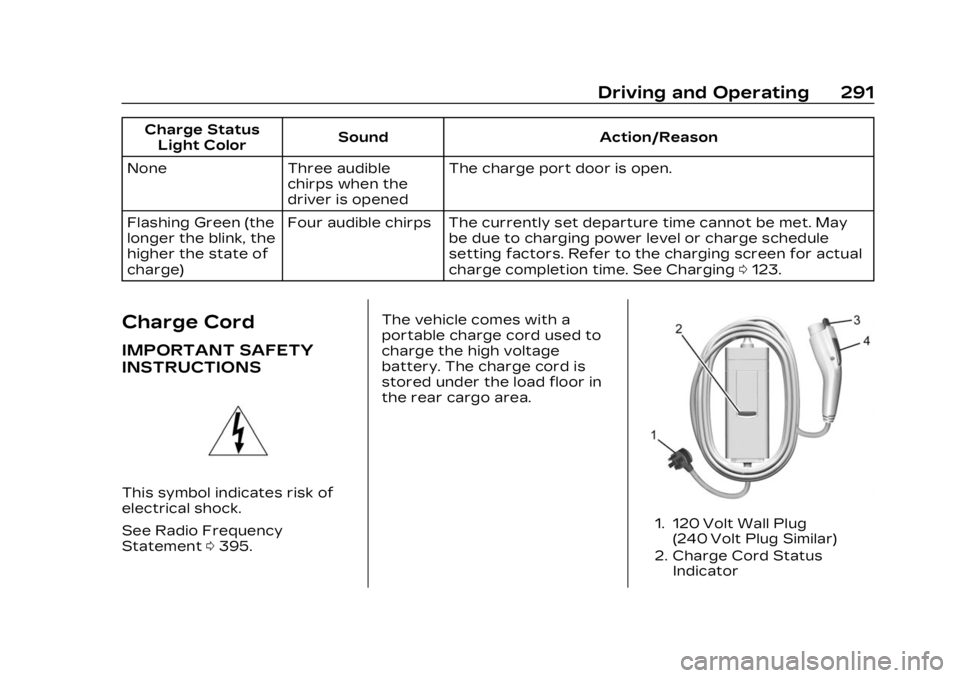
Charge StatusLight Color Sound Action/Reason
None Three audible chirps when the
driver is opened The charge port door is open.
Flashing Green (the
longer the blink, the
higher the state of
charge) Four audible chirps The currently set departure time cannot be met. May
be due to charging power level or charge schedule
setting factors. Refer to the charging screen for actual
charge completion time. See Charging 0123.
Charge Cord
IMPORTANT SAFETY
INSTRUCTIONS
This symbol indicates risk of
electrical shock.
See Radio Frequency
Statement 0395. The vehicle comes with a
portable charge cord used to
charge the high voltage
battery. The charge cord is
stored under the load floor in
the rear cargo area.
1. 120 Volt Wall Plug
(240 Volt Plug Similar)
2. Charge Cord Status Indicator
Page 306 of 424
Cadillac Lyriq Owner Manual (GMNA-Localizing-U.S./Canada-15644413) -
2023 - CRC - 2/23/22
Driving and Operating 305
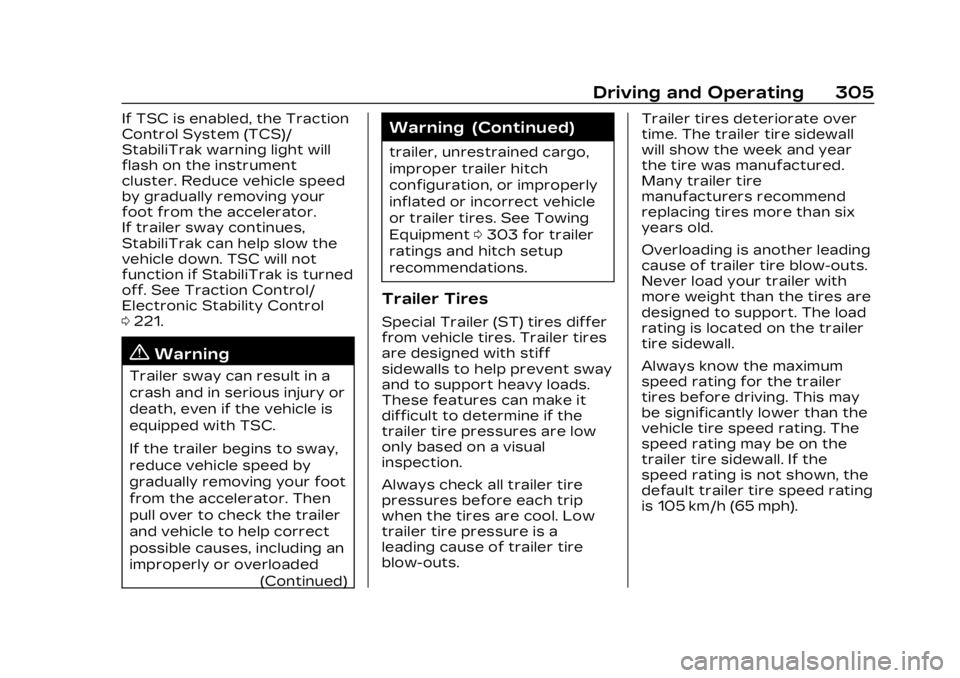
If TSC is enabled, the Traction
Control System (TCS)/
StabiliTrak warning light will
flash on the instrument
cluster. Reduce vehicle speed
by gradually removing your
foot from the accelerator.
If trailer sway continues,
StabiliTrak can help slow the
vehicle down. TSC will not
function if StabiliTrak is turned
off. See Traction Control/
Electronic Stability Control
0221.
{Warning
Trailer sway can result in a
crash and in serious injury or
death, even if the vehicle is
equipped with TSC.
If the trailer begins to sway,
reduce vehicle speed by
gradually removing your foot
from the accelerator. Then
pull over to check the trailer
and vehicle to help correct
possible causes, including an
improperly or overloaded
(Continued)
Warning (Continued)
trailer, unrestrained cargo,
improper trailer hitch
configuration, or improperly
inflated or incorrect vehicle
or trailer tires. See Towing
Equipment0303 for trailer
ratings and hitch setup
recommendations.
Trailer Tires
Special Trailer (ST) tires differ
from vehicle tires. Trailer tires
are designed with stiff
sidewalls to help prevent sway
and to support heavy loads.
These features can make it
difficult to determine if the
trailer tire pressures are low
only based on a visual
inspection.
Always check all trailer tire
pressures before each trip
when the tires are cool. Low
trailer tire pressure is a
leading cause of trailer tire
blow-outs. Trailer tires deteriorate over
time. The trailer tire sidewall
will show the week and year
the tire was manufactured.
Many trailer tire
manufacturers recommend
replacing tires more than six
years old.
Overloading is another leading
cause of trailer tire blow-outs.
Never load your trailer with
more weight than the tires are
designed to support. The load
rating is located on the trailer
tire sidewall.
Always know the maximum
speed rating for the trailer
tires before driving. This may
be significantly lower than the
vehicle tire speed rating. The
speed rating may be on the
trailer tire sidewall. If the
speed rating is not shown, the
default trailer tire speed rating
is 105 km/h (65 mph).
Page 307 of 424
Cadillac Lyriq Owner Manual (GMNA-Localizing-U.S./Canada-15644413) -
2023 - CRC - 2/23/22
306 Driving and Operating
Conversions and
Add-Ons
Add-On Electrical
Equipment
{Warning
The Data Link Connector
(DLC) is used for vehicle
service and Emission
Inspection/Maintenance
testing. See Service Vehicle
Soon Light0115. A device
connected to the DLC —
such as an aftermarket fleet
or driver-behavior tracking
device —may interfere with
vehicle systems. This could
affect vehicle operation and
cause a crash. Such devices
may also access information
stored in the vehicle’s
systems.
Caution
Some electrical equipment
can damage the vehicle or
cause components to not
work and would not be
covered by the vehicle
warranty. Always check with
your dealer before adding
electrical equipment.
Add-on equipment can drain
the vehicle's 12-volt battery,
even if the vehicle is not
operating.
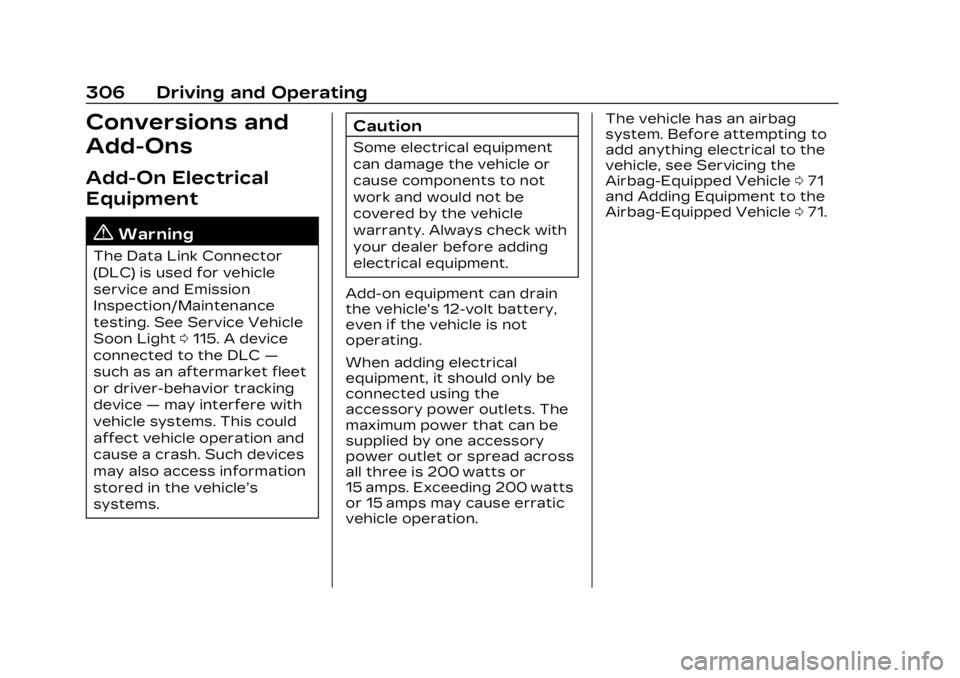
When adding electrical
equipment, it should only be
connected using the
accessory power outlets. The
maximum power that can be
supplied by one accessory
power outlet or spread across
all three is 200 watts or
15 amps. Exceeding 200 watts
or 15 amps may cause erratic
vehicle operation. The vehicle has an airbag
system. Before attempting to
add anything electrical to the
vehicle, see Servicing the
Airbag-Equipped Vehicle
071
and Adding Equipment to the
Airbag-Equipped Vehicle 071.
Page 308 of 424

Cadillac Lyriq Owner Manual (GMNA-Localizing-U.S./Canada-15644413) -
2023 - CRC - 2/23/22
Vehicle Care 307
Vehicle Care
General Information
General Information . . . . . . 308
California PerchlorateMaterials
Requirements . . . . . . . . . . . . . 308
Accessories and Modifications . . . . . . . . . . . . . 308
Vehicle Checks
Doing Your OwnService Work . . . . . . . . . . . . . 309
Hood . . . . . . . . . . . . . . . . . . . . . . . . . . . 310
Underhood Compartment Overview . . . . . . . . . . . . . . . . . . . . 312
Cooling System . . . . . . . . . . . . . 313
Washer Fluid . . . . . . . . . . . . . . . . 314
Brakes . . . . . . . . . . . . . . . . . . . . . . . . . 315
Brake Fluid . . . . . . . . . . . . . . . . . . . 316
Battery - North America . . . . . . . . . . . . . . . . . . . . . . 317
Park Brake and P (Park) Mechanism Check . . . . . . . 320
Wiper Blade Replacement . . . . . . . . . . . . . . 320
Windshield Replacement . . . . . . . . . . . . . . . 321
Gas Strut(s) . . . . . . . . . . . . . . . . . . 321
Headlamp Aiming
Front Headlamp Aiming . . . . . . . . . . . . . . . . . . . . . . . 322
Bulb Replacement
Bulb Replacement . . . . . . . . . 323
LED Lighting . . . . . . . . . . . . . . . . 323
Electrical System
High Voltage Devices andWiring . . . . . . . . . . . . . . . . . . . . . . . 323
Electrical System Overload . . . . . . . . . . . . . . . . . . . . 323
Fuses and Circuit Breakers . . . . . . . . . . . . . . . . . . . . 325
Underhood Compartment Fuse Block . . . . . . . . . . . . . . . . . 326
Instrument Panel Fuse Block . . . . . . . . . . . . . . . . . . . . . . . . . 331
Wheels and Tires
Tires . . . . . . . . . . . . . . . . . . . . . . . . . . . 334
All-Season Tires . . . . . . . . . . . 335
Winter Tires . . . . . . . . . . . . . . . . 336
Self-Sealing Tires . . . . . . . . . 336
Low-Profile Tires . . . . . . . . . . 337
Tire Sidewall Labeling . . . . 337
Tire Designations . . . . . . . . . . 338
Tire Terminology andDefinitions . . . . . . . . . . . . . . . . . 339
Tire Pressure . . . . . . . . . . . . . . . 342 Tire Pressure Monitor
System . . . . . . . . . . . . . . . . . . . . . . 343
Tire Pressure Monitor Operation . . . . . . . . . . . . . . . . . . 344
Tire Inspection . . . . . . . . . . . . . 347
Tire Rotation . . . . . . . . . . . . . . . 348
When It Is Time for New
Tires . . . . . . . . . . . . . . . . . . . . . . . . . 349
Buying New Tires . . . . . . . . . 350
Different Size Tires and Wheels . . . . . . . . . . . . . . . . . . . . . . 352
Uniform Tire Quality Grading . . . . . . . . . . . . . . . . . . . . . 352
Wheel Alignment and Tire Balance . . . . . . . . . . . . . . . 354
Wheel Replacement . . . . . . 354
Tire Chains . . . . . . . . . . . . . . . . . . 355
If a Tire Goes Flat . . . . . . . . . 355
Jump Starting
Jump Starting - North America . . . . . . . . . . . . . . . . . . . . . 356
Towing the Vehicle
Transporting a DisabledVehicle . . . . . . . . . . . . . . . . . . . . . . 359
Recreational Vehicle Towing . . . . . . . . . . . . . . . . . . . . . . 362
Page 317 of 424
Cadillac Lyriq Owner Manual (GMNA-Localizing-U.S./Canada-15644413) -
2023 - CRC - 2/23/22
316 Vehicle Care
Brake Fluid
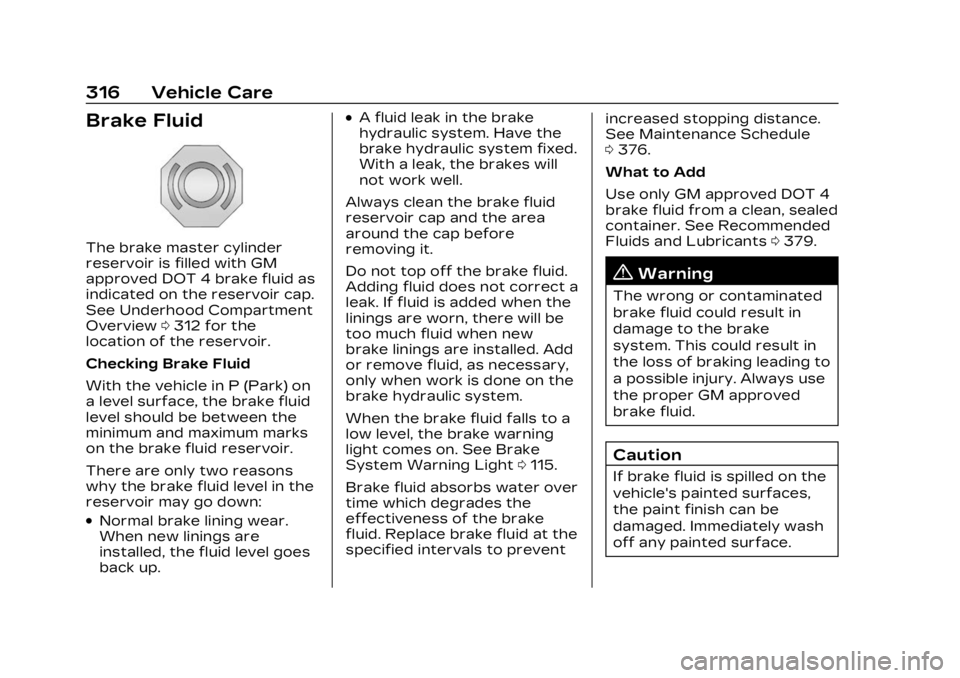
The brake master cylinder
reservoir is filled with GM
approved DOT 4 brake fluid as
indicated on the reservoir cap.
See Underhood Compartment
Overview0312 for the
location of the reservoir.
Checking Brake Fluid
With the vehicle in P (Park) on
a level surface, the brake fluid
level should be between the
minimum and maximum marks
on the brake fluid reservoir.
There are only two reasons
why the brake fluid level in the
reservoir may go down:
.Normal brake lining wear.
When new linings are
installed, the fluid level goes
back up.
.A fluid leak in the brake
hydraulic system. Have the
brake hydraulic system fixed.
With a leak, the brakes will
not work well.
Always clean the brake fluid
reservoir cap and the area
around the cap before
removing it.
Do not top off the brake fluid.
Adding fluid does not correct a
leak. If fluid is added when the
linings are worn, there will be
too much fluid when new
brake linings are installed. Add
or remove fluid, as necessary,
only when work is done on the
brake hydraulic system.
When the brake fluid falls to a
low level, the brake warning
light comes on. See Brake
System Warning Light 0115.
Brake fluid absorbs water over
time which degrades the
effectiveness of the brake
fluid. Replace brake fluid at the
specified intervals to prevent increased stopping distance.
See Maintenance Schedule
0
376.
What to Add
Use only GM approved DOT 4
brake fluid from a clean, sealed
container. See Recommended
Fluids and Lubricants 0379.
{Warning
The wrong or contaminated
brake fluid could result in
damage to the brake
system. This could result in
the loss of braking leading to
a possible injury. Always use
the proper GM approved
brake fluid.
Caution
If brake fluid is spilled on the
vehicle's painted surfaces,
the paint finish can be
damaged. Immediately wash
off any painted surface.
Page 324 of 424
Cadillac Lyriq Owner Manual (GMNA-Localizing-U.S./Canada-15644413) -
2023 - CRC - 2/23/22
Vehicle Care 323
Bulb Replacement
For the proper type of
replacement bulbs, or any bulb
changing procedure not listed
in this section, contact your
dealer.
Caution
Do not replace incandescent
bulbs with aftermarket LED
replacement bulbs. This can
cause damage to the vehicle
electrical system.
LED Lighting
This vehicle has several LED
lamps. For replacement of any
LED lighting assembly, contact
your dealer.
Electrical System
High Voltage Devices
and Wiring
{Warning
Exposure to high voltage
can cause shock, burns, and
even death. The high voltage
components in the vehicle
can only be serviced by
technicians with special
training.
High voltage components
are identified by labels. Do
not remove, open, take
apart, or modify these
components. High voltage
cable or wiring has orange
covering or labels. Do not
probe, tamper with, cut,
or modify high voltage cable
or wiring.
Electrical System
Overload
The vehicle has fuses and
circuit breakers to protect
against an electrical system
overload.
When the current electrical
load is too heavy, the circuit
breaker opens and closes,
protecting the circuit until the
current load returns to normal
or the problem is fixed. This
greatly reduces the chance of
circuit overload and fire
caused by electrical problems.
Fuses and circuit breakers
protect the wires that provide
the power to the devices in
your vehicle.
If there is a problem on the
road and a fuse needs to be
replaced, the same amperage
fuse can be borrowed. Choose
some feature of the vehicle
that is not needed to use and
replace it as soon as possible.
Page 329 of 424

Cadillac Lyriq Owner Manual (GMNA-Localizing-U.S./Canada-15644413) -
2023 - CRC - 2/23/22
328 Vehicle Care
Fuses Usage8 MTR MAIN COOL
VLV & ACEC
–
Motor Main
Coolant Valve and
Air Condition
Electric
Compressor
9 Motor: PECP &
Motor: ESSCP
–
Power Electronics
Coolant Pump and
Energy Storage
System
Coolant Pump
10 –
11 –
12 ECP_S & OBCM 2
–
Electrification
Control Processor
(Traction Power
Inverter Module 2)
& On Board
Charging Module 2
13 –
14 – Fuses Usage
15 TRLR PRK LAMPS
–
Trailer Park
Lamps
–
16 TRLR REV LAMP
–
Trailer
Reverse Lamp
–
17 –
18 GLBX DR RELSE
–
Glove Box Release
19 –
20 –
21 CHARGE PORT
DR MTR
–Charge
Port Door Motor
22 AC/DC INV MDL
–
Alternate Current/
Direct Current
Inverter Module
23 –
24 –
25 – Fuses Usage
26 Spare27 –
28 ETC MDL
–
Electronic Toll
Control Module
29 –
30 Rear Cargo APO
–
Rear Cargo
Auxiliary Power
Outlet
31 TRLR INTERFACE
MDL BATT
SOURCE 1
–
Trailer Interface
Module Battery
Source 1
32 Spare
33 Spare
34 ELM 5
–Exterior
Lighting Module 5
35 ELM 4
–Exterior
Lighting Module 4
36 –