2023 ALFA ROMEO STELVIO climate control
[x] Cancel search: climate controlPage 140 of 268
STARTING AND OPERATING
138
CONNECTING THE ELECTRICAL SYSTEM
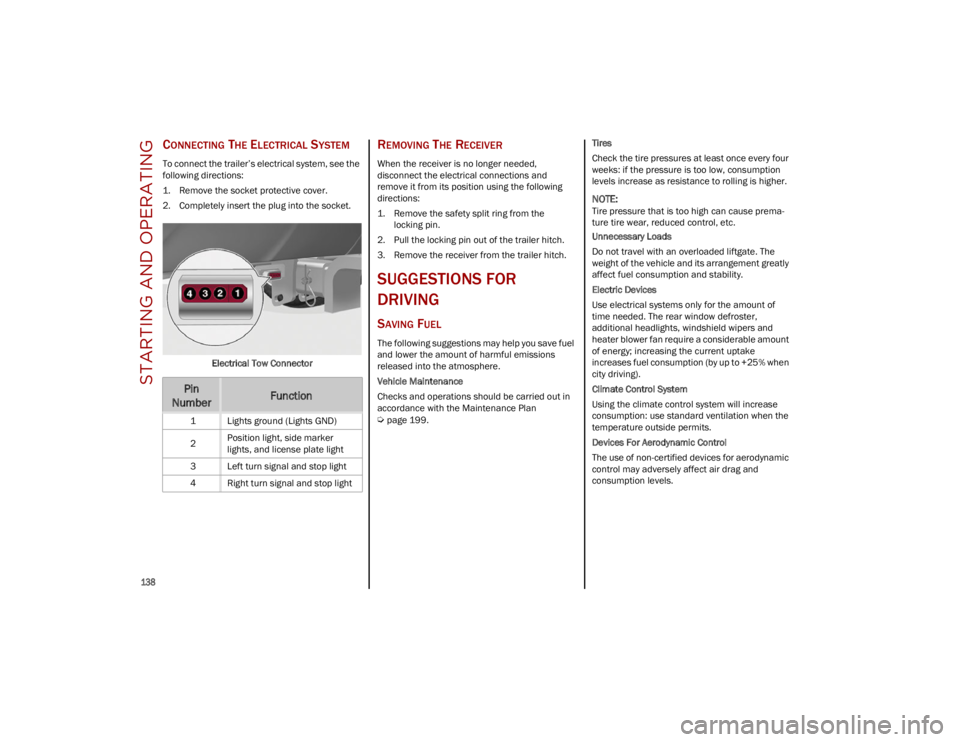
To connect the trailer’s electrical system, see the
following directions:
1. Remove the socket protective cover.
2. Completely insert the plug into the socket.Electrical Tow Connector
REMOVING THE RECEIVER
When the receiver is no longer needed,
disconnect the electrical connections and
remove it from its position using the following
directions:
1. Remove the safety split ring from thelocking pin.
2. Pull the locking pin out of the trailer hitch.
3. Remove the receiver from the trailer hitch.
SUGGESTIONS FOR
DRIVING
SAVING FUEL
The following suggestions may help you save fuel
and lower the amount of harmful emissions
released into the atmosphere.
Vehicle Maintenance
Checks and operations should be carried out in
accordance with the Maintenance Plan
Ú
page 199. Tires
Check the tire pressures at least once every four
weeks: if the pressure is too low, consumption
levels increase as resistance to rolling is higher.
NOTE:
Tire pressure that is too high can cause prema
-
ture tire wear, reduced control, etc.
Unnecessary Loads
Do not travel with an overloaded liftgate. The
weight of the vehicle and its arrangement greatly
affect fuel consumption and stability.
Electric Devices
Use electrical systems only for the amount of
time needed. The rear window defroster,
additional headlights, windshield wipers and
heater blower fan require a considerable amount
of energy; increasing the current uptake
increases fuel consumption (by up to +25% when
city driving).
Climate Control System
Using the climate control system will increase
consumption: use standard ventilation when the
temperature outside permits.
Devices For Aerodynamic Control
The use of non-certified devices for aerodynamic
control may adversely affect air drag and
consumption levels.
Pin
NumberFunction
1 Lights ground (Lights GND)
2 Position light, side marker
lights, and license plate light
3 Left turn signal and stop light
4 Right turn signal and stop light
23_GU_OM_EN_USC_t.book Page 138
Page 184 of 268

SAFETY
182
PERIODIC SAFETY CHECKS YOU SHOULD
M
AKE OUTSIDE THE VEHICLE
Tires
Examine tires for excessive tread wear and
uneven wear patterns. Check for stones, nails,
glass, or other objects lodged in the tread or
sidewall. Inspect the tread for cuts and cracks.
Inspect sidewalls for cuts, cracks, and bulges.
Check the wheel nuts for tightness. Check the
tires (including spare) for proper cold inflation
pressure.
Lights
Have someone observe the operation of brake
lights and exterior lights while you work the
controls. Check turn signal and high beam
indicator lights on the instrument panel.
Door Latches
Check for proper closing, latching, and locking.
Fluid Leaks
Check area under the vehicle after overnight
parking for fuel, coolant, oil, or other fluid leaks.
Also, if gasoline fumes are detected or if fuel, or
brake fluid leaks are suspected, the cause should
be located and corrected immediately.
EXHAUST GAS
The best protection against carbon monoxide
entry into the vehicle body is a properly
maintained engine exhaust system.
Whenever a change is noticed in the sound of the
exhaust system, when exhaust fumes can be
detected inside the vehicle, or when the
underside or rear of the vehicle is damaged, have
a competent mechanic inspect the complete
exhaust system and adjacent body areas for
broken, damaged, deteriorated, or mispositioned parts. Open seams or loose connections could
permit exhaust fumes to seep into the passenger
compartment. In addition, inspect the exhaust
system each time the vehicle is raised for
lubrication or oil change. Replace as required.
CARBON MONOXIDE WARNINGS
WARNING!
Exhaust gases can injure or kill. They contain
carbon monoxide (CO), which is colorless and
odorless. Breathing it can make you
unconscious and can eventually poison you. To
avoid breathing (CO), follow these safety tips:
Do not run the engine in a closed garage or in
confined areas any longer than needed to
move your vehicle in or out of the area.
If you are required to drive with the trunk/
liftgate/rear doors open, make sure that all
windows are closed and the climate control
BLOWER switch is set at high speed. DO NOT
use the recirculation mode.
If it is necessary to sit in a parked vehicle with
the engine running, adjust your heating or
cooling controls to force outside air into the
vehicle. Set the blower at high speed.
WARNING!
Carbon monoxide (CO) in exhaust gases is
deadly. Follow the precautions below to
prevent carbon monoxide poisoning:
Do not inhale exhaust gases. They contain
carbon monoxide, a colorless and odorless
gas, which can kill. Never run the engine in a
closed area, such as a garage, and never sit
in a parked vehicle with the engine running
for an extended period. If the vehicle is
stopped in an open area with the engine
running for more than a short period, adjust
the ventilation system to force fresh, outside
air into the vehicle.
Guard against carbon monoxide with proper
maintenance. Have the exhaust system
inspected every time the vehicle is raised.
Have any abnormal conditions repaired
promptly. Until repaired, drive with all side
windows fully open.
When exiting the vehicle, always make sure
the ignition is in the off position, remove the
key fob from the vehicle, and lock your
vehicle.
23_GU_OM_EN_USC_t.book Page 182
Page 219 of 268

217
Control Unit Under Passenger Side Footboard
Passenger Side Control Unit
FUNCTIONFUSEAMPERAGE
Front power window (driver’s side)F3325
Front power window (passenger side) F3425
Supply for Information and Entertainment system, Climate Control system, alarm, power
door mirror folding, EOBD system, USB port F36
15
Safe Lock device (driver side door unlock – if equipped), doors unlock, central lock F3820
Windshield washer pump F4320
Rear left power window F4725
Rear right power window F4825
Heater rear window coil F9415
23_GU_OM_EN_USC_t.book Page 217
Page 240 of 268
SERVICING AND MAINTENANCE
238
DEPARTMENT OF
TRANSPORTATION
UNIFORM TIRE QUALITY
GRADES
The following tire grading categories
were established by the National
Highway Traffic Safety Administration.
The specific grade rating assigned by
the tire's manufacturer in each
category is shown on the sidewall of
the tires on your vehicle.
All passenger vehicle tires must conform
to Federal safety requirements in
addition to these grades.
TREADWEAR
The Treadwear grade is a comparative
rating, based on the wear rate of the
tire when tested under controlled
conditions on a specified government
test course. For example, a tire graded
150 would wear one and one-half times
as well on the government course as a
tire graded 100. The relative
performance of tires depends upon the
actual conditions of their use, however,
and may depart significantly from the
norm due to variations in driving habits,
service practices, and differences in
road characteristics and climate.
TRACTION GRADES
The Traction grades, from highest to
lowest, are AA, A, B, and C. These
grades represent the tire's ability to
stop on wet pavement, as measured
under controlled conditions on
specified government test surfaces of
asphalt and concrete. A tire marked C
may have poor traction performance.
TEMPERATURE GRADES
The temperature grades are A (the
highest), B, and C, representing the
tire's resistance to the generation of
heat and its ability to dissipate heat,
when tested under controlled
conditions on a specified indoor
laboratory test wheel. Sustained high
temperature can cause the material of
the tire to degenerate and reduce tire
life, and excessive temperature can
lead to sudden tire failure. The grade C
corresponds to a level of performance,
which all passenger vehicle tires must
meet under the Federal Motor Vehicle Safety Standard No. 109. Grades B and
A represent higher levels of
performance on the laboratory test
wheel, than the minimum required
by law.
STORING THE VEHICLE
If the vehicle is left inactive for longer than a
month, the following precautions should be
observed:
Park the vehicle in an area that is covered and
dry, and well-ventilated if possible. Slightly
open the windows.
Check that the Electric Park Brake (EPB) is
not activated.
Carry out the “Liftgate Emergency Opening”
procedure
Ú
page 62.
Disconnect the negative battery terminal and
check the battery charge. Repeat this check
once every three months during storage.
If the battery is not disconnected from the
electrical system, check its state of charge
every 30 days.
Clean and protect the painted parts using
protective wax.
WARNING!
The traction grade assigned to this tire is
based on straight-ahead braking traction
tests, and does not include acceleration,
cornering, hydroplaning, or peak traction
characteristics.
WARNING!
The temperature grade for this tire is
established for a tire that is properly inflated
and not overloaded. Excessive speed,
under-inflation, or excessive loading, either
separately or in combination, can cause heat
buildup and possible tire failure.
23_GU_OM_EN_USC_t.book Page 238
Page 262 of 268

260
INDEX
A
Accessories Purchased By The Owner.......... 4
Active Blind Spot Assist .............................146
Active Safety Systems ................................ 140
Active Speed Limiter ..................................101
Active Torque Vectoring (ATV) System ......140
Adaptive Cruise Control (ACC)
(Cruise Control) .................................102, 105Off ........................................................... 106
On............................................................106
Additives, Fuel ............................................ 250
Adjust Forward.............................................. 31, 34
Rearward ........................................... 31, 34
Air Bag......................................................... 163 Air Bag Operation ...................................165Air Bag Warning Light ............................162
Driver Knee Air Bag................................ 165Enhanced Accident Response .....168, 198
Event Data Recorder (EDR) ...................198
Front Air Bag...........................................163
If Deployment Occurs ............................167
Knee Impact Bolsters ............................165
Maintaining Your Air Bag System.......... 170
Maintenance ..........................................170
Redundant Air Bag Warning Light.........163
Side Air Bags ..........................................165
Transporting Pets...................................180
Air Bag Light ......................................162, 180
Air Pressure Tires ........................................................230
Alfa Active Suspension (AAS)....................... 99
Alfa DNA System .......................................... 97
Antifreeze (Engine Coolant) ....................... 251
Anti-Lock Braking (ABS) System ................ 140 Anti-Lock Warning Light ...............................76
Automatic Climate Controls .........................50
Automatic Dimming Mirror...........................38
Automatic Door Locks ..................................28
Automatic Headlights ...................................44
Automatic Temperature Control (ATC) ........50
Automatic Transmission ..............................91
Auxiliary Driving Systems .......................... 144
Auxiliary Power Outlet ..................................57
B
Battery ..................................................79, 207 Charging System Light .............................79
Keyless Key Fob Replacement ................20
Battery Recharging .................................... 208
Belts, Seat .................................................. 180
Blind Spot Monitoring ............................... 144
Bodywork (Cleaning And Maintenance) ... 239
B-Pillar Location......................................... 227
Brake System Warning Light .................................... 75, 76
Brakes ........................................................ 244 Brake Fluid Level................................... 207
Brightness, Interior Lights............................47
Bulbs, Light ................................................ 182
C
Camera, Rear ............................................. 128
Capacities, Fluid ........................................ 251
Carbon Monoxide Warning ....................... 182
Cargo Compartment .....................................66
Certification Label ..................................... 132
Chart, Tire Sizing........................................ 225
Check Engine Light
(Malfunction Indicator Light) .......................85 Checking Levels ................................ 204, 205
Checking Your Vehicle For Safety ............. 180
Checks, Safety ........................................... 180
Child Restraint ........................................... 170
Child Restraints
Booster Seats ........................................ 173
Child Seat Installation ........................... 178
How To Stow An unused ALR Seat Belt ..................................... 176
Infant And Child Restraints ................... 172
LATCH Positions ..................................... 174
Lower Anchors And Tethers For Children ....................................... 174
Older Children And Child Restraints ..... 172
Seating Positions ................................... 173
Clean Air Gasoline ..................................... 249
Cleaning Wheels.................................................... 235
Climate Control ......................................49, 55 Automatic ................................................. 50
Compact Spare Tire ................................... 234
Contract, Service........................................ 257
Cooling System Cooling Capacity .................................... 251
Selection Of Coolant (Antifreeze) ......... 251
Cruise Control (Speed Control) ........ 102, 105
Customer Assistance ................................. 255
D
Daytime Running Lights .............................. 43
Defroster, Windshield ................................ 180
Dimensions ................................................ 246
Disabled Vehicle Towing............................ 196
Door Ajar.................................................79, 80
Door Ajar Light .......................................79, 80
23_GU_OM_EN_USC_t.book Page 260