2022 TOYOTA COROLLA tire size
[x] Cancel search: tire sizePage 322 of 678
3204-5. Using the driving support systems
WA R N I N G
●Unlike the parking brake, hill-start
assist control is not intended to hold
the vehicle stationary for an extended period of time. Do not
attempt to use hill-start assist con-
trol to hold the vehicle on an incline, as doing so may lead to an acci-
dent.
■When the TRC/VSC is activated
The slip indicator light flashes. Always
drive carefully. Reckless driving may
cause an accident. Exercise particular care when the indicator light flashes.
■When the TRC/VSC systems are turned off
Be especially careful and drive at a
speed appropriate to the road condi- tions. As these are the systems to
help ensure vehicle stability and driv-
ing force, do not turn the TRC/VSC systems off unless necessary.
■Replacing tires
Make sure that all tires are of the
specified size, brand, tread pattern
and total load capacity. In addition, make sure that the tires are inflated to
the recommended tire inflation pres-
sure level. The ABS, TRC and VSC systems will
not function correctly if different tires
are installed on the vehicle. Contact any authorized Toyota retailer
or Toyota authorized repairer, or any
reliable repairer for further information when replacing tires or wheels.
■Handling of tires and the suspen-sion
Using tires with any kind of problem
or modifying the suspension will affect the driving assist systems, and may
cause a system to malfunction.
If you make no extreme correction
with the steering or brakes, your vehi-
cle and trailer should stabilize. (P.153)
■Secondary Collision Brake (if equipped)
Do not rely solely upon the Secondary
Collision Brake. This system is designed to help reduce the possibil-
ity of further damage due to a second-
ary collision, however, that effect changes according to various condi-
tions. Overly relying on the system
may result in death or serious injury.
Page 323 of 678
321
4
4-6. Driving tips
Driving
4-6.Driving tips
Use fluids that are appropriate to
the prevailing out side tempera-
tures.
• Engine oil
• Engine coolant
• Washer fluid
Have a service technician
inspect the condition of the bat-
tery.
Have the vehicle fitted with four
snow tires or purchase a set of
tire chains for the front tires.
Ensure that all tire s are the same size
and brand, and that chains match the
size of the tires.
Winter driving tips
Carry out the necessary prepa-
rations and inspections before
driving the vehicle in winter.
Always drive the vehicle in a
manner appropriate to the pre-
vailing weather conditions.
Pre-winter preparations
WA R N I N G
■Driving with snow tires
Observe the following precautions to
reduce the risk of accidents.
Failure to do so may result in a loss of vehicle control and cause death or
serious injury.
●Use tires of the size specified.
●Maintain the recommended level of air pressure.
●Do not drive at speeds in excess of the speed limit or the speed limit
specified for the snow tires being
used.
●Use snow tires on a ll, not just some
wheels.
■Driving with tire chains
Observe the following precautions to reduce the risk of accidents.
Failure to do so may result in the vehi-
cle being unable to be driven safely, and may cause death or serious
injury.
●Do not drive in excess of the speed
limit specified for the tire chains
being used, or 50 km/h (30 mph), whichever is lower.
●Avoid driving on bumpy road sur-faces or over potholes.
●Avoid sudden acceleration, abrupt steering, sudden braking and shift-
ing operations that cause sudden
engine braking.
●Slow down sufficiently before enter-
ing a curve to ensure that vehicle control is maintained.
●Do not use LTA (Lane Tracing Assist) system. (if equipped)
●Do not use LDA (Lane Departure Alert with steering control) system.
(if equipped)
NOTICE
■Repairing or replacing snow tires
Request repairs or replacement of snow tires from any authorized Toyota
retailer or Toyota authorized repairer,
or any reliable repairer or legitimate tire retailers.
This is because the removal and
attachment of snow tires affects the operation of the tire pressure warning
valves and transmitters.
Page 324 of 678
3224-6. Driving tips
Perform the following according to
the driving conditions:
Do not try to forcibly open a win-
dow or move a wiper that is fro-
zen. Pour warm water over the
frozen area to melt the ice. Wipe
away the water immediately to
prevent it from freezing.
To ensure proper operation of
the climate control system fan,
remove any snow that has accu-
mulated on the air inlet vents in
front of the windshield.
Check for and remove any
excess ice or snow that may
have accumulated on the exte-
rior lights, vehicle’s roof, chassis,
around the tires or on the brakes.
Remove any snow or mud from
the bottom of your shoes before
getting in the vehicle.
Accelerate the vehicle slowly, keep
a safe distance between you and
the vehicle ahead, and drive at a
reduced speed suitable to road
conditions.
Park the vehicle and shift the
shift lever to P (Multidrive), or 1
or R (manual transmission) with-
out setting the parking brake.
The parking brake may freeze
up, preventing it from being
released. If the vehicle is parked
without setting the parking brake,
make sure to block the wheels.
Failure to do so may be danger-
ous because it may cause the
vehicle to move unexpectedly,
possibly leading to an accident.
Vehicles with a Multidrive: If the
vehicle is parked without setting
the parking brake, confirm that
the shift lever cannot be moved
out of P*.
*: The shift lever will be locked if it is
attempted to be shifted from P to any
other position without depressing the
brake pedal. If the shift lever can be
shifted from P, there may be a prob-
lem with the shift lock system. Have
the vehicle inspected by any author-
ized Toyota retailer or Toyota author-
ized repairer, or any reliable repairer
or legitimate tire retailers immedi-
ately.
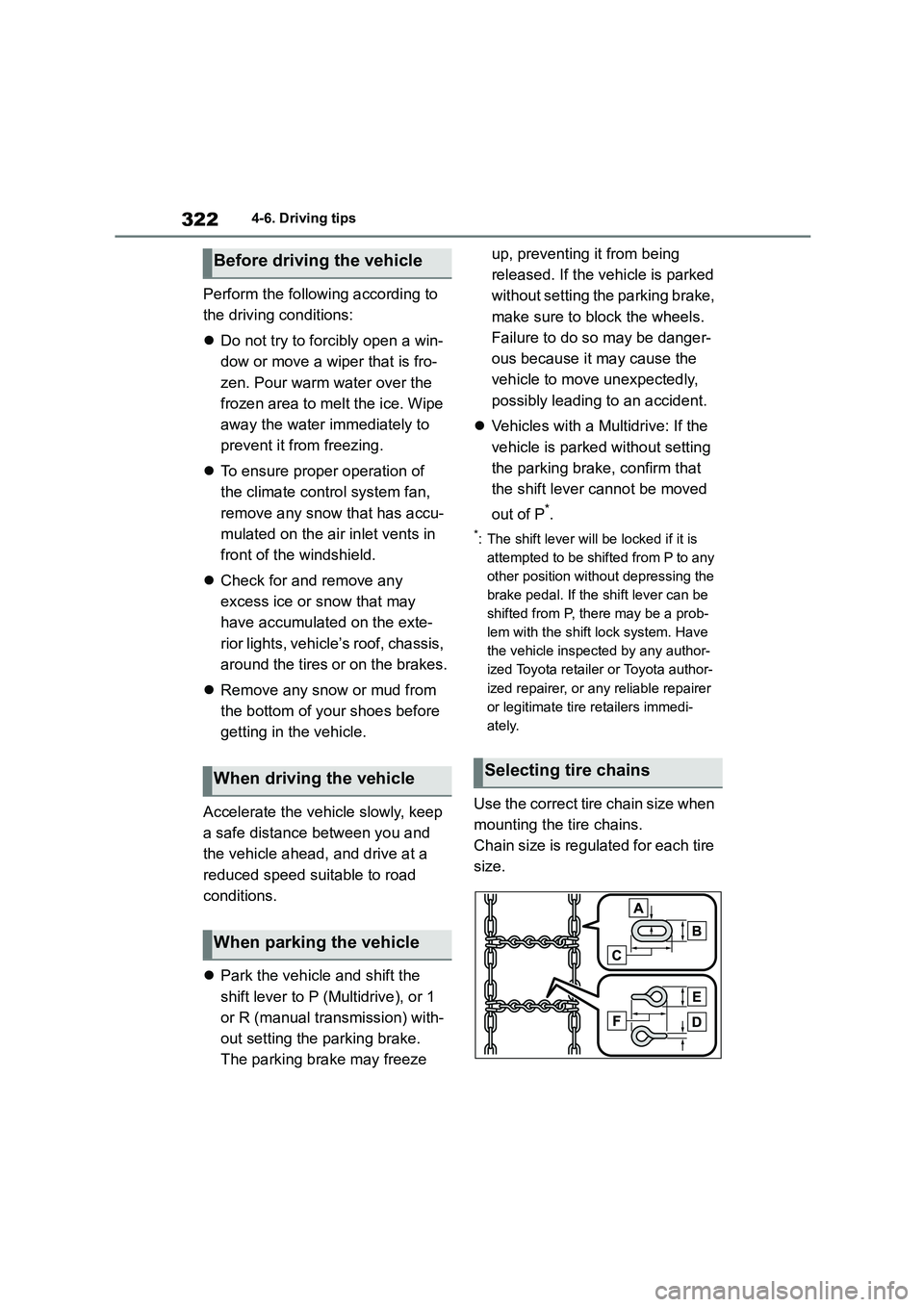
Use the correct tire chain size when
mounting the tire chains.
Chain size is regulated for each tire
size.
Before driving the vehicle
When driving the vehicle
When parking the vehicle
Selecting tire chains
Page 432 of 678
4307-3. Do-it-yourself maintenance
Replace the tires if the treadwear indi-
cators are showing on a tire.
■When to replace your vehicle’s
tires
Tires should be replaced if:
●The treadwear indicators are showing on a tire.
●You have tire damage such as cuts, splits, cracks deep enough to expose
the fabric, and bulges indicating inter-
nal damage
●A tire goes flat repeatedly or cannot
be properly repaired due to the size or location of a cut or other damage
If you are not sure, consult with any
authorized Toyota retailer or Toyota authorized repairer, or any reliable
repairer.
■Tire life
Any tire over 6 years old must be checked by a qualified technician even if
it has seldom or never been used or
damage is not obvious.
■Low profile tires (17-inch tires and 18-inch tires)
Generally, low profile tires will wear
more rapidly and tire grip performance will be reduced on snowy and/or icy
roads when compared to standard tires.
Be sure to use snow tires or tire chains
on snowy and/or icy roads and drive carefully at a speed appropriate for road
and weather conditions.
■If the tread on snow tires wears
down below 4 mm (0.16 in.)
The effectiveness of the tires as snow
tires is lost.
■Checking the tire valves
When replacing the tires, check the tire valves for deformat ion, cracks, and
other damage.
WA R N I N G
■When inspecting or replacing
tires
Observe the following precautions to prevent accidents.
Failure to do so may cause damage
to parts of the drive train as well as dangerous handling characteristics,
which may lead to an accident result-
ing in death or serious injury.
●Do not mix tires of different makes,
models or tread patterns.
Also, do not mix tires of remarkably different treadwear.
●Do not use tire sizes other than those recommended by Toyota.
●Do not mix differently constructed tires (radial, bias-belted or bias-ply
tires).
●Do not mix summer, all season and
snow tires.
●Do not use tires that have been
used on another vehicle.
Do not use tires if you do not know how they were used previously.
●Vehicles with a compact spare tire: Do not tow if your vehicle has a
compact spare tire installed.
●Vehicles with an emergency tire
puncture repair kit: Do not tow any-
thing if a tire that has been repaired using the emergency tire puncture
repair kit is installed. The load on
the tire may cause unexpected damage to the tire.
NOTICE
■Low profile tires (17-inch tires
and 18-inch tires)
Low profile tires may cause greater
damage than usual to the tire wheel
when sustaining impact from the road surface. Therefore, pay attention to
the following:
Page 433 of 678
431
7
7-3. Do-it-yourself maintenance
Maintenance and care
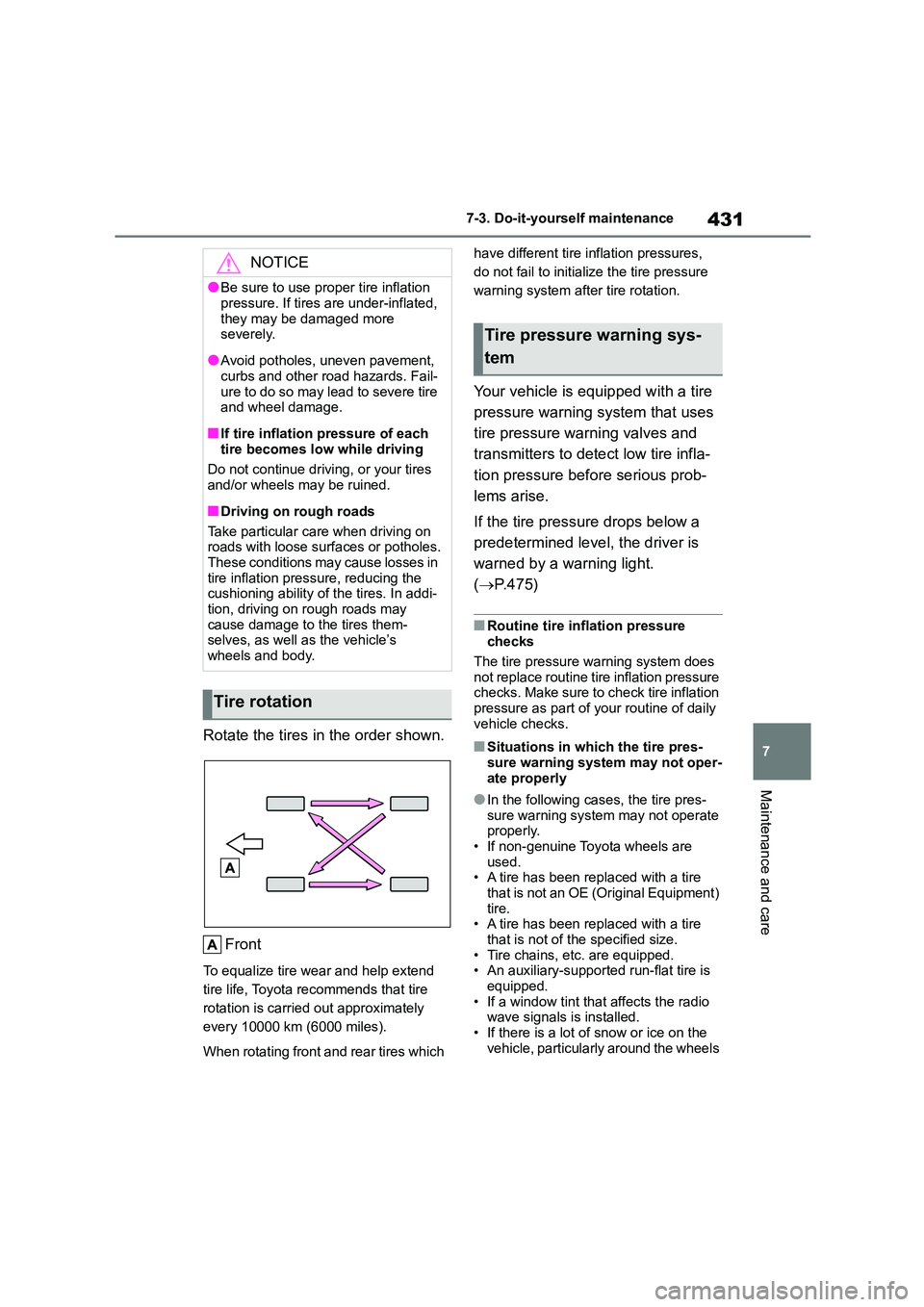
Rotate the tires in the order shown.
Front
To equalize tire wear and help extend
tire life, Toyota recommends that tire
rotation is carried out approximately
every 10000 km (6000 miles).
When rotating front and rear tires which
have different tire inflation pressures,
do not fail to initialize the tire pressure
warning system afte r tire rotation.
Your vehicle is equipped with a tire
pressure warning system that uses
tire pressure warning valves and
transmitters to detect low tire infla-
tion pressure before serious prob-
lems arise.
If the tire pressure drops below a
predetermined level, the driver is
warned by a warning light.
( P. 4 7 5 )
■Routine tire inflation pressure
checks
The tire pressure warning system does
not replace routine tire inflation pressure
checks. Make sure to check tire inflation pressure as part of your routine of daily
vehicle checks.
■Situations in which the tire pres-
sure warning system may not oper-
ate properly
●In the following cases, the tire pres-
sure warning system may not operate properly.
• If non-genuine Toyota wheels are
used. • A tire has been replaced with a tire
that is not an OE (Original Equipment)
tire. • A tire has been replaced with a tire
that is not of the specified size.
• Tire chains, etc. are equipped. • An auxiliary-supported run-flat tire is
equipped.
• If a window tint that affects the radio wave signals is installed.
• If there is a lot of snow or ice on the
vehicle, particularly around the wheels
NOTICE
●Be sure to use proper tire inflation
pressure. If tires are under-inflated,
they may be damaged more severely.
●Avoid potholes, uneven pavement, curbs and other road hazards. Fail-
ure to do so may lead to severe tire
and wheel damage.
■If tire inflation pressure of each
tire becomes low while driving
Do not continue driving, or your tires and/or wheels may be ruined.
■Driving on rough roads
Take particular care when driving on
roads with loose surfaces or potholes.
These conditions may cause losses in tire inflation pressure, reducing the
cushioning ability of the tires. In addi-
tion, driving on rough roads may cause damage to the tires them-
selves, as well as the vehicle’s
wheels and body.
Tire rotation
Tire pressure warning sys-
tem
Page 444 of 678
4427-3. Do-it-yourself maintenance
■The tire pressure warning sys-
tem must be init ialized in the
following circumstances:
When rotating front and rear tires
which have different tire inflation
pressures.
When changing the tire size.
When the tire inflation pressure
is changed such as when chang-
ing traveling speed or load
weight.
When the tire pressure warning
system is initialized , the current tire
inflation pressure is set as the
benchmark pressure.
■How to initialize the tire pres-
sure warning system
1 Park the vehicle in a safe place
and turn the engine switch off.
Initialization cannot be performed while
the vehicle is moving.
2 Adjust the tire inflation pressure
to the specified co ld tire inflation
pressure level. ( P.533)
Make sure to adjust the tire pressure to
the specified cold tire inflation pressure level. The tire pressure warning system
will operate based on this pressure
level.
3 Turn the engine switch to ON.
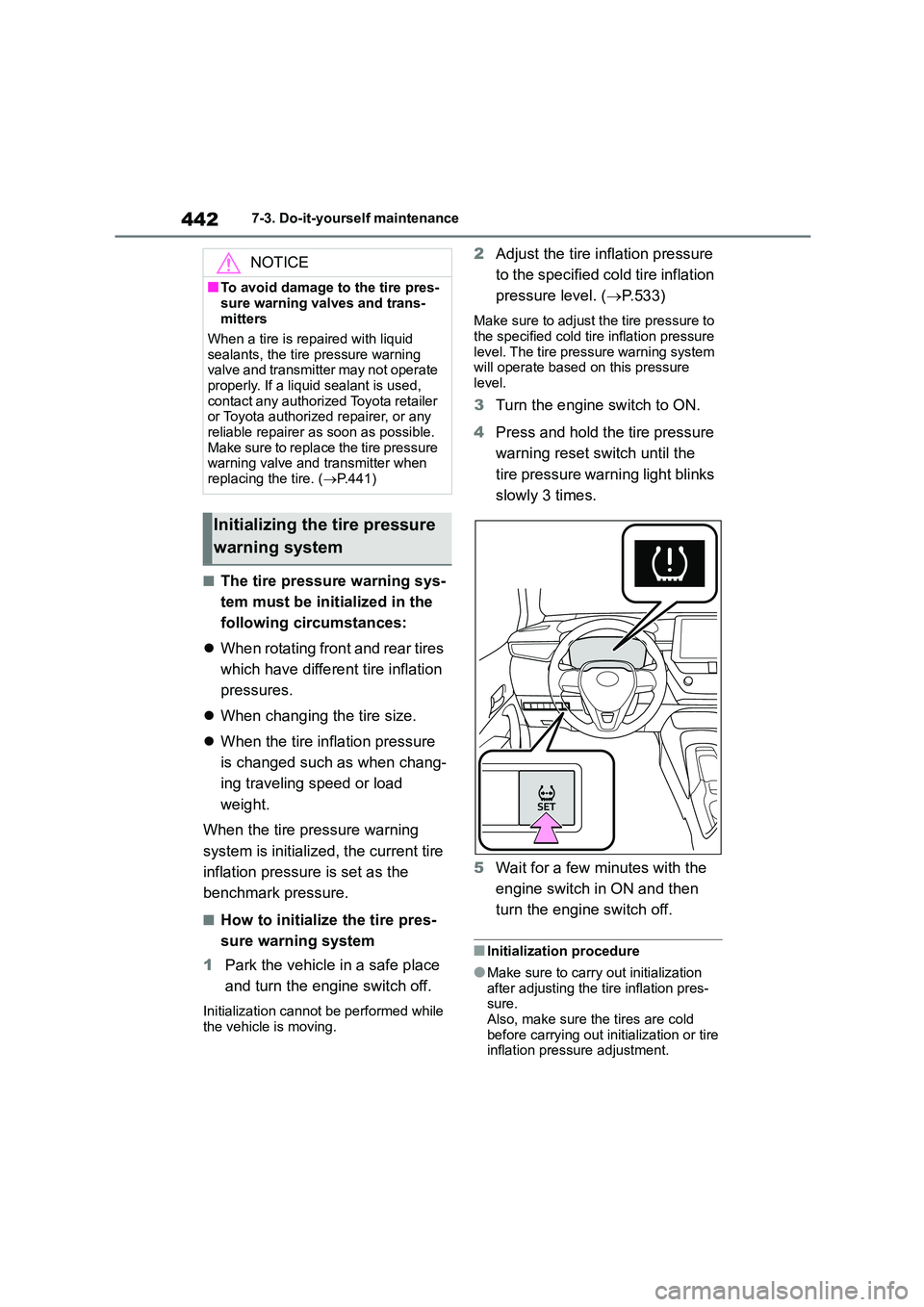
4 Press and hold the tire pressure
warning reset switch until the
tire pressure warning light blinks
slowly 3 times.
5 Wait for a few minutes with the
engine switch in ON and then
turn the engine switch off.
■Initialization procedure
●Make sure to carry out initialization
after adjusting the tire inflation pres- sure.
Also, make sure the tires are cold
before carrying out initialization or tire inflation pressure adjustment.
NOTICE
■To avoid damage to the tire pres-
sure warning valves and trans-
mitters
When a tire is repaired with liquid
sealants, the tire pressure warning
valve and transmitter may not operate properly. If a liquid sealant is used,
contact any authorized Toyota retailer
or Toyota authorized repairer, or any
reliable repairer as soon as possible. Make sure to replace the tire pressure
warning valve and transmitter when
replacing the tire. ( P.441)
Initializing the tire pressure
warning system
Page 447 of 678
445
7
7-3. Do-it-yourself maintenance
Maintenance and care
When replacing wheels, care
should be taken to ensure that they
are equivalent to those removed in
load capacity, diameter, rim width
and inset*.
Replacement wheels are available
at any authorized Toyota retailer or
Toyota authorized repairer, or any
reliable repairer.
*: Conventionally referred to as offset.
Toyota does not recommend using
the following:
Wheels of different sizes or types
Used wheels
Bent wheels that have been
straightened
■When replacing wheels
The wheels of your vehicle are equipped with tire pressure warning valves and
transmitters that allow the tire pressure
warning system to provide advance warning in the event of a loss in tire
inflation pressure. Whenever wheels are
replaced, the tire pressure warning valves and transmitters must be
installed. ( P.441)
WA R N I N G
●Uneven wear
●Poor handling
●Possibility of blowouts resulting
from overheated tires
●Air leaking from between tire and
wheel
●Wheel deformation and/or tire dam-
age
●Greater possibility of tire damage
while driving (due to road hazards,
expansion joints, sharp edges on the road, etc.)
NOTICE
■When inspecting and adjusting
tire inflation pressure
Be sure to put the tire valve caps back
on.
If a valve cap is not installed, dirt or moisture may get into the valve and
cause an air leak, resulting in
decreased tire inflation pressure.
Wheels
If a wheel is bent, cracked or
heavily corroded, it should be
replaced. Otherwise, the tire
may separate from the wheel
or cause a loss of handling
control.
Wheel selection
Page 448 of 678
4467-3. Do-it-yourself maintenance
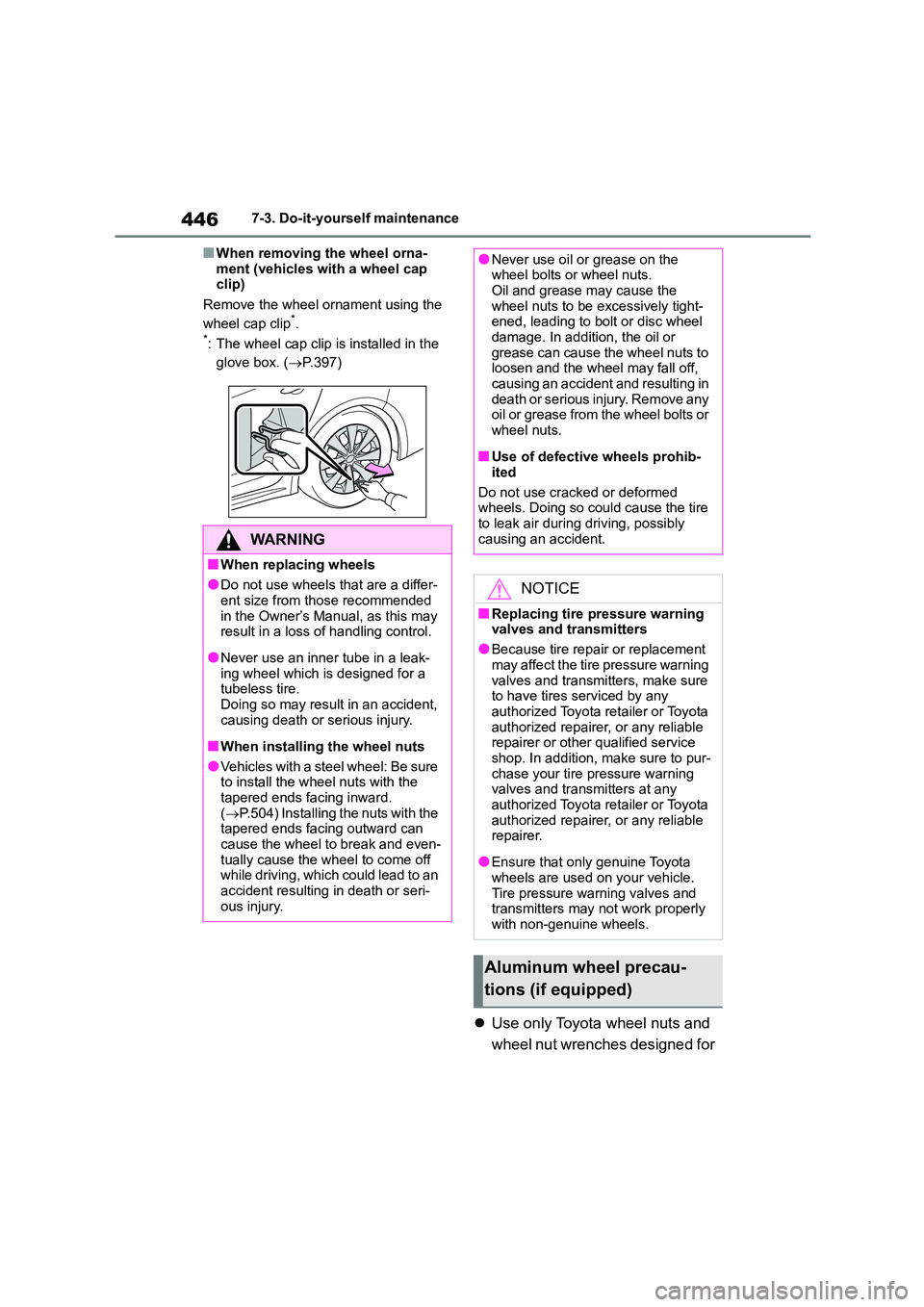
■When removing the wheel orna-
ment (vehicles with a wheel cap clip)
Remove the wheel ornament using the
wheel cap clip*.*: The wheel cap clip is installed in the
glove box. ( P.397)
Use only Toyota wheel nuts and
wheel nut wrenches designed for
WA R N I N G
■When replacing wheels
●Do not use wheels that are a differ-
ent size from those recommended
in the Owner’s Manual, as this may result in a loss of handling control.
●Never use an inner tube in a leak-ing wheel which is designed for a
tubeless tire.
Doing so may result in an accident, causing death or serious injury.
■When installing the wheel nuts
●Vehicles with a steel wheel: Be sure
to install the wheel nuts with the
tapered ends facing inward. ( P.504) Installing the nuts with the
tapered ends facing outward can
cause the wheel to break and even- tually cause the wheel to come off
while driving, which could lead to an
accident resulting in death or seri- ous injury.
●Never use oil or grease on the wheel bolts or wheel nuts.
Oil and grease may cause the
wheel nuts to be excessively tight- ened, leading to bolt or disc wheel
damage. In addition, the oil or
grease can cause the wheel nuts to loosen and the wheel may fall off,
causing an accident and resulting in
death or serious injury. Remove any oil or grease from the wheel bolts or
wheel nuts.
■Use of defective wheels prohib-
ited
Do not use cracked or deformed wheels. Doing so could cause the tire
to leak air during driving, possibly
causing an accident.
NOTICE
■Replacing tire pressure warning valves and transmitters
●Because tire repair or replacement
may affect the tire pressure warning valves and transmitters, make sure
to have tires serviced by any
authorized Toyota retailer or Toyota authorized repairer, or any reliable
repairer or other qualified service
shop. In addition, make sure to pur- chase your tire pressure warning
valves and transmitters at any
authorized Toyota retailer or Toyota authorized repairer, or any reliable
repairer.
●Ensure that only genuine Toyota
wheels are used on your vehicle.
Tire pressure warning valves and transmitters may not work properly
with non-genuine wheels.
Aluminum wheel precau-
tions (if equipped)