2022 TOYOTA COROLLA radio
[x] Cancel search: radioPage 122 of 678
1203-2. Opening, closing and locking the doors
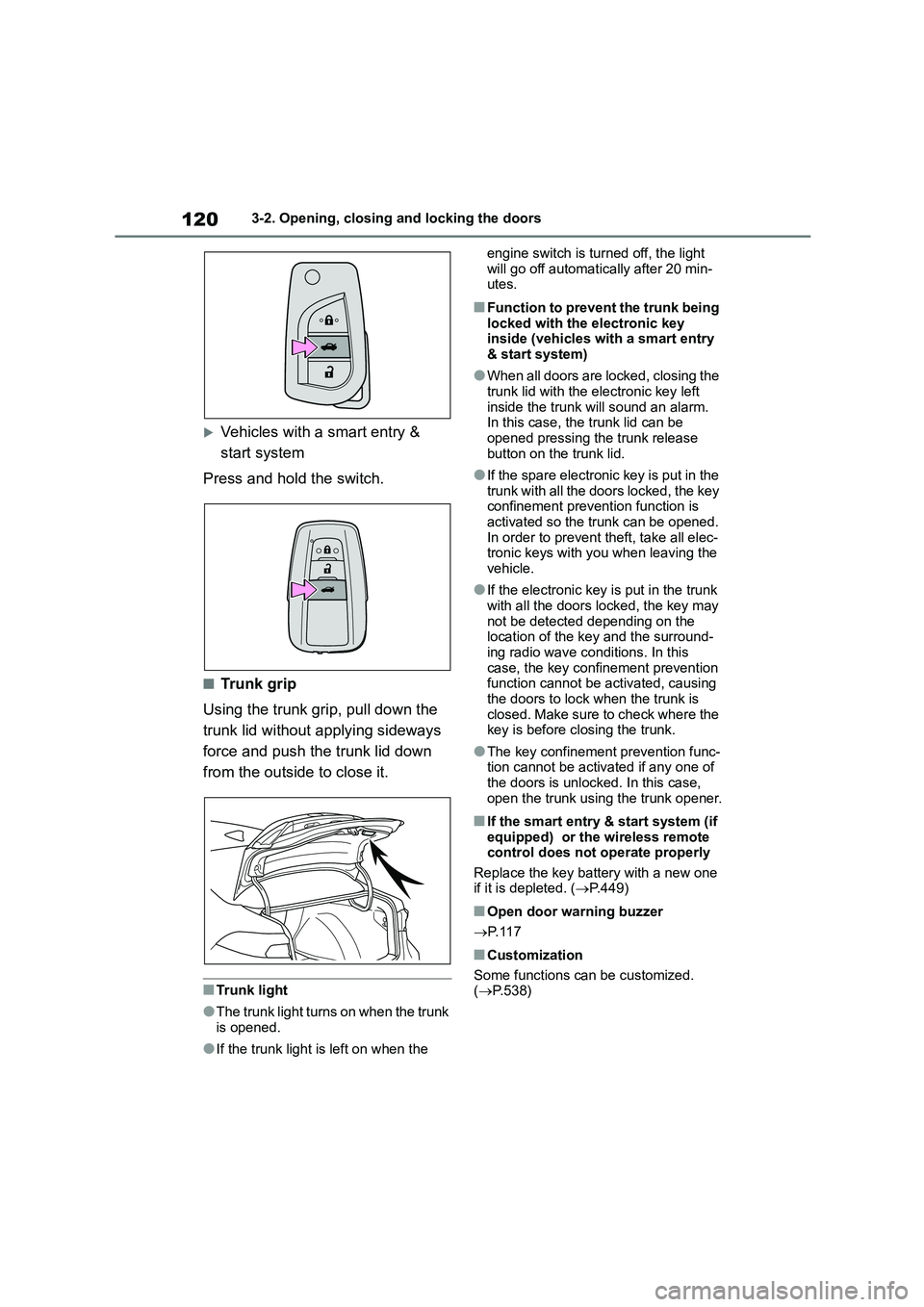
Vehicles with a smart entry &
start system
Press and hold the switch.
■Trunk grip
Using the trunk grip, pull down the
trunk lid without applying sideways
force and push the trunk lid down
from the outside to close it.
■Trunk light
●The trunk light turns on when the trunk
is opened.
●If the trunk light is left on when the
engine switch is turned off, the light
will go off automatically after 20 min- utes.
■Function to prevent the trunk being
locked with the electronic key
inside (vehicles with a smart entry & start system)
●When all doors are locked, closing the trunk lid with the electronic key left
inside the trunk will sound an alarm.
In this case, the trunk lid can be opened pressing the trunk release
button on the trunk lid.
●If the spare electronic key is put in the
trunk with all the doors locked, the key
confinement prevention function is activated so the trunk can be opened.
In order to prevent theft, take all elec-
tronic keys with you when leaving the vehicle.
●If the electronic key is put in the trunk with all the doors locked, the key may
not be detected depending on the
location of the key and the surround- ing radio wave conditions. In this
case, the key confinement prevention
function cannot be activated, causing the doors to lock when the trunk is
closed. Make sure to check where the
key is before closing the trunk.
●The key confinement prevention func-
tion cannot be activated if any one of the doors is unlocked. In this case,
open the trunk using the trunk opener.
■If the smart entry & start system (if
equipped) or the wireless remote control does not operate properly
Replace the key battery with a new one
if it is depleted. ( P.449)
■Open door warning buzzer
P. 1 1 7
■Customization
Some functions can be customized.
( P.538)
Page 124 of 678
1223-2. Opening, closing and locking the doors
●Interior buzzer sounds continuously
■Battery-saving function (vehicles
with entry function)
The battery-saving function will be acti-
vated in order to prevent the electronic
key battery and the vehicle battery from being discharged while the vehicle is not
operated for a long time.
●In the following situations, the smart
entry & start system may take some
time to unlock the doors.
• The electronic key has been left within approximately 3.5 m (11 ft.) of the out-
side of the vehicle for 2 minutes or
longer. • The smart entry & start system has
not been used for 5 days or longer.
●If the smart entry & start system has
not been used for 14 days or longer,
the doors cannot be unlocked from
any door except the driver’s door. In this case, hold the driver’s door han-
dle, or use the wireless remote control
or mechanical key to unlock the doors.
■Electronic key battery-saving func-
tion
When battery-saving mode is set, bat- tery depletion is minimized by stopping
the electronic key from receiving radio
waves.
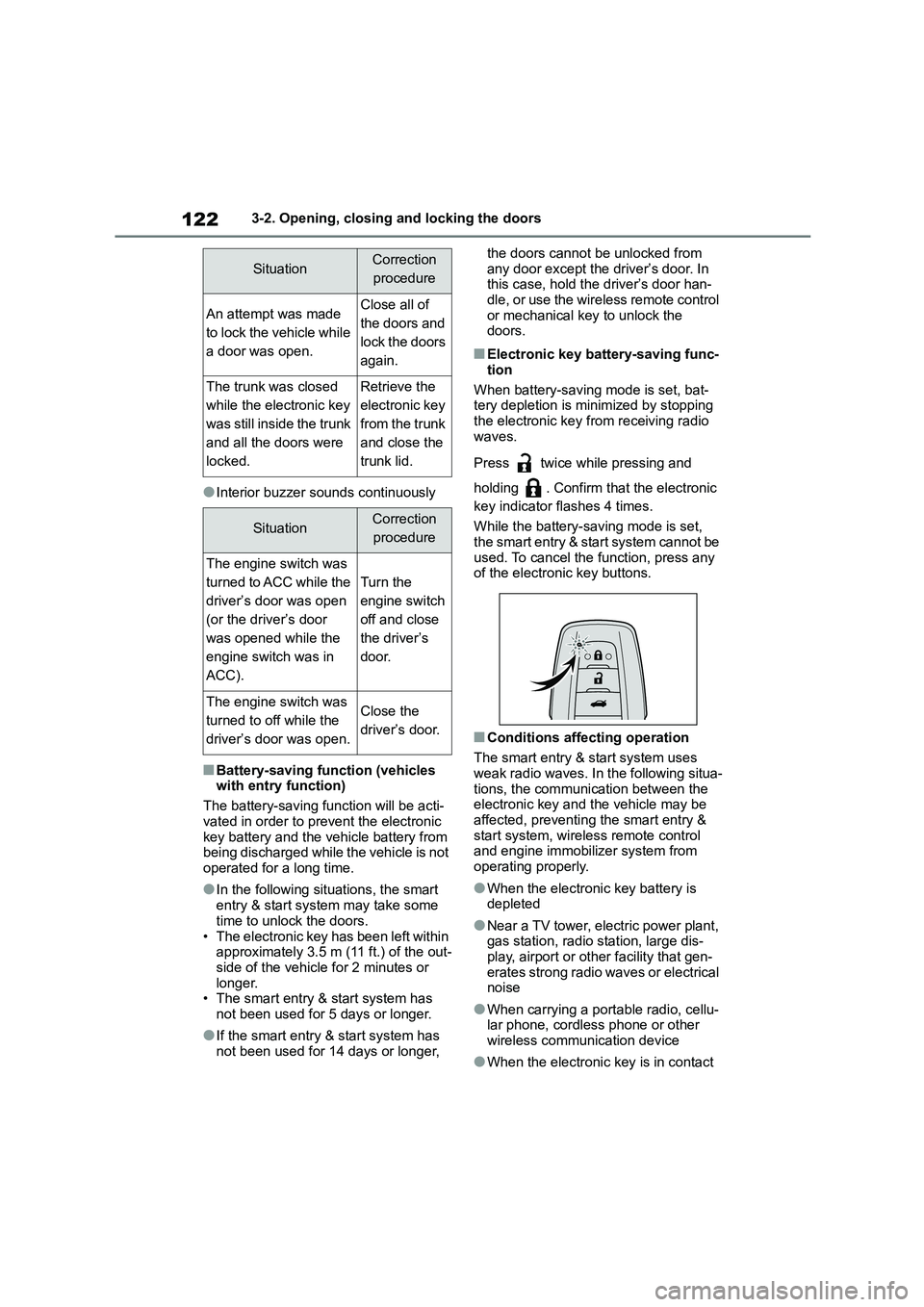
Press twice while pressing and
holding . Confirm that the electronic
key indicator flashes 4 times.
While the battery-saving mode is set,
the smart entry & start system cannot be
used. To cancel the function, press any of the electronic key buttons.
■Conditions affecting operation
The smart entry & start system uses
weak radio waves. In the following situa-
tions, the communication between the electronic key and the vehicle may be
affected, preventing the smart entry &
start system, wirele ss remote control and engine immobilizer system from
operating properly.
●When the electronic key battery is depleted
●Near a TV tower, electric power plant, gas station, radio station, large dis-
play, airport or other facility that gen-
erates strong radio waves or electrical noise
●When carrying a portable radio, cellu-lar phone, cordless phone or other
wireless communication device
●When the electronic key is in contact
SituationCorrection
procedure
An attempt was made
to lock the vehicle while
a door was open.
Close all of
the doors and
lock the doors
again.
The trunk was closed
while the electronic key
was still inside the trunk
and all the doors were
locked.
Retrieve the
electronic key
from the trunk
and close the
trunk lid.
SituationCorrection
procedure
The engine switch was
turned to ACC while the
driver’s door was open
(or the driver’s door
was opened while the
engine switch was in
ACC).
Turn the
engine switch
off and close
the driver’s
door.
The engine switch was
turned to off while the
driver’s door was open.
Close the
driver’s door.
Page 125 of 678
123
3
3-2. Opening, closing and locking the doors
Before driving
with, or is covered by the following
metallic objects • Cards to which aluminum foil is
attached
• Cigarette boxes that have aluminum foil inside
• Metallic wallets or bags
•Coins • Hand warmers made of metal
• Media such as CDs and DVDs
●When other wireless keys (that emit
radio waves) are being used nearby
●When carrying the electronic key
together with the following devices
that emit radio waves • Another vehicle’s electronic key or a
wireless key that emits radio waves
• Personal computers or personal digi- tal assistants (PDAs)
• Digital audio players
• Portable game systems
●If window tint with a metallic content or
metallic objects are attached to the rear window
●When the electronic key is placed near a battery charger or electronic
devices
●When the vehicle is parked in a pay
parking spot where radio waves are
emitted
If the doors cannot be locked/unlocked
using the smart en try & start system,
lock/unlock the doors by performing any of the following (vehicles with entry func-
tion):
●Bring the electronic key close to either
front door handle and operate the
entry function.
●Operate the wireless remote control.
If the doors cannot be locked/unlocked
using the above methods, use the mechanical key. ( P.512)
If the engine cannot be started using the
smart entry & start system refer to P.512.
■Note for the entr y function (if
equipped)
●Even when the electronic key is within
the effective range (detection areas),
the system may not operate properly in the following cases:
• The electronic key is too close to the
window or outside door handle, near the ground, or in a high place when
the doors are locked or unlocked.
• The electronic key is near the ground or in a high place, or too close to the
center of the rear bumper when the
trunk is opened. • The electronic key is on the instru-
ment panel, rear package tray or floor,
or in the door pockets or glove box when the engine is started or engine
switch modes are changed.
●Do not leave the electronic key on top
of the instrument panel or near the
door pockets when exiting the vehicle. Depending on the radio wave recep-
tion conditions, it may be detected by
the antenna outside the cabin and the door will become lockable from the
outside, possibly trapping the elec-
tronic key inside the vehicle.
●As long as the electronic key is within
the effective range, the doors may be locked or unlocked by anyone. How-
ever, only the doors detecting the
electronic key can be used to unlock the vehicle.
●Even if the electronic key is not inside the vehicle, it may be possible to start
the engine if the electronic key is near
the window.
●The doors may unlock or lock if a
large amount of water splashes on the door handle, such as in the rain or in a
car wash when the electronic key is
within the effective range. (The doors will automatically be locked after
approximately 30 seconds if the doors
are not opened and closed.)
●If the wireless remote control is used
to lock the doors when the electronic
key is near the vehicle, there is a pos- sibility that the door may not be
unlocked by the entry function. (Use
the wireless remote control to unlock the doors.)
Page 126 of 678

1243-2. Opening, closing and locking the doors
●Touching the door lock or unlock sen-
sor while wearing gloves may prevent lock or unlock operation.
●On some models: When the lock operation is performed using the lock
sensor, recognition signals will be
shown up to two consecutive times. After this, no recognition signals will
be given.
●If the door handle becomes wet while
the electronic key is within the effec-
tive range, the door may lock and unlock repeatedly. In that case, follow
the following correction procedures to
wash the vehicle: • Place the electronic key in a location 2
m (6 ft.) or more away from the vehi-
cle. (Take care to ensure that the key is not stolen.)
• Set the electronic key to battery-sav-
ing mode to disable the smart entry & start system. ( P.122)
●If the electronic key is inside the vehi- cle and a door handle becomes wet
during a car wash, a message may be
shown on the multi-information dis- play and a buzzer will sound outside
the vehicle. To turn off the alarm, lock
all the doors.
●The lock sensor may not work prop-
erly if it comes into contact with ice, snow, mud, etc. Clean the lock sensor
and attempt to operate it again.
●A sudden handle operation or a han-
dle operation immediately after enter-
ing the effective range may prevent the doors from being unlocked. Touch
the door unlock sensor and check that
the doors are unlocked before pulling the door handle again.
●If there is another electronic key in the
detection area, it may take slightly longer to unlock the doors after the
door handle is gripped.
■When the vehicle is not driven for
extended periods
●To prevent theft of the vehicle, do not
leave the electronic key within 2 m (6 ft.) of the vehicle.
●The smart entry & start system can be
deactivated in advance. ( P.538)
●Setting the electronic key to bat-
tery-saving mode helps to reduce key battery depletion. ( P.122)
■To operate the system properly
●Make sure to carry the electronic key when operating th e system. Do not
get the electronic key too close to the
vehicle when operating the system from the outside of the vehicle.
Depending on the position and holding condition of the electronic key, the key
may not be detected correctly and the
system may not operate properly. (The alarm may go off accidentally, or the
door lock prevention function may not
operate.)
●Do not leave the electronic key inside
the trunk. The key confinement prevention func-
tion may not operate, depending on
the location of the key (the inside edge of the trunk), conditions (inside a
metal bag, close to metallic objects)
and the radio waves in the surround- ing area. ( P.120)
■If the smart entry & start system
does not operate properly
●Locking and unlocking the doors
(vehicles with entry function): P.512
●Starting the engine: P.512
■Customization
Some functions can be customized.
( P.538)
■If the smart entry & start system has been deactivated in a custom-
ized setting
●Locking and unlocking the doors (vehicles with entry function): Use the
wireless remote control or mechanical
key. ( P.113, 512)
●Starting the engine and changing
engine switch modes: P.512
●Stopping the engine: P.162
Page 127 of 678
125
3
3-2. Opening, closing and locking the doors
Before driving
WA R N I N G
■Caution regarding interference
with electronic devices
●People with implantable cardiac pacemakers, cardiac
resynchronization therapy-pace-
makers or implantable cardioverter defibrillators should maintain a rea-
sonable distance between them-
selves and the smart entry & start
system antennas. ( P.121) The radio waves may affect the
operation of such devices. If neces-
sary, the entry function can be disa- bled. Ask any authorized Toyota
retailer or Toyota authorized
repairer, or any reliable repairer for details, such as the frequency of
radio waves and timing of the emit-
ted radio waves. Then, consult your doctor to see if you should disable
the entry function.
●Users of any electrical medical
device other than implantable car-
diac pacemakers, cardiac resynchronization therapy-pace-
makers or implantable cardioverter
defibrillators should consult the manufacturer of the device for infor-
mation about its operation under
the influence of radio waves. Radio waves could have unex-
pected effects on the operation of
such medical devices.
Ask any authorized Toyota retailer or
Toyota authorized repairer, or any reli- able repairer for details on disabling
the entry function.
Page 209 of 678

207
4
4-5. Using the driving support systems
Driving
• When passing under an object (road
sign, billboard, etc.)
• When approaching an electric toll gate
barrier, parking area barrier, or other barrier that opens and closes
• When using an automatic car wash
• When driving through or under objects that may contact your vehicle, such as
thick grass, tree branches, or a ban-
ner
• When driving through steam or smoke
• When driving near an object that reflects radio waves, such as a large
truck or guardrail
• When driving near a TV tower, broad- casting station, electric power plant, or
other location where strong radio
waves or electrical noise may be pres- ent
■Situations in which the system may
not operate properly
●In some situations such as the follow-
ing, an object may not be detected by
the radar sensor and front camera, preventing the system from operating
properly:
• When a detectable object is
approaching your vehicle • When your vehicle or a detectable
object is wobbling
• If a detectable object makes an abrupt maneuver (such as sudden swerving,
acceleration or deceleration)
• When your vehicle approaches a detectable object rapidly
• When a detectable object is not
directly in front of your vehicle
• When a detectable object is near a
wall, fence, guardrail, manhole cover, vehicle, steel plate on the road, etc.
• When a detectable object is under a
structure • When part of a detectable object is
hidden by an object, such as large
baggage, an umbrella, or guardrail • When multiple detectable objects are
close together
• If the sun or other light is shining directly on a detectable object
• When a detectable object is a shade
of white and looks extremely bright • When a detectable object appears to
be nearly the same color or brightness
as its surroundings • If a detectable object cuts or suddenly
emerges in front of your vehicle
• When the front of your vehicle is hit by water, snow, dust, etc.
• When a very bright light ahead, such
as the sun or the headlights of oncom- ing traffic, shines directly into the front
camera
• When approaching the side or front of a vehicle ahead
• If a vehicle ahead is a motorcycle
• If a vehicle ahead is narrow, such as a personal mobility vehicle
• If a preceding vehicle has a small rear
end, such as an unloaded truck
• If a preceding vehicle has a low rear end, such as a low bed trailer
Page 327 of 678
5
325
5
Audio system
Audio system
.5-1. Basic Operations
Audio system types .......... 326
Using the steering wheel audio
switches.......................... 327
USB port ........................... 328
5-2. Using the audio system
Optimal use of the audio sys-
tem ................................. 329
5-3. Using the radio
Radio operation ................ 331
5-4. Playing an audio CD and
MP3/WMA discs
CD player operation.......... 333
5-5. Using an external device
Listening to an iPod .......... 339
Listening to USB memory
device ............................. 344
5-6. Using Bluetooth® devices
Bluetooth® audio/phone.... 349
Using the steering wheel
switches.......................... 354
Register a Bluetooth® device
....................................... 354
5-7. “SETUP” menu
Using the “SETUP” menu
(“Bluetooth” menu).......... 356
Using the “SETUP” menu
(“TEL” menu) .................. 358
5-8. Bluetooth® Audio
Operating a Bluetooth® ena-
bled portable player ........ 362
5-9. Bluetooth® Phone
Making a phone call .......... 364
When receiving a phone call
........................................ 365
Speaking on the phone ..... 365
5-10. Bluetooth®
Bluetooth®........................ 367
Page 328 of 678
3265-1. Basic Operations
5-1.Basic Operations
*: If equipped
Vehicles with navigation/multimedia system
Refer to the “Navigation and multim edia system Owner's manual” or “Multi-
media Owner’s Manual”.
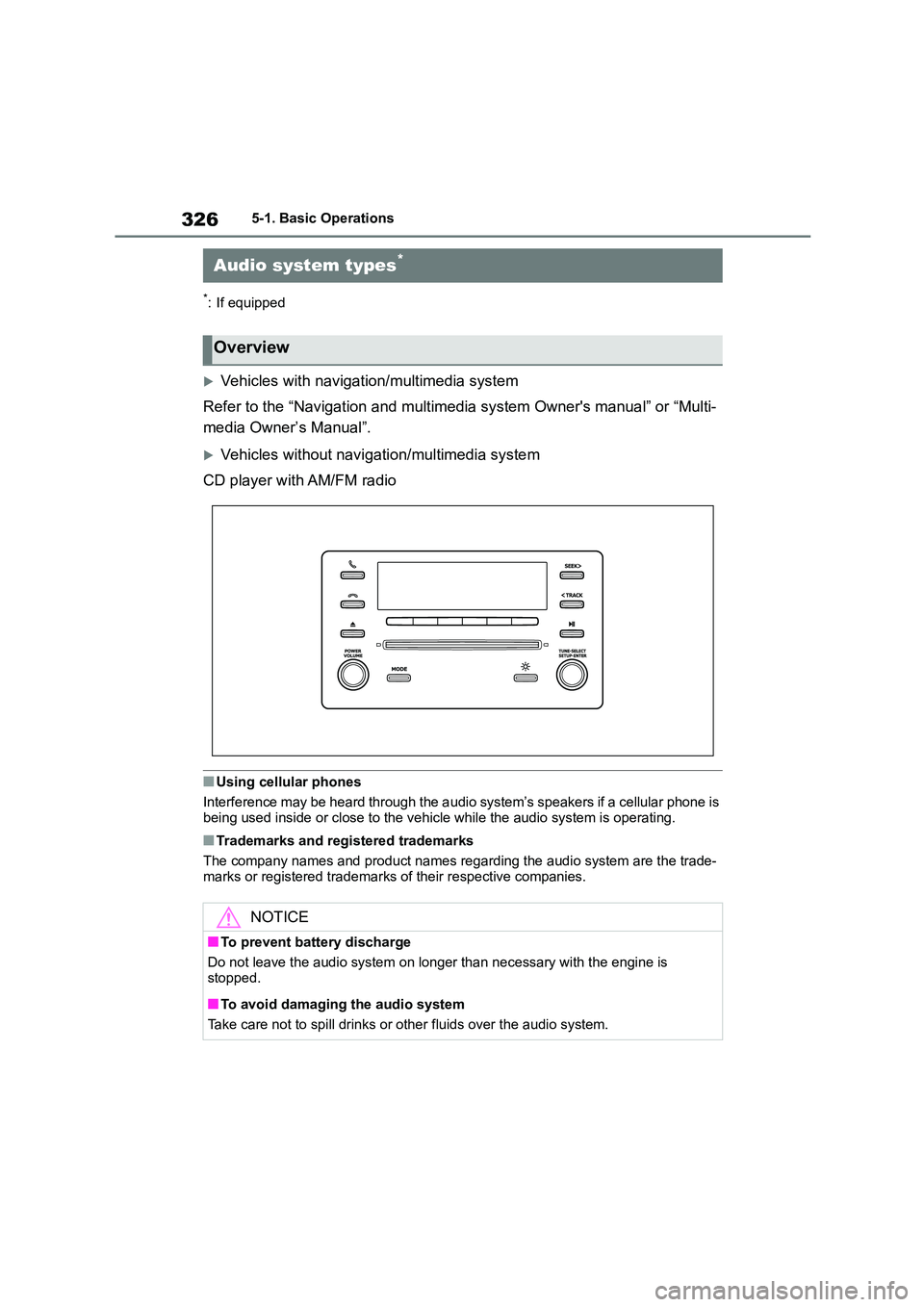
Vehicles without navigation/multimedia system
CD player with AM/FM radio
■Using cellular phones
Interference may be heard through the a udio system’s speakers if a cellular phone is
being used inside or close to the vehi cle while the audio system is operating.
■Trademarks and registered trademarks
The company names and product names regarding the audio system are the trade-
marks or registered trademarks of their respective companies.
Audio system types*
Overview
NOTICE
■To prevent battery discharge
Do not leave the audio system on longer than necessary with the engine is stopped.
■To avoid damaging the audio system
Take care not to spill drinks or other fluids over the audio system.