2022 TOYOTA BZ4X roof
[x] Cancel search: roofPage 150 of 674

148
Owners Manual_Europe_M42D76_en
2-2. Charging
*: If equippedThis system generates solar power
with the solar panel equipped to the
roof of the vehicle (solar roof).
The traction battery is charged
while parking.
The electrical consumption of the
traction battery is reduced during
driving.
The electrical consumption of the
traction battery is suppressed
increasing BEV driving distance
by supplementing power con-
sumption for the auxiliary sys-
tems using solar power.
12-volt battery
Solar charging system*
A system that provides power
to the traction battery and aux-
iliary systems by performing
solar charging via the large
solar panel (solar roof)
equipped on the vehicle roof.
Even when a parking lot does not
have charging equipment and in
the event of a disaster, it is possi-
ble to charge* the traction battery
without any special operations as
long as sunlight is available.
*: The charging amount via the solar
charging system differs depending
on conditions, such as season and
weather.
Solar charging system oper-
ation
Page 151 of 674

149
2
Owners Manual_Europe_M42D76_en
2-2. Charging
Electric Vehicle system
Solar roof
Solar ECU
Traction battery
Information related to the solar
charging system can be checked
on the multi-information display and
multimedia.
Meter control switches ( P.176)
Multi-information display
Multimedia
Multi-information display
1 Press or of the meter
control switches to select .
2 Press or of the meter
control switches to select solar
charging screen.
Current power generation
Mileage with power generation*
*: Mileage with power generation from
the end of the previous drive to the
current state. These values are cal-
culated by converting the power gen-
erated into driving distance, and may
differ from the actual driving distance.
When optional tires are installed, the
displayed value may differ from the
actual driving distance.
Multimedia
Energy screen
1 Press .
2 Press “Solar charging”.
If a screen other than the desired one is displayed, select “Energy” on the
Displaying information
related to the solar charging
system
Page 153 of 674

151
2
Owners Manual_Europe_M42D76_en
2-2. Charging
Electric Vehicle system
of the solar charging system operates
• There is a malfunction in the solar charging system
●The amount of power generated by the solar roof differs according to the season, climate, weather conditions,
vehicle angle and surrounding condi- tions.
●If even part of the solar roof is in the shade, there may be an extreme drop in power generation.
●Please adhere to the following in order to allow full performance of the
solar roof. • Clean the roof on a routine basis (Especially fallen leaves and bird
droppings can lead to a substantial decrease in power generation)• Remove snow from the roof as soon
as possible • Do not attach any seals or stickers to the roof
It is recommended not to install a roof carrier etc. unless it is necessary
●When the traction battery is fully charged, charging the battery via the solar charging system is not per-
formed. When it is not necessary to perform charging from an external power source, charge the vehicle as
much as possible using the solar charging system during the day and use the external power source only at
night. As a result, the solar charging system can be used effectively.
●When the vehicle is left in the hot weather, the temperature preservation function of the solar charging system
becomes easy to operate due to high temperature of the vehicle interior.
●Applying a glass coating to the solar roof may change the refractive index of light and reduce the amount of
power generated.
●Small dots, lines, and stains may be
visible inside the solar roof, however there is no problem with the power generation function or safety.
NOTICE
■To protect the solar charging system from damage
●Make sure to observe the following precautions.
• Do not modify the solar roof
• Do not condense sunlight onto the
solar roof
• Do not place anything on top of the
solar roof
• Do not subject the solar roof to
strong impacts or apply force with sharp objects from the inside roof of the vehicle.
●If the solar roof is damaged, do not touch the damaged area and imme-
diately request repairs from any authorized Toyota retailer or Toyota authorized repairer, or any reliable
repairer.
■If luggage is loaded on the roof
P. 2 3 6
Page 238 of 674
236
Owners Manual_Europe_M42D76_en
5-1. Before driving
WARNING
●Do not place cargo or luggage in or on the following locations.
• At the feet of the driver
• On the front passenger or rear seats (when stacking items)
• On the luggage cover
• On the instrument panel
• On the dashboard
• In front of the instrument cluster
●Secure all items in the occupant
compartment.
■Load and distribution
●Do not overload your vehicle.
●Do not apply loads unevenly.
Improper loading may cause deteri- oration of steering or braking con-trol which may cause death or
serious injury.
■When using a roof luggage car-
rier (vehicles with roof rails)
Observe the following precautions:
●Place the cargo so that its weight is
distributed evenly between the front and rear axles.
●If loading long or wide cargo, never exceed the vehicle overall length or width. ( P.554)
●Before driving, make sure the cargo is securely fastened on the roof lug-
gage carrier.
●Loading cargo on the roof luggage
carrier will make the center of grav- ity of the vehicle higher. Avoid high speeds, sudden starts, sharp turns,
sudden braking or abrupt maneu- vers, otherwise it may result in loss of control or vehicle rollover due to
failure to operate this vehicle cor- rectly and result in death or serious injury.
●If driving for a long distance, on rough roads, or at high speeds, stop the vehicle now and then
during the trip to make sure the cargo remains in its place.
●Do not exceed 75 kg (165.3 lb.) cargo weight on the roof luggage carrier.
NOTICE
■When loading cargo (vehicles with panoramic moon roof and solar roof)
Be careful not to scratch the surface of the panoramic moon roof and solar roof.
Page 280 of 674

278
Owners Manual_Europe_M42D76_en
5-4. Using the driving support systems
WARNING
●Always keep the windshield clean.
• If the windshield is dirty or covered
with an oily film, water droplets, snow, etc., clean the windshield.
• Even if a glass coating agent is
applied to the windshield, it will still be necessary to use the windshield wipers to remove water droplets,
etc., from the area of the windshield in front of the front camera.
• If the inner side of the windshield
where the front camera is installed is dirty, contact any authorized Toyota retailer or Toyota authorized
repairer, or any reliable repairer
●Do not attach stickers (including
transparent stickers) or other items to the area of the windshield in front of the front camera (shaded area in
the illustration).
Approximately 4 cm (1.6 in.)
Approximately 4 cm (1.6 in.)
●If the part of the windshield in front of the front camera is fogged up or
covered with condensation or ice, use the windshield defogger to remove the fog, condensation, or
ice.
●If water droplets cannot be properly
removed from the area of the wind- shield in front of the front camera by the windshield wipers, replace the
wiper insert or wiper blade.
●Do not attach window tint to the
windshield.
●Replace the windshield if it is dam- aged or cracked. If the windshield has been replaced, recalibration of
the front camera will be necessary. For details, contact any authorized Toyota retailer or Toyota authorized
repairer, or any reliable repairer.
●Do not allow liquids to contact the
front camera.
●Do not allow bright lights to shine
into the front camera.
●Do not damage the lens of the front
camera or allow it to become dirty. When cleaning the inside of the windshield, do not allow glass
cleaner to contact the lens of the front camera. Do not touch the lens of the front camera. If the lens of
the front camera is dirty or dam- aged, contact any authorized Toyota retailer or Toyota authorized
repairer, or any reliable repairer.
●Do not subject the front camera to a
strong impact.
●Do not change the position or orien-
tation of the front camera or remove it.
●Do not disassemble the front cam-era.
●Do not modify any parts around the front camera, such as the inside rear view mirror or ceiling.
●Do not attach accessories which may obstruct the front camera to
the hood, front grille, or front bumper. For details, contact any authorized Toyota retailer or Toyota
authorized repairer, or any reliable repairer.
●If a surfboard or other long object is to be mounted on the roof, make sure that it will not obstruct the front
camera.
●Do not modify or change the head-
lights and other lights.
Page 414 of 674

412
Owners Manual_Europe_M42D76_en
5-5. Driving tips
the driving conditions:
Do not try to forcibly open a win-
dow or move a wiper that is fro-
zen. Pour warm water over the
frozen area to melt the ice. Wipe
away the water immediately to
prevent it from freezing.
To ensure proper operation of
the climate control system fan,
remove any snow that has accu-
mulated on the air inlet vents in
front of the windshield.
Check for and remove any
excess ice or snow that may
have accumulated on the exte-
rior lights, vehicle’s roof, chassis,
around the tires or on the brakes.
Remove any snow or mud from
the bottom of your shoes before
getting in the vehicle.
Accelerate the vehicle slowly, keep
a safe distance between you and
the vehicle ahead, and drive at a
reduced speed suitable to road
conditions.
Turn automatic mode of the park-
ing brake off. Otherwise, the
parking brake may freeze and
not be able to be released auto-
matically.
Also, avoid using the following as the
parking brake may operate automati-
cally, even if automatic mode is off.
• Brake hold system
• Remote parking function
Park the vehicle and shift the
shift position to P without setting
the parking brake. The parking
brake may freeze up, preventing
it from being released. If the
vehicle is parked without setting
the parking brake, make sure to
block the wheels.
Failure to do so may be danger-
ous because it may cause the
vehicle to move unexpectedly,
possibly leading to an accident.
When the parking brake is in
automatic mode, release the
parking brake after shifting the
shift position to P. ( P.255)
If the vehicle is parked without
setting the parking brake, con-
firm that the shift position cannot
be moved out of P.
If the vehicle is left parked with
the brakes damp in cold tem-
peratures, there is a possibility of
the brakes freezing.
Use the correct tire chain size when
mounting the tire chains. Chain size
When driving the vehicle
When parking the vehicle
WARNING
■When parking the vehicle
When parking the vehicle without applying the parking brake, make
sure to chock the wheels. If you do not chock the wheels, the vehicle may move unexpectedly, possibly resulting
in an accident.
Selecting tire chains
Page 416 of 674

414
Owners Manual_Europe_M42D76_en
5-5. Driving tips
Specific design characteristics
give it a higher center of gravity
than ordinary passenger cars.
This vehicle design feature
causes this type of vehicle to be
more likely to rollover. Utility
vehicles have a significantly
higher rollover rate than other
types of vehicles.
An advantage of the higher
ground clearance is a better view
of the road allowing you to antici-
pate problems.
It is not designed for cornering at
the same speeds as ordinary
passenger cars any more than
low-slung sports cars designed
to perform satisfactorily under
off-road conditions. Therefore,
sharp turns at excessive speeds
may cause rollover.
Your vehicle is not designed to be
driven off-road. However, in the
Utility vehicle precau-
tions
This vehicle belongs to the
utility vehicle class, which has
higher ground clearance and
narrower tread in relation to
the height of its center of grav-
ity.
Utility vehicle feature
WARNING
■Utility vehicle precautions
Always observe the following precau-
tions to minimize the risk of death or serious injury or damage to your vehi-cle:
●In a rollover crash, an unbelted per-son is significantly more likely to die than a person wearing a seat belt.
Therefore, the driver and all pas- sengers should always fasten their seat belts.
●Avoid sharp turns or abrupt maneu-vers, if at all possible.
Failure to operate this vehicle cor- rectly may result in loss of control or vehicle rollover causing death or
serious injury.
●Loading cargo on the roof luggage
carrier (if equipped) will make the center of the vehicle gravity higher. Avoid high speeds, sudden starts,
sharp turns, sudden braking or abrupt maneuvers, otherwise it may result in loss of control or vehicle
rollover due to failure to operate this vehicle correctly.
●Always slow down in gusty cross-winds. Because of its profile and higher center of gravity, your vehi-
cle is more sensitive to side winds than an ordinary passenger car. Slowing down will allow you to have
better control.
●Do not drive horizontally across
steep slopes. Driving straight up or straight down is preferred. Your vehicle (or any similar off-road vehi-
cle) can tip over sideways much more easily than forward or back-ward.
Off-road driving
Page 445 of 674
443
6
Owners Manual_Europe_M42D76_en
6-4. Using the other interior features
Interior features
WARNING
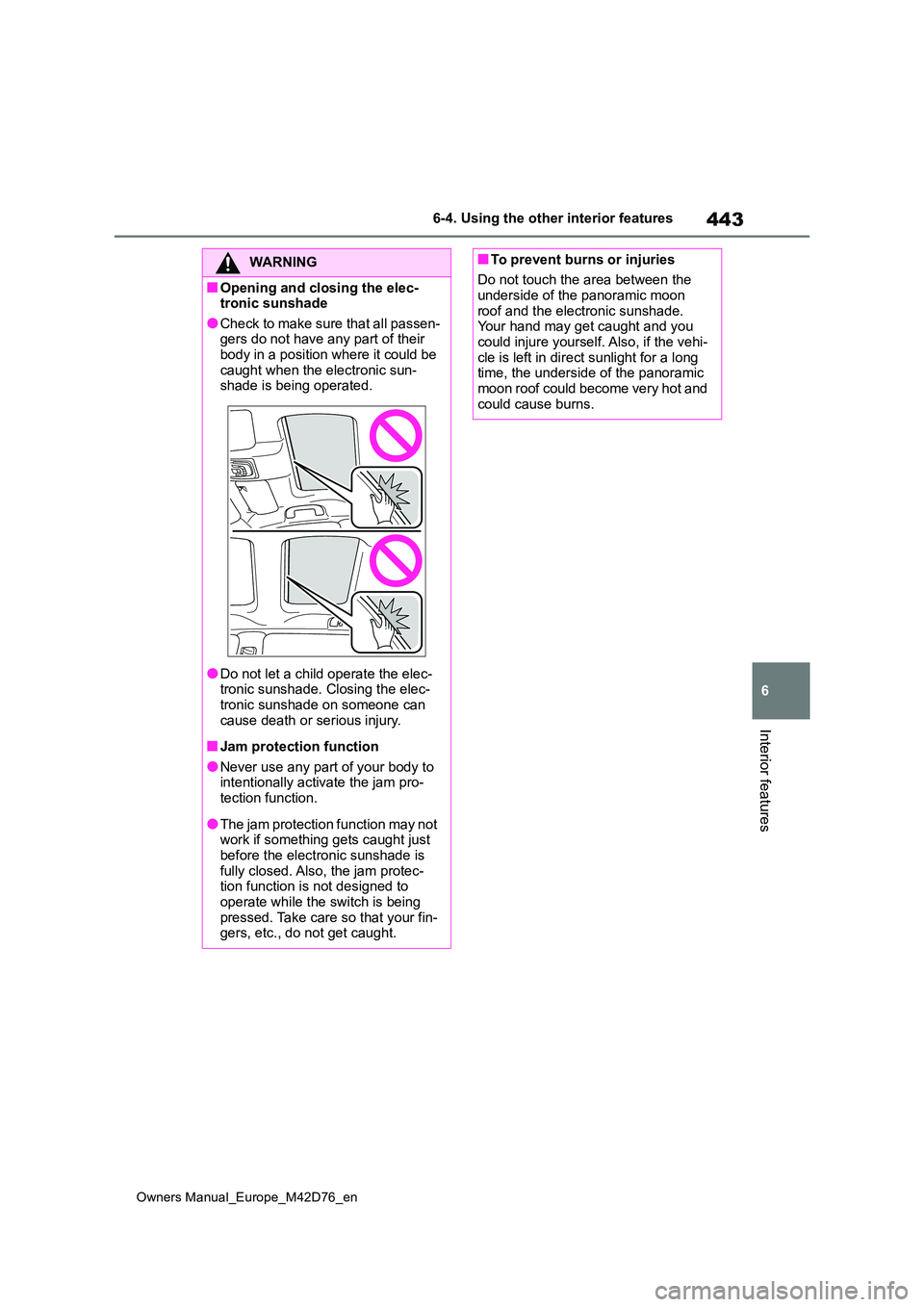
■Opening and closing the elec- tronic sunshade
●Check to make sure that all passen-gers do not have any part of their body in a position where it could be
caught when the electronic sun- shade is being operated.
●Do not let a child operate the elec-tronic sunshade. Closing the elec-tronic sunshade on someone can
cause death or serious injury.
■Jam protection function
●Never use any part of your body to intentionally activate the jam pro-tection function.
●The jam protection function may not work if something gets caught just
before the electronic sunshade is fully closed. Also, the jam protec-tion function is not designed to
operate while the switch is being pressed. Take care so that your fin-gers, etc., do not get caught.
■To prevent burns or injuries
Do not touch the area between the underside of the panoramic moon
roof and the electronic sunshade. Your hand may get caught and you could injure yourself. Also, if the vehi-
cle is left in direct sunlight for a long time, the underside of the panoramic moon roof could become very hot and
could cause burns.