2022 SUZUKI CELERIO Gear
[x] Cancel search: GearPage 91 of 201

4-3
DRIVING TIPS
76MH1-74E
76MH1-74E
Keep weight to a minimum The heavier the load, the more fuel the vehicle consumes. Take out any luggageor cargo when it is not necessary.
Keep tire pressures correct Underinflation of the tires can waste fuel due to increased running resistance of the tires. Keep your tires inflated to the correctpressure shown on the label on the driver’s side door or the driver’s door lock pillar.
Highway Driving
When driving at highway speeds, pay attention to the following: Stopping distance progressively increases with vehicle speed. Apply the brakes far enough ahead of the stoppingpoint to allow for the extra stopping dis- tance. On rainy days, “Hydroplaning” can occur.“Hydroplaning” is the loss of direct con- tact between the road surface and the vehicle’s tires due to a water film formingbetween them. Steering or braking the vehicle while “Hydroplaning” can be very difficult, and loss of control can occur.Keep speed down when the road surface is wet. At high speeds, the vehicle may beaffected by side winds. Therefore, reduce speed and be prepared for unex- pected buffeting, which can occur at theexits of tunnels, when passing by a cut of a hill, or when being overtaken by large vehicles, etc.
Driving on Hills
76MH0A063
When climbing steep hills, the vehiclemay begin to slow down and show a lackof power. If this happens, you should shift to a lower gear so that the engine will again be operating in its normalpower range. Shift rapidly to prevent the vehicle from losing momentum. When driving down a hill, the engineshould be used for braking by shifting into a lower gear.
Driving on Slippery Roads
60G089S
Under wet road conditions you should drive at a lower speed than on dry roadsdue to possible slippage of tires during braking. When driving on icy, snow-cov- ered, or muddy roads, reduce your speedand avoid sudden acceleration, abrupt braking, or sharp steering movements.
Tire Chains (if equipped)Tire chains should only be used if they are needed to increase traction or are required by law. Make sure that the chains you use
WA R N I N G
Try not to hold the brake pedal down too long or too often while goingdown a steep or long hill. This could cause the brakes to overheat, result- ing in reduced braking efficiency.Failure to take this precaution could result in loss of vehicle control.
R N D -M+
NOTICE
When descending a down hill, NEVER turn the igni tion key to the “LOCK” position. Emission control system damage may result.
80
Page 92 of 201
4-4
DRIVING TIPS
76MH1-74E
76MH1-74E
are the correct size for your vehicle’s tires. Also make sure that there is enough clear- ance between the fenders and the chainsas installed on the tires.
Install the chains on the front tires tightly, according to the chain manufacturer’s instructions. Retight en the chains after driving about 1.0 km (1/2 mile) if neces-sary. With the chains installed, drive slowly.
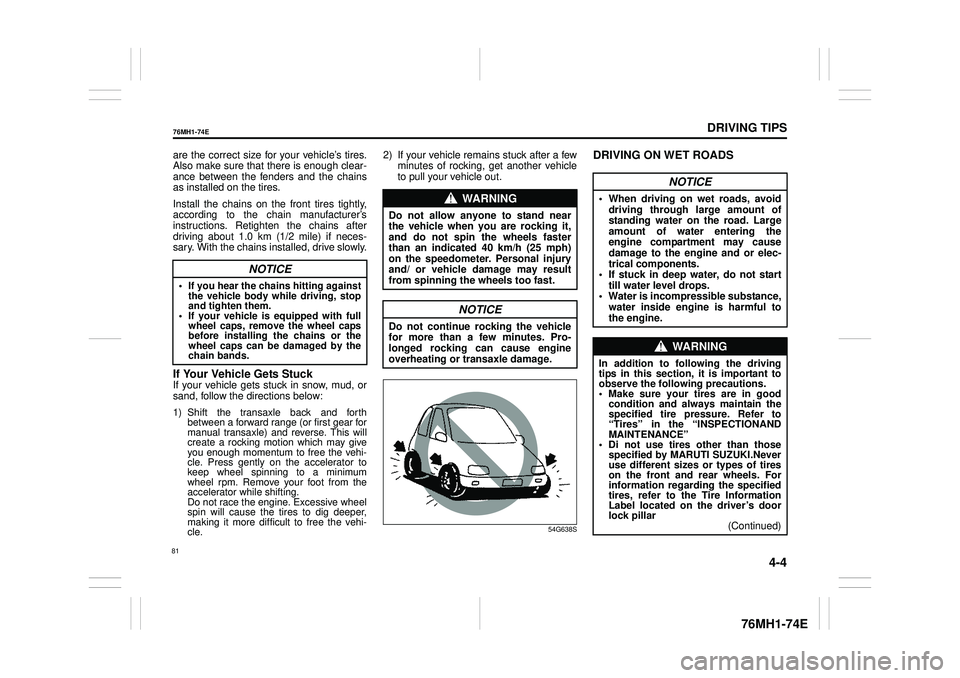
If Your Vehicle Gets StuckIf your vehicle gets stuck in snow, mud, orsand, follow the directions below:
1) Shift the transaxle back and forth between a forward range (or first gear formanual transaxle) and reverse. This willcreate a rocking motion which may giveyou enough momentum to free the vehi- cle. Press gently on the accelerator to keep wheel spinning to a minimumwheel rpm. Remove your foot from theaccelerator while shifting. Do not race the engine. Excessive wheelspin will cause the tires to dig deeper,making it more difficult to free the vehi- cle.
2) If your vehicle remains stuck after a few minutes of rocking, get another vehicle to pull your vehicle out.
54G638S
DRIVING ON WET ROADS
NOTICE
• If you hear the chains hitting against the vehicle body while driving, stopand tighten them.• If your vehicle is equipped with fullwheel caps, remove the wheel caps before installing the chains or the wheel caps can be damaged by thechain bands.
WA R N I N G
Do not allow anyone to stand near the vehicle when you are rocking it,and do not spin the wheels faster than an indicated 40 km/h (25 mph) on the speedometer. Personal injuryand/ or vehicle damage may result from spinning the wheels too fast.
NOTICE
Do not continue rocking the vehicle for more than a few minutes. Pro-longed rocking can cause engine overheating or transaxle damage.
NOTICE
• When driving on wet roads, avoid driving through large amount of standing water on the road. Large amount of water entering theengine compartment may cause damage to the engine and or elec- trical components.• If stuck in deep water, do not start till water level drops. • Water is incompressible substance,water inside engine is harmful to the engine.
WA R N I N G
In addition to following the driving tips in this section, it is important to observe the following precautions. • Make sure your tires are in good condition and always maintain the specified tire pressure. Refer to“Tires” in the “INSPECTIONAND MAINTENANCE” • Di not use tires other than thosespecified by MARUTI SUZUKI.Never use different sizes or types of tires on the front and rear wheels. Forinformation regard ing the specified tires, refer to the Tire Information Label located on the driver’s doorlock pillar(Continued)
81
Page 94 of 201

4-6
DRIVING TIPS
76MH1-74E
76MH1-74E
72F-08-011
Braking 1) Use the parking brake when parking your vehicle and shift the gear shift lever into the first gear or reverse gearposition for the sake of safety. 2) Don
Page 103 of 201

5-7
OTHER CONTROLS AND EQUIPMENT
76MH1-74E
76MH1-74E
Instrument Panel Pocket
(driver’s side) (1) /
Instrument Panel Pocket (center) (2)
Front Cup Holders (3)
Rear Cup Holder (5)
76MH0A075
Open the top to use the cup holder.
Rear Door Pocket (6)This pocket is provided for holding light and small items.
Bottle holder You should hold a bottle with a cap in the holder.
Floor Mats (if equipped)
68LM554
To prevent the driver’s side floor mat fromsliding forward and possibly interfering withthe operation of the pedals, Maruti genuine floor mats are recommended. Whenever you put the driver’s side floormat back in the vehicle after it has been removed, be sure to hook the floor mat grommet(s) to the fastener(s) and positionthe floor mat properly in the footwell.
When you replace the floor mats in your vehicle with a different type such as all- weather floor mats, we highly recommend using Maruti genuine floor mats for properfitting.
WA R N I N G
Do not place any objects which may fall out from the pocket when the vehi-cle is moving. Failure to take the precaution may result in an object interfering with thepedals and causing a loss of vehicle control or an accident.
WA R N I N G
Failure to take the precautions listedbelow could cause personal injury or vehicle damage.• Be careful when you are using the cup holders to hold a cup contain- ing hot liquid. Spilling out hot liquidcan cause burn injury. • Do not use the cup holders to hold sharp-edged, hard, or breakableobjects. Objects in the cup holdersmay be thrown about during a sud- den stop or impact, and could cause personal injury. • Be careful not to sp ill liquid or insert any foreign materi als into the mov- ing part of the gearshift lever, or anyelectrical components. Liquid or for- eign materials may damage these parts.
EXAMPLEEXAMPLE
92
Page 147 of 201

6-1
VEHICLE LOADING AND TOWING
76MH1-74E
76MH1-74E
Vehicle Loading
Your vehicle was designed for specific weight capacities. The weight capacities ofyour vehicle are indicated by the Gross Vehicle Weight Rating (GVWR) and the Permissible maximum Axle Weight (PAW,front and rear). The GVWR and PAW (front and rear) are listed in the “SPECIFICA- TIONS” section.
GVWR – Maximum permissible overall weight of the fully loaded vehicle (includingall the occupants, accessories and cargo plus the trailer nose weight if towing a trailer).PAW – (Front and Rear) Maximum permis- sible weight on an individual axle.
Actual weight of the loaded vehicle and actual loads at the front and rear axles can only be determined by weighing the vehi-cle. Compare these weights to the GVWR and PAW (front and rear). If the gross vehi- cle weight or the load on either axleexceeds these ratings, you must remove enough weight to bring the load down to the rated capacity.
Trailer Towing
Your MARUTI SUZUKI was originallydesigned to carry people and a normal amount of cargo, not to tow a trailer.MAR- UTI SUZUKI does not recommend you useyour vehicle to tow a trailer. Towing a trailer can adversely affect handling, durability, and fuel economy.
Towing Your Vehicle
Your vehicle may be towed behind anothervehicle (such as a motorhome), providedyour vehicle is 2 wheel drive (2WD) and you use the proper towing method speci- fied for your vehicle. The towing methodyou must use depends on the specifica- tions of your vehicle: whether it is a manual transaxle vehicle or an Auto Gear Shiftvehicle.
Use the towing instruction table to select the proper towing method for your vehicle, and carefully follow the corresponding instructions. Be sure to use proper towingequipment designed for recreational tow- ing and make sure that towing speed does not exceed 90 km/h (55 mph).
WA R N I N G
Never overload your vehicle. Thegross vehicle weight (sum of theweights of the vehicle, all the occu- pants, accessories, cargo plus trailer nose weight if towing a trailer) mustnever exceed the Gross Vehicle Weight Rating (GVWR). In addition, never distribute a load so that theweight on either th e front or rear axle exceeds the Permissible maximum Axle Weight (PAW).
WA R N I N G
Always distribute cargo evenly. Toavoid personal injury or damage to your vehicle, always secure cargo to prevent it from shifting if the vehiclemoves suddenly. Place heavier objects on the floor and as far for- ward in the cargo area as possible.Never pile cargo higher than the top of the seat backs.
WA R N I N G
When you tow your vehicle, follow the instructions below to avoid acci-dents and damage to your vehicle. In addition, be sure to observe govern- ment and local requirements regard-ing vehicle lighting and trailer hitches or tow bars.
WA R N I N G
A safety chain should always be used when you tow your vehicle.
136
Page 148 of 201

6-2
VEHICLE LOADING AND TOWING
76MH1-74E
76MH1-74E
TOWING INSTRUCTION TABLE
76MH022
A: 2WD VEHICLES WITH MANUAL TRANSAXLE OR AUTO GEAR SHIFT 1) Secure the front wheels on a towingdolly according to the instructions pro- vided by the dolly manufacturer. 2) Release the parking brake.
76MH023
B: 2WD VEHICLES WITH MANUAL TRANSAXLE OR AUTO GEAR SHIFT 1) Shift the gearshift lever into neutral. 2) Turn the ignition key to the
Page 149 of 201

INSPECTION AND MAINTENANCE
76MH1-74E
76MH1-74E
138
INSPECTION AND MAINTENANCEMaintenance Schedule ....................................................... 7-2
Periodic Maintenance Schedule . ....................................... 7-2
Drive Belt ............................................................................. 7-6
Engine Oil and Filter ........................................................... 7-6
Engine Coolant .................................................................... 7-10
Air Cleaner ........................................................................... 7-12
Spark Plugs ......................................................................... 7-12
Gear Oil ................................................................................ 7-14
Clutch Pedal ........................................................................ 7-14
Fuel Filter (Diesel engine) .................................................. 7-15
Brakes .......... ........................................................................ 7-15
Steering ................................................................................ 7-17
Tires ...................................................................................... 7-18
Battery .................................................................................. 7-19
Fuses .................................................................................... 7-20
Bulb Replacement ............................................................... 7-23
Wiper Blades ....................................................................... 7-28
Windshield Washer Fluid ................................................... 7-31
Air Conditioning System .................................................... 7-31
Page 154 of 201

7-5
INSPECTION AND MAINTENANCE
76MH1-74E
76MH1-74E
Interval: This interval should be judged by odometer reading or months, whichever comes first.
FREE INSPECTIONPERIODIC MAINTENANCE AT COST
km (x1000) 1 5 10 20 30 40 50 60 70 80
months 1 6 12 24 36 48 60 72 84 96
ELECTRICAL
10-1. Battery electrolyte (Level, leakage) I I I I I I I I I I
10-2. Wiring harness connection (Loose, damage) – I I I I I I I I I
10-3. Lightening system (Operat ion, stains, damage) I I I I I I I I I I
10-4. Horn (Operation) I I I I I I I I I I
10-5.System Voltage II I I I I I I I I
BODY
11-1. All chassis bolts and nuts (Tighten) – I T T T T T T T T
11-2. All latches, hinges and locks (Function)) I I&L I&L I&L I&L I&L I&L I&L I&L I&L
ROAD TEST
12-1. Operation of Brakes, gear shifting and speedometer I I I I I I I I I I
12-2.Body and chassis noise I I I I I I I I I I
AIR CONDITIONER (If equipped)
13-1. Check belt tension I I I I I I I I I I
13-2. Tighten compressor mounting bolt – T T T T T T T T T
13-3. All hose joint (Check, tighten) I I I I II I I I I
13-4. Check functioning of Recirc flap I I I I I I I I I I
13-5. Clean condenser with low pressure water – C C CCC C C C C
13-6. Check belt for frayed edges – I I I I I I I I I
13-7.Check all mounting bolts – I I I I I I I I I
143