2022 SUZUKI CELERIO Gear
[x] Cancel search: GearPage 79 of 201

3-9
OPERATING YOUR VEHICLE
76MH1-74E
76MH1-74E
Creeping function This vehicle has a creeping function that helps the vehicle to start smoothly byengaging the clutch. When the gearshift lever is in any of the positions “D”, “M” or “R”, and you release your foot from thebrake pedal, the vehicle starts slowly with- out depressing the accelerator pedal. The creeping function is disabled if you depressthe brake pedal or pull up the parking brake lever.
NOTE: If the driver’s door is opened and/or the parking brake lever is engaged with thegear in the “M”, “D” or “R” position, the creeping function will not operate.
Parking and Stopping the vehicle Auto Gear Shift does not have a parking position. The vehicle can be parked withthe gearshift lever in any position. When stopping the vehicle, the gear will be shifted to 1st.
Drive (D) mode When the Drive (D) mode is activated, the most appropriate gear position is automati- cally selected upon operation of the accel- erator pedal and variation of vehicle speed.
Normal driving: 1) Start the engine as instructed in
Page 80 of 201

3-10
OPERATING YOUR VEHICLE
76MH1-74E
76MH1-74E
Starting off on an uphill/downhill:
Uphill1) Apply the parking brake firmly so that the vehicle does not roll backwards.2) Shift the gearshift lever to the “D” posi-tion while depressing the brake pedal.Make sure that the gear position indica-tor in the instrumental cluster displays1st gear. 3) Release the brake pedal and depress the accelerator pedal gradually, andwhen the vehicle starts to move, releasethe parking brake and depress the accel-erator pedal to start off.
Downhill 1) Depress the brake pedal and shift the gearshift lever to the “D” position. Make sure that the gear is in 1st by checkingthe gear position indicator. 2) Release the brake pedal and depress the accelerator pedal slowly. Even if theaccelerator pedal is not depressed, the clutch will be engaged when the vehicle speed increases.
Using engine braking: When driving on a downhill slope, down- shifting is recommended. So you can useengine braking. By placing the gearshift lever in the “M” position, the Manual (M) mode is selected,and you can shift to a lower gear manually. For details of downshift operation, refer to “Upshift and downshift” in the “Manual (M)mode”.
Manual (M) mode The gears are not shifted automatically. To shift the transaxle, the driver must operate the gearshift lever to the “+” or “–” direc-tion. As for conventional manual transaxle vehicles, releasing the accelerator pedal a little may help the transaxle to shift smoothly.
Upshift and downshift:
Upshifting
76MH0A058
NOTICE
If the gearshift lever cannot shift into any position, or the gear is changedto “N” position automatically when the vehicle speed becomes less than 10 km/h (6 mph), there may be a sys-tematic malfunction. In this case, ask your MARUTI SUZUKI dealer to inspect the Auto Gear Shift system assoon as possible.
NOTICE
Do not operate the system as described below. The life cycle of the clutch may be reduced.• Using the accelerator pedal to hold the vehicle on an uphill slope with the gearshift lever in the “D” or “M”position. If you perform this opera- tion for a certain period of time, a warning buzzer will sound.• Shifting the gearsh ift lever to the “D”, “M” or “R” position while rac- ing the engine.• Driving at low speed using a high gear. • Holding the vehicle on an uphillslope using the creeping function. If you perform this operation for a certain period of time, a warningbuzzer will sound.
NOTICE
On an uphill slope, never hold thevehicle at a stop using only the accel-erator pedal or the creeping function. If you perform this operation for a certain period of time, a warningbuzzer will sound, and in some cases the engine will stall. This can also cause excessive damage to theclutch.R
N
D
-
M
+
69
Page 81 of 201
3-11
OPERATING YOUR VEHICLE
76MH1-74E
76MH1-74E
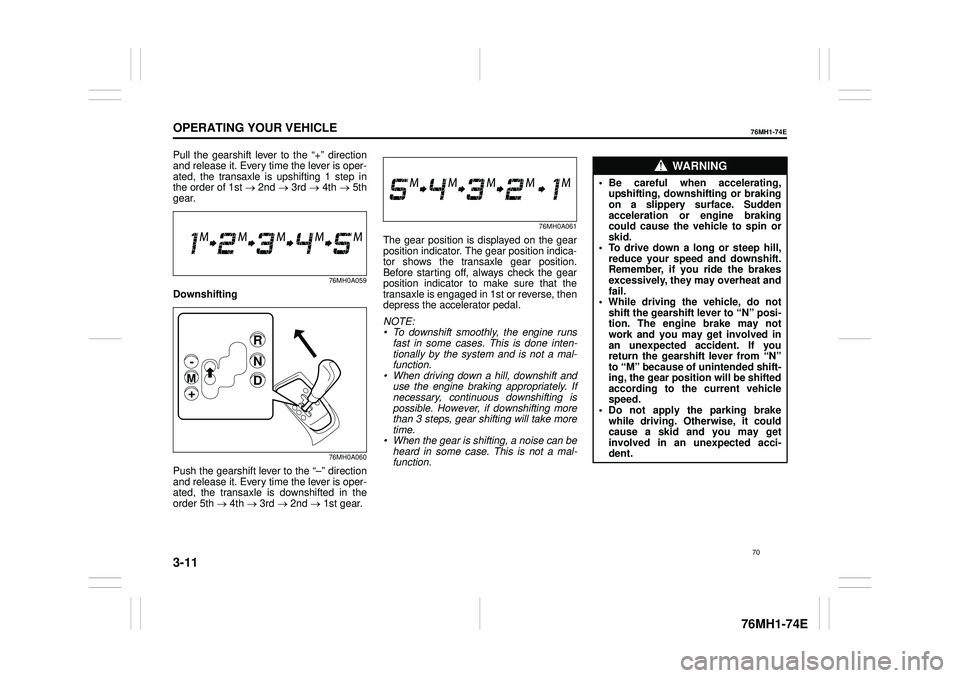
Pull the gearshift lever to the “+” direction and release it. Every time the lever is oper- ated, the transaxle is upshifting 1 step inthe order of 1st 2nd 3rd 4th 5th gear.
76MH0A059
Downshifting
76MH0A060
Push the gearshift lever to the “–” directionand release it. Every time the lever is oper- ated, the transaxle is downshifted in theorder 5th 4th 3rd 2nd 1st gear.
76MH0A061
The gear position is displayed on the gear position indicator. The gear position indica- tor shows the transaxle gear position.Before starting off, always check the gear position indicator to make sure that the transaxle is engaged in 1st or reverse, thendepress the accelerator pedal.
NOTE: • To downshift smoothly, the engine runs fast in some cases. This is done inten- tionally by the system and is not a mal-function. • When driving down a hill, downshift and use the engine braking appropriately. Ifnecessary, continuous downshifting is possible. However, if downshifting more than 3 steps, gear shifting will take moretime. • When the gear is shifting, a noise can be heard in some case. This is not a mal-function.
R
N
D
-
M
+
WA R N I N G
• Be careful when accelerating,upshifting, downshifting or brakingon a slippery surface. Sudden acceleration or engine braking could cause the vehicle to spin orskid. • To drive down a long or steep hill, reduce your speed and downshift.Remember, if you ride the brakes excessively, they may overheat and fail.• While driving the vehicle, do not shift the gearshift lever to “N” posi- tion. The engine brake may notwork and you may get involved in an unexpected accident. If you return the gearshif t lever from “N” to “M” because of unintended shift- ing, the gear position will be shifted according to the current vehiclespeed. • Do not apply the parking brake while driving. Otherwise, it couldcause a skid and you may get involved in an unexpected acci- dent.
70
Page 83 of 201

3-13
OPERATING YOUR VEHICLE
76MH1-74E
76MH1-74E
Starting off on an uphill/downhill slope:
Uphill 1) Apply the parking brake firmly so that the vehicle does not roll backwards. 2) Shift the gearshift lever to the “M” posi-tion while depressing the brake pedal. Make sure that the gear position indica- tor in the instrument al cluster displays 1st gear. 3) Release the brake pedal and depress the accelerator pedal gradually, andwhen the vehicle starts to move, release the parking brake and depress the accelerator pedal to start off.
Downhill 1) Depress the brake pedal and shift thegearshift lever to the “M” position. Check the gear position indicator to make sure that the gear is in 1st.2) Release the brake pedal and depress the accelerator pedal slowly. Even though the accelerator pedal is notdepressed, the clutch will be engaged when the vehicle speed increases.
Backing up After the vehicle has stopped completely, depress the brake pedal and shift the gear-shift lever to the “R” position. Depress the accelerator pedal slowly as when starting off in 1st gear. Before backing up, makesure that reverse gear is selected by checking the gear position indicator.
76MH0A062
NOTE: • If reverse gear cannot be engaged even though the gearshift lever has been shifted from the “N” to the “R” position,the system will re-try shifting automati- cally. This will take some time, noise may be heard from the gears, and shift-ing gear shock may occur. However, they do not indicate a malfunction. • The “N” indicator will flash, the depressbrake pedal indicator will come on and a warning buzzer (long pulse sound) will sound if any of the following casesoccur; – If you shift the gearshift lever from the “N” to the “R” position without depress-ing the brake pedal – If the system is unable to re-try shifting You should depress the brake pedal andshift the gearshift lever to “N” position,
then shift to “R” position again a few sec- onds later. • The system will not allow shifting to the“R” position if the vehicle speed is over about 3 km/h (2 mph). If the gearshift lever is operated under this condition,the “N” indicator in the instrument cluster will blink. However, when the vehicle speed drops below about 3 km/h (2mph), the gear will be shifted to reverse. Make sure that the vehicle has stopped completely before shifting to the “R”position.
Stopping The vehicle can be stopped by depressing the brake pedal regardless of the gearposition. This is because the clutch is auto- matically disengaged to prevent the engine from stopping. If the gearshift lever is in the “D” position, the gear will be downshifted to 1st when the vehicle stops.
NOTICE
On an uphill slope, never hold thevehicle at a stop using only the accel-erator pedal or creeping function. If you perform this operation for a cer- tain period of time, a warning buzzerwill sound, and in some cases the engine will stall. This can also cause excessive damage to the clutch.
NOTICE
On a downhill slope, never hold thevehicle at a stop using only the accel- erator pedal or the creeping function. If you perform this operation for acertain period of time, a warning buzzer will sound, and in some cases the engine will stall. This can alsocause excessive damage to the clutch.
72
Page 84 of 201

3-14
OPERATING YOUR VEHICLE
76MH1-74E
76MH1-74E
If the gearshift lever is in the “M” posi- tion, the gear will be downshifted to 1st when the vehicle stops.
Parking Unlike an automatic transaxle, Auto GearShift does not have a parking position. The vehicle can be parked with the gearshift lever in any position.1) Apply the parking brake firmly. 2) While depressing the brake pedal, shift the gearshift lever to the “R” position ona downhill slope, and to the 1st position in the drive (D) mode or the “M(1)” posi- tion in the manual (M) mode on anuphill slope and confirm the gear posi- tion by checking the gear position indi- cator.3) Stop the engine.
NOTE: • After the engine is stopped, the gear in the transaxle does not change even ifyou shift the gearshift lever in any posi- tion. Always shift the gearshift lever before stop the engine.• Check the transaxle gear position by looking at the gear position indicator, then turn the ignition switch off to stopthe engine. Release the brake pedal after a few seconds. The gearshift lever will be locked in the position it was inwhen the ignition switch was turned off.
Parking cancel Depress the brake pedal, turn the ignition switch to the “ON” position, and shift thegearshift lever to the “N” position. The gear will be disengaged.
WA R N I N G
• When stopping, for example, at a traffic light, be su re to depress the brake pedal firmly. For your safety, apply the parking brake, too, when stopping on a hill.• When racing the engine, make sure that the gear is in the “N” position by checking the gear position indi- cator. If the accelerator is operated with the gear in any other position, the vehicle may move resulting inan unexpected accident. • Do not leave your vehicle unat- tended while the engine is running.• When leaving the vehicle, stop the engine and park the vehicle with a gear engaged. If you need to leavethe vehicle with the engine running, apply the parking brakes firmly, and shift the gearshift lever to the“N” position. Otherwise, the vehi- cle may move unexpectedly and may cause an accident.
NOTICE
• On a slope, never hold the vehicleat a stop using only the acceleratorpedal or the creeping function. If you perform this operation for a certain period of time, a warningbuzzer will sound, and in some cases the engine will stall. This can also cause excessive damage tothe clutch. • If the gearshift lever is operated more than necessary, the systemmay not allow operation of the gearshift lever for a certain period of time, and the gear may not beshifted appropriately. Therefore, do not operate the gearshift lever if not necessary.
WA R N I N G
• If the gear is not engaged properlyand completely be fore the ignition switch is turned off, the vehicle may not be parked with the gearengaged. Always confirm the gear position by checking the gear posi- tion indicator when parking.• On a downhill slope, the gear should be put in reverse, and in 1st gear on an uphill slope. Otherwise,the vehicle may move, and cause an unexpected accident. If the gear is left in the “N” position, the vehi-cle cannot be parked with a gear engaged.
73
Page 85 of 201

3-15
OPERATING YOUR VEHICLE
76MH1-74E
76MH1-74E
Warning functions A warning buzzer will sound or the indica- tor will blink under the following conditions.
Warning buzzer The clutch is heated due to excessiveload. The creeping function is being activated for a long period of time.
The ignition switch is turned to the “LOCK” position with the gear in 2nd, 3rd, 4th or 5th. In this case, turn the igni- tion switch to the “ON” position and shiftthe gearshift lever in the “N” position, shift it to the “D” or “M” or “R” position, then turn the ignition switch to “LOCK”. During a stop, the driver’s door is opened with the gearshift lever in the “R”, “D” or “M” positi on while the engine is running.
“N” indicato r blinking When the gear indicator lamp blinks “N”, you should depress the brake pedal and shift the gearshift lever to “N” position.
“1st” indicator blinking
When the gear indicator lamp blinks “1st”, you should depress the brake pedal and shift the gearshift lever to “N” position, thenshift to “D” or “M” position again a few sec- onds later.
“R” indicator blinking When the gear indicator lamp blinks “R”, you should depress the brake pedal andshift the gearshift lever to “N” position, then shift to “R” position again a few seconds later.
Braking
60G165S
The distance needed to bring any vehicleto a halt increases with the speed of the vehicle. The braking distance needed, for example, at 60 km/h (37 mph) will beapproximately 4 times greater than the braking distance needed at 30 km/h (19 mph). Start to brake the vehicle when thereis plenty of distance between your vehicle
and the stopping point, and slow down gradually.
Power-Assisted BrakesYour vehicle has power-assisted brakes. If power assistance is lost due to a stalledengine or other failur es, the system is still fully operational on reserve power and you can bring the vehicle to a complete stop bypressing the brake pedal once and holding it down. The reserve power is partly used up when you depress the brake pedal andreduces each time the pedal is pressed. Apply smooth and even pressure to the pedal. Do not pump the pedal.
NOTICE
In the above cases, pull over to theside of the road and stop the engine,and then ask your MARUTI SUZUKI dealer to inspect your vehicle. Other- wise, the clutch disc may be dam-aged.EXAMPLE
WA R N I N G
If water gets into the brake drums, brake performance may become poorand unpredictable. After driving through water or washingthe underside of the vehicle, test thebrakes while driving at a slow speedto see if they have maintained their normal effectiveness. If the brakes are less effective than normal, dry themby repeatedly applying the brakeswhile driving slowly until the brakeshave regained their normal effective-ness.
74
Page 89 of 201

4-1
DRIVING TIPS
76MH1-74E
76MH1-74E
52D078S
Running-in Catalytic Converter
80G106
The purpose of the catalytic converter is to minimize the amount of harmful pollutantsin your vehicle’s exhaust. Use of leaded fuel in vehicles equipped with catalytic converters is prohibited, because leaddeactivates the pollutant-reducing compo- nents of the catalyst system.
The converter is designed to last the life of the vehicle under normal usage and when unleaded fuel is used. No special mainte-nance is required on the converter. How- ever, it is very important to keep the engine properly tuned. Engine misfiring, whichcan result from an improperly tuned engine, may cause overheating of the cat- alyst. This may result in permanent heatdamage to the catalyst and other vehicle components.
WA R N I N G
• Wear Your Seat Belts at All Times. Even though air bags are equippedat the front seating positions, the driver and all passengers should be properly restrained at all times,using the seat belts provided. Refer to the “Seat Belts and Child Restraint Systems” section forinstructions on proper use of the seat belts. • Never drive while under the influ-ence of alcohol or other drugs. Alcohol and drugs can seriously impair your ability to drive safely,greatly increasing the risk of injury to yourself and others. You should also avoid driving when you aretired, sick, irritated, or under stress.
NOTICE
The future performance and reliabil- ity of the engine depends on the care and restraint exercised during its early life. It is especially important toobserve the following precautions during the initial 960 km (600 miles) of vehicle operation.• After starting, do not race the engine. Warm it up gradually. • Avoid prolonged vehicle operationat a constant speed. Moving parts will break in better if you vary your speed.• Start off from a stop slowly. Avoid full throttle starts. • Avoid hard braking, especiallyduring the first 320 km (200 miles) of driving. • Do not drive slowly with thetransaxle in a high gear. • Drive the vehicle at moderate engine speeds.• Do not tow a trailer during the first 960 km (600 miles) of vehicle oper- ation.
78
Page 90 of 201

4-2
DRIVING TIPS
76MH1-74E
76MH1-74E
54G584S
Improving Fuel Economy
The following instructions will help you improve fuel economy.
Avoid excessive idling If you are to wait for more than a minutewhile you are parked, stop the engine and start it again later. When warming up a cold engine, do not allow the engine to idleor apply full throttle until the engine has reached operating temperature. Allow the engine to warm up by driving.
Avoid “fast” starts Fast starts away from lights or stop signs will consume fuel unnecessarily andshorten engine life. Start off slowly.
Avoid unnecessary stops Avoid unnecessary deceleration and stop- ping. Try to maintain a slow, steady speed whenever possible. Slowing down and thenaccelerating again uses more fuel.
Keep a steady cruising speed Keep as constant a speed as road and traf- fic conditions will permit.
Keep the air cleaner clean
60A183S
If the air cleaner is clogged with dust, there will be greater intake resistance, resulting in decreased power output and increased fuel consumption.
NOTICE
To avoid damaging catalyst or othervehicle damage:• Maintain the engine in the properoperating condition.• In the event of an engine malfunc-tion, particularly one involving engine misfiring or other apparent loss of performance, have the vehi-cle serviced promptly.• Do not turn off the engine or inter-rupt the ignition when the transaxleis in gear and the vehicle is in motion.• Do not try to start the engine bypushing or towing the vehicle, orcoasting down a hill.• Do not idle the engine with anyspark plug wires disconnected orremoved, such as during diagnos- tic testing.• Do not idle the vehicle for pro-longed periods if idling seemsrough or there are other malfunc-tions.• Do not allow the fuel tank to getnear the empty level.• Avoid driving your vehicle atexcessively high engine speed inor around the red zone of thetachometer (if equipped).
WA R N I N G
Be careful in areas where you parkand drive; the catalytic converter and other exhaust components can get very hot. As with any vehicle, do not park or operate this vehicle in areas where combustible materials such asdry grass or leaves can come in con- tact with a hot exhaust system.
EXAMPLE
79