2022 RAM 1500 engine
[x] Cancel search: enginePage 427 of 496

SERVICING AND MAINTENANCE425
(Continued)
To guarantee optimum performance of the system,
keep the surfaces of the charge air cooler,
condenser and radiator clean and free of debris.
Periodically check the hoses leading to and from
the charge air cooler for cracks or loose clamps
resulting in loss of pressure and reduced engine
performance.
BRAKE SYSTEM
In order to ensure brake system performance, all
brake system components should be inspected
periodically Ú
page 394.
Fluid Level Check — Brake Master Cylinder
The fluid level of the brake master cylinder should
be checked whenever the vehicle is serviced, or
immediately if the Brake System Warning Light is
on. If necessary, add fluid to bring level within the
designated marks on the side of the reservoir of
the brake master cylinder. Be sure to clean the top
of the master cylinder area before removing cap.
With disc brakes, fluid level can be expected to fall
as the brake pads wear. Brake fluid level should be
checked when pads are replaced. If the brake fluid
is abnormally low, check the system for leaks
Úpage 476.
WARNING!
Riding the brakes can lead to brake failure and
possibly a collision. Driving with your foot resting
or riding on the brake pedal can result in
abnormally high brake temperatures, excessive
lining wear, and possible brake damage. You
would not have your full braking capacity in an
emergency.WARNING!
Use only manufacturer's recommended brake
fluid Ú page 476. Using the wrong type of
brake fluid can severely damage your brake
system and/or impair its performance. The
proper type of brake fluid for your vehicle is
also identified on the original factory installed
hydraulic master cylinder reservoir.
To avoid contamination from foreign matter or
moisture, use only new brake fluid or fluid that
has been in a tightly closed container. Keep
the master cylinder reservoir cap secured at
all times. Brake fluid in an open container
absorbs moisture from the air resulting in a
lower boiling point. This may cause it to boil
unexpectedly during hard or prolonged
braking, resulting in sudden brake failure. This
could result in a collision.
Overfilling the brake fluid reservoir can result
in spilling brake fluid on hot engine parts,
causing the brake fluid to catch fire. Brake
fluid can also damage painted and vinyl
surfaces, care should be taken to avoid its
contact with these surfaces.
Do not allow petroleum based fluid to contam -
inate the brake fluid. Brake seal components
could be damaged, causing partial or
complete brake failure. This could result in a
collision.
WARNING!
8
22_DT_OM_EN_USC_t.book Page 425
Page 428 of 496

426SERVICING AND MAINTENANCE
AUTOMATIC TRANSMISSION
Special Additives
The manufacturer strongly recommends against
using any special additives in the transmission.
Automatic Transmission Fluid (ATF) is an
engineered product and its performance may be
impaired by supplemental additives. Therefore, do
not add any fluid additives to the transmission.
Avoid using transmission sealers as they may
adversely affect seals.
Fluid Level Check
The fluid level is preset at the factory and does not
require adjustment under normal operating
conditions. Routine fluid level checks are not
required, therefore the transmission has no
dipstick. An authorized dealer can check your
transmission fluid level using special service tools.
If you notice fluid leakage or transmission
malfunction, visit an authorized dealer
immediately to have the transmission fluid level
checked. Operating the vehicle with an improper
fluid level can cause severe transmission damage.
Fluid And Filter Changes
Under normal operating conditions, the fluid
installed at the factory will provide satisfactory
lubrication for the life of the vehicle.
Routine fluid and filter changes are not required.
However, change the fluid and filter if the fluid
becomes contaminated (with water, etc.), or if the
transmission is disassembled for any reason.
Selection Of Lubricant
It is important to use the proper transmission fluid
to ensure optimum transmission performance and
life. Use only the manufacturer recommended
transmission fluid Úpage 476. It is important to
maintain the transmission fluid at the correct level
using the recommended fluid. No chemical flushes
should be used in any transmission; only the
approved lubricant should be used.
CAUTION!
Do not use chemical flushes in your
transmission as the chemicals can damage your
transmission components. Such damage is not
covered by the New Vehicle Limited Warranty.CAUTION!
If a transmission fluid leak occurs, visit an
authorized dealer immediately. Severe
transmission damage may occur. An authorized
dealer has the proper tools to adjust the fluid
level accurately.
CAUTION!
Using a transmission fluid other than the
manufacturer’s recommended fluid may cause
deterioration in transmission shift quality and/or
torque converter shudder Ú page 476.
22_DT_OM_EN_USC_t.book Page 426
Page 429 of 496

SERVICING AND MAINTENANCE427
REAR AXLE AND 4X4 FRONT DRIVING
A
XLE FLUID LEVEL
For normal service, periodic fluid level checks are
not required. When the vehicle is serviced for other
reasons the exterior surfaces of the axle assembly
should be inspected. If gear oil leakage is
suspected inspect the fluid level Úpage 476. This
inspection should be made with the vehicle in a
level position.
The fluid level should be even with the bottom of
the fill hole (within 1/4 in (6.4 mm) of edge of hole)
for the front axle and rear axle.
Drain And Refill
For the proper maintenance intervals Úpage 394.
Lubricant Selection
For further information Ú page 476.
NOTE:The presence of water in the gear lubricant will
result in corrosion and possible failure of differ -
ential components. Operation of the vehicle in
water, as may be encountered in some off-highway
types of service, will require draining and refilling
the axle to avoid damage. Limited-Slip Differentials
Rear axles equipped with a Limited Slip Differential
require that 5 oz. (148 ml) Mopar® Limited Slip
Additive be added to the gear lubricant
Ú
page 476. The Mopar® Limited Slip Additive
should be added to the gear lubricant whenever a
fluid change is made to an axle equipped with a
Limited Slip Differential.
NOTE:When refilling a limited slip differential axle which
requires a friction modification additive, the
additive should be added before the gear lubricant
to ensure proper additive fill.
TRANSFER CASE
Fluid Level Check
This fluid level can be checked by removing the
filler plug. The fluid level should be to the bottom
edge of the filler plug hole (or within 1/8 inch of the
bottom) with the vehicle in a level position.
Drain And Refill
For the proper maintenance intervals Úpage 394.
Selection Of Lubricant
Use only the manufacturer recommended fluid
Úpage 476.
FUSES
General Information
WARNING!
When replacing a blown fuse, always use an
appropriate replacement fuse with the same
amp rating as the original fuse. Never replace
a fuse with another fuse of higher amp rating.
The use of a fuse with a rating other than indi -
cated may result in a dangerous electrical
system overload. If a properly rated fuse
continues to blow, it indicates a problem in the
circuit that must be corrected. Never replace a
blown fuse with metal wires or any other mate -
rial. Do not place a fuse inside a circuit
breaker cavity or vice versa. Failure to use
proper fuses may result in serious personal
injury, fire and/or property damage.
Before replacing a fuse, make sure that the
ignition is off and that all the other services
are switched off and/or disengaged.
If the replaced fuse blows again, contact an
authorized dealer.
If a general protection fuse for safety systems
(air bag system, braking system), power unit
systems (engine system, transmission
system) or steering system blows, contact an
authorized dealer.
8
22_DT_OM_EN_USC_t.book Page 427
Page 430 of 496

428SERVICING AND MAINTENANCE
The fuses protect electrical systems against
excessive current.
When a device does not work, you must check the
fuse element inside the blade fuse for a break/
melt.
Also, please be aware that using power outlets for
extended periods of time with the engine off may
result in vehicle battery discharge.
Blade Fuses
External Power Distribution Center
The Power Distribution Center is located in the
engine compartment near the battery. This center
contains cartridge fuses, micro fuses, relays, and
circuit breakers. A description of each fuse and
component may be stamped on the inside cover,
otherwise the cavity number of each fuse is
stamped on the inside cover that corresponds to
the following chart.CAUTION!
If it is necessary to wash the engine
compartment, take care not to directly hit the
fuse box, and the windshield wiper motors with
water.
1 — Fuse Element
2 — Blade Fuse with a good/functional fuse
element
3 — Blade fuse with a bad/not functional fuse el
-
ement (blown fuse)
CAUTION!
When installing the power distribution center
cover, it is important to ensure the cover is
properly positioned and fully latched. Failure
to do so may allow water to get into the power
distribution center and possibly result in an
electrical system failure.
22_DT_OM_EN_USC_t.book Page 428
Page 468 of 496

466
TECHNICAL SPECIFICATIONS
VEHICLE IDENTIFICATION NUMBER (VIN)
The VIN is found on the left front corner of the
instrument panel, visible through the windshield.
Vehicle Identification Number
NOTE:It is illegal to remove or alter the VIN.
BRAKE SYSTEM
If power assist is lost for any reason (for example,
repeated brake applications with the engine off),
the brakes will still function. However, you will
experience a substantial increase in braking effort
to stop the vehicle.
If either the front or rear hydraulic system lose
normal braking capability, the remaining system
will still function with some loss of overall braking
effectiveness. This will be evident by increased
pedal travel during application, greater pedal force
required to slow or stop, and the Brake Warning
Light and the ABS Warning Light will activate
during brake use.
WHEEL AND TIRE TORQUE SPECIFICATIONS
Proper lug nut/bolt torque is very important to
ensure that the wheel is properly mounted to the
vehicle. Any time a wheel has been removed and
reinstalled on the vehicle, the lug nuts/bolts
should be torqued using a properly calibrated
torque wrench using a six-sided (hex) deep wall
socket.
TORQUE SPECIFICATIONS
**Use only authorized dealer recommended lug
nuts/bolts and clean or remove any dirt or oil
before tightening.
NOTE:Do not oil wheel studs. For chrome wheels, do not
substitute with chrome plated wheel nuts.
Inspect the wheel mounting surface prior to
mounting the tire and remove any corrosion or
loose particles.
Lug Nut/
Bolt
Torque Lug Nut/
Bolt Type**Lug
Nut/Bolt
SizeLug Nut/
Bolt
Socket
Size
130 Ft-Lb
(176 N·m) ConeM14 x
1.5022 mm
22_DT_OM_EN_USC_t.book Page 466
Page 469 of 496
TECHNICAL SPECIFICATIONS467
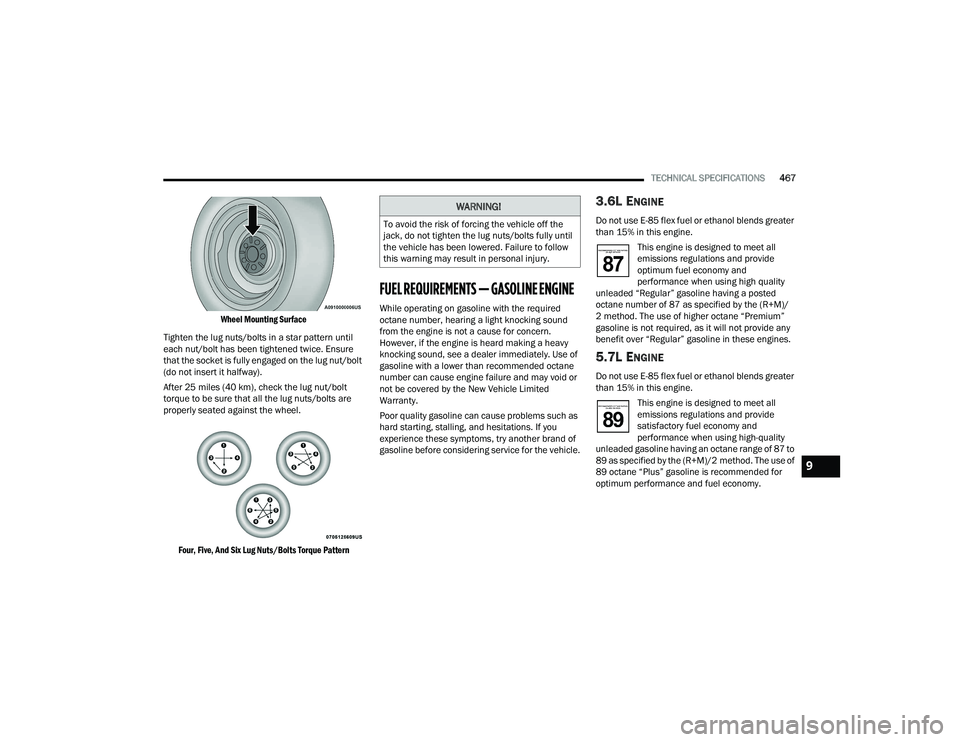
Wheel Mounting Surface
Tighten the lug nuts/bolts in a star pattern until
each nut/bolt has been tightened twice. Ensure
that the socket is fully engaged on the lug nut/bolt
(do not insert it halfway).
After 25 miles (40 km), check the lug nut/bolt
torque to be sure that all the lug nuts/bolts are
properly seated against the wheel.
Four, Five, And Six Lug Nuts/Bolts Torque Pattern
FUEL REQUIREMENTS — GASOLINE ENGINE
While operating on gasoline with the required
octane number, hearing a light knocking sound
from the engine is not a cause for concern.
However, if the engine is heard making a heavy
knocking sound, see a dealer immediately. Use of
gasoline with a lower than recommended octane
number can cause engine failure and may void or
not be covered by the New Vehicle Limited
Warranty.
Poor quality gasoline can cause problems such as
hard starting, stalling, and hesitations. If you
experience these symptoms, try another brand of
gasoline before considering service for the vehicle.
3.6L ENGINE
Do not use E-85 flex fuel or ethanol blends greater
than 15% in this engine. This engine is designed to meet all
emissions regulations and provide
optimum fuel economy and
performance when using high quality
unleaded “Regular” gasoline having a posted
octane number of 87 as specified by the (R+M)/
2 method. The use of higher octane “Premium”
gasoline is not required, as it will not provide any
benefit over “Regular” gasoline in these engines.
5.7L ENGINE
Do not use E-85 flex fuel or ethanol blends greater
than 15% in this engine.
This engine is designed to meet all
emissions regulations and provide
satisfactory fuel economy and
performance when using high-quality
unleaded gasoline having an octane range of 87 to
89 as specified by the (R+M)/2 method. The use of
89 octane “Plus” gasoline is recommended for
optimum performance and fuel economy.
WARNING!
To avoid the risk of forcing the vehicle off the
jack, do not tighten the lug nuts/bolts fully until
the vehicle has been lowered. Failure to follow
this warning may result in personal injury.
9
22_DT_OM_EN_USC_t.book Page 467
Page 470 of 496

468TECHNICAL SPECIFICATIONS
REFORMULATED GASOLINE
Many areas of the country require the use of
cleaner-burning gasoline referred to as
“reformulated gasoline”. Reformulated gasoline
contains oxygenates and are specifically blended
to reduce vehicle emissions and improve air
quality.
The use of reformulated gasoline is recommended.
Properly blended reformulated gasoline will
provide improved performance and durability of
engine and fuel system components.
MATERIALS ADDED TO FUEL
Besides using unleaded gasoline with the proper
octane rating, gasolines that contain detergents,
corrosion and stability additives are
recommended. Using gasolines that have these
additives will help improve fuel economy, reduce
emissions, and maintain vehicle performance.
Designated TOP TIER Detergent
Gasoline contains a higher level of
detergents to further aide in minimizing
engine and fuel system deposits. When
available, the usage of TOP TIER Detergent
Gasoline is recommended. Visit
www.toptiergas.com for a list of TOP TIER
Detergent Gasoline retailers. Indiscriminate use of fuel system cleaning agents
should be avoided. Many of these materials
intended for gum and varnish removal may contain
active solvents or similar ingredients. These can
harm fuel system gasket and diaphragm materials.
GASOLINE/OXYGENATE BLENDS
Some fuel suppliers blend unleaded gasoline with
oxygenates such as ethanol.
Problems that result from using gasoline
containing more than 15% ethanol (E-15) or
gasoline containing methanol are not the
responsibility of the manufacturer and may void
the New Vehicle Limited Warranty.
DO NOT USE E-85 IN NON-FLEX FUEL
V
EHICLES
Non-Flex Fuel Vehicles (FFV) are compatible with
gasoline containing up to 15% ethanol (E-15). Use
of gasoline with higher ethanol content may void
the New Vehicle Limited Warranty.
If a Non-FFV vehicle is inadvertently fueled with
E-85 fuel, the engine will have some or all of these
symptoms:
Operate in a lean mode.
OBD II Malfunction Indicator Light on.
Poor engine performance.
Poor cold start and cold drivability.
Increased risk for fuel system component corro -
sion.
CNG AND LP FUEL SYSTEM
M
ODIFICATIONS
Modifications that allow the engine to run on
Compressed Natural Gas (CNG) or Liquid Propane
(LP) may result in damage to the engine,
emissions, and fuel system components. Problems
that result from running CNG or LP are not the
responsibility of the manufacturer and may void
the New Vehicle Limited Warranty.
CAUTION!
DO NOT use E-85, gasoline containing methanol,
or gasoline containing more than 15% ethanol
(E-15). Use of these blends may result in starting
and drivability problems, damage critical fuel
system components, cause emissions to exceed
the applicable standard, and/or cause the
Malfunction Indicator Light to illuminate. Please
observe pump labels as they should clearly
communicate if a fuel contains greater than
15% ethanol (E-15).
22_DT_OM_EN_USC_t.book Page 468
Page 471 of 496

TECHNICAL SPECIFICATIONS469
(Continued)
METHYLCYCLOPENTADIENYL
M
ANGANESE TRICARBONYL (MMT) IN
G
ASOLINE
MMT is a manganese-containing metallic additive
that is blended into some gasoline to increase
octane. Gasoline blended with MMT provides no
performance advantage beyond gasoline of the
same octane number without MMT. Gasoline
blended with MMT reduces spark plug life and
reduces emissions system performance in some
vehicles. The manufacturer recommends that
gasoline without MMT be used in your vehicle. The
MMT content of gasoline may not be indicated on
the gasoline pump; therefore, you should ask the
gasoline retailer whether the gasoline contains
MMT. MMT is prohibited in Federal and California
reformulated gasoline.
FUEL SYSTEM CAUTIONSNOTE:Intentional tampering with the emissions control
system can result in civil penalties being assessed
against you.
FUEL REQUIREMENTS – DIESEL ENGINE
Federal law requires that you must fuel this vehicle
with Ultra Low Sulfur Highway Diesel fuel (15 ppm
Sulfur maximum) and prohibits the use of Low
Sulfur Highway Diesel fuel (500 ppm Sulfur
maximum) to avoid damage to the emissions
control system.
Use good quality diesel fuel from a reputable
supplier in your vehicle. For most year-round
service, No. 2 diesel fuel meeting ASTM (formerly
known as the American Society for Testing and
Materials) specification D-975 Grade S15 will
provide good performance. If the vehicle is
exposed to extreme cold (below 20°F or -7°C), or
is required to operate at colder-than-normal
conditions for prolonged periods, use Climatized
Number 2 diesel fuel or dilute the Number 2 diesel
fuel with 50% Number 1 diesel fuel. This will
provide better protection from fuel gelling or
wax-plugging of the fuel filters.
CAUTION!
Follow these guidelines to maintain your
vehicle’s performance:
The use of leaded gasoline is prohibited by
Federal law. Using leaded gasoline can impair
engine performance and damage the emis -
sions control system.
An out-of-tune engine or certain fuel or ignition
malfunctions can cause the catalytic
converter to overheat. If you notice a pungent
burning odor or some light smoke, your engine
may be out of tune or malfunctioning and may
require immediate service. Contact an autho -
rized dealer for service assistance.
The use of fuel additives, which are now being
sold as octane enhancers, is not recom -
mended. Most of these products contain high
concentrations of methanol. Fuel system
damage or vehicle performance problems
resulting from the use of such fuels or addi -
tives is not the responsibility of the manufac-
turer and may void or not be covered under
the New Vehicle Limited Warranty.
CAUTION!
WARNING!
Do not use alcohol or gasoline as a fuel blending
agent. They can be unstable under certain
conditions and hazardous or explosive when
mixed with diesel fuel.9
22_DT_OM_EN_USC_t.book Page 469