2022 PEUGEOT 301 bulb
[x] Cancel search: bulbPage 4 of 148

2
Contents
■
Overview
■
Eco-driving
1Dashboard instrumentsInstrument panel 7
Warning and indicator lamps 7
Indicators 10
Distance recorders 11
Setting the date and time 12
Trip computer 12
2AccessRemote control / Key 15
Central locking 16
Back-up procedures 17
Doors 18
Boot 18
Alarm 19
Electric windows 20
3Ease of use and comfortFront seats 21
Rear bench seat 22
Steering wheel adjustment 23
Mirrors 23
Heating and Ventilation 24
Air conditioning, manual (without
display screen)
25
Electronic air conditioning (with
display screen)
26
Front demisting - defrosting 27
Demisting/de-icing the rear screen and/or
the door mirrors 28
Interior fittings 28
Courtesy lamps 30
4Lighting and visibilityExterior lighting control stalk 31
Direction indicators 32
Headlamp beam height adjustment 33
Wiper control stalk 33
Changing a wiper blade 34
5SafetyGeneral safety recommendations 35
Hazard warning lamps 35
Horn 36
Electronic stability control (ESC) 36
Seat belts 37
Airbags 39
Child seats 41
Deactivating the front passenger airbag 43
ISOFIX child seats 45
Child lock 48
6DrivingDriving recommendations 49
Starting-switching off the engine 51
Parking brake 52
Hill start assist 52
5-speed manual gearbox 53
6-speed manual gearbox 53
6-speed automatic gearbox 54
Gear shift indicator 56
Stop & Start 56
Tyre under-inflation detection 58
Driving and manoeuvring aids - General
recommendations
60
Speed limiter 61
Cruise control - Specific recommendations 62
Cruise control 63
Rear parking sensors 64
Reversing Camera 65
7Practical informationCompatibility of fuels 67
Refuelling 67
Misfuel prevention (Diesel) 68
Snow chains 68
Energy economy mode 69
Towing device 69
Very cold climate screen 70
Roof bars 70
Bonnet 71
Engine compartment 72
Checking levels 73
Checks 74
Free-wheeling 76
Advice on care and maintenance 76
8In the event of a breakdownWarning triangle 79
Running out of fuel (Diesel) 79
Tool kit 79
Spare wheel 80
Changing a bulb 83
Fuses 87
12 V battery 88
Page 6 of 148

4
Overview
Presentation
These illustrations and descriptions are intended
as a guide. The presence and location of some
components varies according to the version, trim
level and country of sale.
Instruments and controls
1.Bonnet release
2. Dashboard fuses
3. Horn
4. Instrument panel
5. Audio and telematics systems
6. Warning lamp display for seat belts and front
passenger airbag
Courtesy lamps
Rear view mirror 7.
Emergency warning lamps
Locking/unlocking from the inside
8. Adjusting the date/time
9. Heating, ventilation
Manual air conditioning (without display
screen)
Electronic air conditioning (with display
screen)
Front demisting/defrosting
Rear screen demisting/defrosting
Heated windscreen
10. Manual gearbox
Automatic gearbox (EAT6)
Gear shift indicator
11 . USB socket
12 V accessory socket / Cigar lighter
12. Parking brake
13. Electric windows deactivation
Steering-mounted controls
1.External lighting/direction indicators control
stalk
Voice recognition activation button 2.
Speed Limiter/Cruise Control
3. Audio system setting controls
4. Wiper/screenwash/trip computer control stalk
Side control bar
1.Manual headlamp beam height adjustment
2. DSC/ASR systems
3. Stop & Start
4. Boot lid opening
5. Alarm
6. Door mirrors adjustment
Labels
"Lighting and visibility - Exterior lighting
control stalk" and "In the event of a
breakdown - Changing a bulb" sections:
"Safety - Child seats - Deactivating the front
passenger airbag" section:
Page 37 of 148
35
Safety
5General safety
recommendations
Do not remove the labels attached in
different places on your vehicle. They
include safety warnings as well as
identification information for the vehicle.
For all work on your vehicle, use a
qualified workshop that has the technical
information, skills and equipment required, all
of which a PEUGEOT dealer is able to
provide.
Depending on country regulations,
certain safety equipment may be
mandatory: high visibility safety vests,
warning triangles, breathalysers, spare bulbs,
spare fuses, fire extinguisher, first aid kit, mud
flaps at the rear of the vehicle, etc.
Installing electrical accessories:
– The fitting of electrical equipment or
accessories not approved by PEUGEOT
may
cause excessive current consumption and
faults and failures with the electrical system
of your vehicle. Contact a PEUGEOT dealer
for information on the range of approved
accessories.
–
As a safety measure, access to the
diagnostic socket, used for the vehicle's
electronic systems, is reserved strictly for
PEUGEOT dealers or qualified workshops,
equipped with the special tools required (risk
of malfunctions of the vehicle's electronic
systems that could cause breakdowns or
serious accidents). The Manufacturer cannot
be held responsible if this advice is not
followed.
–
Any modification or adaptation not intended
or authorised by PEUGEOT
or carried out
without meeting the technical requirements
defined by the Manufacturer will result in the
suspension of the commercial warranty.
Installation of accessory radio
communication transmitters
Before installing a radio communication
transmitter with an external aerial, you must
without fail contact a PEUGEOT dealer for
the specification of transmitters which can
be fitted (frequency, maximum power, aerial
position, specific installation requirements),
in line with the Vehicle Electromagnetic
Compatibility Directive (2004/104/EC).
Declarations of conformity for radio
equipment
The relevant certificates are available on the
brand website:
http://public.servicebox.peugeot.com/APddb/
Hazard warning lamps
► Pressing this red button causes all the
direction indicators to flash.
They can work with the ignition switched off.
Automatic operation of hazard warning lamps
When braking in an emergency, depending on
the rate of deceleration, the hazard warning
lamps come on automatically. They switch off
automatically when you next accelerate.
They can be switched off by pressing the button.
Page 85 of 148
83
In the event of a breakdown
8
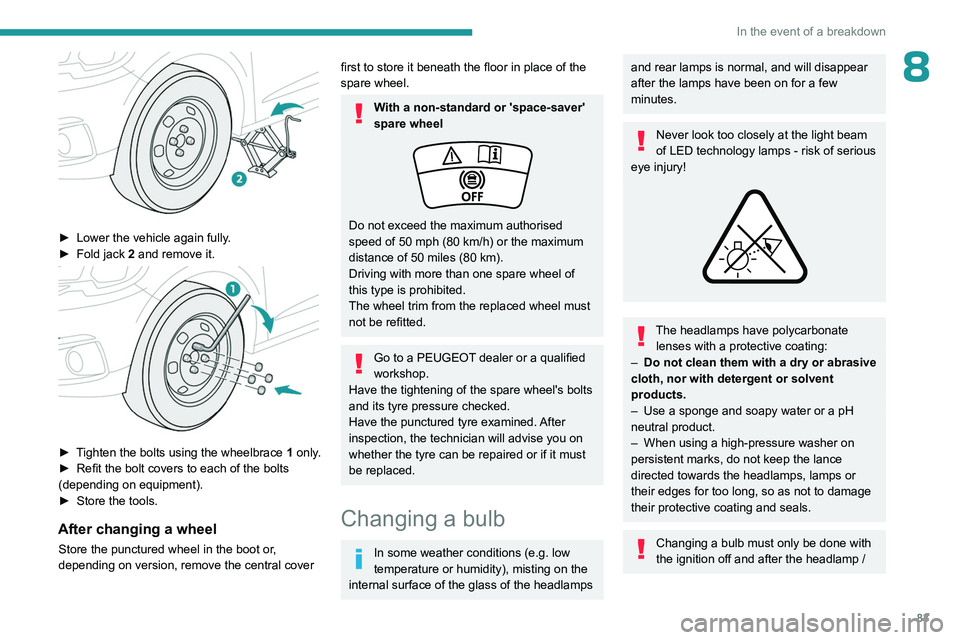
► Lower the vehicle again fully.
► Fold jack 2 and remove it.
► Tighten the bolts using the wheelbrace 1 only.
► Refit the bolt covers to each of the bolts
(depending on equipment).
►
Store the tools.
After changing a wheel
Store the punctured wheel in the boot or,
depending on version, remove the central cover
first to store it beneath the floor in place of the
spare wheel.
With a non-standard or 'space-saver'
spare wheel
Do not exceed the maximum authorised
speed of 50 mph (80 km/h) or the maximum
distance of 50 miles (80 km).
Driving with more than one spare wheel of
this type is prohibited.
The wheel trim from the replaced wheel must
not be refitted.
Go to a PEUGEOT dealer or a qualified
workshop.
Have the tightening of the spare wheel's bolts
and its tyre pressure checked.
Have the punctured tyre examined. After
inspection, the technician will advise you on
whether the tyre can be repaired or if it must
be replaced.
Changing a bulb
In some weather conditions (e.g. low
temperature or humidity), misting on the
internal surface of the glass of the headlamps
and rear lamps is normal, and will disappear
after the lamps have been on for a few
minutes.
Never look too closely at the light beam
of LED technology lamps - risk of serious
eye injury!
The headlamps have polycarbonate lenses with a protective coating:
–
Do not clean them with a dry or abrasive
cloth, nor with detergent or solvent
products.
–
Use a sponge and soapy water or a pH
neutral product.
–
When using a high-pressure washer on
persistent marks, do not keep the lance
directed towards the headlamps, lamps or
their edges for too long, so as not to damage
their protective coating and seals.
Changing a bulb must only be done with
the ignition off and after the headlamp /
Page 86 of 148
84
In the event of a breakdown
lamp has been switched off for several
minutes - risk of serious burns!
Do not touch the bulb directly with your
fingers; use a lint-free cloth.
It is essential only to use anti-ultraviolet
(UV) type bulbs, so as not to damage the
headlamp.
Always replace a failed bulb with a new bulb
of the same type and specification. To avoid
lighting imbalance, replace the bulbs in pairs.
Refitting the lamp units
Perform the operations in the reverse
order to dismantling.
Light-emitting diode (LED)
headlamps and lamps
Depending on version, the affected types of
headlamps/lamps are:
–
Daytime running lamps/sidelamps.
If you need to replace this type of bulb,
you must contact a PEUGEOT dealer or
a qualified workshop.
Do not touch the LED technology bulbs - risk
of electrocution!
Front lamps
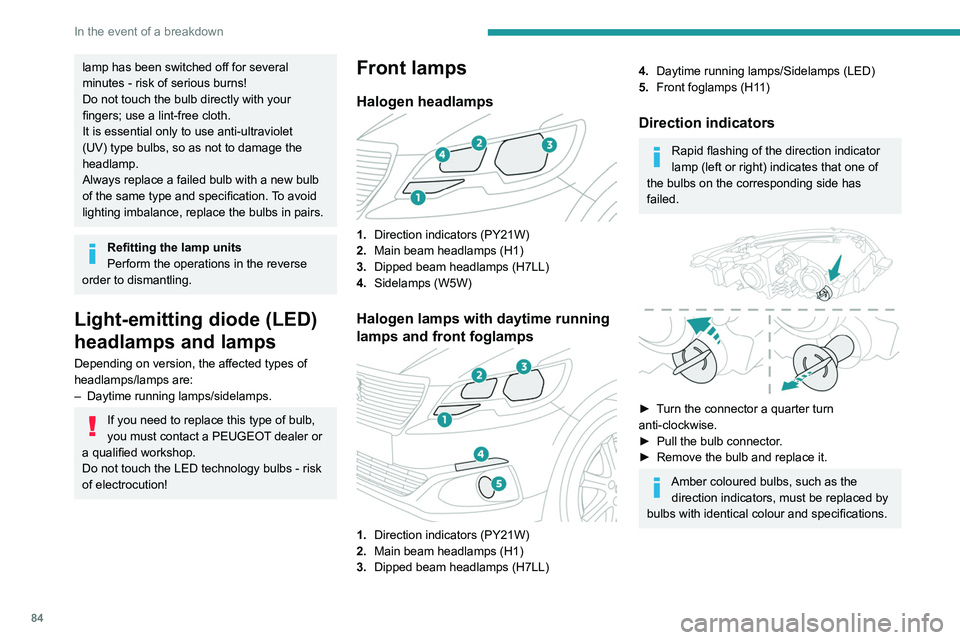
Halogen headlamps
1. Direction indicators (PY21W)
2. Main beam headlamps (H1)
3. Dipped beam headlamps (H7LL)
4. Sidelamps (W5W)
Halogen lamps with daytime running
lamps and front foglamps
1.Direction indicators (PY21W)
2. Main beam headlamps (H1)
3. Dipped beam headlamps (H7LL)
4.Daytime running lamps/Sidelamps (LED)
5. Front foglamps (H11)
Direction indicators
Rapid flashing of the direction indicator
lamp (left or right) indicates that one of
the bulbs on the corresponding side has
failed.
► Turn the connector a quarter turn
anti-clockwise.
►
Pull the bulb connector
.
►
Remove the bulb and replace it.
Amber coloured bulbs, such as the direction indicators, must be replaced by
bulbs with identical colour and specifications.
Page 87 of 148
85
In the event of a breakdown
8Main beam headlamps
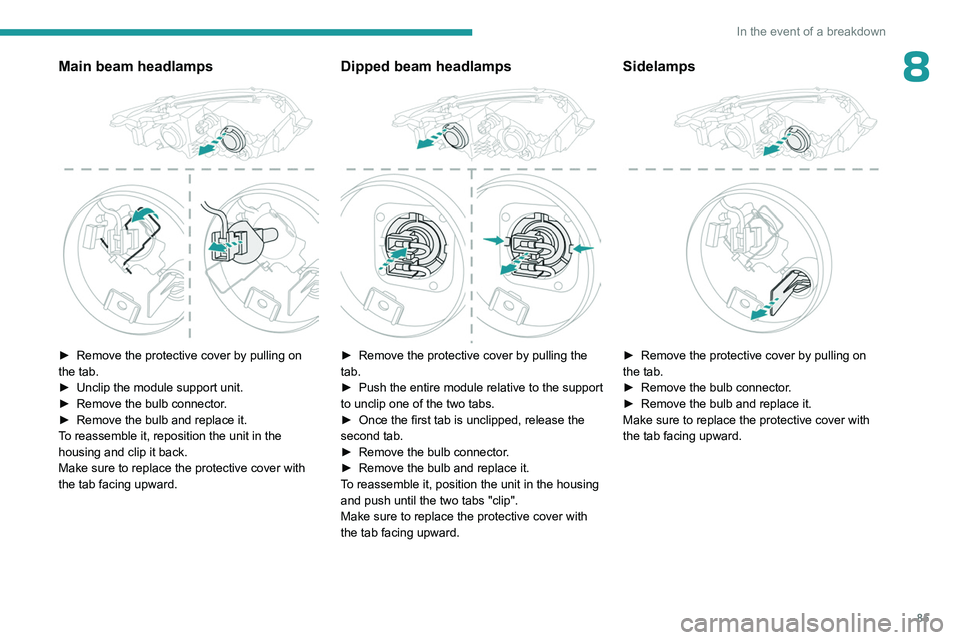
► Remove the protective cover by pulling on
the tab.
►
Unclip the module support unit.
►
Remove the bulb connector
.
►
Remove the bulb and replace it.
T
o reassemble it, reposition the unit in the
housing and clip it back.
Make sure to replace the protective cover with
the tab facing upward.
Dipped beam headlamps
► Remove the protective cover by pulling the
tab.
►
Push the entire module relative to the support
to unclip one of the two tabs.
►
Once the first tab is unclipped, release the
second tab.
►
Remove the bulb connector
.
►
Remove the bulb and replace it.
T
o reassemble it, position the unit in the housing
and push until the two tabs "clip".
Make sure to replace the protective cover with
the tab facing upward.
Sidelamps
► Remove the protective cover by pulling on
the tab.
►
Remove the bulb connector
.
►
Remove the bulb and replace it.
Make sure to replace the protective cover with
the tab facing upward.
Page 88 of 148
86
In the event of a breakdown
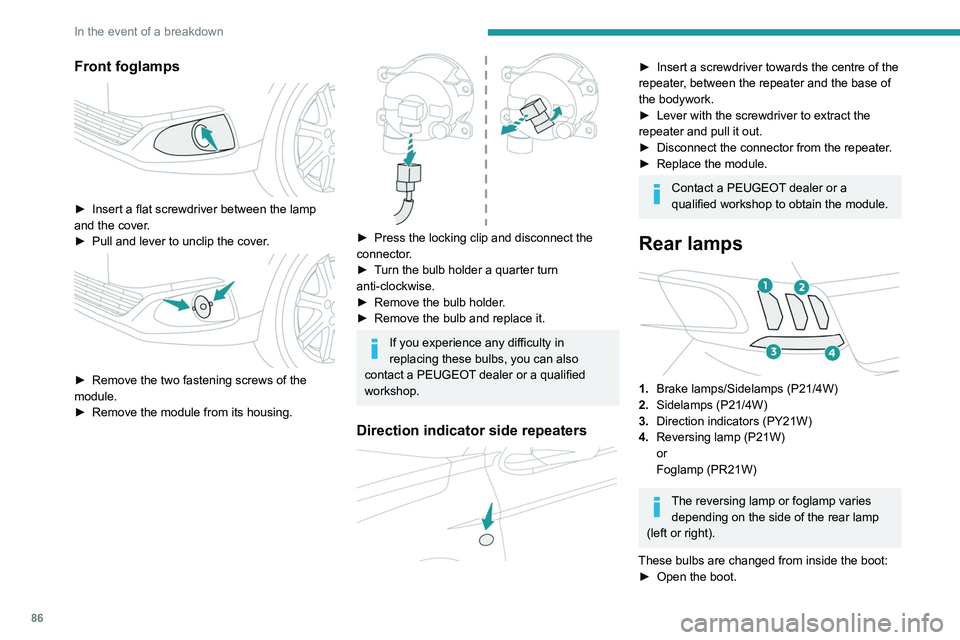
Front foglamps
► Insert a flat screwdriver between the lamp
and the cover .
►
Pull and lever to unclip the cover
.
► Remove the two fastening screws of the
module.
►
Remove the module from its housing.
► Press the locking clip and disconnect the
connector .
►
T
urn the bulb holder a quarter turn
anti-clockwise.
►
Remove the bulb holder
.
►
Remove the bulb and replace it.
If you experience any difficulty in
replacing these bulbs, you can also
contact a PEUGEOT dealer or a qualified
workshop.
Direction indicator side repeaters
► Insert a screwdriver towards the centre of the
repeater , between the repeater and the base of
the bodywork.
►
Lever with the screwdriver to extract the
repeater and pull it out.
►
Disconnect the connector from the repeater
.
►
Replace the module.
Contact a PEUGEOT dealer or a
qualified workshop to obtain the module.
Rear lamps
1. Brake lamps/Sidelamps (P21/4W)
2. Sidelamps (P21/4W)
3. Direction indicators (PY21W)
4. Reversing lamp (P21W)
or
Foglamp (PR21W)
The reversing lamp or foglamp varies
depending on the side of the rear lamp
(left or right).
These bulbs are changed from inside the boot: ►
Open the boot.
Page 89 of 148
87
In the event of a breakdown
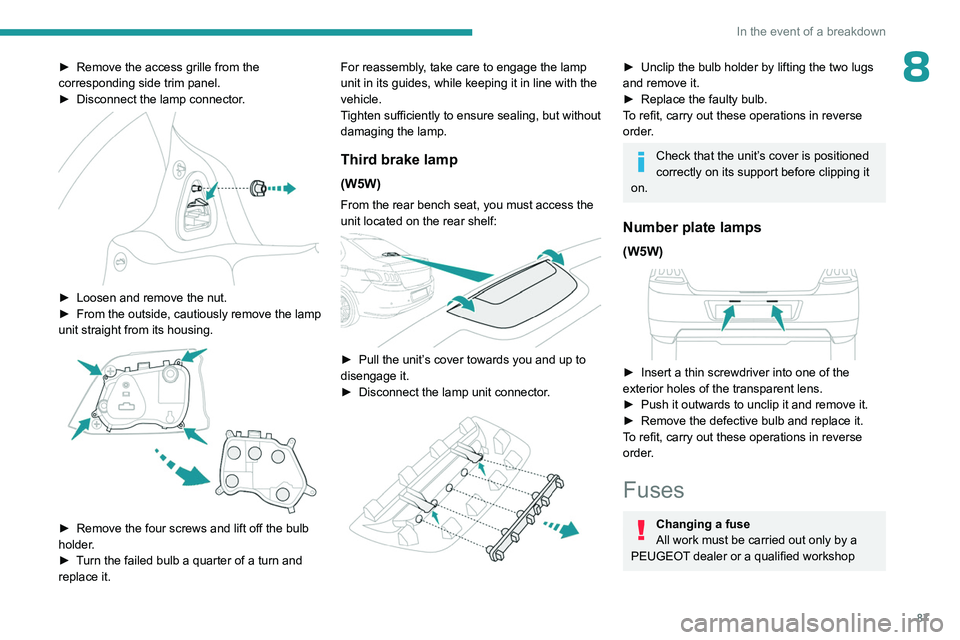
8► Remove the access grille from the
corresponding side trim panel.
►
Disconnect the lamp connector
.
► Loosen and remove the nut.
► From the outside, cautiously remove the lamp
unit straight from its housing.
► Remove the four screws and lift off the bulb
holder .
►
T
urn the failed bulb a quarter of a turn and
replace it. For reassembly, take care to engage the lamp
unit in its guides, while keeping it in line with the
vehicle.
Tighten sufficiently to ensure sealing, but without
damaging the lamp.
Third brake lamp
(W5W)
From the rear bench seat, you must access the
unit located on the rear shelf:
► Pull the unit’
s cover towards you and up to
disengage it.
►
Disconnect the lamp unit connector
.
► Unclip the bulb holder by lifting the two lugs
and remove it.
►
Replace the faulty bulb.
T
o refit, carry out these operations in reverse
order.
Check that the unit’s cover is positioned
correctly on its support before clipping it
on.
Number plate lamps
(W5W)
► Insert a thin screwdriver into one of the
exterior holes of the transparent lens.
►
Push it outwards to unclip it and remove it.
►
Remove the defective bulb and replace it.
T
o refit, carry out these operations in reverse
order.
Fuses
Changing a fuse
All work must be carried out only by a
PEUGEOT dealer or a qualified workshop