Page 157 of 663

3-61
Convenience Features
3
Do not pull or push the power sun-
shade by hand as such action may
damage the power sunshade or
cause it to malfunction.
Information
Wrinkles formed on the power sun-
shade are normal due to material
characteristic.
Tilt open/close (Front)
Push the sunroof switch upward,the sunroof glass tilts open.
Push the sunroof switch forward, the sunroof glass automatically
closes.
To stop the sunroof movement at any
point, push the sunroof switch in any
direction.
Slide open/close (Front)
Push the sunroof switch rearward, the sunshade and sunroof glass
slide open.
Push the sunroof switch forward,
only the sunroof glass closes.
Push the sunroof switch forward or rearward to the first detent posi-
tion, the sunroof glass moves until
the switch is released.
Push the sunroof switch forward or rearward to the second detent
position, the sunroof glass oper-
ates automatically (auto slide fea-
ture).
To stop the sunroof movement at
any point, push the sunroof switch
in any direction.
i
NOTICE
OLX2048029OLX2048028
Page 158 of 663

3-62
Convenience Features
Automatic reversal
If the power sunshade or sunroof
glass senses any obstacle while it is
closing automatically, it will reverse
direction then stop at a certain posi-
tion.
The auto reverse function may not
work if an object thin or soft is caught
between the sliding power sunshade
or sunroof glass and sunroof sash. Do not continue to push the
sunroof switch after the sunroof
is fully opened, closed, or tilted.
Damage to the sunroof motor
could occur.
Continuous operations such as slide open/close, tilt open/close,
etc. may cause the motor or sun-
roof system to malfunction.
Regularly remove any accumu- lated dust on the sunroof rail.
Using the sunroof for a long time can make noise caused by
dust in accumulated between
the sunroof and vehicle body.
Open the sunroof and remove
dust regularly using a clean
cloth.
Do not try to open the sunroof when the temperature is below
freezing or when the sunroof is
covered with snow or ice, other-
wise the motor could be dam-
aged. In cold and wet climates,
the sunroof may not work prop-
erly.
NOTICE
Make sure heads, hands, arms
or any other body parts or
objects are out of the way
before operating the sunroof.
Body parts or objects may get
caught causing injuries or
vehicle damage.
Never deliberately use your
body parts to test the auto-
matic reversal function. The
power sunshade or sunroof
glass may reverse direction,
but there is a risk of injury.
WARNING
ODH043039
Page 159 of 663
3-63
Convenience Features
3
Do not open or drive with thesunroof glass open immediately
after rain or washing the vehicle.
Water may wet the interior of the
vehicle.
Do not extend any luggage out- side the sunroof while driving.
Vehicle damage may occur if the
vehicle suddenly stops.Resetting the sunroof
In some circumstances resetting the
sunroof operation may need to be
performed. Some instances where
resetting the sunroof may be
required include:
OLX2048032
■ Front
■Rear
OLX2048098
Do not extend your head, arms,
body parts or objects outside
the sunroof while driving.
Injuries may occur if the vehicle
suddenly stops.
WARNING
Page 160 of 663

3-64
Convenience Features
When the 12-volt battery is either disconnected or discharged
When the sunroof fuse is replaced
If the sunroof one-touch AUTO OPEN/CLOSE operation is not
functioning properly Sunroof resetting procedure:
1. It is recommended to perform the
reset procedure with the vehicle
engine running. Start the vehicle in
P (Park).
2. Make sure the power sunshade or sunroof glass is in the fully closed
position. If the power sunshade or
sunroof glass is open, push the
switch forward until the power sun-
shade and sunroof glass is fully
closed.
3. Release the switch when the power sunshade or sunroof glass
is fully closed.
4. Push the switch forward until the power sunshade or sunroof glass
moves slightly. Then release the
switch.
5. Once again push and hold the sunroof switch forward until the
power sunshade or sunroof glass
slides open and close. Do not
release the switch until the opera-
tion is completed. If you release
the switch during operation, start
the procedure again from step 2.
Information
If the sunroof is not reset when the
vehicle battery is disconnected or dis-
charged, or the sunroof fuse is blown,
the sunroof may not operate normally.
i
Page 161 of 663
3-65
Convenience Features
3
Sunroof open warning
If the driver turns off the engine when
the sunroof is not fully closed, the
warning chime will sound for several
seconds and the sunroof open warn-
ing will appear on the cluster LCD
display.
Close the sunroof securely when
leaving your vehicle.
OLX2048108
Make sure the sunroof is closed
fully when leaving your vehicle.
If the sunroof is left open, rain
or snow may wet the interior of
the vehicle. Also, leaving the
sunroof open when the vehicle
is unattended may invite theft.
CAUTION
Page 201 of 663
3-105
Convenience Features
3
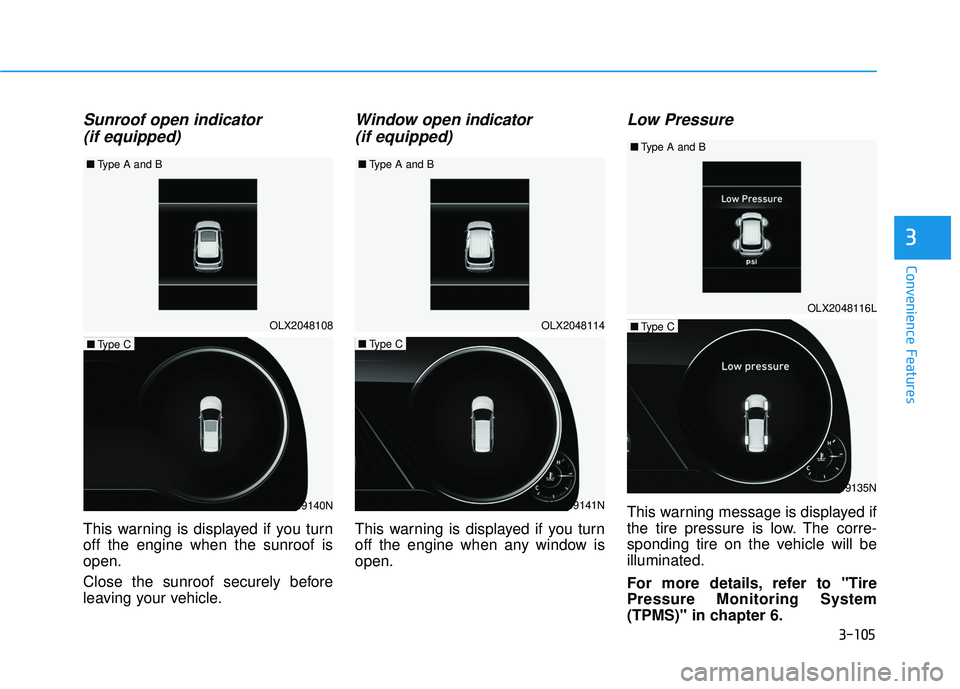
Sunroof open indicator (if equipped)
This warning is displayed if you turn
off the engine when the sunroof is
open.
Close the sunroof securely before
leaving your vehicle.
Window open indicator
(if equipped)
This warning is displayed if you turn
off the engine when any window is
open.
Low Pressure
This warning message is displayed if
the tire pressure is low. The corre-
sponding tire on the vehicle will be
illuminated.
For more details, refer to "Tire
Pressure Monitoring System
(TPMS)" in chapter 6.
OLX2048108
■
Type A and B
OLX2049140N
■Type C
OLX2049141N
■Type C
OLX2049135N
■Type COLX2048114
OLX2048116L
■
Type A and B ■
Type A and B
Page 289 of 663

3-193
Convenience Features
3
Operation Tips
To keep dust or unpleasant fumesfrom entering the vehicle through
the ventilation system, temporarily
set the air intake control to recircu-
lation mode. Return the control to
fresh mode when the unpleasant
air outside has diminished. This will
help keep the driver alert and com-
fortable.
To help prevent the inside of the windshield from fogging, set the air
intake control to fresh mode and
fan speed to the desired position,
turn on the air conditioning system,
and adjust the temperature control
to the desired temperature.
Air conditioning
Your HYUNDAI vehicle air condition-
ing system is filled with R-134a
refrigerant.
1. Start the engine.
2. Press the air conditioning button.
3. Select the Face Level mode. 4. Set the air intake control to
Recirculation mode temporarily to
allow the cabin to cool quickly.
When the desired temperature in
the cabin is reached, change the
air intake control back to Fresh
mode.
5. Adjust the fan speed control and temperature control to maintain
maximum comfort.
When maximum cooling is desired,
set the temperature control to the
MAX A/C position, then set the fan
speed control to the highest setting.
When using the air conditioning
system, monitor the engine tem-
perature gauge closely while driv-
ing up hills or in heavy traffic when
outside temperatures are high. Air
conditioning system operation
when climbing a steep grade or in
high outside ambient tempera-
tures can cause engine overheat-
ing.
Continue to use the fan, but turn
the air conditioning system off if
the engine temperature gauge
indicates engine overheating.
Air conditioning system operation tips
If the vehicle has been parked in direct sunlight during hot weather,
open the windows for a short time
to let the hot air inside the vehicle
escape.
After sufficient cooling has been achieved, switch back from recircu-
lation mode to fresh mode.
To help reduce moisture inside of the windows on rainy or humid
days, decrease the humidity inside
the vehicle by operating the air con-
ditioning system with the windows
and sunroof closed.
Use the air conditioning system every month only for a few minutes
to ensure maximum system per-
formance.
If you operate air conditioner exces- sively, the difference between the
temperature of the outside air and
that of the windshield could cause
the outer surface of the windshield
to fog up, causing loss of visibility.
In this case, set the mode selection
knob or button to the position
and fan speed control to the lower
speed.
NOTICE
Page 304 of 663

3-208
Convenience Features
Operation Tips
To keep dust or unpleasant fumesfrom entering the car through the
ventilation system, temporarily set
the air intake control to the recircu-
lation mode. Return the control to
the to fresh mode when the
unpleasant air outside has dimin-
ished. This will help keep the driver
alert and comfortable.
To help prevent the inside of the windshield from fogging, set the air
intake control to fresh mode and
the fan speed to the desired posi-
tion, turn on the air conditioning
system, and adjust the temperature
control to the desired temperature.
Air conditioning
Your HYUNDAI vehicle air condition-
ing system is filled with R-134a
refrigerant.
1. Start the engine.
2. Press the air conditioning button.
3. Select the Face Level mode. 4. Set the air intake control to
Recirculation mode temporarily to
allow the cabin to cool quickly.
When the desired temperature in
the cabin is reached, change the
air intake control back to Fresh
mode.
5. Adjust the fan speed control and temperature control to maintain
maximum comfort.
When maximum cooling is desired,
set the temperature control to the
MAX A/C position, then set the fan
speed control to the highest setting.
When using the air conditioning
system, monitor the engine tem-
perature gauge closely while driv-
ing up hills or in heavy traffic
when outside temperatures. Air
conditioning system operation
when climbing a steep grade or in
high outside ambient tempera-
tures can cause engine overheat-
ing. Continue to use the fan, but
turn the air conditioning system
off if the engine temperature
gauge indicates engine overheat-
ing.
Air conditioning system operation
tips
If the vehicle has been parked in direct sunlight during hot weather,
open the windows for a short time
to let the hot air inside the vehicle
escape.
After sufficient cooling has been achieved, switch back from recircu-
lation mode to fresh mode.
To help reduce moisture inside of the windows on rainy or humid
days, decrease the humidity inside
the vehicle by operating the air
conditioning system with the win-
dows and sunroof closed.
Use the air conditioning system every month only for a few minutes
to ensure maximum system per-
formance.
If you operate air conditioner excessively, the difference between
the temperature of the outside air
and that of the windshield could
cause the outer surface of the
windshield to fog up, causing loss
of visibility. In this case, set the
mode selection knob or button to
the position and fan speed
control to the lower speed.
NOTICE