2022 HYUNDAI KONA sensor
[x] Cancel search: sensorPage 440 of 579
Driver assistance system
7-108
Rear Cross-Traffic Safety system
malfunction and limitations
Rear Cross-Traffic Safety system
malfunction
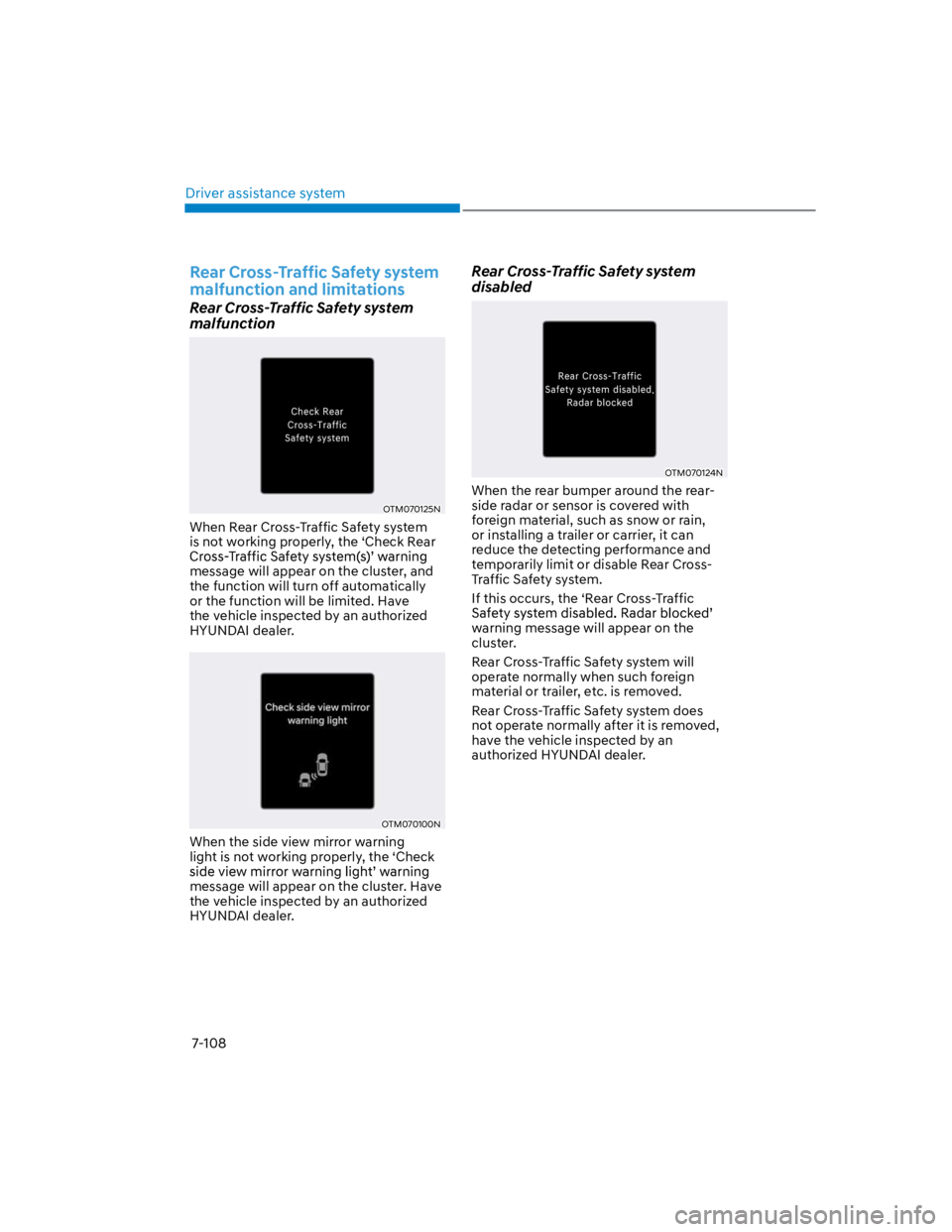
OTM070125N
When Rear Cross-Traffic Safety system
is not working properly, the ‘Check Rear
message will appear on the cluster, and
the function will turn off automatically
or the function will be limited. Have
the vehicle inspected by an authorized
HYUNDAI dealer.
OTM070100N
When the side view mirror warning
light is not working properly, the ‘Check
message will appear on the cluster. Have
the vehicle inspected by an authorized
HYUNDAI dealer.
Rear Cross-Traffic Safety system
disabled
OTM070124N
When the rear bumper around the rear-
side radar or sensor is covered with
foreign material, such as snow or rain,
or installing a trailer or carrier, it can
reduce the detecting performance and
temporarily limit or disable Rear Cross-
Traffic Safety system.
If this occurs, the ‘Rear Cross-Traffic
warning message will appear on the
cluster.
Rear Cross-Traffic Safety system will
operate normally when such foreign
material or trailer, etc. is removed.
Rear Cross-Traffic Safety system does
not operate normally after it is removed,
have the vehicle inspected by an
authorized HYUNDAI dealer.
Page 445 of 579
07
7-113
Reverse Parking Distance Warning will
help warn the driver if an obstacle is
detected within a certain distance when
the vehicle is moving in reverse at low
speeds.
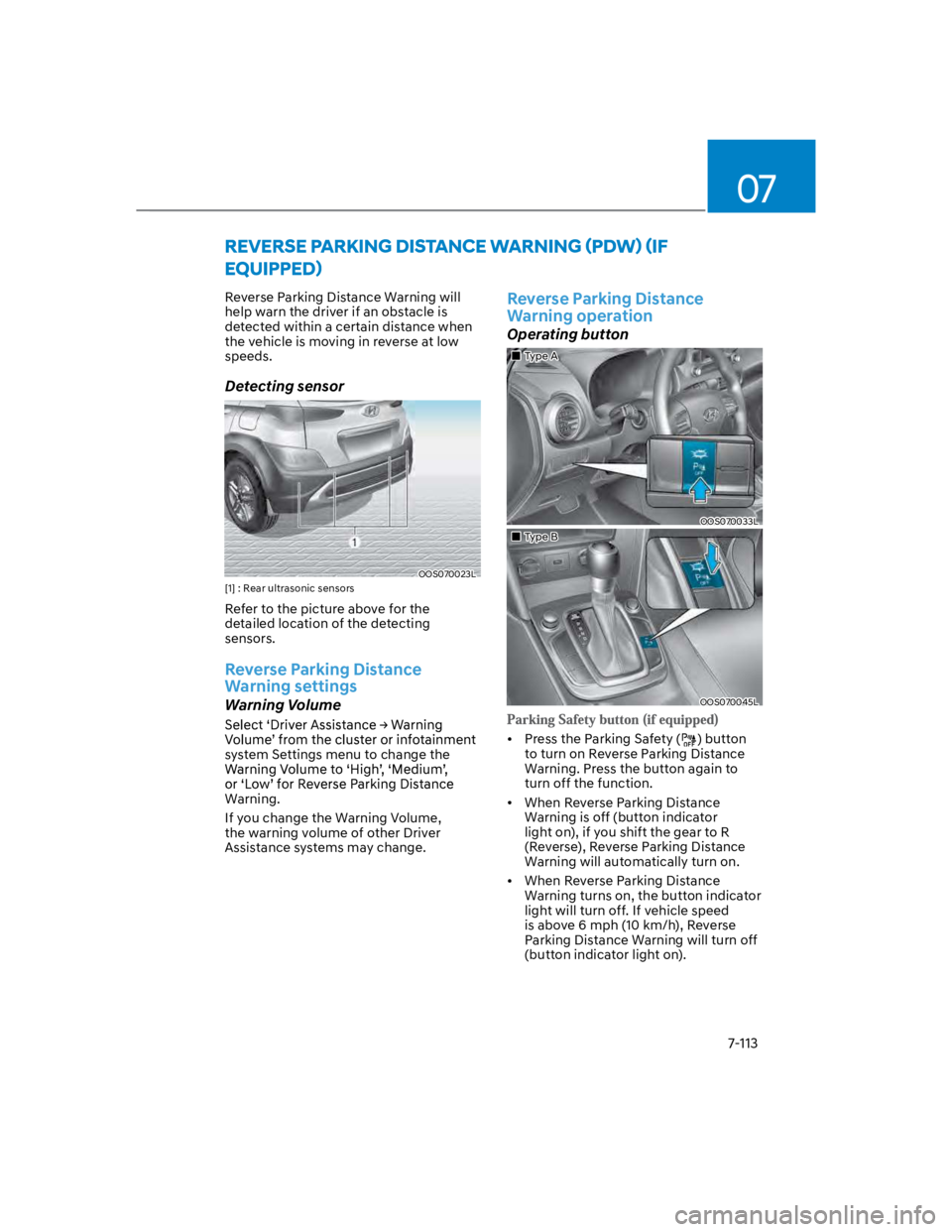
Detecting sensor
OOS070023L
[1] : Rear ultrasonic sensors
Refer to the picture above for the
detailed location of the detecting
sensors.
Reverse Parking Distance
Warning settings
Warning Volume
system Settings menu to change the
Warning.
If you change the Warning Volume,
the warning volume of other Driver
Assistance systems may change.
Reverse Parking Distance
Warning operation
Operating button
Type A
OOS070033L
Type B
OOS070045L
Press the Parking Safety () button
to turn on Reverse Parking Distance
Warning. Press the button again to
turn off the function.
When Reverse Parking Distance
Warning is off (button indicator
light on), if you shift the gear to R
(Reverse), Reverse Parking Distance
Warning will automatically turn on.
When Reverse Parking Distance
Warning turns on, the button indicator
light will turn off. If vehicle speed
is above 6 mph (10 km/h), Reverse
Parking Distance Warning will turn off
(button indicator light on).
Page 446 of 579
Driver assistance system
7-114
Reverse Parking Distance Warning
Reverse Parking Distance Warning
will operate when the gear is in R
(Reverse).
Reverse Parking Distance Warning
may be able to detect a person,
animal or object in the rear when the
mph (10 km/h).
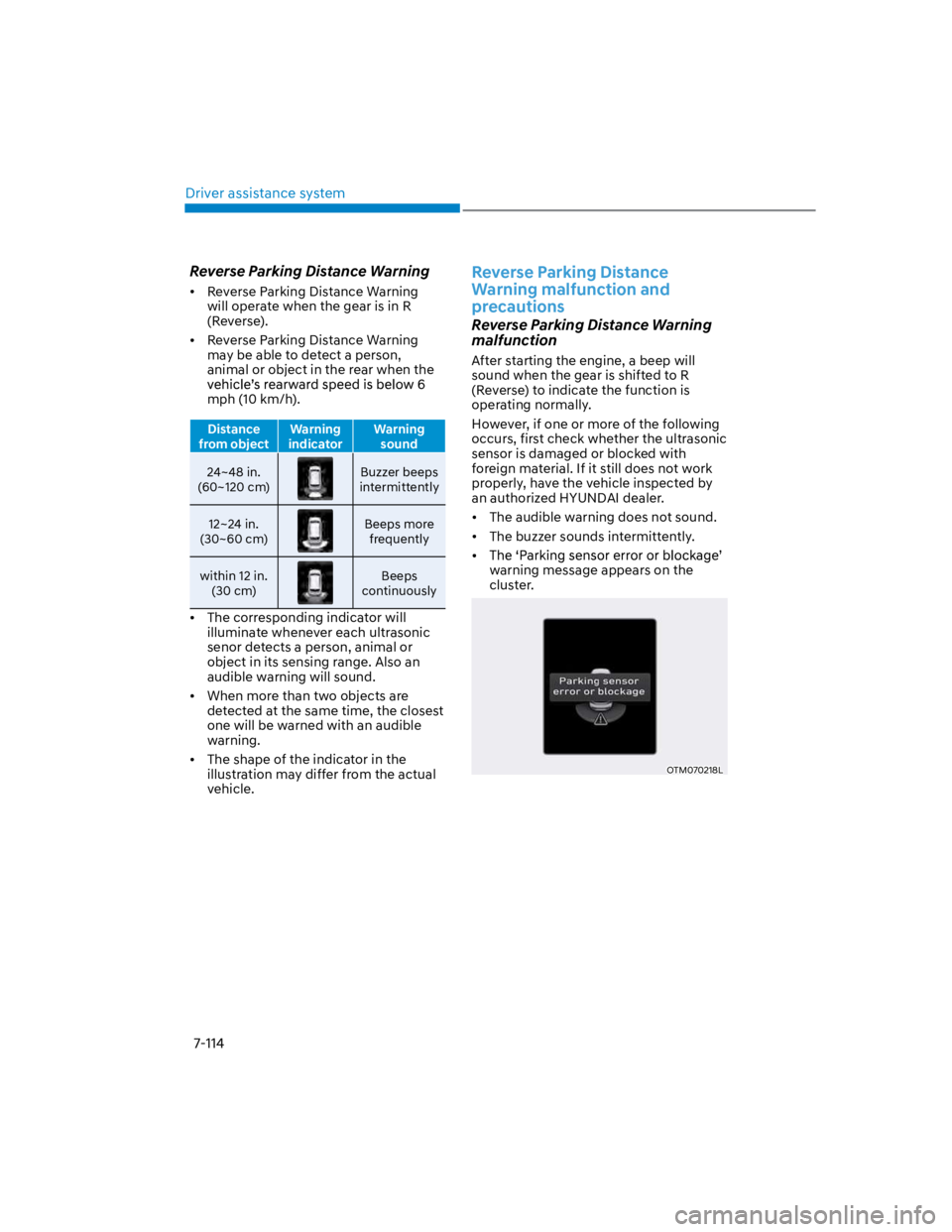
Distance
from object
Warning
indicator
Warning
sound
24~48 in.
(60~120 cm)
Buzzer beeps
intermittently
12~24 in.
(30~60 cm)
Beeps more
frequently
within 12 in.
(30 cm)
Beeps
continuously
The corresponding indicator will
illuminate whenever each ultrasonic
senor detects a person, animal or
object in its sensing range. Also an
audible warning will sound.
When more than two objects are
detected at the same time, the closest
one will be warned with an audible
warning.
The shape of the indicator in the
illustration may differ from the actual
vehicle.
Reverse Parking Distance
Warning malfunction and
precautions
Reverse Parking Distance Warning
malfunction
After starting the engine, a beep will
sound when the gear is shifted to R
(Reverse) to indicate the function is
operating normally.
However, if one or more of the following
occurs, first check whether the ultrasonic
sensor is damaged or blocked with
foreign material. If it still does not work
properly, have the vehicle inspected by
an authorized HYUNDAI dealer.
The audible warning does not sound.
The buzzer sounds intermittently.
warning message appears on the
cluster.
OTM070218L
Page 447 of 579

07
7-115
WARNING
Reverse Parking Distance Warning
is a supplemental function. The
operation of Reverse Parking
Distance Warning can be affected
by several factors (including
environmental conditions). It is the
responsibility of the driver to always
check the rear view before and while
parking.
Your new vehicle warranty does not
cover any accidents or damage to
the vehicle due to driver error.
Pay close attention when driving
near objects, pedestrians, and
especially children. Some objects
may not be detected by the
ultrasonic sensors, due to the objects
distance, size or material, all of
which can limit the effectiveness of
the sensor.
Limitations of Reverse Parking
Distance Warning
Reverse Parking Distance Warning
may not operate normally when:
- Moisture is frozen to the sensor
- Sensor is covered with foreign
material, such as snow or water
(Reverse Parking Distance Warning
will operate normally when such
foreign material are removed.)
- The weather is extremely hot or cold
- The sensor or sensor assembly is
disassembled
- The surface of the sensor has been
subjected to a hard impact
- The surface of the sensor has been
scratched with a sharp object
- The sensors or its surrounding
area is directly sprayed with high
pressure washer
Reverse Parking Distance Warning
may malfunction when:
- Heavy rain or water spray is present
- Water flows on the surface of the
sensor
-
sensors
- The sensor is covered with snow
- Driving on uneven road, gravel
roads or bushes
- Objects that generates ultrasonic
waves are near the sensor
- Installing the license plate
differently from the original location
- The vehicle bumper height or
ultrasonic sensor installation has
been modified
- Attaching equipments or
accessories around the ultrasonic
sensors
The following objects may not be
detected:
- Sharp or slim objects, such as ropes,
chains or small poles.
- Objects, which tend to absorb
sensor frequency, such as clothes,
spongy material or snow.
- Objects smaller than 40 in. (100 cm)
in length and narrower than 6 in. (14
cm) in diameter.
- Pedestrians, animals or objects
that are very close to the ultrasonic
sensors
Parking Distance Warning Indicators
may be displayed differently from
the actual detected location when
the obstacle is located between the
sensors.
Parking Distance Warning indicator
may not occur sequentially depending
on vehicle speed or obstacle shape.
If Reverse Parking Distance Warning
needs repair, have the vehicle
inspected by an authorized HYUNDAI
dealer.
Page 461 of 579

08
8-11
Changing a tire with TPMS
If you have a flat tire, the Low Tire
Pressure will come on. Have the flat tire
repaired by an authorized HYUNDAI
dealer as soon as possible or replace the
flat tire with the spare tire.
CAUTION
Never use a puncture-repairing agent
not approved by HYUNDAI to repair
and/or inflate a low pressure tire. The
tire sealant not approved by HYUNDAI
may damage the tire pressure sensor.
The sealant on the tire pressure sensor
and wheel shall be eliminated when you
replace the tire with a new one.
Each wheel is equipped with a tire
pressure sensor mounted inside
the tire behind the valve stem. You
must use TPMS specific wheels. It is
recommended that you always have your
tires serviced by an authorized HYUNDAI
dealer.
Even if you replace the low pressure tire
with the spare tire, the Low Tire Pressure
Telltale will blink or remain on until the
low pressure tire is repaired and placed
on the vehicle.
After you replace the low pressure tire
with the spare tire, the Low Tire Pressure
Telltale may blink or illuminate after
driving about 20 minutes because the
TPMS sensor mounted on the spare
wheel is not initiated.
Once the low pressure tire is reinflated to
the recommended pressure and installed
on the vehicle or the TPMS sensor
mounted on the replaced spare wheel
is initiated by an authorized HYUNDAI
dealer, the TPMS malfunction indicator
and the low tire pressure telltale will
extinguish within a few minutes of
driving.
If the indicator is not extinguished after
a few minutes of driving, please visit an
authorized HYUNDAI dealer.
CAUTION
If original mounted tire is replaced
with the spare tire, the TPMS sensor
on the replaced spare wheel should
be initiated and the TPMS sensor on
the original mounted wheel should
be deactivated by a HYUNDAI dealer.
If the TPMS sensor on the original
mounted wheel located in the spare tire
carrier still activates, the tire pressure
monitoring system may not operate
properly. Have the tire with TPMS
serviced or replaced by an authorized
hyundai dealer.
You may not be able to identify a low tire
by simply looking at it. Always use a good
quality tire pressure gauge to measure
the tire's inflation pressure. Please note
that a tire that is hot (from being driven)
will have a higher pressure measurement
than a tire that is cold.
A cold tire means the vehicle has been
sitting for 3 hours and driven for less
than 1 mile (1.6 km) in that 3 hour period.
Allow the tire to cool before measuring
the inflation pressure. Always be sure
the tire is cold before inflating to the
recommended pressure.
CAUTION
Do not use any tire sealant except the
Tire Mobility Kit approved by HYUNDAI
if your vehicle is equipped with a Tire
Pressure Monitoring System. The liquid
sealant can damage the tire pressure
sensors.
Page 466 of 579
Emergency situations
8-16
TPMS malfunction
indicator
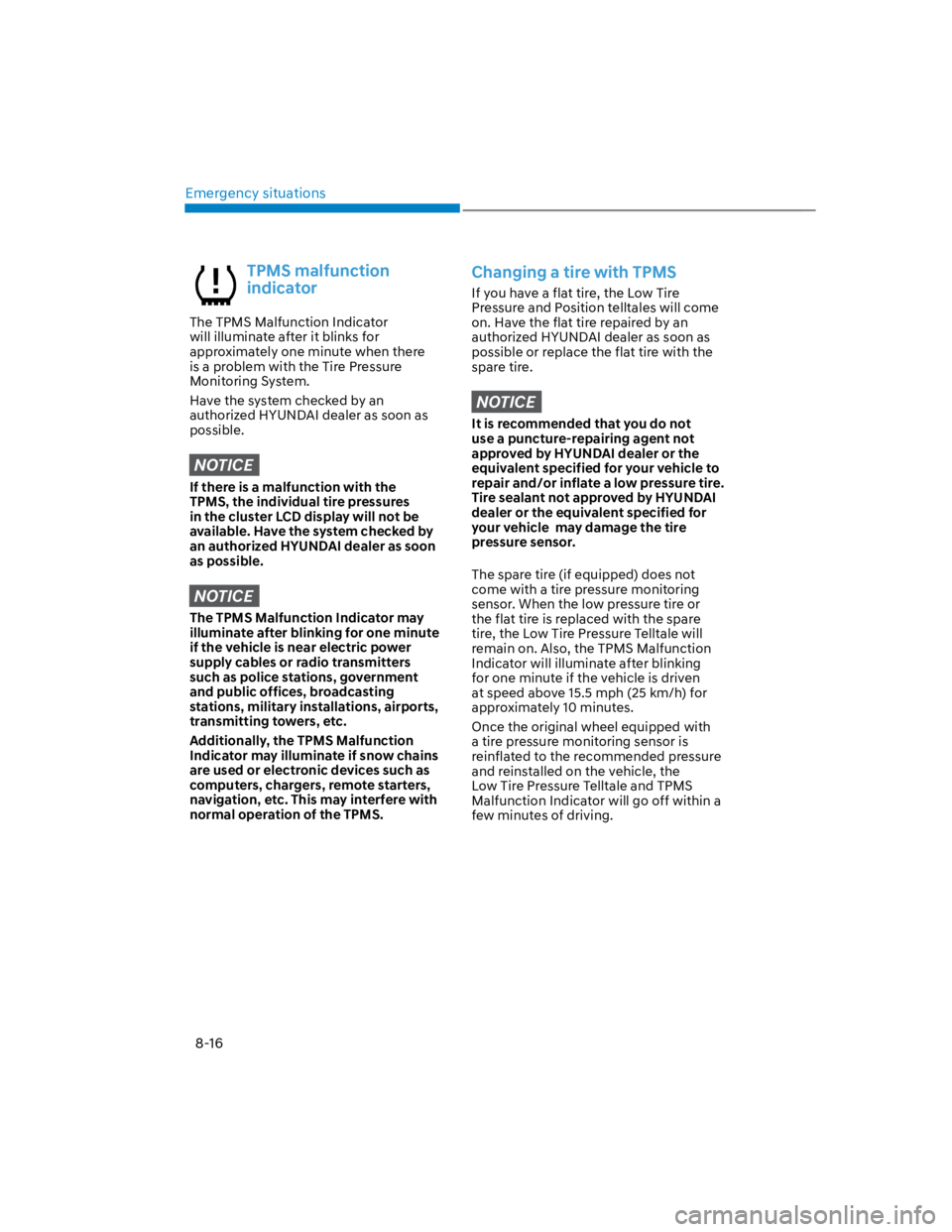
The TPMS Malfunction Indicator
will illuminate after it blinks for
approximately one minute when there
is a problem with the Tire Pressure
Monitoring System.
Have the system checked by an
authorized HYUNDAI dealer as soon as
possible.
NOTICE
If there is a malfunction with the
TPMS, the individual tire pressures
in the cluster LCD display will not be
available. Have the system checked by
an authorized HYUNDAI dealer as soon
as possible.
NOTICE
The TPMS Malfunction Indicator may
illuminate after blinking for one minute
if the vehicle is near electric power
supply cables or radio transmitters
such as police stations, government
and public offices, broadcasting
stations, military installations, airports,
transmitting towers, etc.
Additionally, the TPMS Malfunction
Indicator may illuminate if snow chains
are used or electronic devices such as
computers, chargers, remote starters,
navigation, etc. This may interfere with
normal operation of the TPMS.
Changing a tire with TPMS
If you have a flat tire, the Low Tire
Pressure and Position telltales will come
on. Have the flat tire repaired by an
authorized HYUNDAI dealer as soon as
possible or replace the flat tire with the
spare tire.
NOTICE
It is recommended that you do not
use a puncture-repairing agent not
approved by HYUNDAI dealer or the
equivalent specified for your vehicle to
repair and/or inflate a low pressure tire.
Tire sealant not approved by HYUNDAI
dealer or the equivalent specified for
your vehicle may damage the tire
pressure sensor.
The spare tire (if equipped) does not
come with a tire pressure monitoring
sensor. When the low pressure tire or
the flat tire is replaced with the spare
tire, the Low Tire Pressure Telltale will
remain on. Also, the TPMS Malfunction
Indicator will illuminate after blinking
for one minute if the vehicle is driven
at speed above 15.5 mph (25 km/h) for
approximately 10 minutes.
Once the original wheel equipped with
a tire pressure monitoring sensor is
reinflated to the recommended pressure
and reinstalled on the vehicle, the
Low Tire Pressure Telltale and TPMS
Malfunction Indicator will go off within a
few minutes of driving.
Page 467 of 579

08
8-17
If the indicators do not extinguish after a
few minutes, please visit an authorized
HYUNDAI dealer.
Each wheel is equipped with a tire
pressure sensor mounted inside the tire
behind the valve stem (except for the
spare tire). You must use TPMS specific
wheels. It is recommended that you
always have your tires serviced by an
authorized HYUNDAI dealer.
You may not be able to identify a tire
with low pressure by simply looking at it.
Always use a good quality tire pressure
gauge to measure. Please note that a tire
that is hot (from being driven) will have a
higher pressure measurement than a tire
that is cold.
A cold tire means the vehicle has been
sitting for 3 hours and driven for less
than 1 mile (1.6 km) in that 3 hour period.
Allow the tire to cool before measuring
the inflation pressure. Always be sure
the tire is cold before inflating to the
recommended pressure.
WARNING
The TPMS cannot alert you to severe
and sudden tire damage caused by
external factors such as nails or road
debris.
If you feel any vehicle instability,
immediately take your foot off
the accelerator, apply the brakes
gradually with light force, and slowly
move to a safe position off the road.
WARNING
Tampering with, modifying, or disabling
the Tire Pressure Monitoring System
(TPMS) components may interfere
with the system’s ability to warn the
driver of low tire pressure conditions
and/or TPMS malfunctions. Tampering
with, modifying, or disabling the Tire
Pressure Monitoring System (TPMS)
components may void the warranty for
that portion of the vehicle.
Information
1.
2.
3.
Page 481 of 579

08
8-31
Information
CAUTION
If the inflation pressure is not
maintained, drive the vehicle a second
time, refer to Distributing the sealant.
Then repeat steps 1 to 4.
Use of the TMK may be ineffectual for
tire damage larger than approximately
0.16 inch (4 mm).
Contact an authorized HYUNDAI dealer
if the tire cannot be made roadworthy
with the Tire Mobility Kit.
WARNING
The tire inflation pressure must be
inflated to the proper pressure (Refer to
“Tire and Wheels” section in chapter 2).
If it is not, do not continue driving.
Call for road side service or towing.
CAUTION
Tire pressure sensor
The sealant on the tire pressure sensor
and wheel should be removed when
you replace the tire with a new one and
inspect the tire pressure sensors. We
recommend that you get this done at an
authorized dealer.
Information