2022 HYUNDAI I20 drive belt
[x] Cancel search: drive beltPage 34 of 444
Important safety precautions ........................................................................ 4-2
Always wear your seat belt ....................................................................................... 4-2
Restrain all children ................................................................................................... 4-2
Air bag hazards .......................................................................................................... 4-2
Driver distraction
....................................................................................................... 4-2
Control your speed .................................................................................................... 4-3
Keep your vehicle in safe condition ......................................................................... 4-3
Seats ................................................................................................................ 4-4
Front seats ..................................................................................................................4-7
Rear seats ..................................................................................................................4-11
Seat belts ........................................................................................................ 4-15
Pre-tensioner seat belt ........................................................................................... 4-20
Additional seat belt safety precautions ................................................................. 4-22
Care of seat belts..................................................................................................... 4-24
Child restraint system ................................................................................... 4-25
Using a child restraint system .................................................................................4-27
Installing a Child Restraint System (CRS) .............................................................. 4-28
Air bag - supplemental restraint system (SRS) ........................................... 4-36
How does the air bag system operate ....................................................................4-37
Do not install a child restraint on the front passenger’s seat ............................... 4-39
Air bag warning and indicator ................................................................................ 4-40
SRS components and functions .............................................................................. 4-41
Driver’s and passenger’s front air bag
................................................................... 4-44
Side impact air bag ................................................................................................. 4-46
Curtain air bag ......................................................................................................... 4-47
SRS Care .................................................................................................................. 4-53
Air bag warning label
.............................................................................................. 4-56
4. Safety system
4
This chapter provides you with important information about how to protect
yourself and your passengers. It explains how to properly use your seats and seat
belts, and how your air bags work.
Additionally, this chapter explains how to properly restrain infants and children in
your vehicle.
Page 35 of 444

4-2
Safety system
You will find many safety precautions
and recommendations throughout this
section, and throughout this manual.
The safety precautions in this section are
among the most important.
Always wear your seat belt
A seat belt is your best protection in all
types of accidents. Air bags are designed
to supplement seat belts, not replace
them. So even though your vehicle is
equipped with air bags, ALWAYS make
sure you and your passengers wear your
seat belts, and wear them properly.
Restrain all children
All children under age 13 should ride
in your vehicle properly restrained in a
rear seat, not the front seat. Infants and
small children should be restrained in
an appropriate child restraint. Larger
children should use a booster seat with
the lap/shoulder belt until they can use
the seat belt properly without a booster
seat.
Air bag hazards
While air bags can save lives, they can
also cause serious or fatal injuries to
occupants who sit too close to them, or
who are not properly restrained. Infants,
young children, and short adults are at
the greatest risk of being injured by an
inflating air bag. Follow all instructions
and warnings in this manual.
Driver distraction
Driver distraction presents a serious and
potentially deadly danger, especially for
inexperienced drivers. Safety should be
the first concern when behind the wheel
and drivers need to be aware of the wide
array of potential distractions, such as
drowsiness, reaching for objects, eating,
personal grooming, other passengers,
and using cellular phones.
Drivers can become distracted when
they take their eyes and attention off
the road or their hands off the wheel to
focus on activities other than driving. To
reduce your risk of distraction and an
accident:
• ALWAYS set up your mobile devices
(i.e., MP3 players, phones, navigation
units, etc.) when your vehicle is parked
or safely stopped.
• ONLY use your mobile device when
allowed by laws and conditions permit
safe use.
NEVER text or email while driving.
Most countries have laws prohibiting
drivers from texting. Some countries
and cities also prohibit drivers from
using handheld phones.
• NEVER let the use of a mobile device
distract you from driving. You have a
responsibility to your passengers and
others on the road to always drive
safely, with your hands on the wheel
as well as your eyes and attention on
the road.
IMPORTANT SAFETY PRECAUTIONS
Page 38 of 444
4-5
04
WARNING
Loose objects
Loose objects in the driver’s foot area
could interfere with the operation of
the foot pedals, possibly causing an
accident. Do not place anything under
the front seats.
WARNING
Uprighting seat
When you return the seatback to its
upright position, hold the seatback and
return it slowly and be sure there are
no other occupants around the seat. If
the seatback is returned without being
held and controlled, the back of the
seat could move forward or backward
resulting in accidental injury to a
person struck by the seatback.
WARNING
Driver responsibility for passengers
Riding in a vehicle with seatback
reclined could lead to serious or fatal
injury in an accident. If a seat is reclined
during an accident, the occupant’s hips
may slide under the lap portion of the
seat belt applying great force to the
unprotected abdomen. The protection
of your restraint system (seat belt
and air bags) is greatly reduced by
reclining your seat. Serious or fatal
internal injuries could result. The driver
must advise the passenger to keep
the seatback in an upright position
whenever the vehicle is in motion.
WARNING
Do not use a sitting cushion that
reduces friction between the seat and
passenger. The passenger’s hips may
slide under the lap portion of the seat
belt during an accident or a sudden
stop. Serious or fatal internal injuries
could result because the seat belt can’t
operate normally.
WARNING
Driver’s seat
• Never attempt to adjust seat while
the vehicle is moving. This could
result in loss of control, and an
accident causing death, serious
injury, or property damage.
• Do not allow anything to interfere
with the normal position of the
seatback. Storing items against
a seatback or in any other way
interfering with proper locking of
a seatback could result in serious
or fatal injury in a sudden stop or
collision.
• Always drive and ride with your
seatback upright and the lap portion
of the seat belt snug and low across
the hips. This is the best position to
protect you in case of an accident.
• In order to avoid unnecessary and
perhaps severe air bag injuries,
always sit as far back as possible
from the steering wheel while
maintaining comfortable control of
the vehicle.
Page 39 of 444
4-6
Safety system
WARNING
Rear seatbacks
• The rear seatback must be securely
latched. If not, passengers and
objects could be thrown forward
resulting in serious injury or death
in the event of a sudden stop or
collision.
• Luggage and other cargo should be
laid flat in the cargo area. If objects
are large, heavy, or must be piled,
they must be secured. Under no
circumstances should cargo be piled
higher than the seatbacks. Failure to
follow these warnings cou ld result in
serious injury or death in the event of
a sudden stop, collision or rollover.
• No passenger should ride in the cargo
area or sit or lie on folded seatbacks
while the vehicle is moving. All
passengers must be properly seated
in seats and restrained properly while
riding.
• When resetting the seatback to
the upright position, make sure it
is securely latched by pushing it
forward and backwards.
• To avoid the possibility of burns,
do not remove the carpet in the
cargo area. Emission control devices
beneath this floor generate high
temperatures.
WARNING
After adjusting the seat, always check
that it is securely locked into place by
attempting to move the seat forward
or backward without using the lock
release lever. Sudden or unexpected
movement of the driver’s seat could
cause you to lose control of the vehicle
resulting in an accident.
WARNING
• Do not adjust the seat while wearing
seat belts. Moving the seat cushion
forward may cause strong pressure
on the abdomen.
• Use extreme caution so that hands
or other objects are not caught in the
seat mechanisms while the seat is
moving.
• Do not put a cigarette lighter on the
floor or seat. When you operate the
seat, gas may gush out of the lighter
and cause fire.
• If there are occupants in the rear
seats, be careful while adjusting the
front seat position.
Page 49 of 444
4-16
Safety system
WARNING
• No modifications or additions
should be made by the user which
will either prevent the seat belt
adjusting devices from operating to
remove slack, or prevent the seat
belt assembly from being adjusted to
remove slack.
• When you fasten the seat belt, be
careful not to latch the seat belt
in buckles of other seat. It’s very
dangerous and you may not be
protected by the seat belt properly.
• Do not unfasten the seat belt and
do not fasten and unfasten the seat
belt repeatedly while driving. This
could result in loss of control, and
an accident causing death, serious
injury, or property damage.
• When fastening the seat belt, make
sure that the seat belt does not pass
over objects that are hard or can
break easily.
• Make sure there is nothing in the
buckle. The seat belt may not be
fastened securely.
Seat belt warning
1GQA20831GQA2083
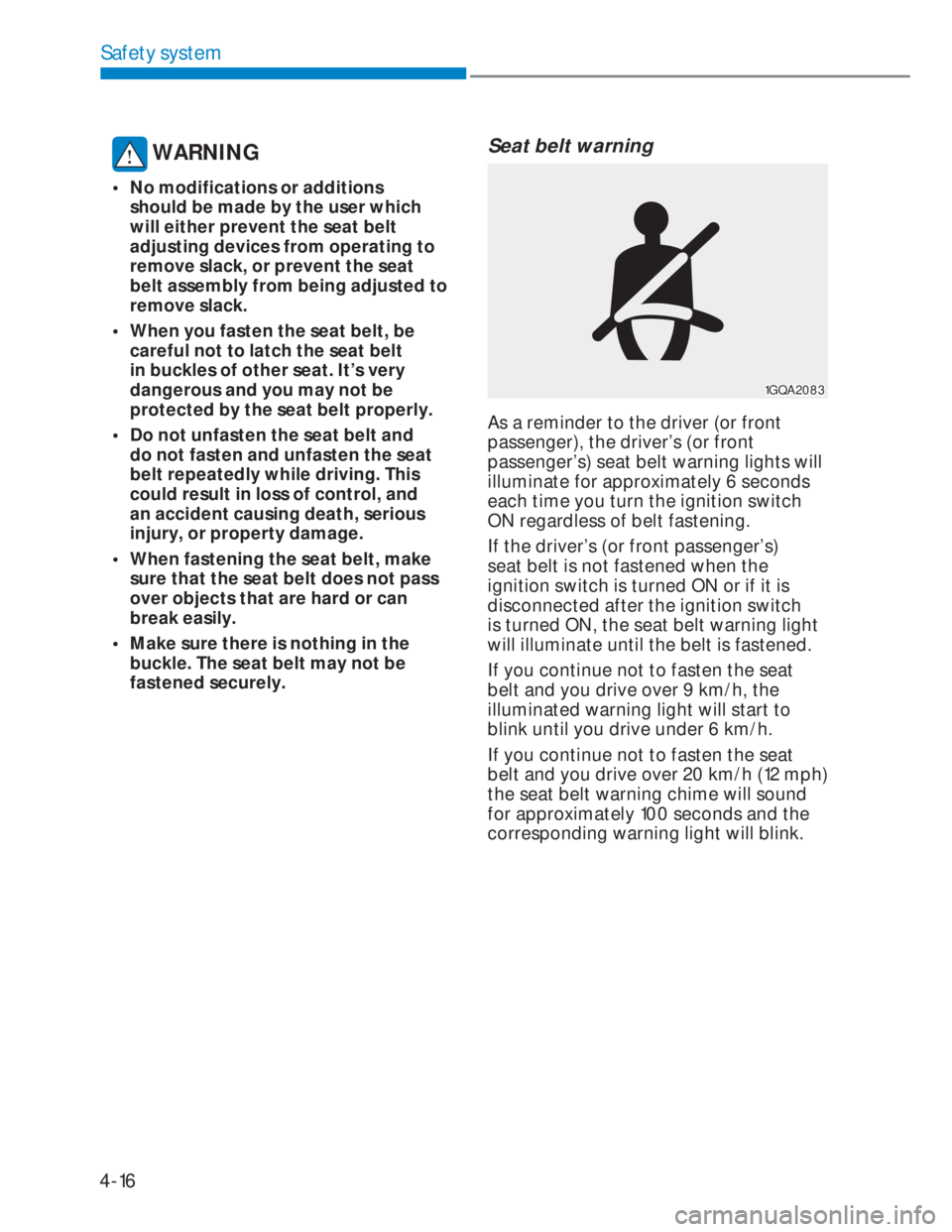
As a reminder to the driver (or front
passenger), the driver’s (or front
passenger’s) seat belt warning lights will
illuminate for approximately 6 seconds
each time you turn the ignition switch
ON regardless of belt fastening.
If the driver’s (or front passenger’s)
seat belt is not fastened when the
ignition switch is turned ON or if it is
disconnected after the ignition switch
is turned ON, the seat belt warning light
will illuminate until the belt is fastened.
If you continue not to fasten the seat
belt and you drive over 9 km/h, the
illuminated warning light will start to
blink until you drive under 6 km/h.
If you continue not to fasten the seat
belt and you drive over 20 km/h (12 mph)
the seat belt warning chime will sound
for approximately 100 seconds and the
corresponding warning light will blink.
Page 53 of 444
4-20
Safety system
OAI3039015OAI3039015
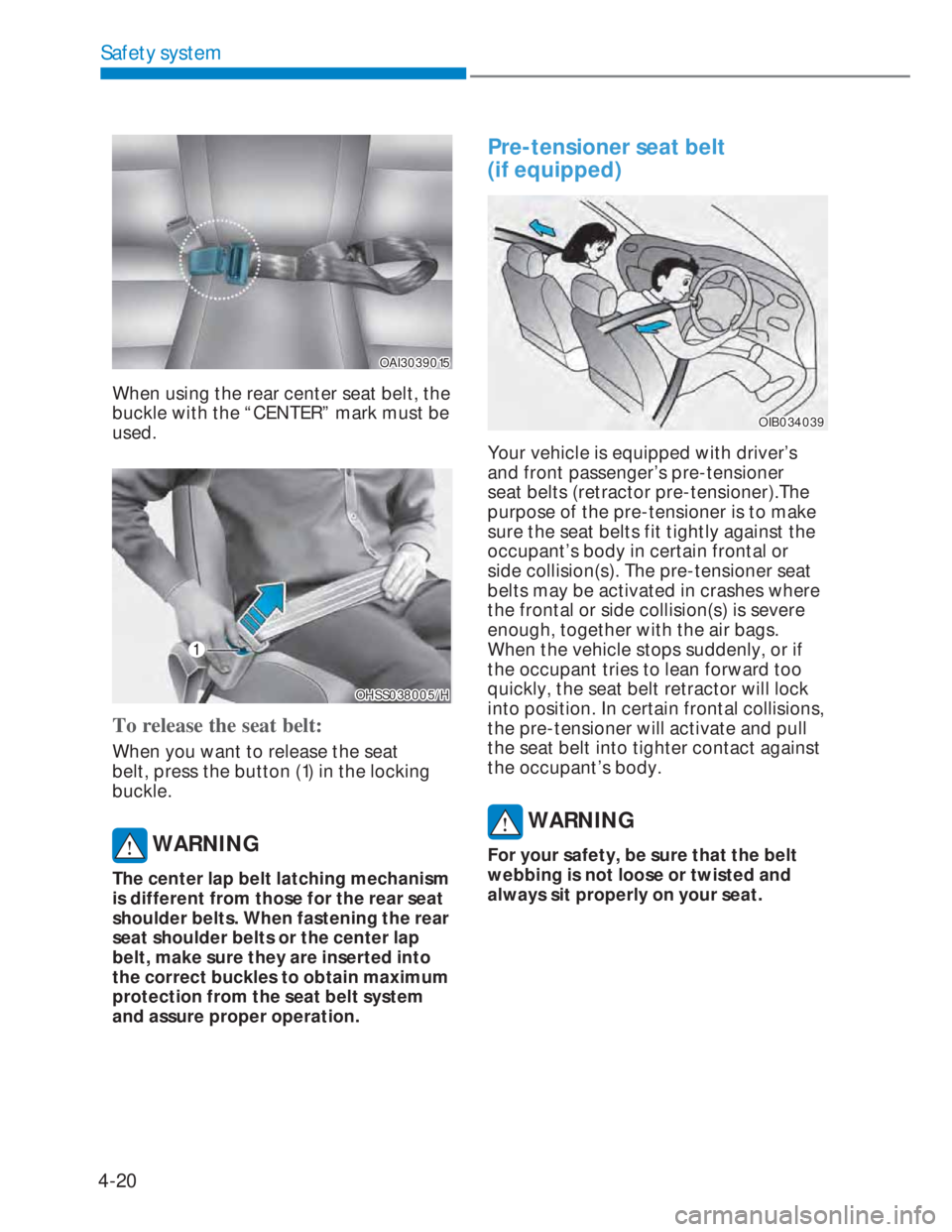
When using the rear center seat belt, the
buckle with the “CENTER” mark must be
used.
OHSS038005/HOHSS038005/H
To release the seat belt:
When you want to release the seat
belt, press the button (1) in the locking
buckle.
WARNING
The center lap belt latching mechanism
is different from those for the rear seat
shoulder belts. When fastening the rear
seat shoulder belts or the center lap
belt, make sure they are inserted into
the correct buckles to obtain maximum
protection from the seat belt system
and assure proper operation.
Pre-tensioner seat belt
(if equipped)
OIB034039OIB034039
Your vehicle is equipped with driver’s
and front passenger’s pre-tensioner
seat belts (retractor pre-tensioner).The
purpose of the pre-tensioner is to make
sure the seat belts fit tightly against the
occupant’s body in certain frontal or
side collision(s). The pre-tensioner seat
belts may be activated in crashes where
the frontal or side collision(s) is severe
enough, together with the air bags.
When the vehicle stops suddenly, or if
the occupant tries to lean forward too
quickly, the seat belt retractor will lock
into position. In certain frontal collisions,
the pre-tensioner will activate and pull
the seat belt into tighter contact against
the occupant’s body.
WARNING
For your safety, be sure that the belt
webbing is not loose or twisted and
always sit properly on your seat.
Page 55 of 444

4-22
Safety system
NOTICE
The sensor that activates the SRS
control module is connected with the
pre–tensioner seat belts. The SRS air
bag warning light on the instrument
cluster will illuminate for approximately
6 seconds after the ignition switch is
placed in the ON position, and then it
should turn off. If the pre-tensioner is
not working properly, the warning light
will illuminate even if the SRS air bag is
not malfunctioning. If the warning light
does not illuminate,stays illuminated
or illuminates when the vehicle is
being driven, we recommend the pre-
tensioner seat belts and/or SRS control
module be inspected by an authorized
HYUNDAI dealer as soon as possible.
i Information
• Both the driver’s and front passenger’s
pre-tensioner seat belts may be
activated in certain frontal or side
collisions.
• When the pre-tensioner seat belts are
activated, a loud noise may be heard
and fine dust, which may appear to be
smoke, may be visible in the passenger
compartment. These are normal
operating conditions and are not
hazardous.
• Although it is non-toxic, the fine dust
may cause skin irritation and should
not be inhaled for prolonged periods.
Wash all exposed skin areas thoroughly
after an accident in which the pre-
tensioner seat belts were activated.
Additional seat belt safety
precautions
Seat belt use during pregnancy
The seat belt should always be used
during pregnancy. The best way to
protect your unborn child is to protect
yourself by always wearing the seat
belt. Pregnant women should always
wear a lap-shoulder seat belt. Place the
shoulder belt across your chest, routed
between your breasts and away from
your neck. Place the lap belt below your
belly so that it fits SNUGLY across your
hips and pelvic bone, under the rounded
part of the belly.
WARNING
To reduce the risk of serious injury or
death to an unborn child during an
accident, pregnant women should
NEVER place the lap portion of the
seat belt above or over the area of the
abdomen where the unborn child is
located.
Seat belt use and children
Infant and small children
Most countries have Child Restraint
System laws which require children
to travel in approved Child Restraint
System devices, including booster seats.
The age at which seat belts can be
used instead of Child Restraint System
differs among countries, so you should
be aware of the specific requirements
in your country, and where you are
travelling. Infant and Child Restraint
System must be properly placed and
installed in a rear seat. For more details
refer to the “Child Restraint Systems”in
this chapter.
Page 57 of 444
4-24
Safety system
Do not lie down
Sitting in a reclined position when the
vehicle is in motion can be dangerous.
Even when buckled up, the protections
of your restraint system (seat belts
and/or air bags) is greatly reduced by
reclining your seatback. Seat belts must
be snug against your hips and chest
to work properly. During an accident,
you could be thrown into the seat belt,
causing neck or other injuries.
The more the seat back is reclined, the
greater the chance for the passenger’s
hips to slide under the lap belt or the
passenger’s neck to strike the shoulder
belt.
WARNING
• NEVER ride with a reclined seatback
when the vehicle is moving.
• Riding with a reclined seatback
increases your chance of serious
or fatal injuries in the event of a
collision or sudden stop.
• Driver and passengers should always
sit well back in their seats,properly
belted,and with the seatbacks
upright.
Care of seat belts
Seat belt systems should never be
disassembled or modified. In addition,
care should be taken to assure that
seat belts and belt hardware are not
damaged by seat hinges, doors or other
abuse.
Periodic inspection
All seat belts should be inspected
periodically for wear or damage of any
kind. Any damaged parts should be
replaced as soon as possible.
Keep belts clean and dry
Seat belts should be kept clean and
dry. If belts become dirty, they can be
cleaned by using a mild soap solution
and warm water. Bleach, dye, strong
detergents or abrasives should not be
used because they may damage and
weaken the fabric.
When to replace seat belts
The entire seat belt assembly or
assemblies should be replaced if the
vehicle has been involved in an accident.
This should be done even if no damage
is visible.We recommend that you
consult an authorized HYUNDAI dealer.